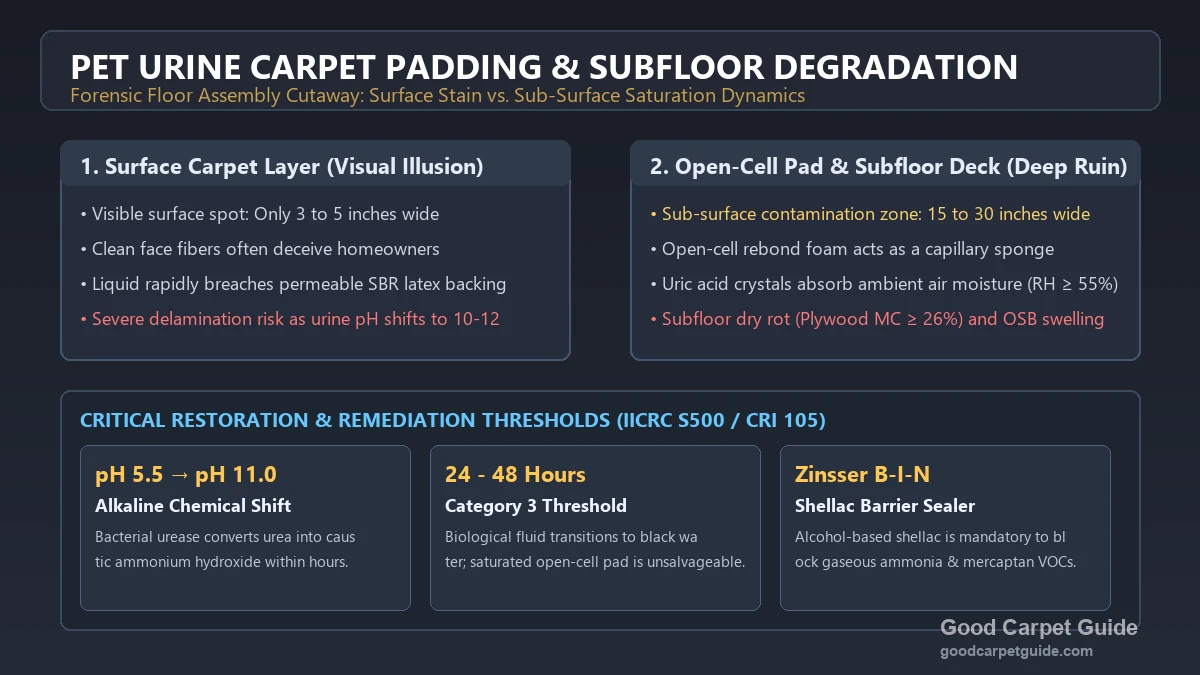
Carpet odor removal fails when the treatment reaches the wrong layer. Liquid contamination passes through the pile in seconds, saturates the cushion, and settles into the open pores of the plywood or concrete slab underneath. A surface clean never reaches that layer. IICRC S100 and S500 project standards place the wetted radius on a subfloor at 200% to 300% wider than the stain visible from above.
Resale inspections expose the gap between appearance and chemistry. A house shows well, the carpets read clean at the walkthrough, and the odor returns within 72 hours of move-in. The buyer assumes the seller hid a problem, and the seller assumes the carpet was never clean.
The failure is procedural. A quick ozone run or a surface steam clean knocks airborne ammonia down for two or three days, then the smell returns stronger than before. The uric acid crystals bonded into the backing, the pad, and the subfloor pores survive both processes untouched.
This guide covers the full chain from chemistry to cost: contamination movement, a six-phase subfloor protocol, the replacement decision matrix, reinstallation standards, and the maintenance rules that prevent a repeat failure.
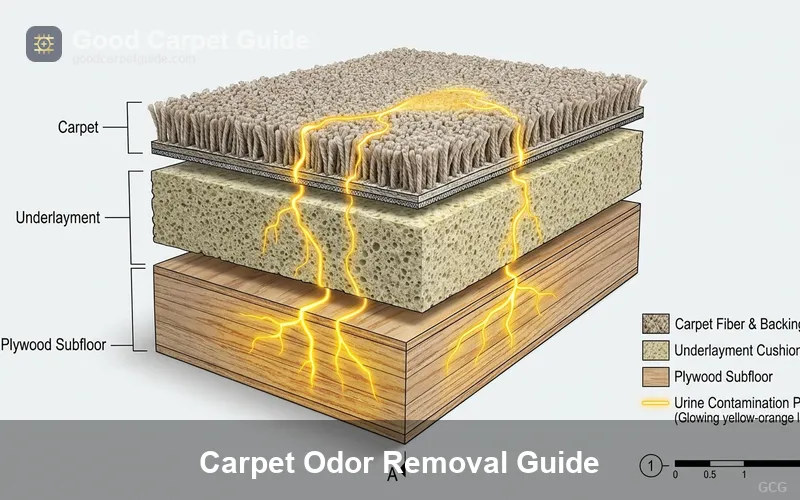
Urine contamination travels down through the pile, spreads sideways inside the cushion, and wicks into the plywood grain, which is why the subfloor footprint runs far wider than the visible stain.
the molecular chemistry behind carpet odor
Carpet odor is not a single compound. It is a sequence of chemical states that change with time, temperature, and humidity. A product formulated for the first state does nothing for the fourth, and the labor spent applying it is wasted alongside the product.
fresh urine is mildly acidic and water-soluble
Fresh mammalian urine carries urea, uric acid, urobilin and urochrome pigments, carbohydrates, proteins, and trace electrolytes in a water base. Its pH sits between 5.0 and 6.0, which is mildly acidic.
In that state the deposit is water-soluble, and immediate hot water extraction removes more than 90% of the liquid fraction before crystallization begins. Timing decides the outcome on day one, and no product substitutes for speed.
the urease cascade pushes the substrate to pH 10 to 12
After the liquid cools, atmospheric bacteria colonize the deposit. Proteus mirabilis and Staphylococcus species produce the enzyme urease, which hydrolyzes urea into ammonium carbamate. Ammonium carbamate then decomposes rapidly into gaseous ammonia (NH₃) and ammonium hydroxide (NH₄OH).
The alkaline byproducts drive the wetted substrate from pH 5 to pH 11 and higher, into caustic territory between pH 10 and pH 12. Two forms of permanent damage follow from that number.
At pH 10 to 12 the dye-fiber bond in acid-dyed nylon breaks, and color loss at the deposit site is permanent. The same caustic environment attacks the styrene-butadiene rubber (SBR) latex that bonds the primary and secondary backings together. Once that latex layer hydrolyzes, tuft rows release and delamination runs outward from the deposit.
urate crystals rehydrate on their own
As water evaporates, uric acid binds with potassium, calcium, and sodium ions in the deposit to form insoluble urate salts. Urate crystals resist cold water and standard surfactants, which is the core problem in every persistent odor complaint.
Those crystals are hygroscopic. Above roughly 65% relative humidity they pull water molecules out of the air, which reactivates dormant bacteria and triggers fresh off-gassing of ammonia and volatile thiols. This mechanism explains the most common complaint in the trade: a carpet that smells worse 48 hours after hot water extraction than it did before the truck arrived.
Low-moisture cleaning methods and encapsulation add far less water to a contaminated substrate than a full hot water pass, which changes how much of the crystal load reactivates. Method selection on odor jobs is a chemistry decision rather than a price decision, and the practical trade-offs between extraction, encapsulation, and dry compound processes are set out in this comparison of carpet cleaning methods compared .
cat urine adds a volatile thiol problem
Cat urine contains felinine (2-amino-7-hydroxy-5,5-dimethyl-4-thiaheptanoic acid), an amino acid that dog urine does not carry. Bacterial degradation cleaves felinine into 3-mercapto-3-methylbutan-1-ol, known as MMB.
MMB is a thiol with an olfactory threshold in the parts-per-billion range, so a deposit too small to move pH still fills a room. Dog urine produces the same urate crystal load without the thiol, which is why cat remediation pairs enzyme digestion with subfloor sealing.
| Compound | Source | Behavior in the carpet assembly | Removal constraint |
|---|---|---|---|
| Urea | Fresh urine | Hydrolyzed by bacterial urease into ammonia | Removable while the deposit is still damp |
| Ammonia (NH₃) | Urease hydrolysis | Gas; migrates through permeable primer films | Needs a vapor barrier, not a deodorizer |
| Uric acid and urate salts | Dried urine | Crystalline; hygroscopic above 65% RH | Insoluble in cold water and surfactants |
| Felinine and MMB | Cat urine | Volatile thiol at parts-per-billion detection | Needs enzymatic digestion plus sealing |
emergency containment in the first fifteen minutes
Odor outcomes are decided before any cleaning product is opened, because a four-ounce accident that wets a four-inch circle on the pile passes through the backing within seconds. The cushion spreads that liquid to a diameter of 8 to 12 inches, and hydrostatic pressure then drives it sideways across a non-yielding subfloor until the contaminated zone finishes at 16 to 24 inches across.
Those first minutes set the ceiling on how much of the deposit can still be recovered. Prompt blotting and controlled dilution keep contamination inside the cushion layer, where extraction reaches it, while a scrub brush or a rented shampooer works the liquid deeper into the backing and the seams.
The sequence for a fresh accident:
- Blot with white absorbent towels and stand on them; replace and repeat until transfer stops.
- Apply cool water in small amounts to dilute the remaining deposit, then blot again.
- Treat the full 16 to 24 inch radius around the visible stain rather than the visible stain alone.
- Skip foaming shampoos, fabric fresheners, and any product that leaves a residue film behind.
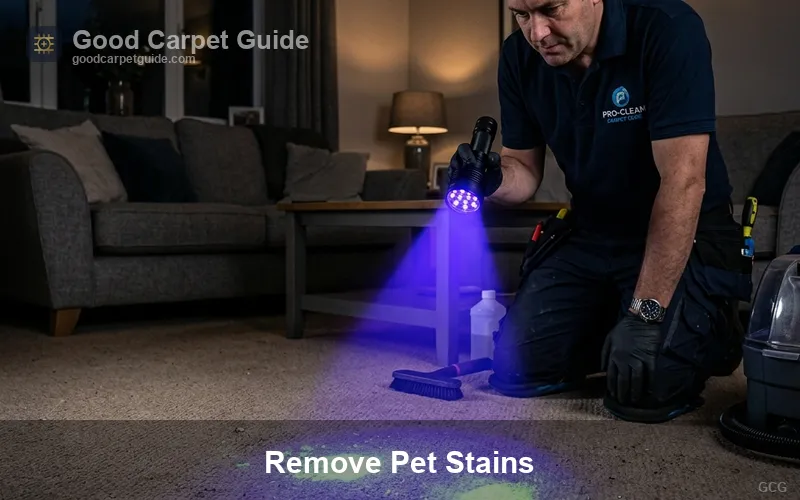
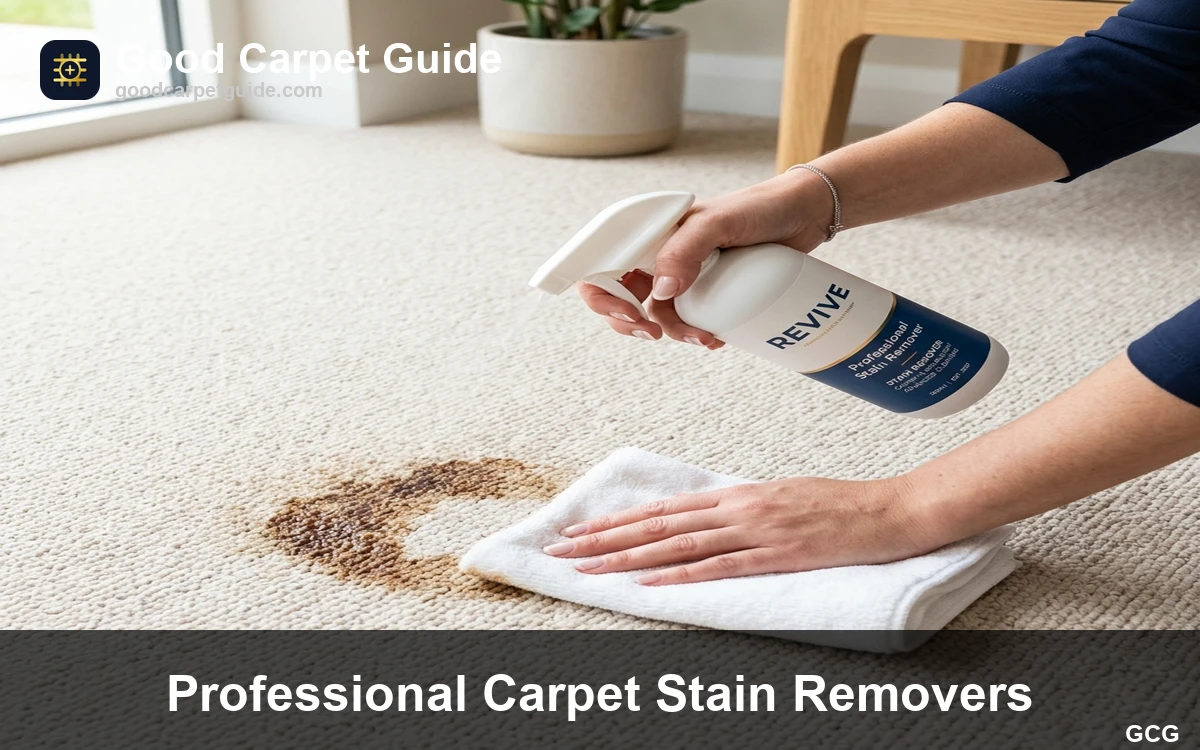
Heat is the wrong tool on a deposit less than 24 hours old. A hot water pass drives the still-soluble liquid fraction deeper into the cushion, and plain dilution recovery beats heat at that stage. The full stain-removal sequence for accidents that have already dried, including dwell times, product classes, and pile-specific dwell limits, is covered in this guide to how to remove pet stains from carpet .
why home remedies and masking sprays backfire
Household remedies dominate search results on this topic and almost none of them touch urate crystals, so each one adds a second problem to the substrate on top of the original deposit.
the baking soda and vinegar reaction makes a salt, not a fix
Acetic acid at pH 2.5 meets sodium bicarbonate at pH 8.3 and produces carbon dioxide, water, and sodium acetate. The effervescence looks like work happening. Sodium acetate has no capacity to digest uric acid or urate salts.
Vinegar does neutralize ammonia gas on contact and drops the surface odor for a few hours. Acetic acid then evaporates, and the buffered ammonia returns as the deposit rehydrates. The smell arrives back on schedule, which trains homeowners to apply more vinegar, and more acid reaches the backing each time.
baking soda residue shears pile fibers
Dry baking soda sifts down through the pile and settles at the backing line, where foot traffic grinds the crystals against the fiber at its thinnest point, just above the tuft knot. The damage appears months later as fuzzing along traffic lanes and matted rows that vacuuming cannot reverse.
masking fragrances stack a second odor problem
Scented powders, aerosol deodorizers, and quaternary ammonium sprays add a fragrance layer on top of unresolved ammonia. The nose reads the combination as a chemical smell sitting over the original one rather than as a clean carpet. Quaternary ammonium compounds also leave a surfactant film that attracts soil, so the traffic lane darkens faster between cleanings.
what actually digests the deposit
Bio-enzymatic digestion relies on live non-pathogenic bacterial strains that produce protease for protein breakdown and urease for urea breakdown. The culture needs two conditions to finish the job: a damp substrate and a temperature between 65°F and 85°F held for 24 to 48 hours. Tarping the floor with polyethylene film prevents premature drying and keeps the colony working.
Oxidation covers the jobs where enzymes dry out too fast. Professional hydrogen peroxide and chlorine dioxide products cleave organic ring structures and sulfur bonds through free radical oxidation, which reaches contamination inside concrete pore networks that stays damp for only minutes at a time.
The enzyme class is the correct first move on a saturated cushion, and a general-purpose pet formula applied at label dilution handles most residential volumes. Nature's Miracle Advanced is formulated for that role, and its bacterial load tolerates the slow, damp dwell time a subfloor job requires:
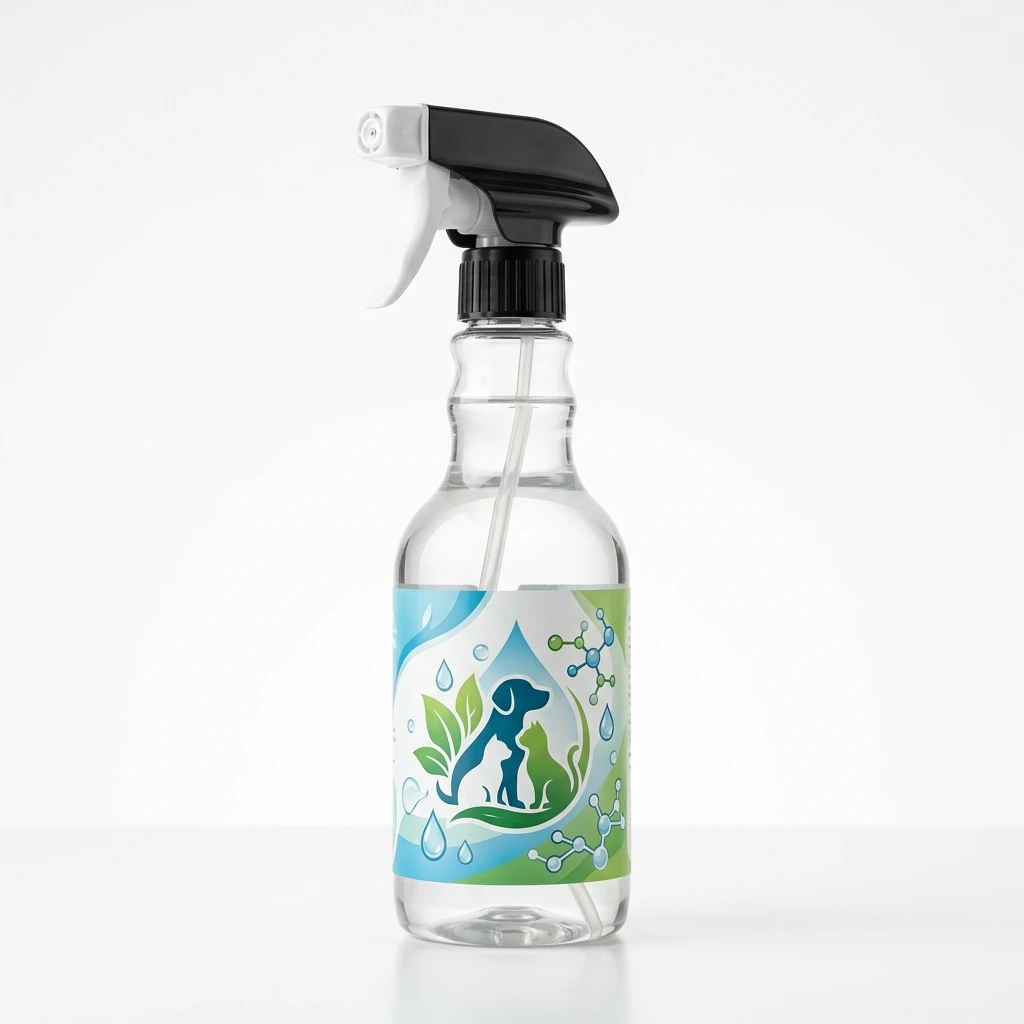
Nature's Miracle Advanced Bio-Enzymatic Formula
High-potency microbial enzyme wash designed for deep-pile saturation and organic protein digestion.
Check Price on Amazonstep-by-step subfloor decontamination and sealing protocol
Once contamination has passed the cushion, every layer above the subfloor becomes disposable material. Six phases take the assembly from mapping to a sealed, reinstalled floor, and the order matters because each phase depends on the result of the one before it.
phase 1: UV-A mapping in total darkness
Dried urine fluoresces under ultraviolet light because of the phosphorus and organic salt content in the residue. A UV-A lamp rated between 365 and 395 nanometers reveals the true contamination boundary on the bare subfloor, and that boundary almost never matches the visible stain.
Mark the outline with painter's tape or chalk as you go, then map the vertical face of the baseboard and the seam lines where wicking traveled sideways. Run the lamp across the whole room rather than the suspected area, because male cats mark vertical surfaces that leave no visible trace under normal light.
phase 2: surgical carpet pullback and cushion disposal
Cut the carpet back at least 12 inches past the UV boundary, and pull it from two adjacent walls so the material can be lifted and folded without tearing the backing. Contaminated cushion goes into bags and leaves the building; reused pad is the most common reason a sealed job fails. Foam holds liquid, salt crystals, and bacterial load in its open cells, and a primer film over reinstalled contaminated pad cannot block what sits beneath it.
Carpet that survives the pullback stays rolled face-out in a dry room. Delaminated backing, or pile matted flat across a radio-sized area, marks the carpet as unrecoverable, and replacement is the cheaper decision at that point. Pullback and reinstallation follow the same mechanics as any restretch job: release the carpet from the tack strip, log the strip condition, and tension the material back into place once the subfloor is dry. The tooling and sequence for that work sit in this carpet repair master guide .
phase 3: enzymatic and oxidative flushing with tarped dwell time
Apply a professional odor counteractant concentrate to the bare subfloor at label dilution and keep the surface visibly damp for the full dwell window. Odorcide KOE is formulated for crystallized organic salts in porous substrates rather than for the airborne note alone, and the concentrate format allows a stronger dilution on a loaded subfloor than a ready-to-use spray allows:
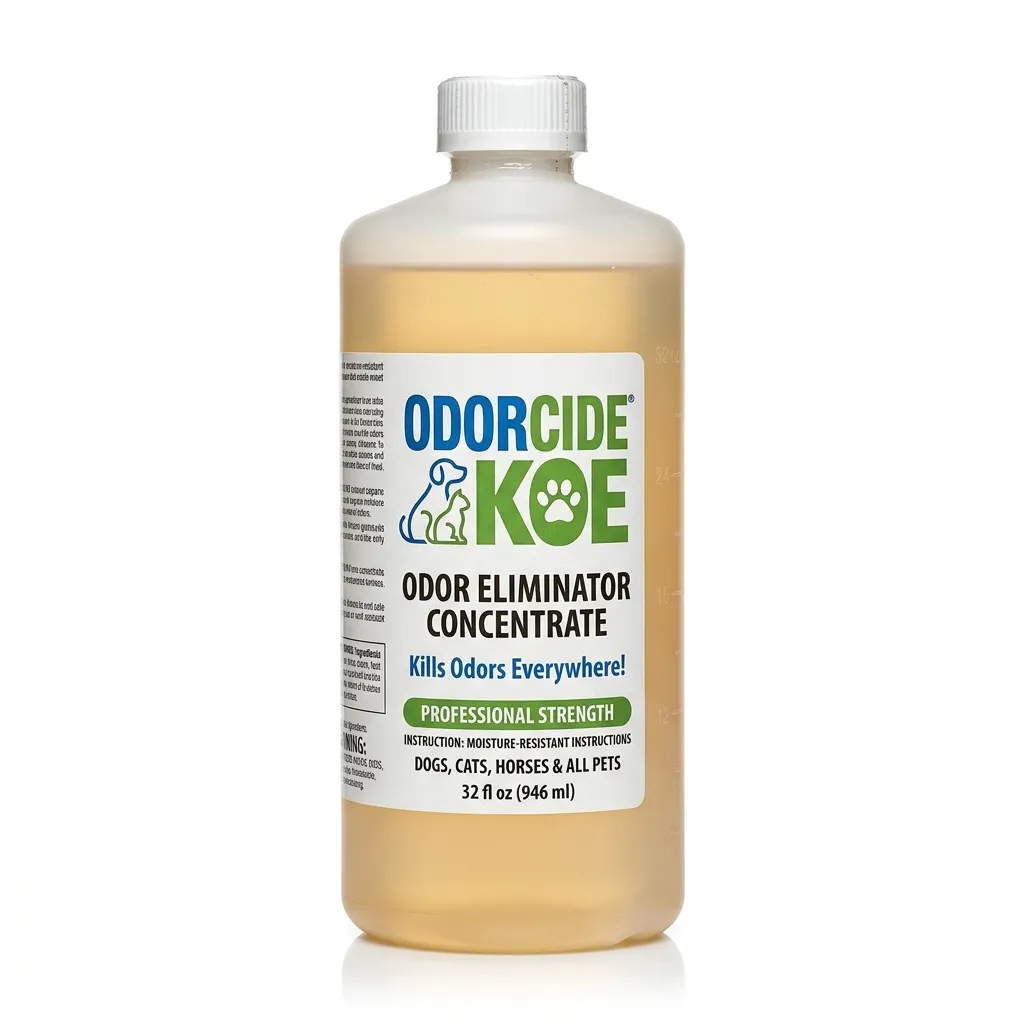
Odorcide KOE Odor Eliminator Concentrate
Professional-grade odor counteractant concentrate formulated to break down crystallized organic urine salts in porous substrates.
Check Price on AmazonCover the treated area with polyethylene film and hold it for 24 to 48 hours at 65°F to 85°F. Heavy or repeated deposits take two applications with a rinse between them, because the first pass spends its bacterial load on the top millimeter of contamination. On concrete, follow the enzyme pass with an oxidative treatment where the substrate dries too fast for a long dwell.
Targeted flushing of individual contamination sites recovers liquid that a mop pushes around instead of removing. A portable extractor with high lift pulls the slurry out of the wood grain and the concrete pore openings, and the recovery tank shows how much of the deposit came back out:
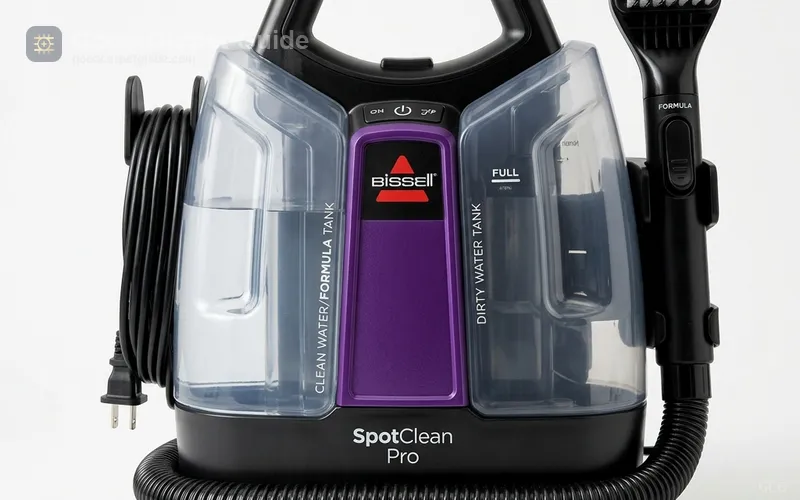
Bissell SpotClean Pro Commercial Spot Cleaner
High-suction portable extractor utilized for targeted subfloor flushing and rapid moisture recovery.
Check Price on Amazonphase 4: moisture verification before any sealer goes down
Water content decides whether the next phase works or fails. Plywood and OSB read back below 12% moisture content on a pin-type meter before any coating goes down, which is the APA threshold for coating a wood subfloor.
Concrete needs its own test. A calcium chloride test per ASTM F1869 quantifies vapor emission from the slab, and an in-situ relative humidity probe per ASTM F2170 reads moisture inside the slab rather than at the surface. Trapping residual moisture under a film creates the exact condition that peeled coatings and mold growth need, and that failure shows up months later as odor no cleaning removes.
phase 5: hermetic sealing with white-pigmented shellac
Water-based primers, PVA primers, and standard oil or latex stain blockers are vapor-permeable films. Ammonia gas molecules pass straight through the microscopic pores of a cured latex film, and the odor returns within 6 to 12 months because the gas source under the coating was never blocked.
White-pigmented shellac solves that specific problem. Zinsser B-I-N is formulated with natural lac beetle secretions dissolved in denatured alcohol, and it dries in about 45 minutes into a hermetic vapor barrier that locks ammonia and thiol gases inside the wood or concrete they came from:
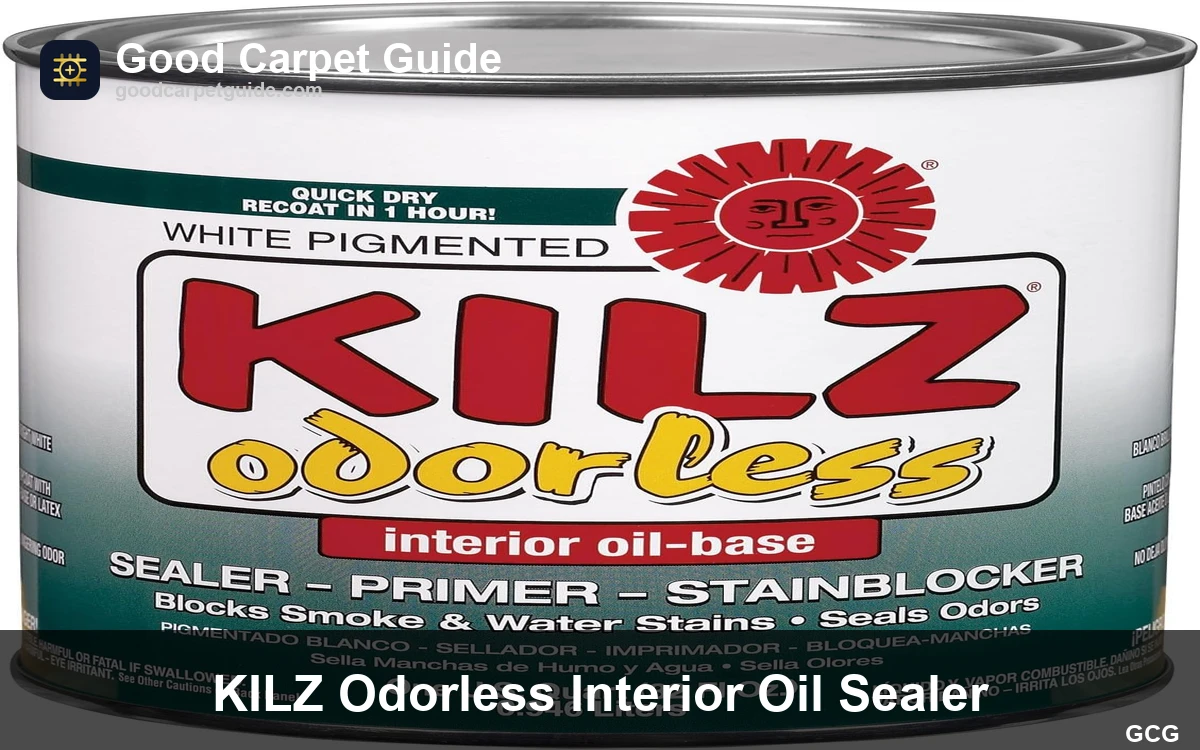
Zinsser B-I-N Shellac-Based Primer Sealer
Heavy-duty shellac-based vapor-barrier primer engineered to permanently seal subfloors and block persistent ammonia off-gassing.
Check Price on AmazonApply two uniform coats in cross-hatch directions, brushing the first coat one way and the second across it, so pinholes in either pass get covered by the other. Ventilate the room and wear a respirator with organic vapor cartridges, because denatured alcohol carries a heavy solvent load in a closed space. Contaminated tack strip sections and the plate line get sealed as well, since the film has to be continuous to block gas.
phase 6: tackless strip assessment and replacement
Rusted pins, black staining across the strip face, and a crushed gully between the strip and the baseboard all mark a strip that has to come out. Urine salts corrode the steel pins, and once the pin tips round over, the reinstalled carpet cannot grip the strip.
Cut out the damaged sections, fit new tackless strip with the pin mouth about a quarter inch off the wall, and seal the exposed subfloor under the strip line before the new strip goes down. Reusing a contaminated strip reintroduces a gas source inside the room directly under the perimeter of the carpet.
subfloor replacement versus sealing: the decision matrix
Sealing works on a subfloor that is structurally intact. Replacement is the correct answer once the material itself has failed.
plywood delamination and structural bounce
Plywood delaminates along resin glue lines when it stays saturated, and the layers separate into sheets that flex underfoot. A two-foot straightedge laid across the area shows the failure: a gap under the middle of the edge means the panel is no longer flat.
Bounce is the second signal. A subfloor that deflects visibly under a technician's weight will crack the shellac film from below, and a cracked barrier leaks ammonia. Panels that show delamination, soft spots, or visible deflection get cut out and replaced rather than coated.
OSB swelling past a quarter inch
Oriented strand board swells at the edges and around individual wood chips, and the swelling does not reverse when the board dries. Once a section has grown more than a quarter inch in thickness, sanding removes the high spots but leaves a board with reduced density and no reliable surface for a continuous film.
Sections past that limit get saw-cut along joist lines and replaced. The cut line needs to land over framing so the new panel carries load, and the replacement panel gets sealed on all faces before installation.
concrete slabs: grinding, deep extraction, and salt migration
Concrete is a porous calcium silicate hydrate matrix, and capillary action pulls urine salts half an inch to a full inch into the pore network. Grinding removes the top layer and opens the pores below it, which releases the mechanical barrier holding the remaining contamination in place.
Ground slabs then get a deep chemical extraction pass, a dwell period with the surface held damp, and a moisture reading before any coating. Ground moisture vapor pressure pushing upward through an unsealed slab keeps carrying salts to the surface, so cap sealing the slab belongs on the job scope wherever a slab sits below grade.
| Substrate | Field signal | Threshold | Action |
|---|---|---|---|
| Plywood | Delamination, soft spots, deflection underfoot | Any visible layer separation or bounce | Cut out over joists and replace |
| OSB | Edge and chip swelling that stays after drying | Swell past 1/4 inch | Saw-cut along joist lines and replace |
| Concrete slab | Salt bloom, deep fluorescence, high vapor emission | Pores loaded beyond surface cleaning | Grind, deep extract, dwell, then cap seal |
cushion and carpet reinstallation standards
Reinstallation determines how long the sealed subfloor stays sealed. Cushion density, thickness, and barrier type all change the load path that reaches the subfloor, and the installation standard for tension decides whether the carpet stays flat over a rebuilt floor.
CRI 104 and 105 tension requirements
The Carpet and Rug Institute publishes residential installation rules as CRI 104, with CRI 105 covering residential carpet installation and the tension requirements that go with it. Broadloom is specified to hold 1.0% to 1.5% elongation in both length and width when installed, and that elongation comes from mechanical power stretching rather than from a knee kicker.
A carpet installed with perimeter tension alone carries wrinkles as soon as humidity changes the dimensional stability of the backing. Over a freshly sealed subfloor, wrinkles matter more than usual because they open a path for air to move across contamination the film was installed to contain.
rebond density and thickness limits
For standard residential cut-pile carpet, the usual specification is an 8-lb to 10-lb rebond cushion no thicker than 7/16 inch. Rebond is a recycled composite of polyurethane foam scrap bonded under heat and pressure, and its mottled, multicolored surface identifies it on sight. Solid single-color prime foam is the lower-density material, and it breaks down into fine dust after prolonged compression.
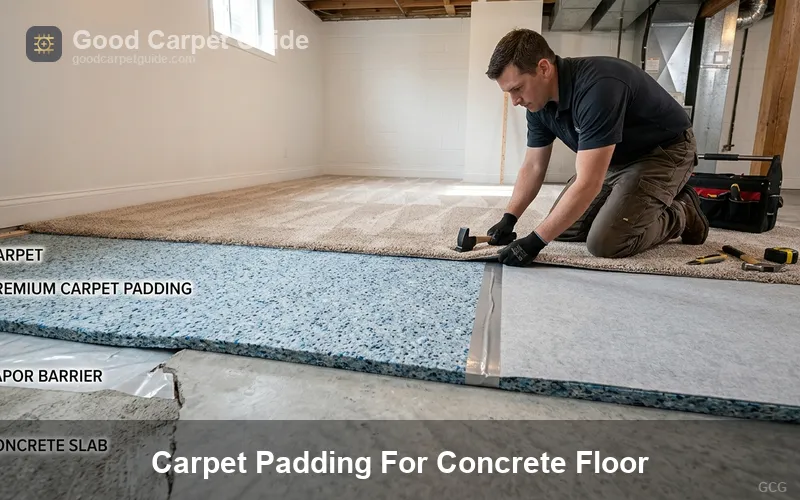
A 1/2-inch, 4-lb to 5-lb foam pad feels softer in a showroom because it compresses easily. That same compressibility lets the carpet backing flex and stretch under traffic, and wrinkles appear in high-traffic rooms within 12 to 24 months. Denser pad resists vertical deflection and keeps the backing under tension, and the density, thickness, and barrier combinations installers specify on moisture-prone jobs are documented in this carpet padding specifications reference.
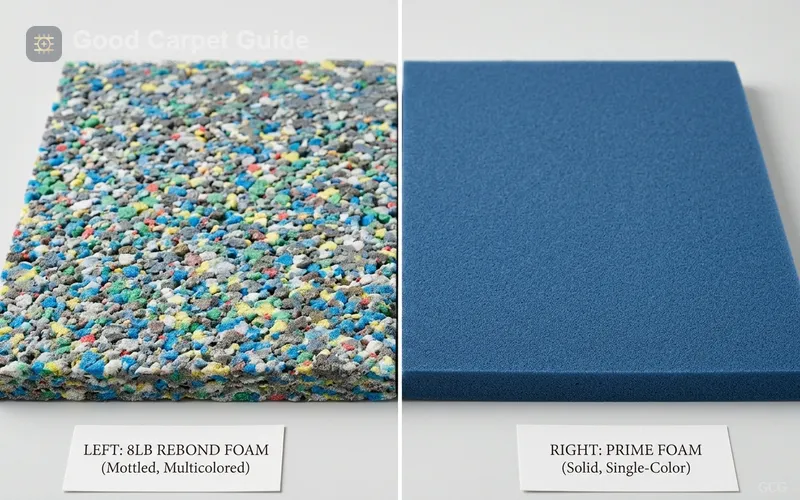
The mottled multicolor face of an 8-lb rebond cushion on the left against solid single-color prime foam on the right; density and face pattern read as the fastest field check before reinstallation.
spill barrier films on slabs and breathable cushions on wood
A spill barrier is a thin plastic film laminated to the top face of a cushion, and it stops liquid arriving from above, including wine, pet accidents, and tracked-in water. A subfloor vapor barrier is a different product with the opposite purpose: polyethylene sheeting placed below the flooring assembly on a concrete slab to hold ground moisture down.
| Barrier type | Location | Blocks moisture from | Wrong application consequence |
|---|---|---|---|
| Spill barrier (top-side pad film) | Top face of cushion, under carpet | Above (spills and accidents) | Minimal risk if omitted; reduced stain protection |
| Subfloor vapor barrier (poly sheeting) | Slab side, below the flooring assembly | Below (ground moisture) | Omission on damp slabs allows wicking into pad and mold growth |
| Double-sided moisture barrier pad | Both faces of cushion | Above and below | Traps slab moisture between two films on concrete and promotes mold underneath |
Per CRI 104 and 105, poly sheeting vapor barriers belong below or under the slab assembly rather than trapped between cushion layers on a wet slab. A pad marketed as a double-sided moisture barrier is built for wood subfloors over crawl spaces or upper stories, where no upward vapor source exists to trap. Over a concrete slab with residual moisture, the bottom film stops that moisture from evaporating, and mold grows beneath the carpet until the smell announces it.
power stretching over a rebuilt subfloor
Carpet goes back down with row runners aligned and the material power stretched into position wall by wall. New tackless strip grips fresh, so the first stretch sets the final tension, and a second pass after a week becomes unnecessary when pin depth and stretcher setup are correct on the first pull.
what professional remediation costs
Carpet odor work prices in three tiers, and the spread between them reflects scope rather than regional pricing. Figures below are in US dollars. Surface treatment starts around USD 0.30 per square foot, and full tear-out, decontamination, sealing, and reinstallation lands between 5.50 and 11.50 per square foot once carpet, cushion, disposal, and subfloor work are loaded in.
| Service scope | Cost per sq ft (USD) | What it includes |
|---|---|---|
| Surface treatment only | 0.30–0.75 | Hot water extraction or enzyme spray; does not reach subfloor contamination |
| Tear-out, decontaminate, seal, reinstall | 5.50–11.50 | Removal and disposal (0.50–1.75), shellac sealing labor (0.75–1.50), mid-grade carpet and cushion installed (4.50–8.00) |
| Staircase remediation | 25–65 per tread | Per-tread labor; a 13-step flight runs 325–845, with landings quoted separately |
Big-box promotional pricing that lands near one to three dollars per square foot is material-only and excludes cushion, labor, tax, and subfloor preparation. Independent flooring dealers typically quote a denser cushion inside the base price and itemize labor separately, and the all-in total often lands below the advertised big-box rate once the add-ons and the required subfloor work are counted.
Concrete work adds its own line that a wood-subfloor estimate never carries. Grinding, extraction, and cap sealing on a slab push labor toward the top of the range, and cutting out and replacing panels carries material and disposal cost rather than coating labor alone.
preventive protocols for pet households and humid climates
Remediation removes the current deposit. Prevention decides how often the process repeats, and the three levers that matter most are fiber choice, indoor humidity, and the size of the containment barrier at every entry point.
fiber choice for pet households
Solution-dyed nylon holds color because the pigment runs through the fiber rather than sitting on the surface, so the alkaline shift from a urine deposit cannot bleach it the way it bleaches a stock-dyed yarn. Triexta behaves similarly on stain resistance and carries a softer hand, and both fibers recover from compression better than polyester.
humidity control and the 65 percent line
Urate crystals reactivate above roughly 65% relative humidity, so indoor humidity is an odor control variable rather than a comfort setting. A dehumidifier set between 40% and 50% in a basement or an air-conditioned slab-on-grade home keeps the crystal load dormant, and the same setting reduces the conditions mold needs. Ventilation does the rest, because a closed room over a damp slab concentrates the ammonia that the slab releases.
entry mats, blot protocol, and pad service life
Walk-off matting at every exterior door removes a large share of tracked particulates and moisture before they reach wall-to-wall carpet. Two mat lengths matter more than mat thickness: a scraper mat outside for grit and an absorbent mat inside for moisture.
When an accident happens, blot with white towels and diluting water rather than a scrub brush, and treat the full contaminated radius instead of the visible patch. Cushion under a pet accident loses compression permanently; replacing the cushion under that zone is a one-hour job that keeps the next round of contamination out of a sealed subfloor.
troubleshooting persistent odor after treatment
| Symptom on site | Root technical cause | Corrective action |
|---|---|---|
| Smell returns 48 hours after a hot water pass | Hygroscopic urate crystals rehydrated and off-gassed | Dwell an enzyme treatment under film, then verify with UV mapping |
| Odor concentrates at the baseboard line | Lateral wicking beyond the mapped area | Extend pullback and sealing 12 inches past the marked boundary |
| Ammonia smell persists through a sealed floor | Vapor-permeable primer used instead of shellac | Strip the film, verify dryness, recoat with two cross-hatch shellac coats |
| Sweet chemical odor layered over an animal note | Fragrance or quaternary ammonium residue on top of ammonia | Extract the residue, then run the enzyme and sealing sequence |
| Cat odor in one vertical corner only | Felinine deposit on drywall or framing, not on the carpet | Map the vertical surface and replace or seal the affected drywall section |
| Odor returns each humid season | Slab moisture carrying salts upward under an unsealed slab | Test slab vapor emission and add cap sealing below the assembly |
what decides whether the odor stays gone
Persistence in carpet odor work comes down to three verified checkpoints rather than to any single product. Contamination gets removed from every layer it reached, the subfloor tests dry before a coating goes down, and the coating is a hermetic vapor barrier rather than a permeable stain blocker.
Jobs that skip the third checkpoint fail first, because a latex or water-based primer looks sealed and reads sealed by eye while ammonia molecules cross that film within a year.
key takeaways for homeowners
- Urate crystals are the odor source, and they rehydrate above 65% relative humidity, which is why the smell returns after a steam clean.
- Baking soda and vinegar produce sodium acetate and carbon dioxide, and neither compound digests uric acid salts.
- Subfloor decontamination runs on dwell time: 24 to 48 hours damp at 65°F to 85°F under polyethylene film.
- Sealing requires white-pigmented shellac applied in two cross-hatch coats, not a water-based or PVA stain blocker.
- Cushion contaminated by a pet accident goes in the trash, and the replacement is 8-lb to 10-lb rebond no thicker than 7/16 inch.
- Wood subfloors must read below 12% moisture content before sealing, and concrete slabs need a vapor emission test.
- Full remediation runs 5.50 to 11.50 per square foot, against 0.30 to 0.75 for surface cleaning that never reaches the source.