TL;DR recommendation matrix
The following matrix summarizes the most common carpet stretching scenarios and identifies the appropriate tool for each installation type.
| Situation | Recommended tool | Expected result |
|---|---|---|
| Installing carpet in an entire room | Power stretcher | Uniform wall-to-wall tension |
| Positioning carpet near a wall | Knee kicker | Local edge adjustment |
| Stretching carpet on stairs | Knee kicker with stair tools after power stretching | Secure edge attachment |
| Repairing localized wrinkles | Power stretcher | Permanent wrinkle removal |
| Reinstalling carpet after flooding | Power stretcher after complete drying | Proper backing tension restoration |
The matrix demonstrates one consistent principle: a power stretcher performs structural stretching, while a knee kicker performs positioning.
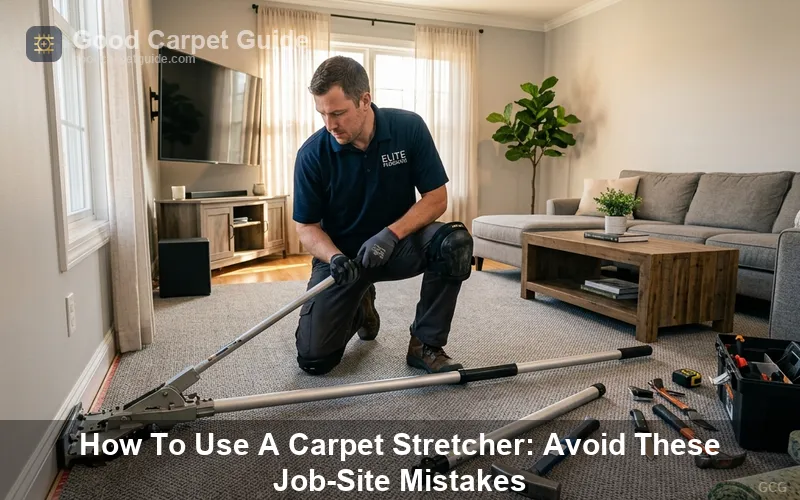
Modern carpet installation depends more on installation technique than carpet price. How to use a carpet stretcher determines whether carpet backing remains stable for years or develops visible ripples after normal household traffic. How to use a carpet stretcher also determines whether many manufacturer warranties remain valid because major brands require power stretching under Carpet and Rug Institute (CRI) installation standards.
Many homeowners believe that striking a knee kicker across a room stretches carpet, but using a kicker alone is not sufficient. In fact, learning how to use a carpet knee kicker correctly is critical for edge-seating and placement, not for full-room tensioning. Experienced flooring inspectors repeatedly document the opposite outcome. Composite field reports from installers, repair technicians, and homeowners show that localized kicking produces delayed buckling after the carpet backing relaxes. The visible wrinkle appears months after installation, but the structural failure begins during installation day.
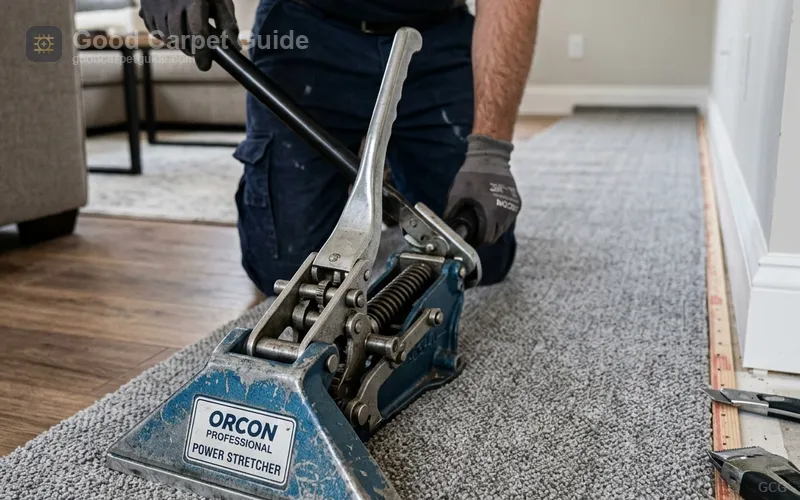
A power stretcher distributes mechanical tension across the entire carpet surface before final trimming, creating the structural stability discussed in the introduction and preparing the carpet for permanent tack strip engagement.
how to use a carpet power stretcher
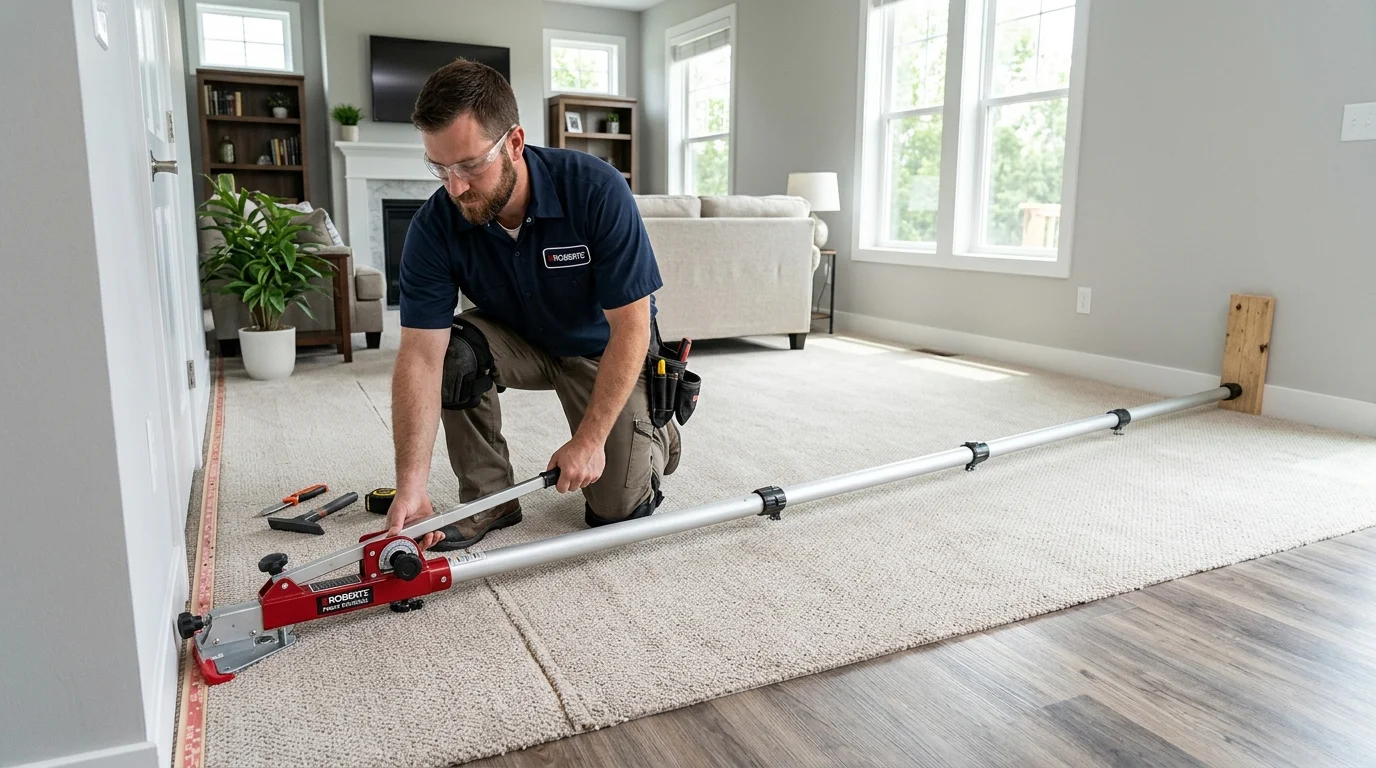
A power stretcher is a mechanical flooring tool that transfers leverage through extension poles to tension carpet backing across an entire room.
Power stretching follows a repeatable installation sequence.
- Position the stretcher head approximately 6 inches from the wall where stretching begins.
- Assemble extension poles until the tail block reaches the opposite wall.
- Brace the tail block securely against structural framing or a protected wall surface.
- Engage the lever mechanism gradually until carpet backing reaches proper tension.
- Seat the carpet onto the tack strip while lever pressure remains applied.
- Release the lever slowly before moving to the next section.
Each stretching cycle transfers force across the room rather than into a single localized point. Uniform tension prevents backing relaxation from concentrating in isolated areas.
Many low-cost installations skip this procedure because power stretching adds approximately 45 to 90 minutes to the project. Composite installer interviews indicate that rushed installations frequently substitute a knee kicker for a power stretcher, creating what repair professionals informally call a "kick-and-go" installation.
Industry inspectors verify proper stretching after warranty claims by examining physical evidence rather than relying on installer statements. Tack strip pins frequently bend slightly toward the wall during proper stretching, and carpet secondary backing exhibits measurable elongation between approximately 1% and 1.5%.
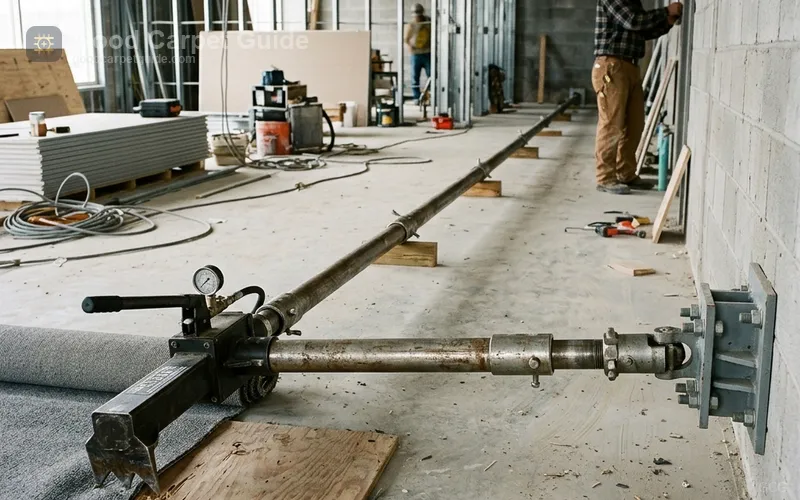
Extension poles convert localized lever force into room-wide carpet tension, bridging the stretching procedure above with the installation mechanics explained in the following section.
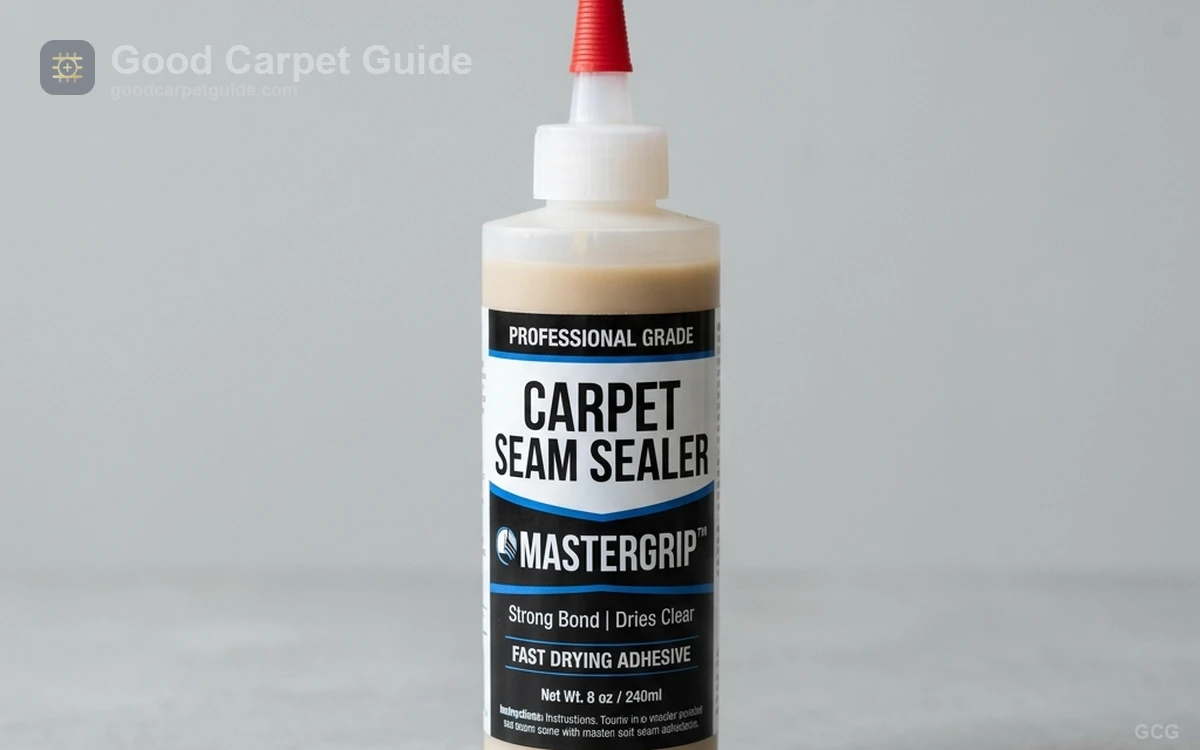
Roberts 8015 Universal Carpet Seam Sealer
Seals carpet seams after stretching and reduces edge separation under long-term traffic loads.
Check Price on Amazonhow to use a power stretcher for carpet
Using a power stretcher for carpet requires systematic tension distribution rather than maximum force.
Experienced installers follow a grid pattern instead of stretching one wall completely before moving elsewhere.
A practical installation sequence includes:
- Stretch the primary wall.
- Stretch the opposite wall.
- Stretch adjacent sides.
- Repeat overlapping passes.
- Trim excess carpet only after final verification.
Overlapping passes equalize stress throughout the carpet backing. Equalized stress reduces future ripple formation caused by polymer relaxation inside the backing layers.
Homeowners frequently ask whether one stretch across the room is sufficient. Field repairs indicate that one-pass installations create diagonal stress concentrations because carpet backing does not elongate uniformly across every section.
Composite reports from repair specialists show that wrinkles appearing two or three years after installation often correspond directly to areas that never received secondary stretching passes.
Proper stretching also depends on carpet cushion performance. Dense premium underlayment stabilizes backing movement and distributes vertical loads more effectively than low-density rebond padding. Many veteran installers summarize this relationship with a simple purchasing strategy: buy a premium cushion and a mid-range carpet rather than an expensive carpet installed over inexpensive padding.
Readers evaluating replacement flooring for sleeping spaces may also benefit from a bedroom carpet guide because underlayment density and carpet comfort interact closely in low-traffic residential rooms.
how to use a roberts carpet stretcher
The Roberts 10-254 Power Stretcher is one of the most widely rented professional carpet stretching systems in North America because its modular pole design adapts to many residential room dimensions.
The Roberts system operates through five major components:
- Connect extension poles to match room length.
- Attach the stretching head into the carpet pile.
- Place the tail block firmly against the opposite wall.
- Operate the lever assembly until proper resistance develops.
- Secure carpet onto tack strips before releasing pressure.
Each component performs a structural function rather than a convenience function. Missing extension sections reduce leverage and create incomplete tension across the room.
Rental centers frequently stock Roberts systems because replacement pole sections and accessories remain readily available. Rental availability also explains why many DIY homeowners encounter Roberts equipment during weekend projects.
Professional installers nevertheless caution against assuming that equipment rental guarantees installation quality. Composite field observations show that inexperienced users frequently overstretch one section while leaving adjacent areas under tension, creating uneven stress fields that eventually develop into visible waves.
For homeowners considering basement flooring projects where concrete moisture and slab movement affect installation quality, the [best carpet for basement guide](/best-carpet-for-basement) explains additional substrate preparation requirements before stretching begins.
how to use a carpet stretcher knee kicker
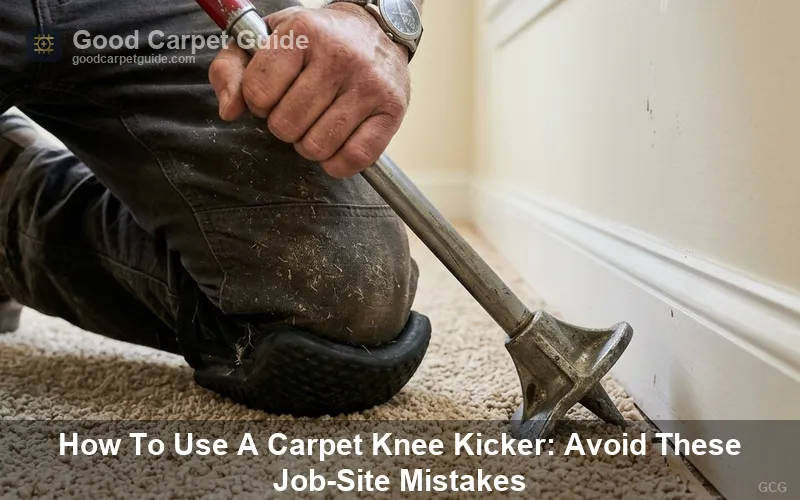
A knee kicker is a positioning tool that transfers short bursts of force into the carpet edge through impact from the installer's knee. A knee kicker does not generate enough leverage to stretch an entire room.
Experienced installers use knee kickers only after wall-to-wall tension has already been created with a power stretcher. The knee kicker shifts carpet a few inches at a time so the backing locks securely onto the tack strip around corners, closets, doorways, and stair edges.
The correct operating sequence follows five steps.
- Place the toothed head several inches away from the wall.
- Angle the head slightly downward so the pins grip the carpet backing.
- Strike the padded end with controlled knee pressure rather than maximum force.
- Move the carpet edge onto the tack strip.
- Repeat the adjustment until the perimeter sits flat.
The procedure positions carpet rather than structurally tensions carpet. Composite reports from flooring inspectors repeatedly identify confusion between the two tools as one of the largest causes of premature carpet failure.
A homeowner posted a photograph of a newly purchased knee kicker and asked whether the tool could stretch an entire house. Multiple experienced installers responded that the tool was appropriate only for finishing work and warned that a full installation completed with a knee kicker alone would almost certainly develop wrinkles.
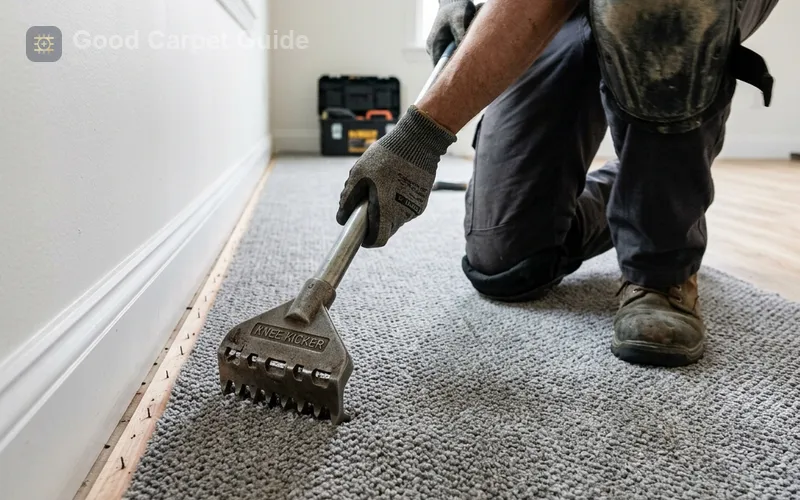
A knee kicker performs edge positioning after structural tension has already been established, connecting full-room power stretching with final tack strip engagement around walls and corners.
stair carpet stretching failures and installer techniques
Stair carpet stretching requires different force management than flat-floor installations because every tread and riser concentrates weight into a relatively small surface area.
Professional installers secure the landing before working down the staircase. The landing establishes the primary tension line that stabilizes the remaining stair assembly.
Composite field reports identify three recurring stair failures.
- Expose tack strips through compressed carpet after inadequate tension.
- Lift carpet noses after repeated foot traffic loosens attachment points.
- Separate side edges after uneven lateral stretching.
One homeowner described walking barefoot on stairs and feeling exposed tack strip pins through the carpet. The technical cause was not defective carpet fiber. The technical cause was insufficient padding thickness combined with poor stretching that allowed carpet movement over time.
Veteran installers also avoid excessive stretching on stair noses. Excessive stretching permanently compresses pile yarn and accelerates visible wear at the highest-contact location.
Dense cushion selection influences stair performance as much as stretching technique. Many installers summarize the purchasing decision with the phrase "buy the Cadillac pad before buying the Cadillac carpet." A premium cushion absorbs impact loads that would otherwise transfer directly into the carpet backing.
Readers comparing products specifically for stair applications may find the [best carpet for stairs guide](/best-carpet-for-stairs) useful because pile construction, density, and backing flexibility all affect stair durability.
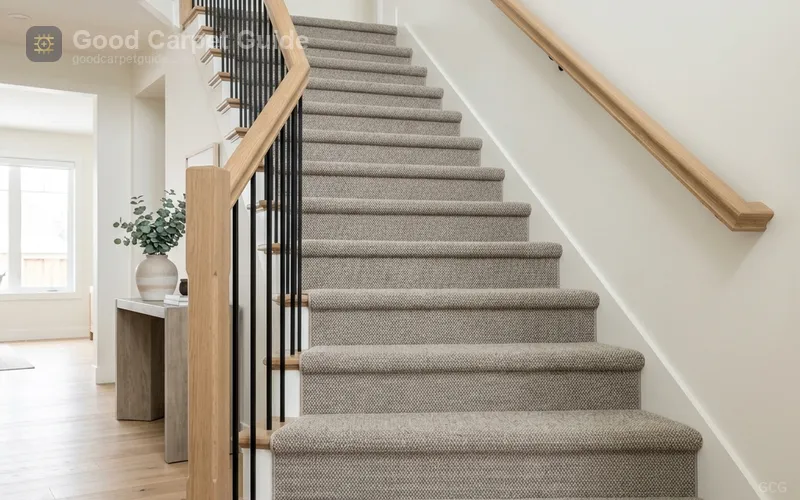
Proper stair stretching secures carpet around every nosing and prevents the tack strip exposure and edge movement described in the previous section while supporting long-term traffic durability.
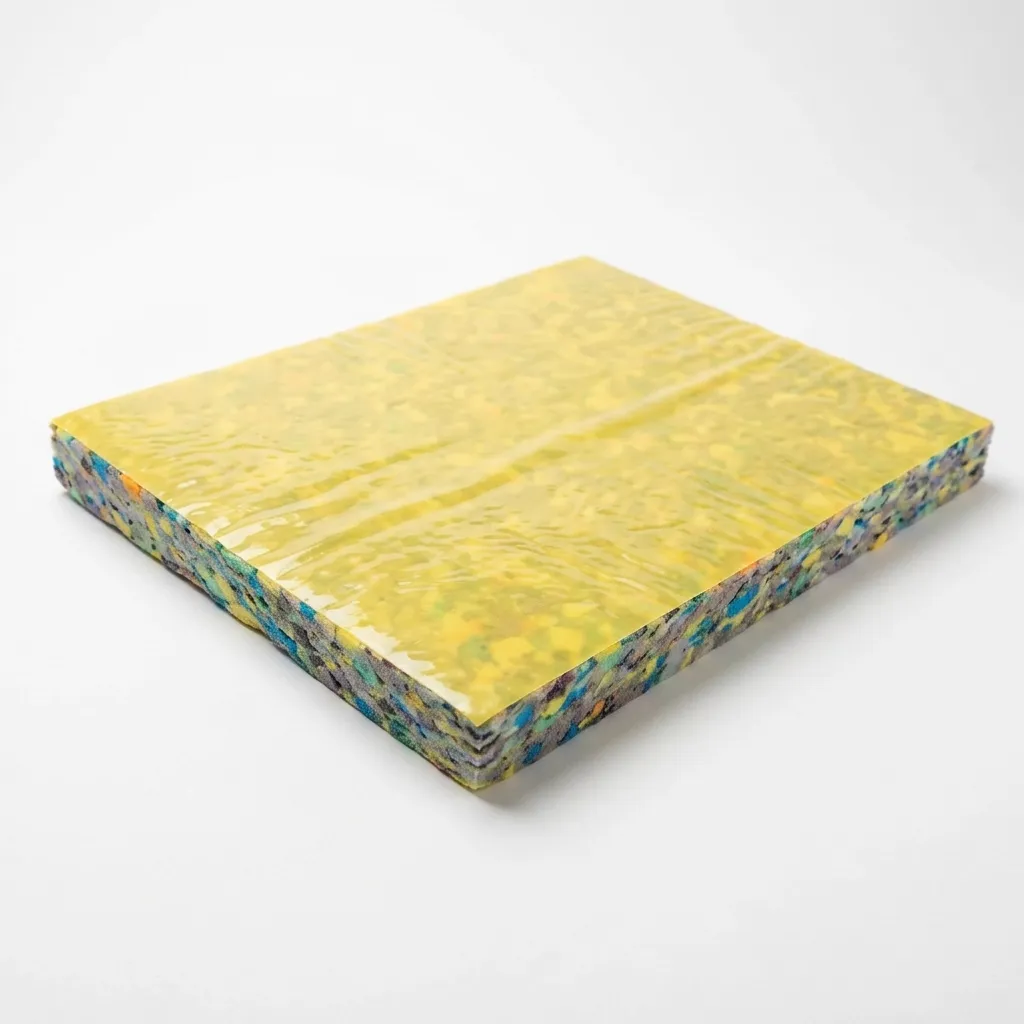
Mohawk SmartCushion Premium Carpet Padding
High-density carpet cushion that improves load distribution beneath stretched carpet and helps reduce long-term backing fatigue.
Check Price on Amazonhow subfloor preparation affects carpet stretching performance
Subfloor preparation determines whether carpet tension remains evenly distributed after installation.
Concrete slabs, plywood panels, and oriented strand board (OSB) each transfer force differently into carpet backing. Surface irregularities create localized stress concentrations that eventually appear as visible ripples.
Professional installers inspect subfloors before assembling stretching equipment.
The inspection process generally includes:
- Check for loose panels.
- Check for moisture intrusion.
- Check for height differences between joints.
- Check for protruding fasteners.
- Check for adhesive residue from previous flooring.
The inspection sequence reduces structural variables before carpet installation begins.
Concrete floors require particular attention because moisture migration weakens adhesives and changes backing behavior. Wood panel systems require attention because vertical movement under load redistributes carpet tension across the room.
Composite repair reports show that many wrinkle complaints originate from subfloor movement rather than carpet manufacturing defects.
Installers commonly apply self-leveling compounds on concrete and sand raised seams on wood substrates before stretching begins. Uniform substrate geometry produces more consistent backing elongation and more predictable long-term performance.
common DIY carpet stretching mistakes
DIY carpet stretching projects fail for predictable technical reasons rather than isolated accidents.
The following installation mistakes appear repeatedly in repair calls.
- Confuse a knee kicker with a power stretcher.
- Stretch one wall without balancing adjacent walls.
- Trim carpet before final tension verification.
- Reuse damaged tack strips without replacement.
- Ignore cushion deterioration beneath existing carpet.
- Rent equipment without learning calibration procedures.
Each mistake reduces installation quality by changing force distribution across the carpet backing.
A frequent misconception assumes that stronger pulling force creates a better installation. Professional installers instead pursue balanced force. Excessive tension damages seams and pile structure while insufficient tension produces delayed buckling.
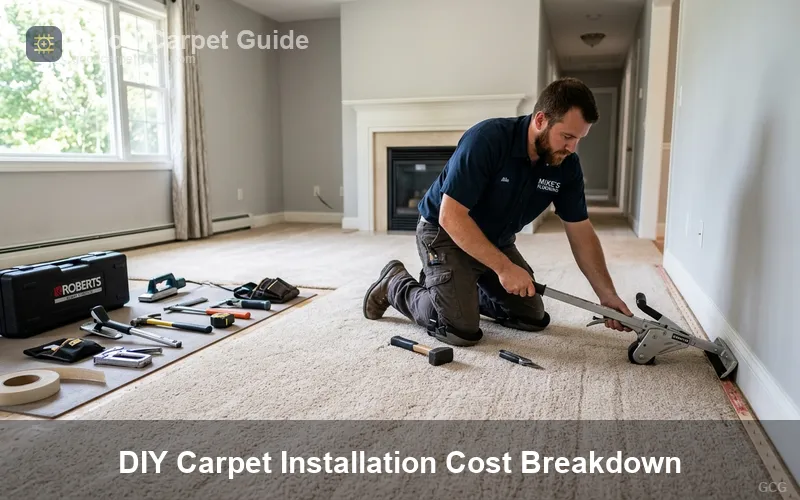
Composite homeowner experiences also reveal misunderstanding about rental economics. Power stretcher rental commonly costs between $25 and $45 per day or $90 to $150 per week, while many local repair specialists complete a professional re-stretching project for labor rates that narrow the expected DIY savings.
For many homeowners, the greatest financial risk is not rental cost but warranty loss. Several manufacturers explicitly require power stretching and reserve the right to deny claims when forensic inspection finds no evidence of proper installation procedures.
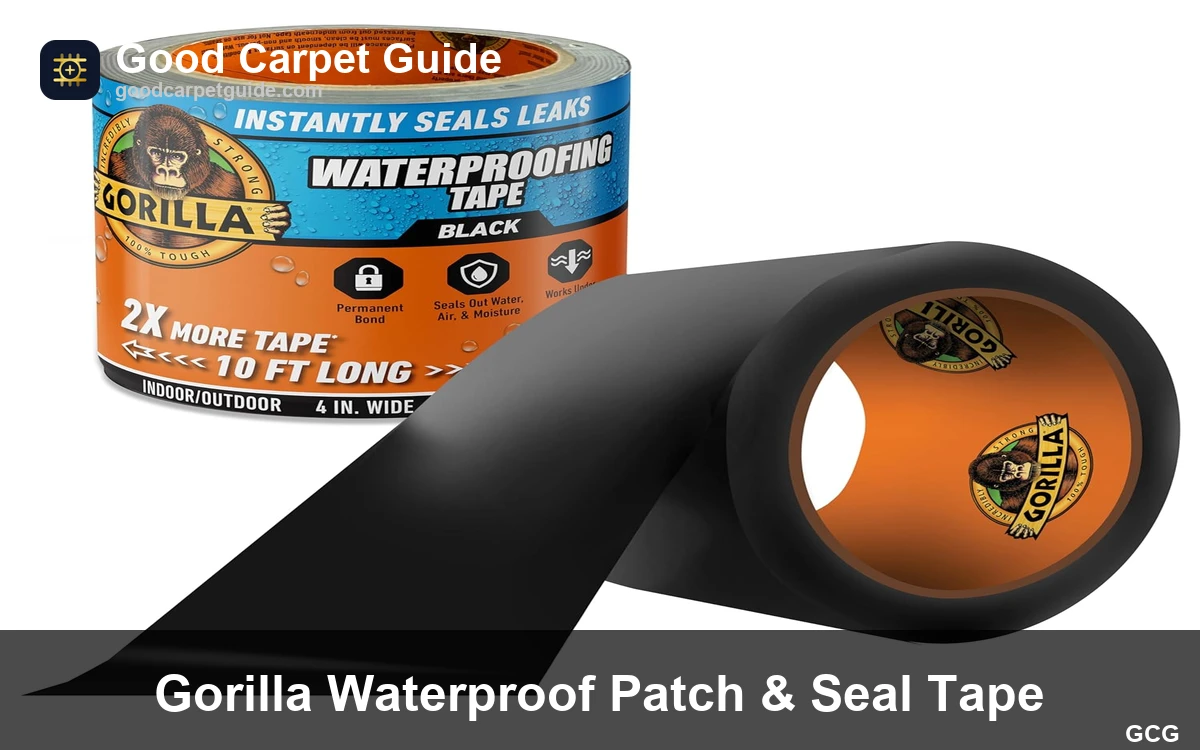
Gorilla Double Sided Carpet Tape
Useful for temporary positioning during repair work and transition detailing before final carpet finishing.
Check Price on Amazonhow do real homeowners and installers describe carpet stretching failures
Composite field reports from homeowners, flooring inspectors, and repair technicians reveal that carpet stretching failures rarely become visible immediately after installation.
Most complaints appear after furniture has remained in place for several months or after seasonal humidity changes have cycled through the home. Carpet backing gradually releases stored tension, exposing installation shortcuts that were invisible on installation day.
One recurring report involved a homeowner who noticed large lumps developing several years after installation. The visible surface waves were not caused by defective carpet yarn. Flooring repair specialists attributed the problem to inadequate wall-to-wall stretching during the original installation.
Another frequently referenced field experience involved a wheelchair user whose carpet had been installed directly over the subfloor without proper padding. The decision was intended to make wheelchair movement easier. Less than six months later, the carpet showed severe crushing and traffic damage. The manufacturer reportedly rejected warranty coverage because residential carpet required approved cushioning beneath the installation.
Color selection problems also appear in installation discussions. One documented homeowner experience described ordering a carpet identified as "Powder Grey" but receiving installers carrying a different color identified as "Porcelain." The homeowner faced the choice of accepting the incorrect product or delaying installation for several weeks while replacement material was sourced.
These experiences demonstrate an important technical principle. Carpet quality alone does not determine installation success. Material selection, stretching technique, cushion specification, and installer workmanship interact throughout the finished flooring system.
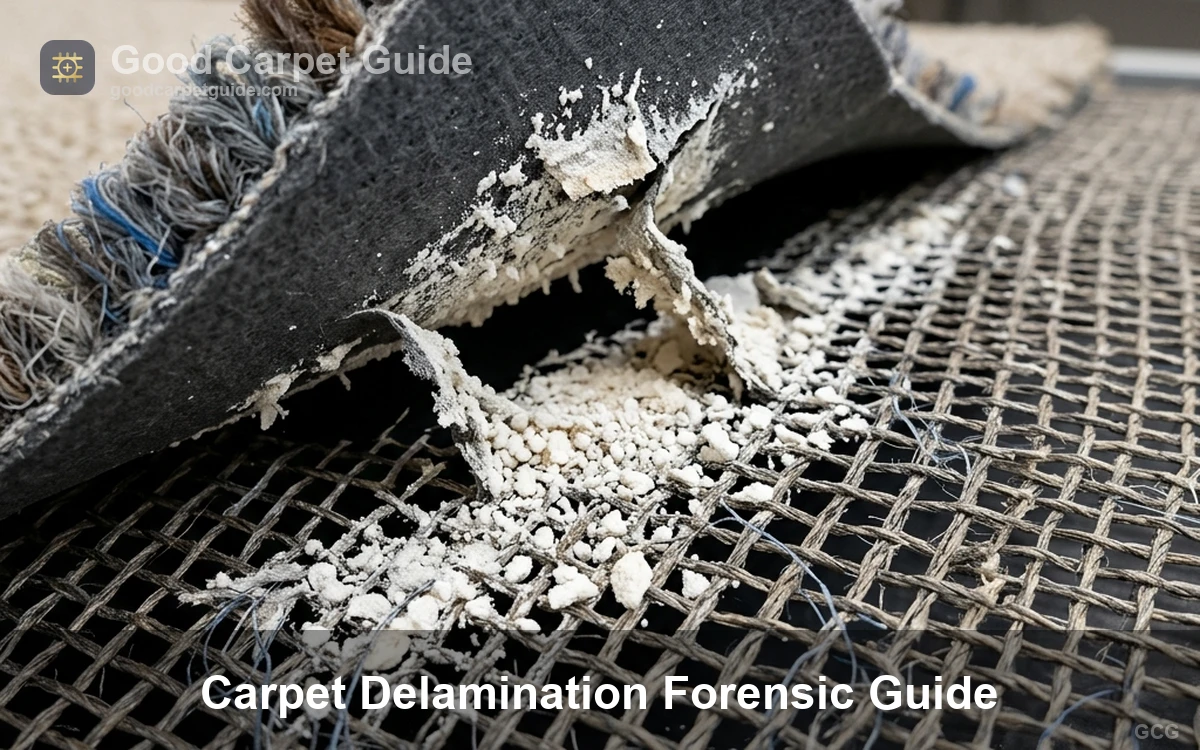
Repair technicians also report that improperly stretched carpet frequently develops secondary structural problems such as seam stress and backing separation. Readers interested in the structural mechanics behind backing failure may benefit from reviewing the [carpet delamination guide](/carpet-delamination), which explains how adhesive layers and backing components separate under long-term mechanical stress.
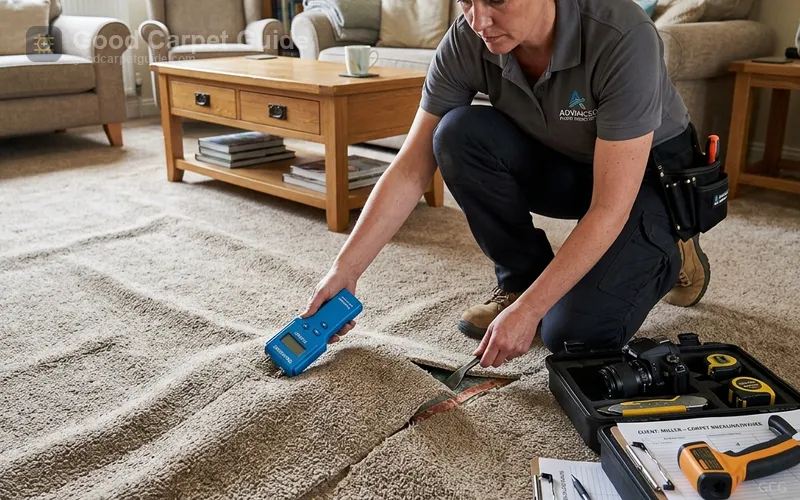
A post-installation inspection of carpet ripples illustrates how backing relaxation exposes installation deficiencies long after the original project appears complete, linking homeowner experiences with structural failure mechanisms.
why do carpet installers and manufacturers disagree about warranty claims
Carpet installers and carpet manufacturers evaluate installation quality from different perspectives.
Independent installers typically focus on project completion time, labor efficiency, and customer scheduling. Manufacturers focus on compliance with documented installation standards because warranty coverage depends on measurable installation procedures rather than verbal assurances.
This difference explains why disputes occasionally arise after wrinkle formation.
Composite industry reports describe situations where low-cost installers claimed that power stretching was unnecessary because manufacturers would never verify installation methods. Flooring inspectors describe the opposite process. Warranty investigations routinely include forensic examination of physical evidence left behind by proper stretching procedures.
Inspectors commonly evaluate:
- Measure backing elongation to verify acceptable stretching percentages.
- Inspect tack strip deformation to identify correct force direction.
- Examine seam condition for evidence of balanced tension.
- Review ripple orientation to identify incomplete stretching patterns.
Each inspection criterion provides objective physical evidence that remains visible after installation.
Several carpet manufacturers explicitly distinguish between power stretchers and alternative tools. Fine-print warranty language from one manufacturer states that installing carpet with a stinger rather than a power stretcher voids warranty protection.
Professional installers who provide written lifetime installation guarantees generally have a strong incentive to follow recommended stretching procedures because future repair costs remain their responsibility.
The practical lesson for homeowners is straightforward. Installation quality should be verified before selecting the lowest labor quote because correcting wrinkles after furniture placement frequently costs more than proper installation from the beginning. Alternatively, homeowners seeking a stretch-free flooring option should consult a professional carpet tile installation guide to evaluate modular floating and peel-and-stick layouts.evaluate modular floating and peel-and-stick layouts; note that carpet tiles require different tools and techniques compared to traditional wall-to-wall stretching.
cost and budget considerations for carpet stretching
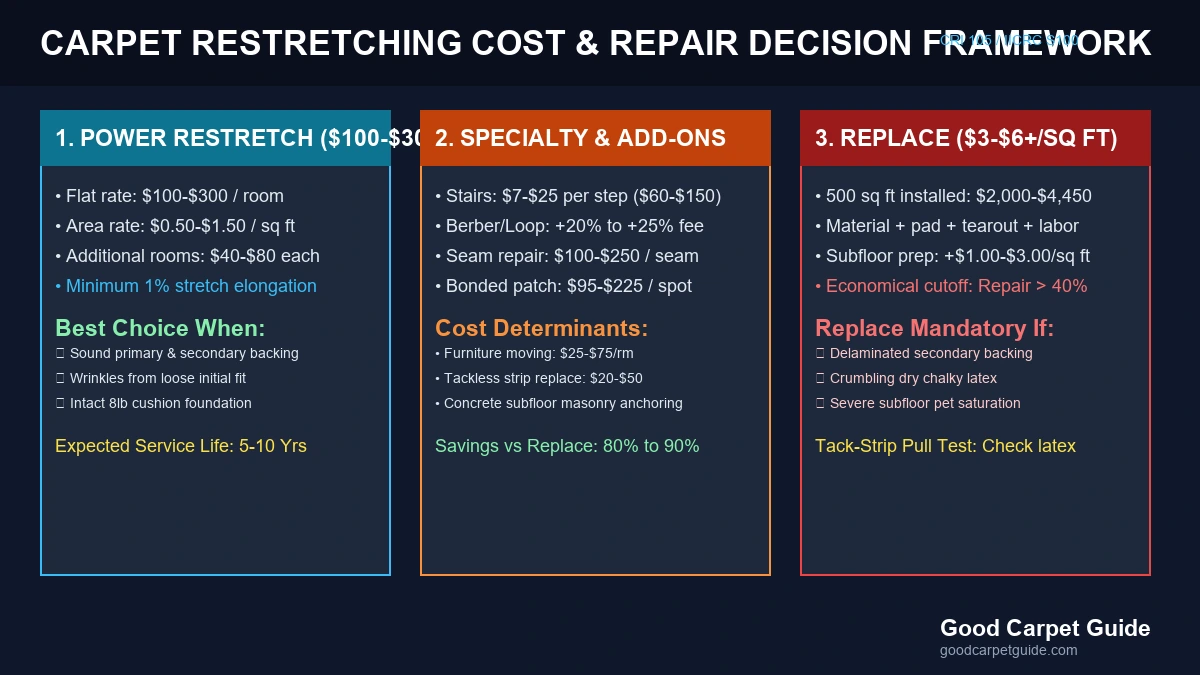
The table below summarizes commonly reported pricing ranges for stretching equipment and professional services in the United States.
| Service or Equipment | Typical Cost |
|---|---|
| Power stretcher rental | $25–$45 per day |
| Weekly power stretcher rental | $90–$150 per week |
| Knee kicker purchase | Approximately $20–$30 |
| Professional re-stretching | $0.30–$0.50 per square foot |
| Installer labor | $60–$80 per hour |
| Minimum service visit | $150–$250 |
The pricing data shows that equipment rental does not eliminate project costs. Equipment rental shifts labor responsibility from an experienced installer to the homeowner.
Composite installer interviews also challenge the assumption that national retailers always provide the lowest total project price. Independent flooring dealers frequently operate with lower overhead and have been reported to quote premium carpet installations at prices up to $1.00 per square foot lower than comparable big-box retailers.
Repair work represents another financial consideration. Carpet repair specialists report generating substantial monthly revenue by correcting wrinkles and buckles created by incomplete stretching performed during original installations. The existence of a dedicated repair market demonstrates how frequently installation shortcuts occur.
Homeowners planning a new project should therefore compare three separate values rather than one purchase price:
- Compare carpet quality.
- Compare cushion specification.
- Compare installer qualifications.
Evaluating all three variables together provides a more accurate estimate of long-term ownership cost than comparing carpet fiber alone.
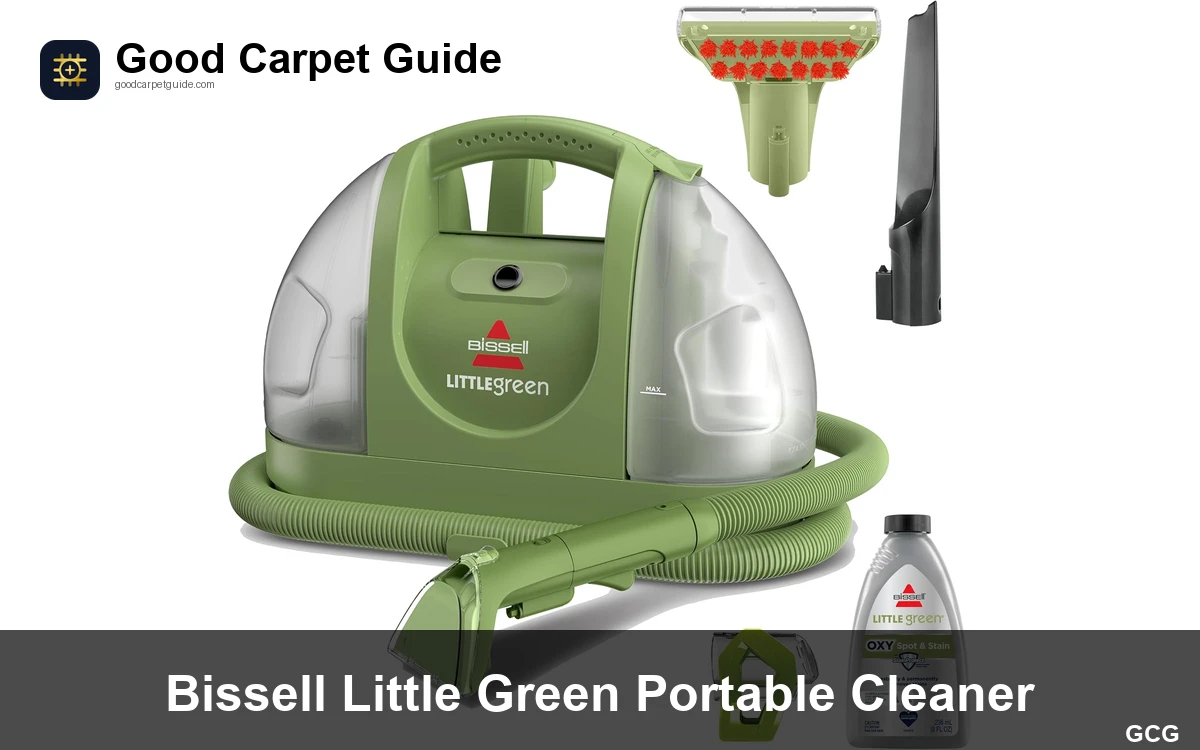
Bissell Little Green Portable Carpet Cleaner
A portable extractor that helps remove installation debris, adhesive residue, and accidental spills after carpet installation or repair work.
Check Price on Amazonwhy does carpet padding matter as much as carpet stretching
Carpet padding performs structural and comfort functions simultaneously.
High-density carpet cushion distributes foot traffic loads across a wider area of the carpet backing. The wider distribution reduces concentrated stress that would otherwise accelerate backing fatigue and visible wear.
Composite installer recommendations consistently prioritize premium padding over premium carpet fiber when budgets are limited. One commonly repeated field recommendation advises homeowners to purchase a "Cadillac pad with a mid-range carpet" instead of pairing premium carpet with inexpensive rebond cushion.
Padding selection also influences acoustic performance, thermal insulation, and walking comfort. Memory foam products manufactured by companies such as Carpenter Co. and moisture-resistant systems marketed under the Tempur-Pedic name receive frequent positive mention in professional flooring discussions because dense cushion supports carpet recovery under repeated loading.
Stretching quality and padding quality therefore function as complementary variables. Excellent stretching cannot compensate for deteriorated cushion, and premium cushion cannot compensate for incomplete stretching.
frequently asked questions
The following section answers the most common queries regarding carpet stretching tools, techniques, and installation requirements.
how many walls should you stretch carpet from?
Professional installers do not stretch carpet from only one wall. Professional installers create balanced tension by working across multiple directions and making overlapping passes until the entire room reaches uniform backing elongation.
Stretching from a single wall concentrates force into one axis and increases the likelihood of diagonal wrinkles appearing after normal household use.
can you install an entire room using only a knee kicker?
No. A knee kicker positions carpet around the perimeter but does not generate enough leverage to tension an entire room.
Composite installer reports consistently identify knee-kicker-only installations as one of the leading causes of premature carpet buckling. A properly installed residential carpet requires a power stretcher to distribute force across the full width and length of the room.
how tight should carpet be after stretching?
Properly stretched carpet should lie flat without visible ripples, loose areas, or excessive resistance at seams.
The goal is balanced structural tension rather than maximum pulling force. Excessive stretching places unnecessary stress on seams and backing components, while insufficient stretching allows backing relaxation to create wrinkles months after installation. When seam failure occurs under tension at thresholds, knowing how to fix carpet seam in doorway transitions prevents the split from expanding.
Professional inspectors commonly evaluate installations by examining backing elongation and tack strip engagement rather than relying only on visual appearance.
how long does a properly stretched carpet stay flat?
A properly stretched carpet remains flat for many years when installed over a suitable cushion and stable subfloor.
Long-term performance depends on several interacting variables:
- Maintain proper backing tension through power stretching.
- Install appropriate carpet padding beneath the carpet.
- Prepare a stable subfloor before installation.
- Control excessive moisture exposure after installation.
- Repair localized damage promptly before movement spreads.
Installations completed according to CRI recommendations maintain structural stability significantly longer than installations completed with localized stretching methods.
is renting a carpet stretcher worth it?
Renting a carpet stretcher reduces equipment costs but does not replace installation experience.
Power stretcher rental typically ranges from $25 to $45 per day or $90 to $150 per week. Professional re-stretching services frequently cost $0.30 to $0.50 per square foot, meaning the financial difference between DIY work and professional labor may be smaller than many homeowners expect.
Projects involving multiple rooms, complicated layouts, or expensive carpet generally benefit from experienced installation because correcting mistakes after furniture is moved back into place creates additional labor costs.
what causes carpet wrinkles to appear years after installation?
Delayed carpet wrinkles result from gradual backing relaxation rather than sudden structural failure.
Carpet backing stores mechanical energy immediately after installation. Incomplete stretching leaves uneven stress inside the backing layers. Normal foot traffic, furniture loading, seasonal temperature changes, and humidity cycles gradually redistribute that stress until visible waves appear on the carpet surface.
The wrinkle therefore develops months or years after installation even though the underlying installation error occurred on the first day.
final installer recommendations
After hundreds of residential flooring projects, one pattern appears repeatedly: most carpet failures originate from installation shortcuts rather than manufacturing defects.
Power stretching remains the accepted professional standard because wall-to-wall leverage distributes tension evenly across the carpet backing. Knee kickers remain valuable finishing tools, but knee kickers do not replace a power stretcher during full-room installation.
Homeowners comparing installation quotes should evaluate more than carpet color and price. The installer should confirm that a power stretcher will be used, the cushion specification should match the expected traffic level, and the subfloor should be inspected before stretching begins. Those three decisions have a greater influence on long-term performance than upgrading from a mid-range carpet fiber to a premium product.
For homeowners installing carpet in bedrooms, basements, or staircases, selecting the correct carpet construction remains important, but proper stretching determines whether that carpet retains its appearance over time. A well-stretched mid-range carpet installed over quality padding consistently outperforms an expensive carpet that never receives proper wall-to-wall tension.
The most reliable project outcome combines four elements:
- Choose a qualified installer who uses a power stretcher on every full-room installation.
- Choose a high-density carpet cushion that supports long-term backing stability.
- Choose a properly prepared subfloor with moisture and flatness issues corrected before installation.
- Choose documented installation practices that satisfy manufacturer warranty requirements.
Following those principles produces a flatter installation, reduces the likelihood of future re-stretching, protects warranty eligibility, and lowers total ownership cost over the life of the carpet.