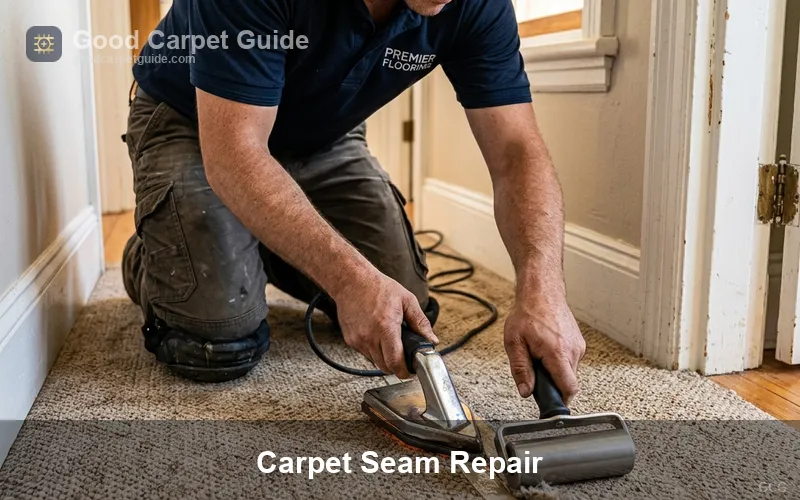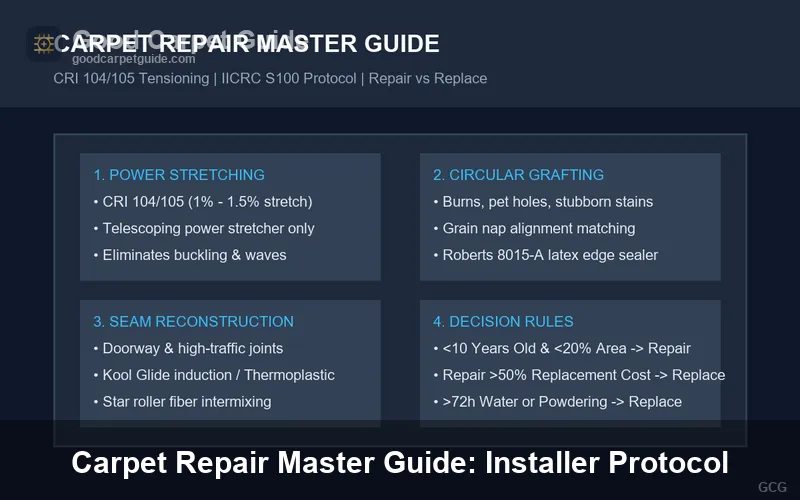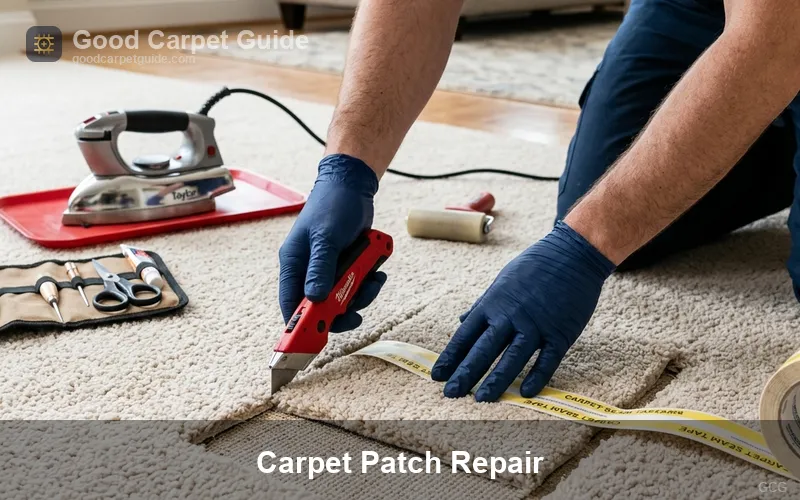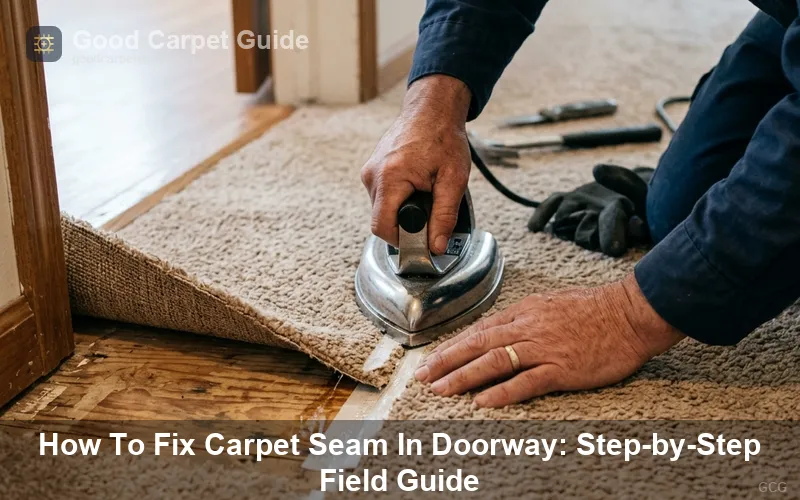
A split, peaked, or fraying carpet seam at a doorway is one of the most common repair calls in residential flooring, as outlined in our carpet repair master guide , which covers full-room stretching and seaming protocols., and how to fix carpet seam in doorway problems depends on the specific failure type present. Doorway seams fail for three distinct reasons: heat-bond tape degradation, pad collapse under pivot traffic, and improper tensioning during the original installation. This guide separates true structural failures from cosmetic issues like seam peaking, and it lays out the tools, costs, and decision points a veteran installer uses on a doorway repair call.
quick reference: doorway seam repair matrix
| Symptom | Likely Cause | DIY Feasibility | Typical Cost Range |
|---|---|---|---|
| Raised ridge along the seam line | Seam peaking from carpet tensioning (not a defect) | Not applicable — no repair exists | $0 (cosmetic, not repairable) |
| Gap opening between two carpet edges | Failed heat-bond seam tape | Low — requires seam iron | $75 – $350 |
| Carpet lifting off the tack strip | Loose tackless strip or collapsed pad | Low — professional stretch recommended | $50 – $100 per area |
| Frayed, shredded fibers at threshold | Pet damage or repeated pivot wear | Very low — patch match required | $75 – $250 |
| Entire section bulging near the door | Under-tensioned original install (knee kicker only) | None — power stretcher required | $50 – $75 per hallway |
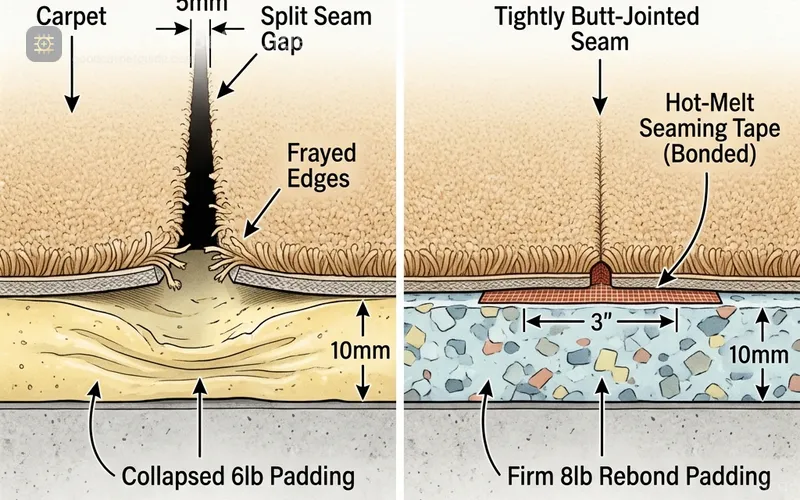
The table above separates cosmetic seam peaking from genuine structural seam failure, a distinction that governs every decision in the sections that follow. Seam peaking, a slightly raised ridge along a doorway seam, is not classified as a defect under most manufacturer inspection standards, while an open, separating seam is a mechanical failure that requires re-taping or re-seaming. Homeowners frequently conflate the two, which leads to unnecessary carpet replacement when a $125–$350 re-seam would have resolved the issue.
how to fix carpet seam in doorway
Fixing a carpet seam in a doorway starts with diagnosing whether the seam has physically separated or is only peaking cosmetically. A separated seam shows visible backing or pad between the two carpet edges, while peaking shows a raised but still-connected seam line. Documented cases show that installers who skip this diagnostic step frequently re-tape seams that never needed repair, wasting a service call on a condition with no fix. Once separation is confirmed, the repair follows a defined workflow using a thermal seaming iron and hot-melt seam tape rather than adhesives applied by hand.
Tools required for a doorway seam repair:
- Seam iron (such as a Kool Glide induction system) — melts the hot-melt adhesive on seaming tape
- Row runner or straightedge — keeps the seam line straight during bonding
- Carpet trimmer or wall trimmer — trims excess fiber cleanly at the seam edge
- Knee kicker — repositions carpet tension locally before bonding
- Seam roller — presses the bonded seam flat while the adhesive cools
- Latex seam sealer — coats raw carpet edges to prevent fiber raveling
- Cut and remove the failed section of seaming tape from beneath the carpet.
- Vacuum the subfloor strip beneath the doorway to remove grit that prevents adhesive bonding.
- Position new hot-melt seam tape adhesive-side up, centered under the gap.
- Preheat the seam iron to the tape manufacturer's specified temperature, typically 270–300°F for standard hot-melt tape.
- Draw the iron slowly along the tape while pressing both carpet edges into the melted adhesive.
- Roll the seam immediately with a seam roller before the adhesive sets, working out any tension bubbles.
- Apply latex seam sealer to any exposed raw edges to prevent future fraying.
Skipping the seam sealer step is the single most common shortcut that causes a repaired seam to fail again within a year, since unsealed edges continue to shed fibers under foot traffic. A completed seam repair should sit flush against the surrounding pile height, with no visible tape line once the fibers are groomed back into place.
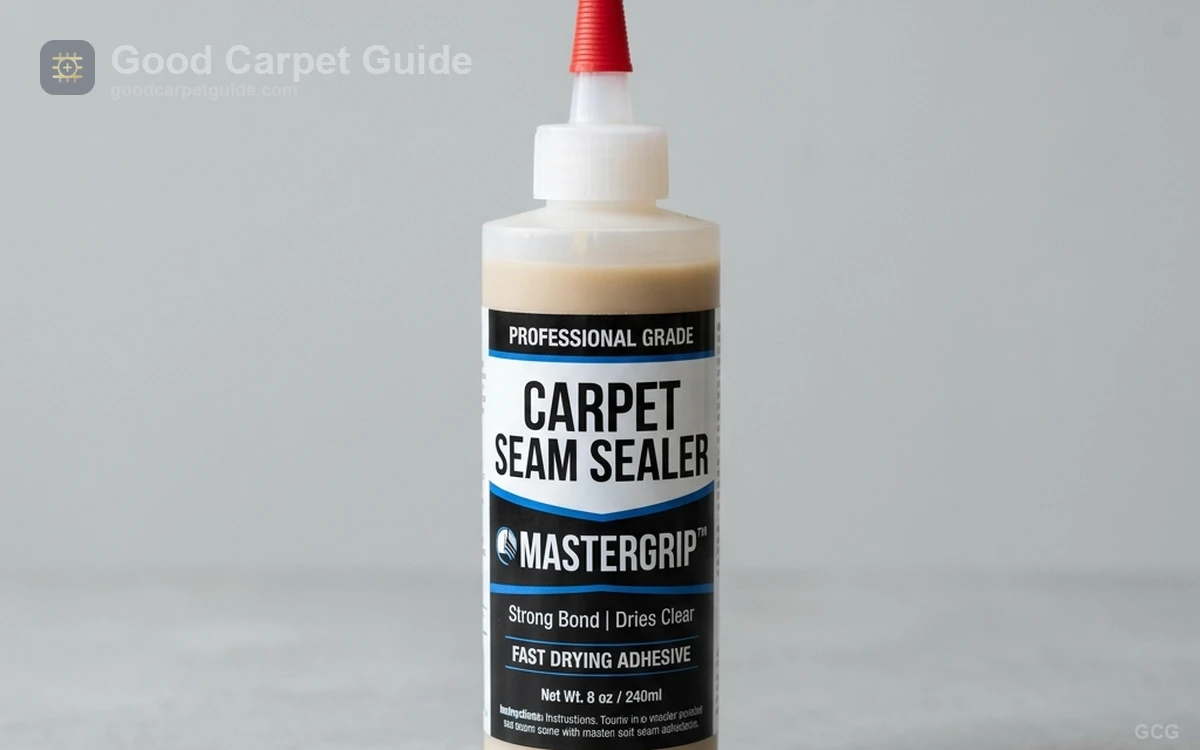
Roberts 8015 Universal Carpet Seam Sealer
Applied to raw carpet edges after any doorway seam repair to prevent fiber raveling and edge fraying.
Check Price on Amazonhow to fix carpet coming up at doorway
Carpet lifting off the floor at a doorway is caused by a failed grip between the carpet backing and the tackless strip, not a seam problem. Tackless strip is a thin wood or metal strip fitted with angled pins that anchor carpet edges around a room's perimeter, and doorway strips take disproportionate stress from foot pivots and door swing clearance. Field reports document that tackless strip pins bent flat or "skip-bent" during the original installation are a leading cause of lifting at thresholds, since inconsistent pin angles fail to hold carpet backing under repeated pull.
The repair sequence differs depending on whether the strip itself is intact:
- Re-secure onto existing strip: Use a knee kicker to stretch the carpet back toward the strip, then press the backing firmly onto the pins by hand or with a stair tool.
- Replace damaged strip: Remove the failed section with a pry bar, cut a new strip to length, and nail it roughly 3/8 inch from the wall or door jamb to preserve tuck clearance.
- Address pad collapse underneath: Cut back the carpet, replace the compressed padding section, then re-stretch and re-secure the carpet edge.
Installer warning box: Never nail replacement tackless strip directly against a door jamb or threshold transition strip. The pins must angle toward the wall, and placement too close to a door swing radius creates a tripping hazard and voids most flooring installer labor warranties.
Concrete slab installations introduce an additional variable at doorway transitions, since alkaline moisture emissions from an uncured or unsealed slab can degrade adhesive bonds beneath the tackless strip over time. Testing subfloor moisture with a calcium chloride test kit before re-nailing strip on a slab is standard practice under most manufacturer installation specifications.
how to seam carpet in a doorway
Seaming new carpet across a doorway threshold requires positioning the seam directly under the door in its closed position, not off to either side. This placement hides the seam line beneath the door slab and keeps the highest-traffic pivot zone away from the bonded edge whenever room layout allows it. Manufacturer installation guidelines from brands including Shaw and Mohawk specify this placement because a seam positioned mid-traffic-lane accelerates the separation forces described in the seam peaking mechanism above.
Doorway seaming differs from open-floor seaming in three respects: the carpet must be cut to match the door's swing clearance, the seam tape must extend the full width of the opening including the jamb returns, and installers typically use a slightly wider tape (up to 4 inches) at doorway transitions to compensate for the concentrated pivot stress. Nylon Type 6,6 carpet, distinguished by its hydrogen-bonded molecular structure, is frequently specified for doorway seam zones in high-traffic homes because its backing resists the tensile pull that causes seam separation more effectively than standard Type 6 nylon under equivalent loads.
A seam iron melts hot-melt tape beneath the doorway threshold, the same bonding method used whether seaming new carpet or repairing a separated seam.
do carpet manufacturers and installers agree on seam peaking
Manufacturers and field installers frequently disagree on whether a raised doorway seam qualifies as a defect. Manufacturer warranty language often lists a visible seam as an inspectable condition, which leads homeowners to file claims expecting a fix. Installers who perform CRI-certified seam work generally hold that seam peaking is caused by the tensioning process itself: stretching carpet toward tackless strip creates localized resistance at the bonded seam, and that resistance forces the edge upward by a fraction of an inch. There is no repair procedure for seam peaking that does not risk further damage, since techniques like hammering the seam flat or shaving fiber tops with napping shears only mask the ridge temporarily while permanently thinning the pile density at that location.
Should carpet seams be visible? A properly executed seam remains visible at close inspection under raking light but should not show a gap, fraying edge, or color mismatch between the two carpet pieces. Under CRI 105 residential installation standards, a seam is considered acceptable when the two edges sit flush and the pile direction matches across the bond line, even if the seam location itself can be identified by touch or angled lighting.
Why can I see the seam in my carpet? Visible seams typically result from one of three conditions: mismatched pile direction between the two carpet pieces, a dye-lot difference between rolls, or seam peaking from normal tensioning. Documented installation reports indicate that dye-lot mismatches are the most preventable cause, since ordering carpet from a single manufacturing lot for an entire room eliminates the color variance that makes a seam line stand out.
should i replace or repair a doorway carpet seam
Replacing an entire room's carpet costs substantially more than repairing a single doorway seam, and the decision typically comes down to the extent of damage beyond the threshold itself. A doorway seam repair, re-tensioning, or patch job is completed in one to four hours with no furniture removal, while full-room replacement requires clearing the space and vacating it for one to three days during installation. Repair remains the lower-friction option whenever the surrounding carpet field, beyond the immediate seam or threshold zone, shows no comparable wear.
Three conditions push the decision toward replacement rather than repair:
- Matting or crushing extends well beyond the doorway into the adjoining traffic lane, indicating the entire carpet has reached the end of its wear cycle.
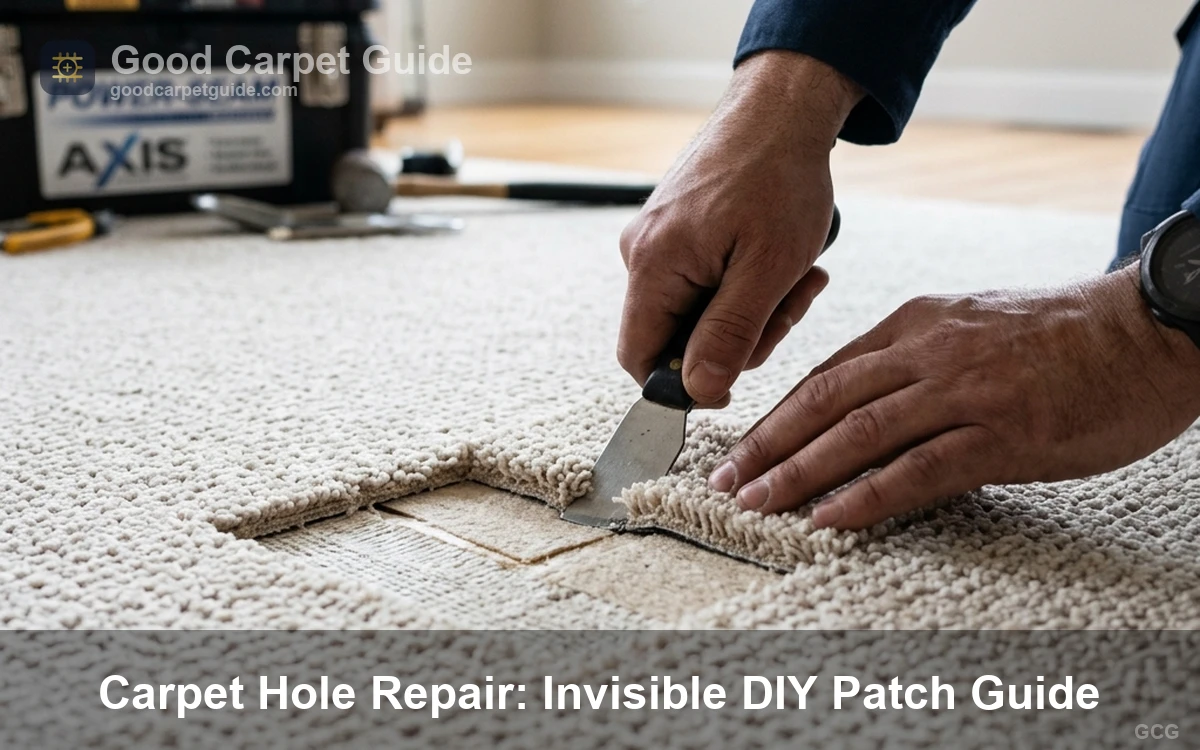
- No donor carpet remains available from a closet or remnant to match the existing dye lot for a patch.
- The padding beneath a large portion of the room has compressed below its rated density, not just the localized doorway section.
A "donor" patch, cut from carpet stored in an unused closet at the time of original installation, produces the closest dye-lot and texture match available for a doorway repair. Homeowners without a donor remnant face a higher risk of a visible patch, since retail carpet dye lots shift between production runs and an exact color match from a new purchase is not guaranteed.
real carpet seam experiences from homeowners and installers
Forum and complaint-board patterns around doorway carpet seams cluster around a small number of recurring scenarios. One frequently cited case involves a homeowner confining a pet to a single room, where the animal claws and chews at the carpet directly at the doorway threshold while the owner is away, producing exposed tack strip and shredded pile within weeks. A separate pattern documented in flooring inspection reports involves aggressive spot-cleaning of pet accidents at a doorway using consumer stain removers; in one inspected case, a combination of cleaning chemicals and biological soiling oxidized the dye on a Shaw carpet, leaving a permanent yellow halo at the transition that no re-seaming could correct.
Retail experiences add a second layer of frustration. A homeowner who purchased Home Depot's LifeProof carpet line reported visible fading within three months of installation, then encountered a warranty runaround where store staff redirected the claim to "the manufacturer" without being able to identify who that manufacturer was. This pattern, sometimes called a warranty deflection loop, appears repeatedly in big-box retail complaints and contrasts with the labor warranties typically offered by independent specialty dealers.
Field note: Barefoot traffic at doorway transitions causes more residue buildup than shod traffic in documented cleaning-industry observations, since natural skin oils leave a sticky film that attracts and binds dust the vacuum cannot fully lift. No-shoes household policies do not eliminate this transitional soiling pattern on their own.
actual cost per square foot data for doorway carpet repair
Doorway carpet repairs are typically priced as flat service jobs rather than strict per-square-foot rates, since the labor and travel overhead dominate the cost of a repair this small. The table below breaks down the national cost ranges reported across common doorway repair scenarios.
| Repair Type | Technical Intervention | National Cost Range |
|---|---|---|
| Doorway seam re-bond | Re-heating existing tape or applying commercial hot glue | $75 – $200 |
| Professional re-seaming | Pulling old tape, row-cutting edges, applying new 6-inch tape | $125 – $350 |
| Doorway patching (under 1 sq. ft.) | Splicing in a closet or remnant donor piece | $75 – $250 |
| Subfloor replacement | Replacing water-damaged subflooring under the doorway | ~$400 per 300 sq. ft. |
| Padding section replacement | Replacing localized worn cushion under the transition | $0.75 – $3.75 per sq. ft. |
| Hallway power stretching | Stretching and re-securing carpet to tack strips | $50 – $100 per area |
Minimum trip fees add a separate layer of cost on top of the repair itself, and standard cost-of-living markets report dispatch minimums of $100 to $300, while metropolitan markets including Los Angeles, New York, and Phoenix commonly charge $300 to $450 just for a technician to arrive. Contractors frame this pricing around lost opportunity cost rather than repair complexity, since a technician traveling to a single doorway repair forgoes a larger installation job for the same half-day.
cost and budget considerations for doorway carpet repair
Padding quality has a larger effect on long-term doorway seam durability than the carpet fiber selection itself, and this is the single most counterintuitive budget factor in a doorway repair or replacement decision. Standard memory foam cushions, including name-brand products like Tempur-Pedic foam pads, commonly collapse under concentrated doorway pivot traffic within 18 to 36 months, and that collapse forces the carpet backing to flex over an uneven surface, which structurally splits the seam above it. Installers commonly recommend 8lb to 10lb rebond padding, produced by manufacturers including Leggett & Platt and Carpenter, specifically at doorway and hallway transitions where pivot stress concentrates.
Budget guidance by scenario:
- Choose re-seaming ($125–$350) over patching when the surrounding carpet field remains in good condition and only the bonded edge has failed.
- Choose padding replacement ($0.75–$3.75 per sq. ft.) when a doorway seam has failed twice in under three years, since repeat failure points to pad collapse rather than tape degradation.
- Budget the higher end of the metropolitan trip-fee range ($300–$450) when scheduling a repair in a high-cost-of-living market rather than assuming the national low-end applies.
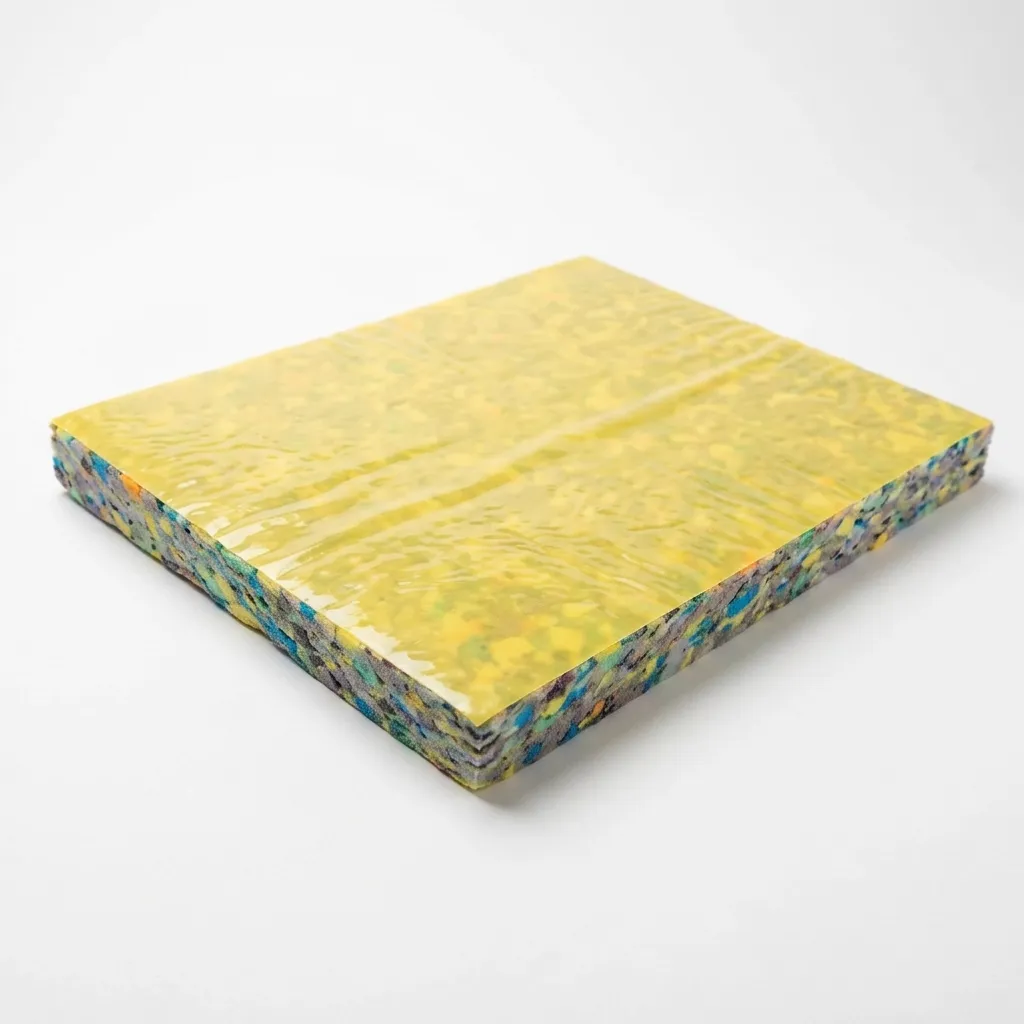
Mohawk SmartCushion Premium Carpet Padding
Recommended as a doorway and hallway replacement pad when repeat seam failure points to pad collapse rather than tape failure.
Check Price on AmazonIndependent specialty dealers, such as Carpet One-affiliated stores, typically charge somewhat higher labor rates than big-box retailers but commonly back doorway repair work with a 24-month labor warranty performed by in-house or directly subcontracted installers. Big-box retail labor is frequently subcontracted to third-party crews paid flat per-job rates, a structure documented to correlate with skipped acclimation periods and unsealed cut edges, both of which are direct contributors to premature doorway seam splitting.
frequently asked questions
How much does a doorway carpet seam repair cost?
A doorway seam repair typically costs $75 to $350 depending on whether the job requires re-bonding existing tape or a full professional re-seam, plus any applicable minimum trip fee.
How long does a repaired doorway seam last?
A properly re-seamed doorway carpet transition, installed with correct hot-melt tape and adequate padding beneath it, commonly lasts as long as the surrounding carpet field under standard residential traffic conditions, provided the underlying pad has not already collapsed.
What do professionals recommend for doorway seam repair?
Professionals recommend thermal seam-iron bonding with hot-melt tape and latex edge sealer over adhesives like duct tape, since certification bodies note that duct tape causes uneven wear as the surrounding pad compresses at a different rate than the taped section.
What is the difference between doorway seam repair types?
Re-bonding reheats and reactivates existing seam tape adhesive for minor gaps, while professional re-seaming removes the old tape entirely and installs new tape, and doorway patching replaces a damaged section with donor carpet rather than repairing the seam itself.
Is professional doorway seam repair worth it over a DIY attempt?
Professional repair is generally worth the cost for doorway seams, since forum consensus among flooring specialists holds that general handymen lack the thermal seaming irons and fiber-blending tools needed for an invisible bond, and a failed DIY attempt often costs more to correct than the original professional rate.
When should a doorway carpet be replaced instead of repaired?
Replace rather than repair when matting extends well past the doorway into the adjoining room, when no donor carpet is available for a dye-lot match, or when padding across a large area of the room has compressed below its rated density rather than just the localized threshold section.
For adjoining rooms affected by the same wear pattern, homeowners evaluating a broader carpet refresh may find it useful to review a carpet seam repair guide before deciding between a doorway-only repair and a room-wide replacement, particularly in homes where hallway carpet shows similar tensioning issues described in a carpet patch repair guide .
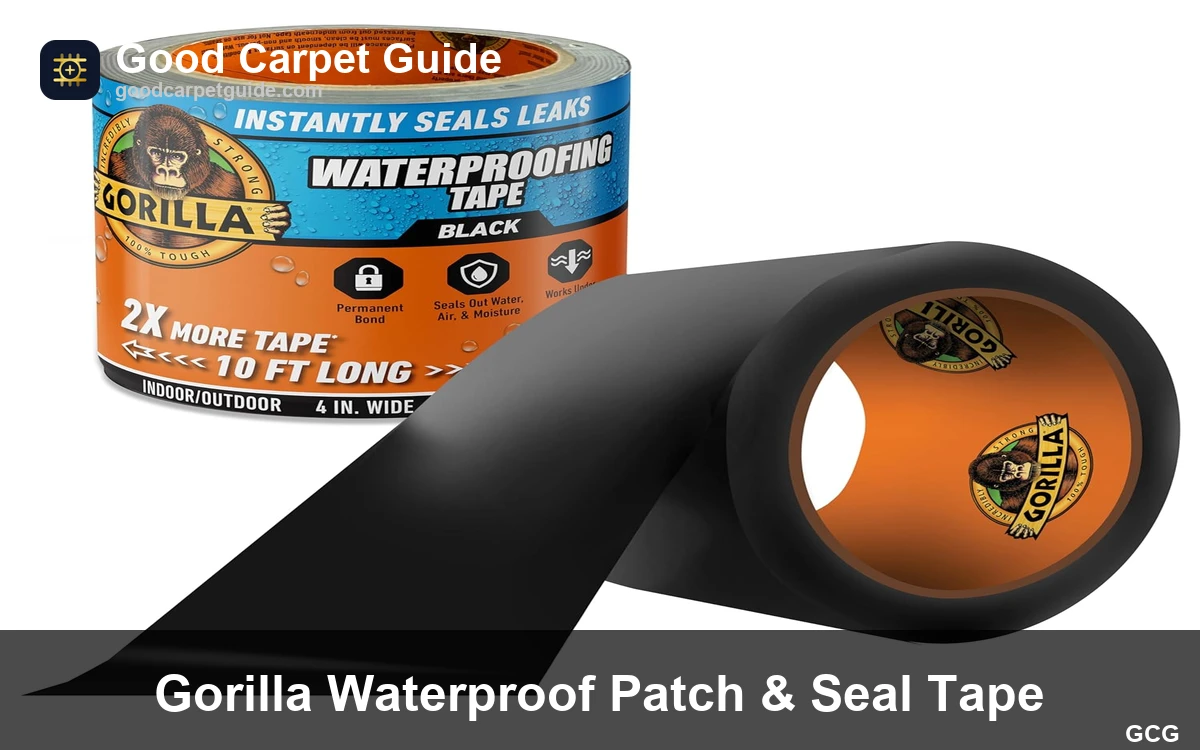
Gorilla Double Sided Carpet Tape
Useful for securing area rugs near a repaired doorway transition, though not a substitute for heat-activated seam tape on the carpet seam itself.
Check Price on Amazonconclusion
A doorway carpet seam repair is the correct call whenever the surrounding carpet field remains sound and the failure is limited to a separated bond, a loosened tackless strip, or a collapsed pad section beneath the threshold. Homeowners facing a raised but intact seam should recognize that seam peaking has no repair procedure and should decline any offer to hammer or shave it flat, since both techniques cause permanent pile damage without resolving the underlying tensioning cause. Repeat seam failure at the same doorway within a short window points toward inadequate padding rather than a tape defect, and upgrading to 8lb–10lb rebond padding at that specific location typically resolves the recurrence. For homes weighing repair against a broader flooring update, a carpet delamination guide covers the structural backing failures that share root causes with chronic doorway seam splits, while homeowners selecting new carpet for adjacent rooms can compare durability against a best carpet for bedrooms guide .