INSTALLER'S DANGER/SAFETY ALERT BOX
• Seaming irons run at roughly 350°F. A traditional grooved-base iron left on the backing for more than a few seconds will scorch synthetic face fibers and release fumes from the melting adhesive. Ventilate the room.
• Power stretchers store mechanical tension across the full width of a room. Never release a telescoping stretcher head under load without bracing it against a wall stud or a tail block. A sudden release can snap back with enough force to bruise a hand or knee.
• Water damage that has sat for more than 72 hours, or any contamination from a sewage source, is a mold and IICRC S100 biohazard concern. Do not attempt a dry patch over a wet subfloor.
• Circle cutters and hook knives carry replaceable blades. Change the blade before every patch job. A dull blade drags fibers instead of cutting them and causes the surrounding pile to fray.
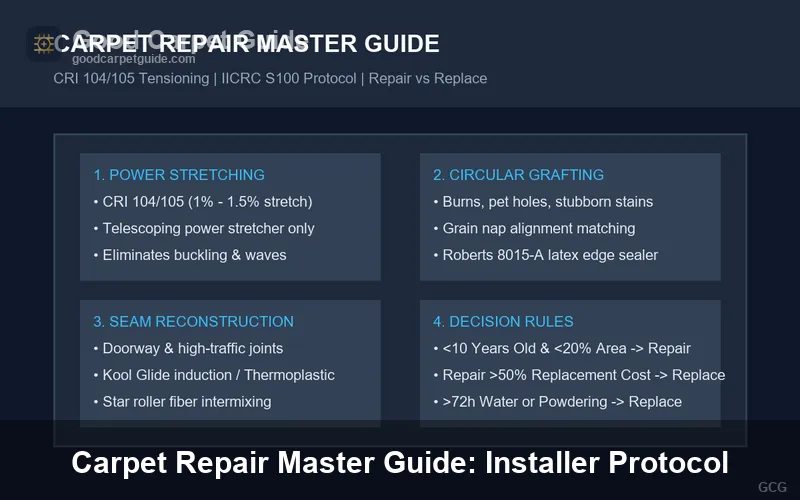
This carpet repair master guide sets out the installer-grade protocol behind the six repairs that account for most residential service calls: buckling and ripples, pet damage, burns, split seams, and delamination. A carpet repair master guide built on Carpet and Rug Institute (CRI) 104/105 tension standards and IICRC S100 water-damage protocol gives homeowners a way to separate a $150 patch from a $2,000 replacement. The sections below walk through the decision factors in the order a field inspector actually applies them: identify the damage type, check the backing condition, apply the 10-year and 50-percent cost rules, then select the repair method that matches the traffic load and pile construction.
how to repair carpet without replacing it
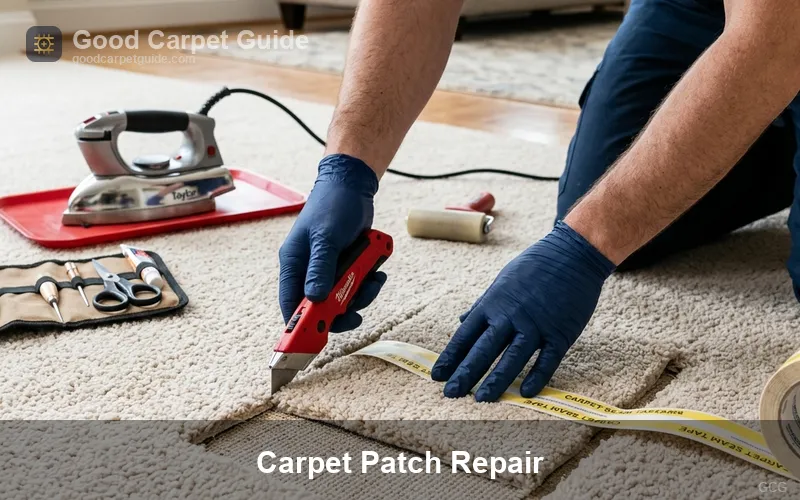
Repairing carpet without full replacement depends on three conditions holding at once: the carpet is under roughly 10 to 15 years old, the damage covers less than 20 percent of the room, and the secondary backing has not degraded. When those three conditions hold, a localized fix, whether a carpet patch repair , a re-stretch, or a seam rebuild, restores the floor for a fraction of replacement cost.
The repair path splits by damage type:
- Ripples and waves: corrected with a telescoping power stretcher, not a knee kicker. A knee kicker positions carpet during original installation. It cannot generate the 1 percent to 1.5 percent stretch that CRI 104/105 specifies for direct glue-down and stretch-in installations.
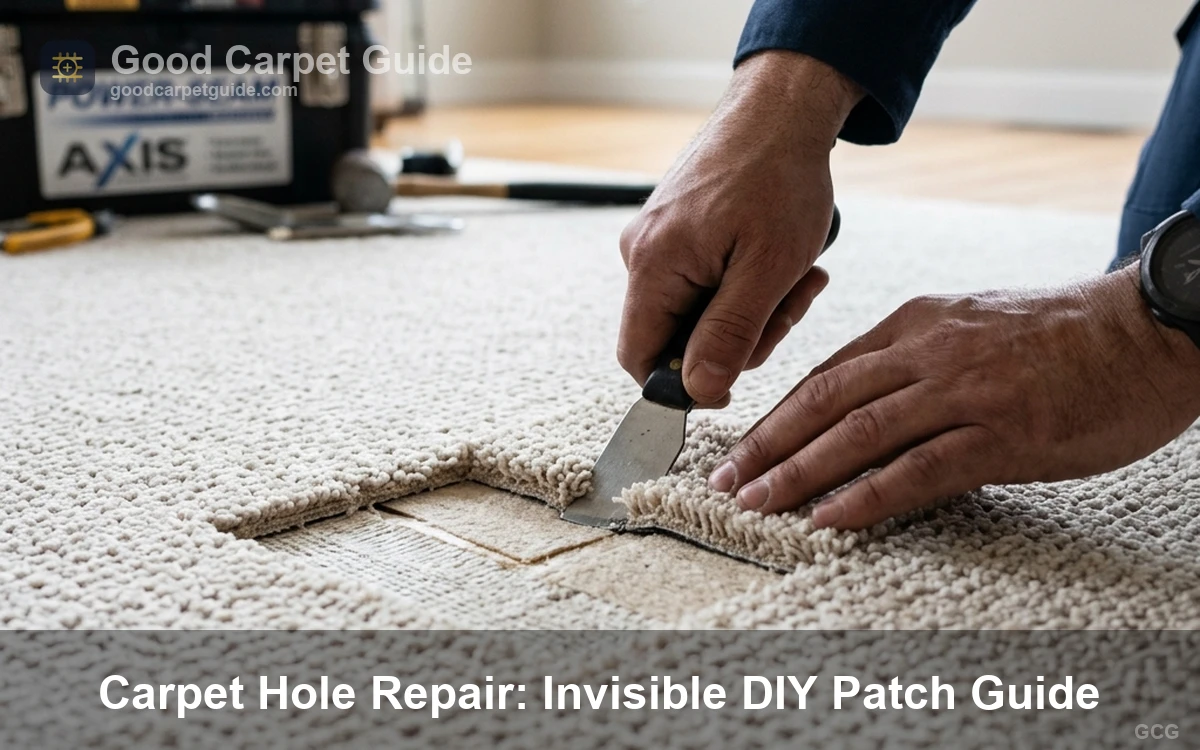
- Isolated holes, burns, or stains: corrected with a circular donor patch cut from a hidden reserve area, such as a closet corner or under a built-in.
- Split or frayed seams: corrected by re-taping with high-temperature hot-melt tape and sealing the cut edges with a latex sealer such as Roberts 8015-A.
- Loose carpet after cleaning: corrected by stretching first. IICRC and CRI guidance both treat stretching as a precondition for cleaning, not a follow-up step, because a loose carpet bunches under a cleaning wand.
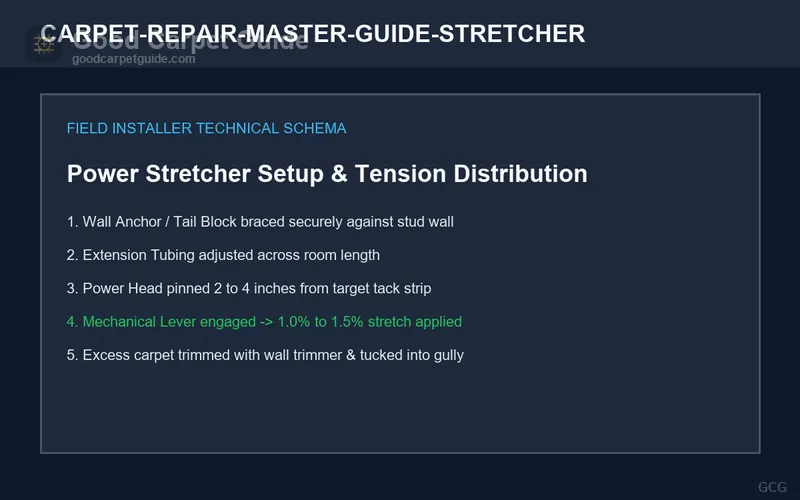
*Caption: A telescoping power stretcher applies the CRI 104/105 tension range that a knee kicker physically cannot reach.*
how to fix carpet seam in doorway
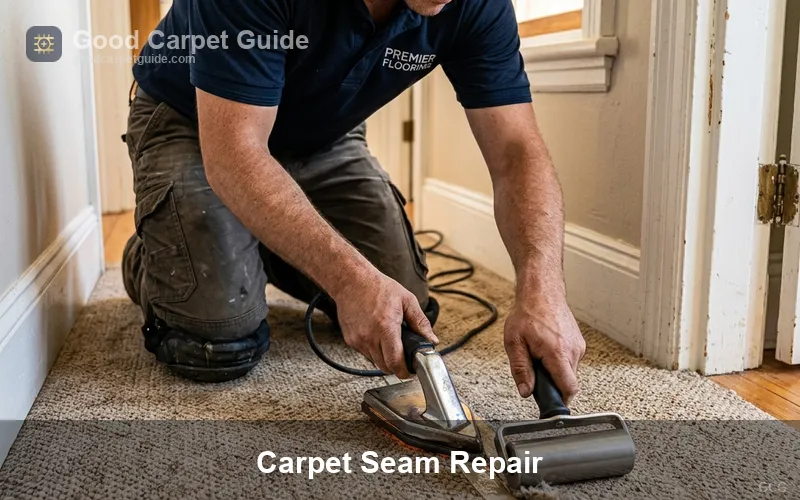
A doorway seam fails first because it takes concentrated foot traffic in a narrow transition zone, and the original hot-melt tape breaks down faster there than anywhere else in the room. The fix starts by cutting back the old tape residue with a hook knife, vacuuming the exposed subfloor or tack strip area, and dry-fitting a fresh strip of seam tape centered under the gap.
For how to fix carpet seam in doorway repairs specifically, the installer protocol runs in this order:
- Trim both carpet edges square using a straight edge, so the seam line runs parallel to the door swing rather than at an angle.
- Slide new hot-melt tape underneath, adhesive side up, centered on the seam.
- Run a traditional seaming iron such as the Roberts 10-282G along the tape at a steady pace, or use an induction tool like the Kool Glide Pro 2, which activates a foil-layered tape by radio frequency and never contacts the backing directly.
- Press the seam closed immediately behind the iron and roll it with a seam roller (Roberts 10-124 or the Orcon Action Roller) to intermix the fiber tufts across the joint.
- Seal both cut edges with a latex sealer before the tape fully cools.
Localized doorway seams under 4 feet run $25 to $50 in typical contractor pricing, with roughly $10 per additional linear foot beyond that span. Full carpet seam repair jobs across a longer run land in the $100 to $250 range; see the full carpet seam repair cost breakdown for room-by-room figures.
Kool Glide Pro 2 Induction Seaming Iron
Radio-frequency induction iron that activates foil seam tape without direct heat contact on carpet backing.
Check Price on Amazonhow to fix iron burn or melted carpet
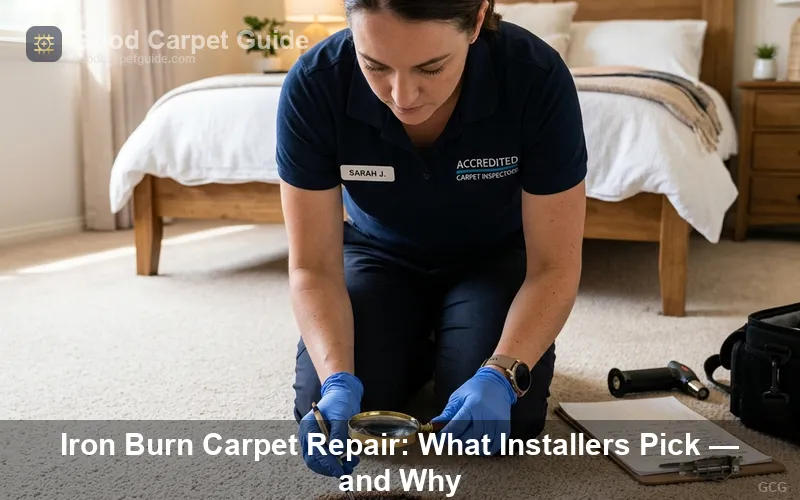
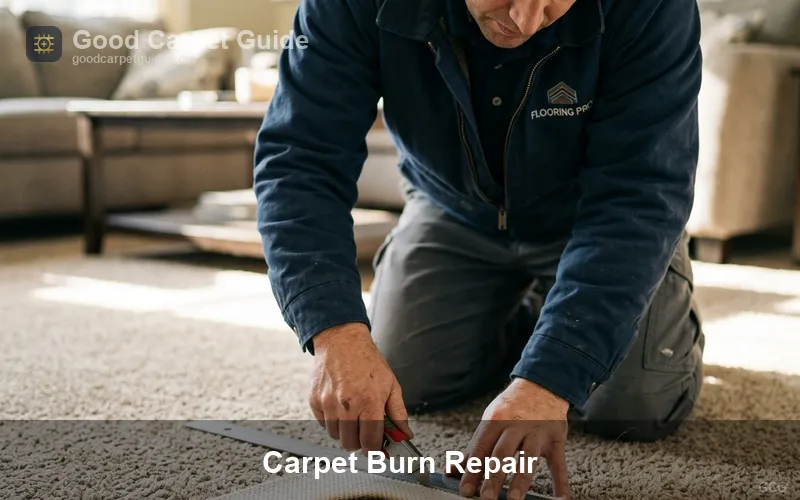
An iron burn or melted-fiber patch is fixed by removing the damaged face fibers down to the backing and grafting in a donor section, not by trimming the melted tips level. Trimming only masks a shallow scorch. A deep burn destroys both the face yarn and the primary backing, and that structural loss requires a graft.
The carpet burn repair and iron burn carpet repair protocol:
- Use a circle cutter such as the Crain 174 Pro or the Orcon Circle Cutter to punch a clean 3-1/8 inch circular hole around the burn. The spring-loaded depth pin stops the blade at backing depth so it does not score the subfloor.
- Cut an identical circle from a donor reserve, matching pile direction against the surrounding carpet's nap so the patch does not catch light differently and read as a visible square.
- Set the patch with an adhesive disc (Gundlach Insta-Hold or Orcon Pressure-Sensitive) pressed up from beneath, bonding the donor plug without a heated iron.
- Trim any raised "sprouts" at the patch edge with duckbill napping shears to level the pile height against the field carpet.
Circular grafts hold up better than square patches over time because a circle has no sharp corners, and corners concentrate mechanical stress under repeated foot traffic. A fresh donor plug against sun-faded carpet can show a visible color difference, similar to a tan line, until the new fibers wear down to match; using a donor patch from a similarly worn area (rather than a pristine closet remnant) reduces that mismatch.
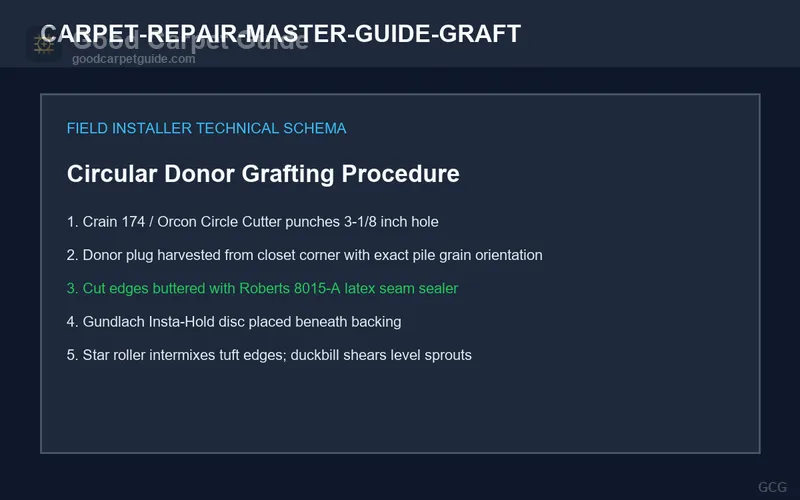
*Caption: Grain alignment on a circular graft is what separates an invisible carpet burn repair from a visible seam square.*
how to repair carpet hole from dog or cat
A dog- or cat-created hole is repaired with the same circular patching method used for burns, with one added step: sealing the cut edges with a latex sealer before the patch goes in, because pet damage tends to fray the surrounding tufts more aggressively than a clean burn. Without a high-solids sealer such as Roberts 8015-A on both the donor plug edge and the hole edge, the cut tufts unravel within a few cleaning cycles.
Doorway and closet-entry damage from pets carries a documented practical problem beyond the repair itself. Renters weighing a DIY patch to protect a security deposit should know that property managers commonly inspect these high-stress zones at move-out, and a visible patch can still result in a full room charge regardless of repair quality. Cats confined behind a closed door tend to dig at the threshold specifically, a location that generic carpet guides skip. Options short of a full patch include a runner across the threshold or, as a temporary cover, furniture or a plant positioned over the scratch zone until a proper carpet hole repair can be scheduled.
If pet urine has reached the padding and subfloor, patching the carpet alone does not resolve the odor. Saturated pad requires replacement, and the subfloor needs treatment and sealing before new pad or carpet goes down.
repair versus replace: the decision framework
Choosing between repair and replacement comes down to carpet age, damage footprint, and backing condition, evaluated in that order. The industry shorthand for this is the 10-year rule paired with the 50-percent rule.
| Condition | Recommended path |
|---|---|
| Carpet under 10 years old, damage under 20% of room, backing intact | Professional repair |
| Carpet 10 to 15+ years old, nearing end of service life | Replacement |
| Repair cost exceeds 50% of new carpet installation cost for that room | Replacement |
| Water sitting over 72 hours or from a contaminated source | Replacement (IICRC S100) |
| Secondary backing crumbling into white powder (dry rot) | Replacement |
| Fibers permanently crushed and matted in high-traffic lanes ("ugly-out") | Replacement |
| Pad and subfloor saturated by repeated pet accidents | Pad and subfloor replacement, carpet usually replaced |
A carpet that is otherwise structurally sound but shows isolated burns, doorway seam splits, or a single ripple from furniture dragging fits squarely into the repair column. A carpet where the latex backing has begun to crumble will not survive the tension of a power stretcher; the backing tears before it reaches CRI 104/105 stretch specifications.
how long does a carpet patch or seam repair last
A correctly executed patch or seam repair lasts for the remaining service life of the carpet, typically 7 to 15 years, provided the repair follows manufacturer tension and adhesive specifications. That range depends on traffic load, pile height, and cleaning frequency; a repair in a low-traffic guest room holds longer than an identical repair in a hallway.
Repair longevity depends on three variables working together rather than any single step:
- Tension: a stretch performed to CRI 104/105 specification (1% to 1.5%) resists re-rippling under normal traffic and seasonal humidity shifts. A stretch performed with a knee kicker alone tends to loosen again within roughly 6 months, since the tool cannot reach code tension in the first place.
- Seam bond: a hot-melt tape seam sealed with a latex edge sealer resists fraying through repeated steam cleaning cycles. An unsealed edge, or one bonded with household adhesive or double-sided tape, tends to loosen and separate under routine hot-water extraction cleaning.
- Patch edge treatment: a circular patch with buttered (sealer-treated) edges resists tuft loss. An unsealed square patch frizzes at the corners first, since corners carry the highest mechanical stress under foot traffic.
is carpet repair worth it vs replacement
Carpet repair is worth the cost when the repair price stays under roughly half of a full room replacement and the carpet still has meaningful service life left under the 10-year rule. A $150 to $300 re-stretch or a $125 to $250 patch on a carpet with several years of remaining life clears that bar easily against a room-wide replacement that typically runs several thousand dollars in material and labor.
The calculation shifts once repair costs stack. A room needing a re-stretch, a seam rebuild, and pad replacement simultaneously can approach the 50 percent threshold, at which point new carpet installation becomes the more defensible spend, since it resets the full service clock rather than extending an aging installation piecemeal.
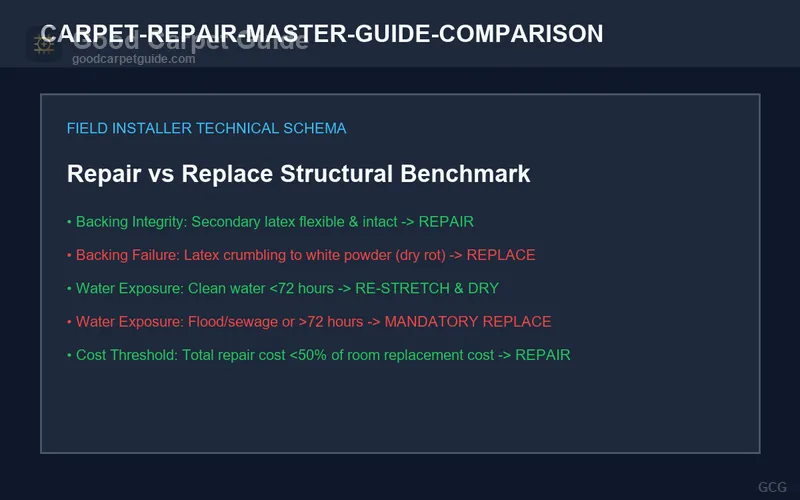
*Caption: Backing condition, visible once the carpet is pulled back, is the deciding factor the 50-percent rule is built around.*
how much does carpet repair cost
Professional contractors typically charge $60 to $80 per hour of labor, plus a call-out or dispatch fee of $100 to $300 to cover transit and administrative overhead. Flat per-repair rates are more common for standard jobs.
| Repair type | Typical cost |
|---|---|
| Isolated patch or burn repair (homeowner supplies donor carpet) | $125 to $250 per patch |
| Structural re-stretching, empty room up to 300 sq ft | $200 |
| Structural re-stretching, furnished room | $300 |
| Hallway stretching | $50 to $75 |
| Seam reconstruction (full run) | $100 to $250 |
| Doorway seam repair, under 4 feet | $25 to $50, plus $10/linear ft beyond |
| Carpet padding replacement, 150 to 200 sq ft room | $200 to $250 (material $0.75 to $3.75/sq ft) |
| Subfloor replacement, 300 sq ft room (water damage) | Approximately $400 |
| Color dyeing or bleach spot repair | $1.50 to $2.50/sq ft, or $125 to $600 total |
DIY costs run lower on paper but require either a tool purchase or a daily rental:
| DIY option | Typical cost |
|---|---|
| Basic patch kit (Orcon Carpet Repair Kit, MPN 13067) | $17.61 |
| Basic patch kit (Gundlach Carpet Repair Kit) | $52.95 |
| Power stretcher rental, per day | $30 to $35 |
| Basic flooring toolbox rental, per day | $20 |
| Kool Glide Pro 2 induction iron (purchase) | $464 to $570 |
| Traditional seaming iron, Roberts 10-282G (purchase) | $125 |
| Roberts 10-124 seam roller (purchase) | $24.97 |
| Roberts 8015-A latex sealer, 8 oz (purchase) | $7.49 |
Amateur repair techniques carry a documented failure pattern within the first 24 months, most commonly a returning ripple from knee-kicker-only stretching or a frizzing patch edge from an unsealed cut. That failure rate is the practical argument for weighing the DIY tool cost against a single professional call-out fee before committing to a rental.
the installer's toolkit: what a professional actually carries
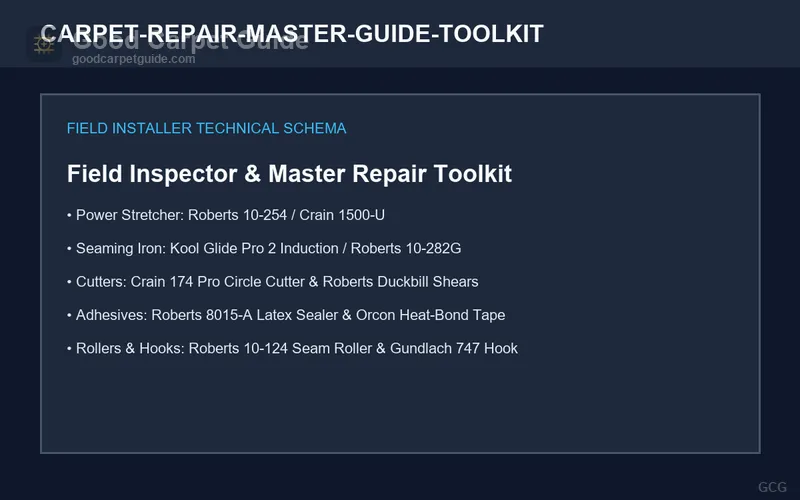
A field carpet repair kit is built around a small set of mechanical tools rather than a large parts inventory. The core list:
- Power stretcher: Roberts 10-254 or Crain 1500-U, telescoping wall-to-wall units with a replacement power head such as the Roberts 10-237-50.
- Stretcher hook for wood subfloors: the Gundlach 747 Double Stretcher Hook, whose double prongs distribute leverage across soft subflooring without tearing the wood.
- Seaming iron: traditional grooved-base (Roberts 10-282G) or induction (Kool Glide Pro 2).
- Circle and patch cutters: Crain 174 Pro or Orcon Circle Cutter, both using a spring-loaded depth pivot pin.
- Latex sealers: Roberts 8015-A or Orcon Fast Lock Edge Sealer, applied to every cut edge before it is covered.
- Seam rollers: Roberts 10-124 or the Orcon Action Roller.
- Adhesive discs: Gundlach Insta-Hold or Orcon Pressure-Sensitive discs for beneath-patch bonding.
- Napping shears: duckbill shears for trimming sprouts and leveling patch pile.
Roberts 8015-A Solvent-Free Latex Seam Sealer
High-solids latex sealer used to buttered cut carpet edges and prevent fraying at patches and seams.
Check Price on Amazon Orcon Carpet Repair Kit with Circle Cutter
Consumer-grade circular patching kit including insta-hold adhesive discs and a spring-loaded depth-pin cutter.
Check Price on Amazon*Caption: The same toolkit spans every repair type in this carpet repair master guide, from a doorway seam to a full-room re-stretch.*
conclusion
A localized carpet repair holds up for the remaining service life of the flooring when it follows CRI 104/105 tension standards, uses a sealed edge on every cut, and matches pile grain on every patch. Homeowners with a carpet under 10 years old and damage under 20 percent of the room should book a patch, seam repair, or re-stretch rather than a full replacement. Renters weighing a DIY patch against a security deposit should budget for the possibility that a move-out inspection still flags the repair. Anyone facing water damage over 72 hours, crumbling latex backing, or fully saturated pad and subfloor should treat replacement as the only durable option, since no patch or stretch restores a backing that has already failed.