A homeowner in a newly built subdivision called me out for an emergency inspection on an eight-month-old plush nylon carpet. Deep ripples ran across the main hallway like ocean swells, and the customer assumed the carpet mill had delivered a defective roll.
When I pulled the carpet off the tack strip near the doorway, the problem became immediately obvious. The builder had installed a half-inch thick, three-pound virgin prime foam pad to save sixty cents per square yard. Foot traffic had crushed the hollow cell structure completely flat in the center walking lane, stretching the primary backing beyond its elastic limit.
Carpet cushion functions as the shock absorber for your entire flooring system. While carpet fibers receive all the decorative attention in retail showrooms, the cushion beneath them dictates wear life, seam integrity, thermal insulation, and warranty validity. Choosing a pad purely on thirty seconds of barefoot showroom softness almost always leads to premature fiber crushing, permanent traffic troughs, and expensive restretching claims.

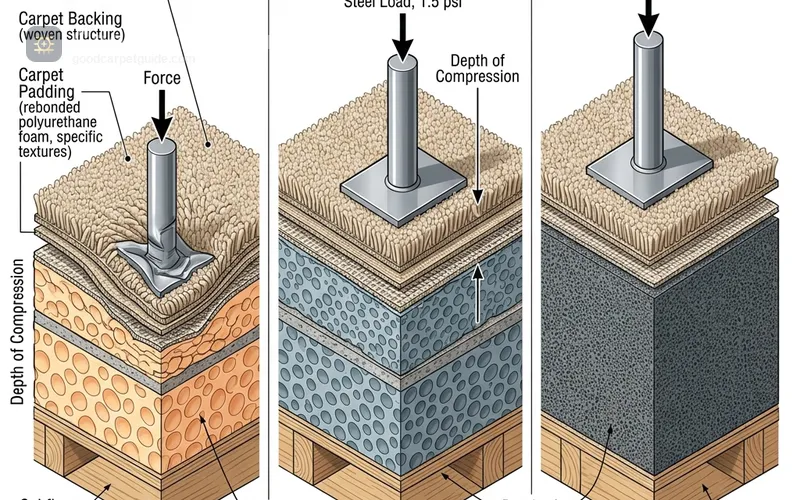
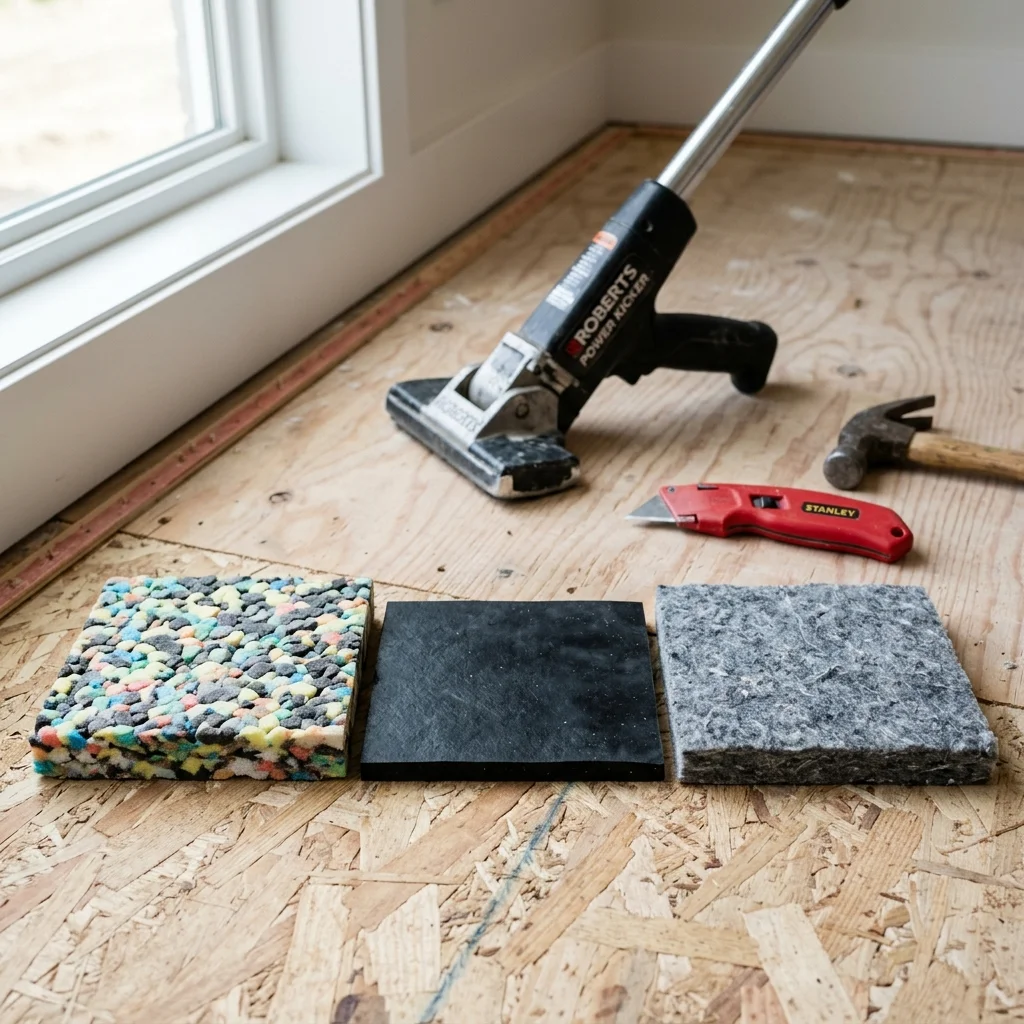
Comparing carpet padding material cross-sections reveals why cell structure and mass density matter far more than uncompressed cushion thickness under sustained foot traffic.
Carpet padding supports the entire flooring assembly
Carpet cushion sits between the structural subfloor and the flexible carpet backing to absorb kinetic energy from daily foot traffic.
When a person walks across a carpeted floor, the heel strike exerts concentrated dynamic pressure ranging from 150 to 250 pounds per square inch. Without a resilient cushion layer beneath, that impact force transfers directly through the pile tufts and reflects off the unyielding subfloor straight into the primary backing. Laboratory data from the Carpet Cushion Council confirms that carpets installed without adequate underlayment experience up to 19.3 percent accelerated thickness loss over 20,000 compression cycles compared to identical carpets supported by resilient cushion.
Beyond cushioning impact, underlayment prevents abrasive destruction of the carpet backing. Concrete subfloors act as coarse grindstones against synthetic latex backings whenever footsteps cause lateral shifting. Cushion eliminates this grinding action by gripping the subfloor while isolating the backing. Furthermore, carpet padding provides critical acoustic dampening by elevating Impact Insulation Class (IIC) ratings and adds thermal insulation that keeps cold concrete slabs comfortable throughout winter.
Material breakdown across modern carpet underlayments
Different cushion materials exhibit distinct cellular structures, densities, compression recovery rates, and environmental characteristics under continuous residential use.
The transition from early twentieth-century cattle hair and jute underlays to post-war sponge rubber and modern synthetic polymers transformed flooring longevity. Today, residential installations draw from four primary material categories, each engineered for specific structural demands and foot traffic profiles.
Bonded polyurethane rebond foam
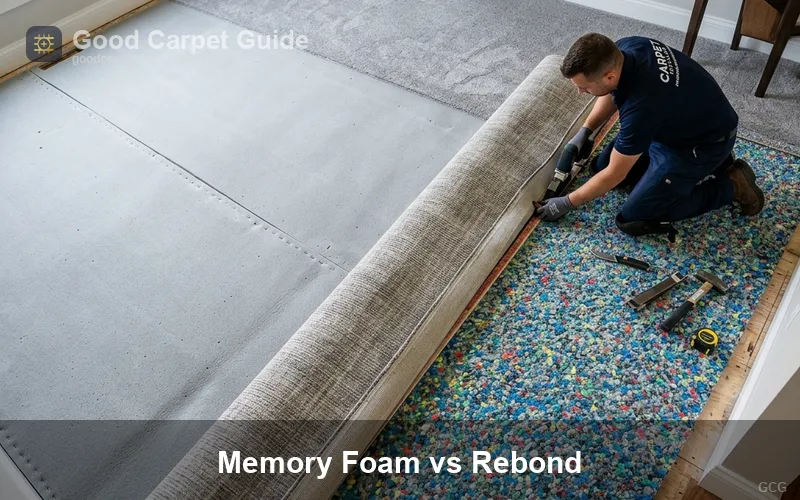
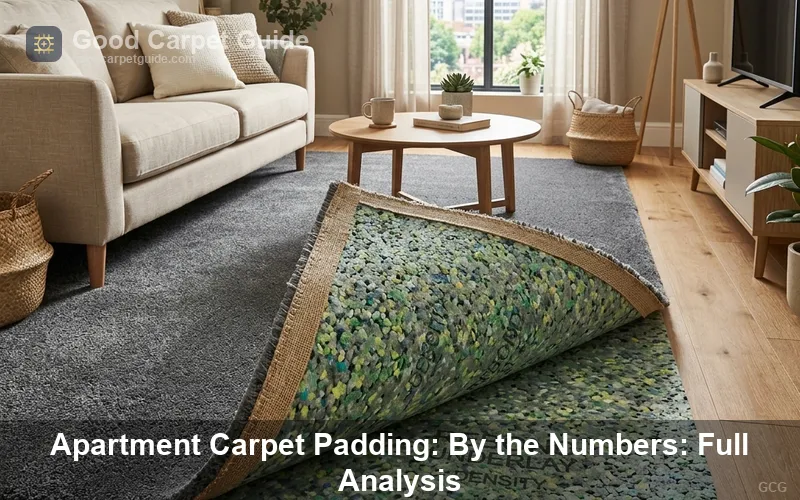
Bonded polyurethane foam, universally known as rebond, accounts for approximately 85 percent of all residential carpet cushion installed in North America. Rebond is manufactured by shredding high-density post-industrial polyurethane foam scraps from automotive seating and furniture manufacturing, blending them with polymeric MDI polyurethane binders, and compressing the mixture under high heat into dense cylindrical logs that are sliced into continuous rolls.
Rebond provides exceptional compression resistance and cost efficiency. Because the foam pieces vary in density and resilience, the composite structure disperses vertical loads horizontally across neighboring foam chips rather than collapsing in a single vertical line. High-grade rebond ranging from 8 to 10 pounds per cubic foot delivers reliable elasticity under heavy residential foot traffic at an accessible price point.
Virgin prime foam and frothed polyurethane
Virgin prime foam consists of newly manufactured, unbonded polyurethane foam sliced directly from large single-pour foam blocks. Because prime foam relies on uniform open cells without dense bonded scrap fragments, it exhibits low density ranging from 2.5 to 4 pounds per cubic foot. Prime foam compresses easily, feels remarkably plush in showroom displays, but ruptures quickly under repeated foot traffic, leaving hollow walking ruts within two to three years.
Frothed polyurethane, by contrast, represents the pinnacle of foam cushion technology. Originally developed for commercial hospitality installations, frothed foam is created by mechanically whipping liquid polyolefin into dense micro-cellular foam with densities exceeding 10 to 12 pounds per cubic foot. Unlike prime foam, frothed cushion uses zero volatile plasticizers, emits near-zero VOCs, will not crumble under rolling office chairs, and provides superior thermal conductivity over hydronic radiant floor heating systems.
Sponge rubber and flat rubber underlay
Rubber carpet underlayments divide into traditional waffle rubber and engineered flat sponge rubber. Waffle rubber is manufactured by molding synthetic SBR rubber onto a scrim backing with raised pockets, creating an exceptionally springy, luxurious initial feel. However, because waffle rubber derives half its volume from hollow air chambers, the thin rubber domes fatigue and flatten permanently under active family traffic.
Flat sponge rubber creates a uniform, solid elastomeric foundation without air cavities. Weighing between 18 and 22 pounds per cubic foot, flat rubber provides dense, continuous support that resists crushing indefinitely. Installers specify flat rubber beneath woven Axminster, Wilton carpets, and low-profile loop styles because it limits vertical deflection while maintaining full elasticity under severe compression cycles.
Needle-punched synthetic and natural fiber felt
Fiber underlayments are manufactured by mechanical needle-punching, interlocking recycled synthetic textile fibers or natural animal hair into dense, non-cellular felt mats. Fiber pads contain no air pockets or blowing agents, weighing between 24 and 40 ounces per square yard with thicknesses rarely exceeding 3/8 inch.
Fiber felt creates a rigid, supportive platform with virtually zero springiness. This firmness makes fiber cushion the mandatory specification beneath commercial carpets, flat-weave wool broadloom, and natural sisal or jute floor coverings. Because fiber mats do not deflect downward under heavy concentrated loads, they prevent rolling office casters and heavy armoires from warping adjacent carpet seams.

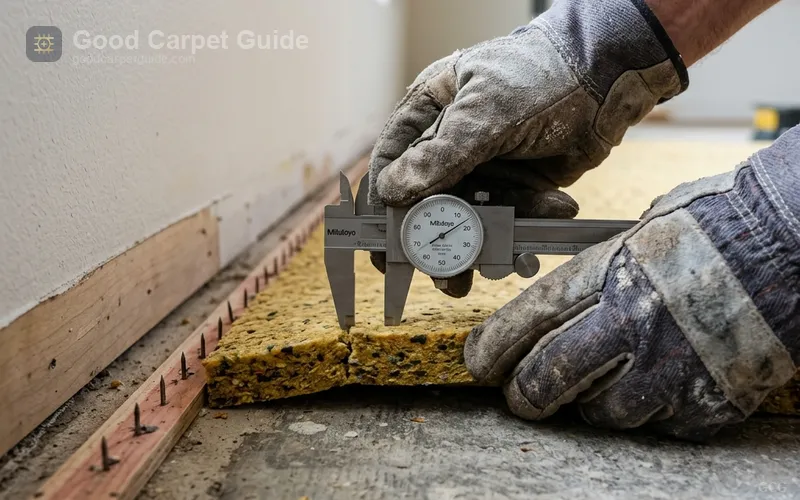
Caliper measurements under concentrated weight prove that excessive padding thickness increases vertical deflection and stretches carpet backing seams beyond manufacturer tolerances.
The half-inch thickness trap and structural failure
The most destructive misconception in residential flooring is the belief that thicker carpet padding always creates a better installation.
Retail flooring salespeople routinely steer customers toward 1/2-inch thick cushions by promoting cloud-like showroom comfort. In field practice, excessive thickness represents the leading cause of carpet restretching calls, delamination claims, and seam separations. To understand why thick, low-density foam ruins backing adhesives, read our guide on how can bad padding ruin carpet over standard living room spans.
Vertical travel and backing delamination
Vertical travel refers to the downward displacement of the carpet assembly under foot weight. When you step onto a 1/2-inch thick, low-density cushion, your foot depresses the pad by 3/8 inch before bottoming out against the subfloor. As your foot lifts, the carpet snaps back upward.
This continuous vertical flexing exerts severe mechanical stress across the carpet's secondary backing. Standard tufted broadloom carpet joins its primary tufting scrim to the secondary backing using a thin layer of styrene-butadiene rubber (SBR) latex adhesive. When the carpet flexes deeply thousands of times each month, the brittle latex adhesive pulverizes into white calcium carbonate powder. The secondary backing separates from the face tufts, causing severe carpet delamination and permanent wavy wrinkles that no power stretcher can remedy.
Manufacturer warranty thickness ceilings
Major carpet mills maintain rigorous cushion parameters written directly into their warranty agreements to protect their products against backing failure.
The Carpet and Rug Institute's CRI 105 Standard for Installation of Residential Carpet explicitly specifies maximum cushion thicknesses based on carpet construction:
- Standard cut-pile carpets: Maximum allowable cushion thickness is 7/16 inch, with a minimum density of 6 pounds per cubic foot.
- Berber and loop-pile carpets: Maximum allowable cushion thickness is 3/8 inch, with a minimum density of 8 pounds per cubic foot.
Installing a 1/2-inch pad beneath a commercial-grade loop or residential Berber carpet immediately voids the mill's texture retention and delamination warranties. The wide loops in Berber carpet rely on a rigid underlayment; excessive vertical travel forces individual yarns to pull laterally through the backing, resulting in rapid zippering tears along row lines.
Density ratings and compression resistance standards
Carpet cushion density measures mass per unit volume, expressed in pounds per cubic foot, and is the sole predictor of long-term compression resistance.
Consumers frequently confuse cushion density with overall pad thickness. Thickness measures vertical profile, whereas density measures how much raw polymer exists within that profile to resist foot compression. Evaluating the structural physics between 8lb vs 10lb carpet padding demonstrates why higher density maintains pile height and prevents carpet matting over decade-long lifespans.
| Cushion Material | Density Rating | Recommended Thickness | Primary Use Case | Expected Lifespan |
|---|---|---|---|---|
| Builder-grade rebond | 5.0 - 6.0 lbs/cu ft | 7/16 inch | Rental turns, low-traffic guest rooms | 3 - 5 years |
| Standard residential rebond | 8.0 lbs/cu ft | 7/16 inch | Main living areas, master suites | 10 - 12 years |
| Heavy-traffic rebond | 10.0 lbs/cu ft | 3/8 - 7/16 inch | Stairs, active hallways, home offices | 12 - 15 years |
| Frothed polyurethane | 10.0 - 12.0 lbs/cu ft | 5/16 - 3/8 inch | Radiant heat, allergy-sensitive homes | 15 - 20 years |
| Flat sponge rubber | 18.0 - 22.0 lbs/cu ft | 1/4 - 3/8 inch | High-end wool, luxury cut-pile | 20+ years |
| Needle-punched synthetic felt | 32.0 - 40.0 oz/sq yd | 5/16 - 3/8 inch | Berber, commercial loop, area rugs | 15+ years |
Six-pound builder grade versus eight-pound residential standard
Six-pound rebond represents the minimum baseline accepted by FHA housing standards. Tract home builders and rental property managers install six-pound cushion because it shaves forty to seventy cents per square yard off material costs. Under single-adult living conditions with minimal furniture movement, six-pound rebond provides acceptable performance for roughly four years. However, in active family households, six-pound foam suffers cellular fatigue in traffic lanes within twenty-four months, leaving the carpet loose and unsupported.
Eight-pound rebond is the professional installer's standard specification for residential living spaces. At eight pounds per cubic foot, the bonded polyurethane chips provide sufficient density to absorb dynamic foot strikes without bottoming out. The cushion maintains an optimal balance between underfoot comfort and structural firmness. This ensurings the carpet stays taut across perimeter tack strips while fulfilling all major mill warranty mandates.
Ten-pound high-traffic density and commercial applications
Ten-pound rebond padding provides a distinctly firmer walking platform engineered specifically for severe compression environments. While homeowners testing samples in a retail showroom occasionally perceive ten-pound cushion as rigid, that firmness prevents heavy furniture divots and preserves carpet backing along high-impact pathways.
Installers specify ten-pound cushion on stair treads, busy corridors, and home offices where rolling casters are used. The increased density prevents stair nosings from cutting through the cushion core under repetitive step impact, while keeping transition seams between adjoining rooms completely level. Comparing memory foam vs rebond padding highlights why visco-elastic memory foam cushions, despite their luxury marketing, lack the rapid elastomeric recovery of ten-pound rebond in high-traffic corridors.
Leggett & Platt Napa 8lb Rebond Carpet Cushion
Premium 8-pound high-density rebond cushion with Spillguard breathable moisture-barrier membrane. Meets CRI Green Label Plus and residential warranty specifications.
Check Price on AmazonSubfloor compatibility and moisture barrier engineering
Subfloor composition dictates whether your cushion requires moisture protection, vapor breathability, or specific mechanical fastening methods.
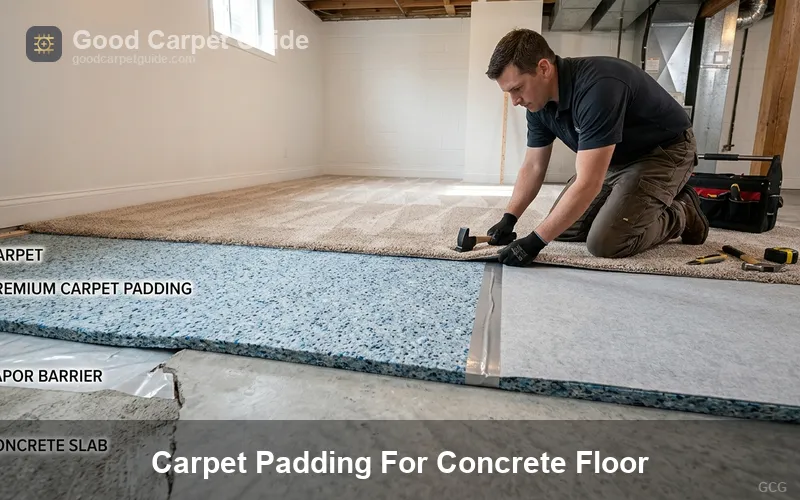
An underlayment installation that performs flawlessly over dry second-story plywood can trigger severe mold colonies or adhesive breakdown when installed incorrectly over a basement concrete slab.

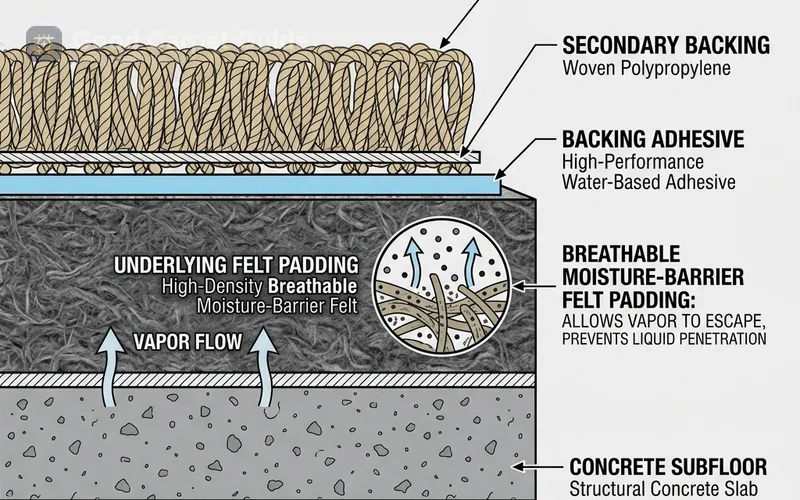
A laminated breathable moisture-barrier film stops surface spills from entering the foam core while allowing subfloor water vapor to escape safely into room air.
Concrete slab moisture and alkaline dust protection
Concrete subfloors remain porous mineral slabs that absorb groundwater through capillary suction and emit water vapor continuously. Installing a traditional non-breathable plastic-wrapped pad over damp concrete traps moisture beneath the cushion, elevating relative humidity past 85 percent and cultivating dark mold colonies along baseboards.
Over concrete, installers specify breathable moisture-barrier padding. Breathable technology features microscopic pores that allow rising subfloor water vapor to pass harmlessly through into room air while stopping liquid spills from penetrating downward. Furthermore, concrete subfloors release fine alkaline calcium carbonate dust over time; dense cushion isolates the carpet backing from this abrasive powder, preventing premature fiber wear from beneath.
Plywood subfloors and acoustic insulation performance
Plywood and oriented strand board (OSB) wooden subfloors require secure mechanical fastening to prevent cushion shifting during installation stretching. Installers secure carpet padding to wood subfloors using 9/16-inch heavy-duty crown staples placed every six to eight inches along seams and twelve inches throughout the field.
Wood floor assemblies also transmit impact vibrations between stories in multi-level homes. Installing dense 8-pound rebond or high-mass flat rubber dampens footstep resonance, elevating the floor's Impact Insulation Class (IIC) by 20 to 25 decibels. This acoustic buffer prevents footstep thuds and airborne voice transfer between bedrooms and ground-floor living areas.
Liquid barrier top skins versus unsealed seam failure
Spill-resistant padding features a specialized thermoplastic polyethylene film laminated directly to the top surface of the cushion core. When children spill juice or pets have accidents, the barrier prevents liquid from soaking into the porous rebond foam, allowing steam extraction equipment to remove the stain entirely from the carpet face.
However, moisture-barrier padding fails completely if the installation seams remain unsealed. Liquid spills follow gravity, running across the slick barrier film until reaching the nearest butt joint, where moisture pours directly down into the raw foam core and pooling subfloor. Professional installers bridge every padding seam with four-inch wide waterproof seam tape, creating an uninterrupted monolithic liquid shield beneath the carpet.
Healthier Choice Green Label Breathable Frothed Polyurethane Pad
High-density frothed viscoelastic polyolefin cushion engineered for zero VOC emissions, radiant heat conductivity, and non-allergenic subfloor isolation.
Check Price on AmazonRoom-by-room padding specification blueprint
Selecting carpet cushion requires matching material density, thickness, and barrier technology to the specific environmental demands of each living space.
Living rooms and active family spaces
Main living rooms experience continuous foot traffic, children playing on the floor, and heavy stationary furniture like sectional sofas and entertainment centers.
- Optimal specification: 7/16-inch thickness, 8-pound density bonded rebond foam with a top-side spill barrier.
- Performance rationale: Eight-pound density prevents heavy furniture legs from crushing the cushion into permanent depressions, while 7/16-inch thickness delivers comfortable underfoot resilience without exceeding CRI 105 vertical deflection limits.
Stairs and high-impact hallway corridors
Staircases concentrate the full weight of ascending and descending foot traffic onto a narrow, two-inch strip along the tread nosing. Hallways channel traffic into tight, repetitive paths.
- Optimal specification: 3/8-inch thickness, 10-pound density rebond foam or 3/8-inch high-density flat rubber.
- Performance rationale: Thinner, denser cushion prevents the carpet from flexing over the stair bullnose, eliminating loose bubbling and keeping the tack strip pins securely anchored through the backing.
Bedrooms and private resting areas
Bedrooms feature lower daily traffic counts and prioritize barefoot morning comfort and acoustic quietness over extreme impact resistance.
- Optimal specification: 7/16-inch thickness, 8-pound density memory foam hybrid or premium frothed polyurethane.
- Performance rationale: Allows maximum luxurious underfoot softness while maintaining sufficient elastomeric density to prevent the carpet backing from stretching loose around bed frames.
Basements and below-grade installations
Basement slabs remain perpetually cool and carry the constant threat of seasonal subfloor vapor emissions or plumbing leaks.
- Optimal specification: 5/16 to 3/8-inch thickness, breathable frothed polyurethane or synthetic needle-punched felt with antimicrobial treatment.
- Performance rationale: Breathable synthetic materials contain no organic cellulose for mold to feed on, will not hold trapped moisture against the slab, and resist deterioration from subfloor alkalinity.
Roberts 10-501 Pro Knee Kicker and Carpet Tensioning Tool
Professional-grade installation tool for setting carpet tension over tack strips and aligning padding seams without tearing cushion backing.
Check Price on AmazonReal installation costs and retail dealer markups
Understanding true wholesale material pricing empowers homeowners to negotiate flooring contracts and identify deceptive sales promotions.
Carpet padding pricing varies dramatically between true wholesale contractor distribution channels and consumer retail showrooms. Retail flooring stores routinely inflate cushion markups to subsidize advertised carpet discounts.
Cost breakdown across padding material tiers
Material costs scale directly with raw polymer weight and specialized laminations:
- Builder-grade rebond (5-6 lb, no barrier): Wholesale cost ranges from 0.25 to0.40 per square foot (2.25 to3.60 per square yard). Retail showroom pricing typically runs 0.65 to0.90 per square foot.
- Premium residential rebond (8 lb w/ barrier): Wholesale cost ranges from 0.55 to0.75 per square foot (4.95 to6.75 per square yard). Retail showroom pricing ranges from 1.10 to1.60 per square foot.
- Specialty frothed foam / flat rubber (10-12 lb+): Wholesale cost ranges from 1.15 to1.85 per square foot (10.35 to16.65 per square yard). Retail pricing runs 2.25 to3.50 per square foot installed.
- Installation labor: Professional installation labor for carpet cushion alone averages 0.35 to0.65 per square foot, covering perimeter tack strip attachment, seam taping, and subfloor prep.
The free padding sales pitch exposed
Flooring retailers frequently advertise whole-house carpet promotions featuring "Free Carpet Padding and Installation."
In nearly every instance, the included "free" padding consists of low-density 3.5-pound to 5-pound prime foam or low-grade rebond remnants that cost the dealer under thirty cents per square yard. When the customer expresses concern over the thin, spongy sample, the salesperson offers an immediate upgrade to an 8-pound moisture-barrier pad for an additional 1.50 to2.00 per square foot. That upgrade fee covers the entire wholesale cost of both the carpet and cushion combined, generating massive profit margins while making the base promotion appear generous.
Always request an unbundled, itemized estimate that separates carpet square footage, padding specification by brand and density rating, and installation labor rates. Investing sixty cents more per square foot in a certified 8-pound or 10-pound cushion protects your thousand-dollar carpet investment, preserves manufacturer warranty coverage, and prevents premature replacement cycles.