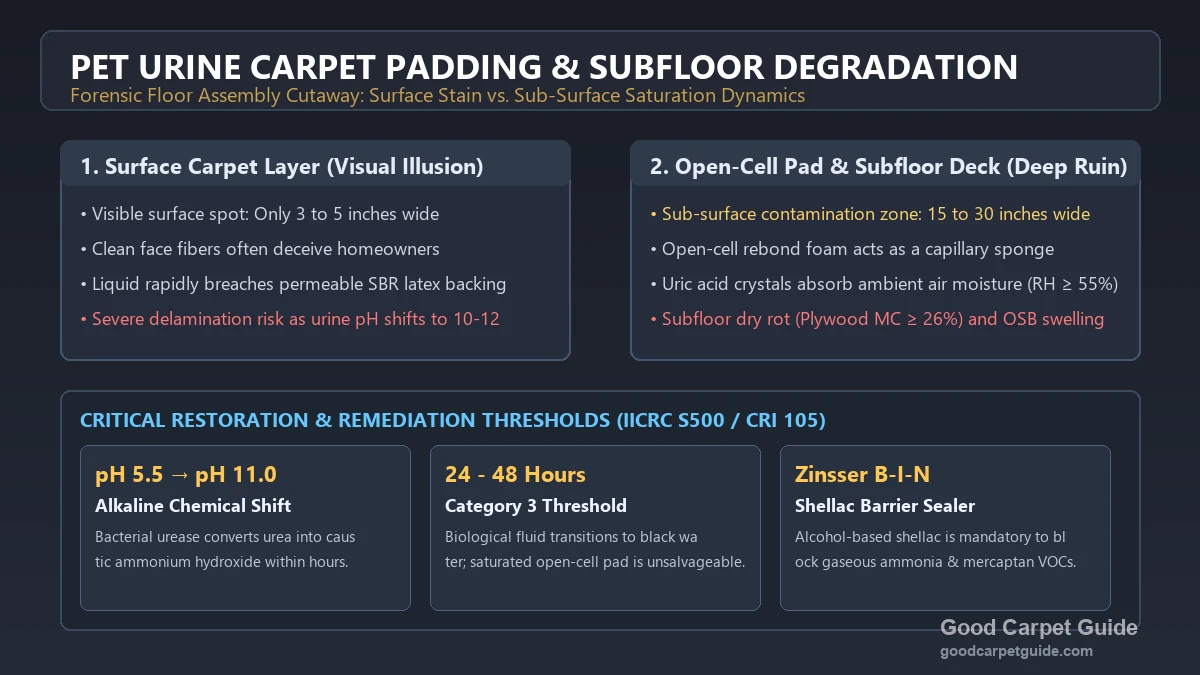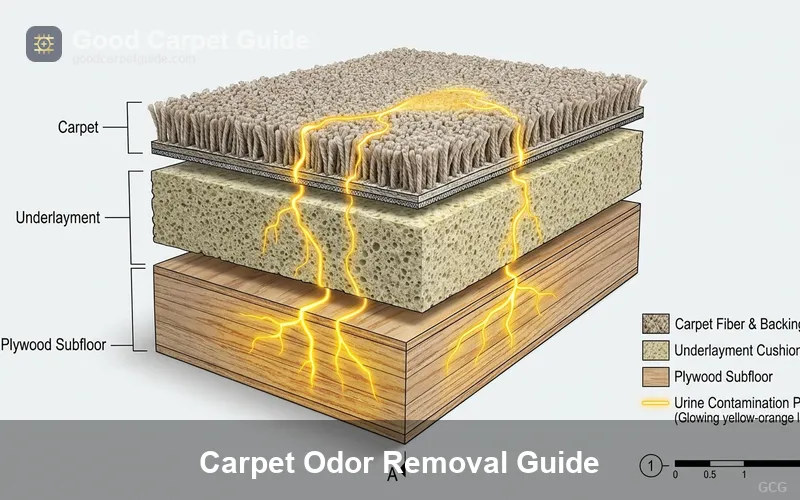
A flooring inspection began after a homeowner reported a faint odor that returned every humid afternoon despite repeated carpet shampooing. Carpet removal exposed urine penetration through the primary backing, through the cushion, and into the plywood subfloor where crystallized salts had accumulated beneath the tack strips. The inspection demonstrated that how to remove pet stains from carpet depends on the depth of contamination rather than the visible surface, and how to remove pet stains from carpet requires different procedures for vomit, urine, bile, and fecal accidents.
The cleaning strategy changes according to fiber chemistry, contaminant chemistry, subfloor material, carpet padding construction, and warranty limitations. Dog bile behaves differently from rabbit urine, enzyme cleaners behave differently from acidic cleaners, and moisture-barrier cushions behave differently after tack strip installation. Cost also changes dramatically once contamination reaches the underlayment or wooden substrate.
how to remove dog throw up stains from carpet
Dog vomit removal begins by removing solids immediately and flushing the remaining residue before acidic pigments permanently bond with carpet fibers.
The first objective is preventing stomach acid from remaining inside the pile. The second objective is preventing pigment migration into the backing. Composite installer field reports consistently show that delayed cleanup creates permanent yellow discoloration on wool and light-colored synthetic carpets.
Follow this sequence:
- Remove solid material with a plastic scraper.
- Blot moisture with white absorbent towels.
- Rinse using cool water.
- Extract moisture with a wet vacuum or portable extractor.
- Apply an approved carpet spot cleaner.
- Blot until transfer stops.
- Dry completely using airflow.
The sequence limits chemical fixation of bile pigments inside the fiber structure.
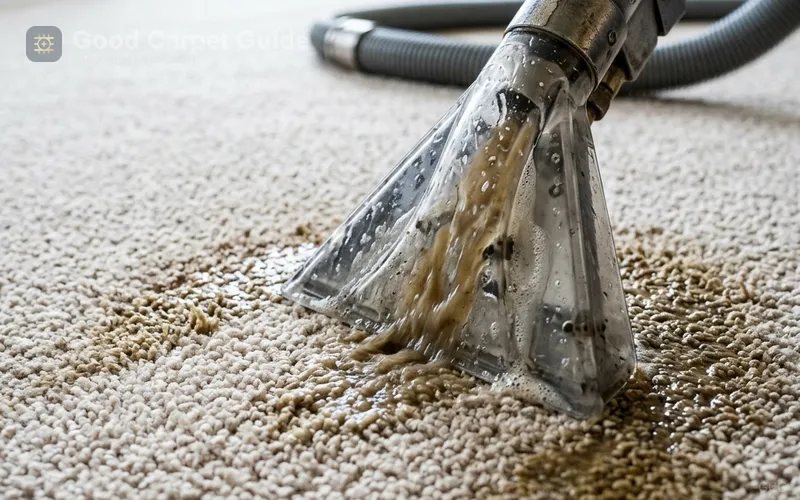
Caption: Immediate extraction of acidic residue reduces pigment bonding before deeper fiber cleaning begins.
Yellow bile creates a separate problem because bilirubin pigments chemically adhere to fibers. Composite homeowner reports describe bright yellow stains remaining after repeated shampooing despite successful odor removal.
Sunlight provides one unusual solution when turmeric medication or bile creates neon yellow discoloration near windows. Ultraviolet radiation degrades turmeric pigments and gradually fades visible staining under direct exposure.
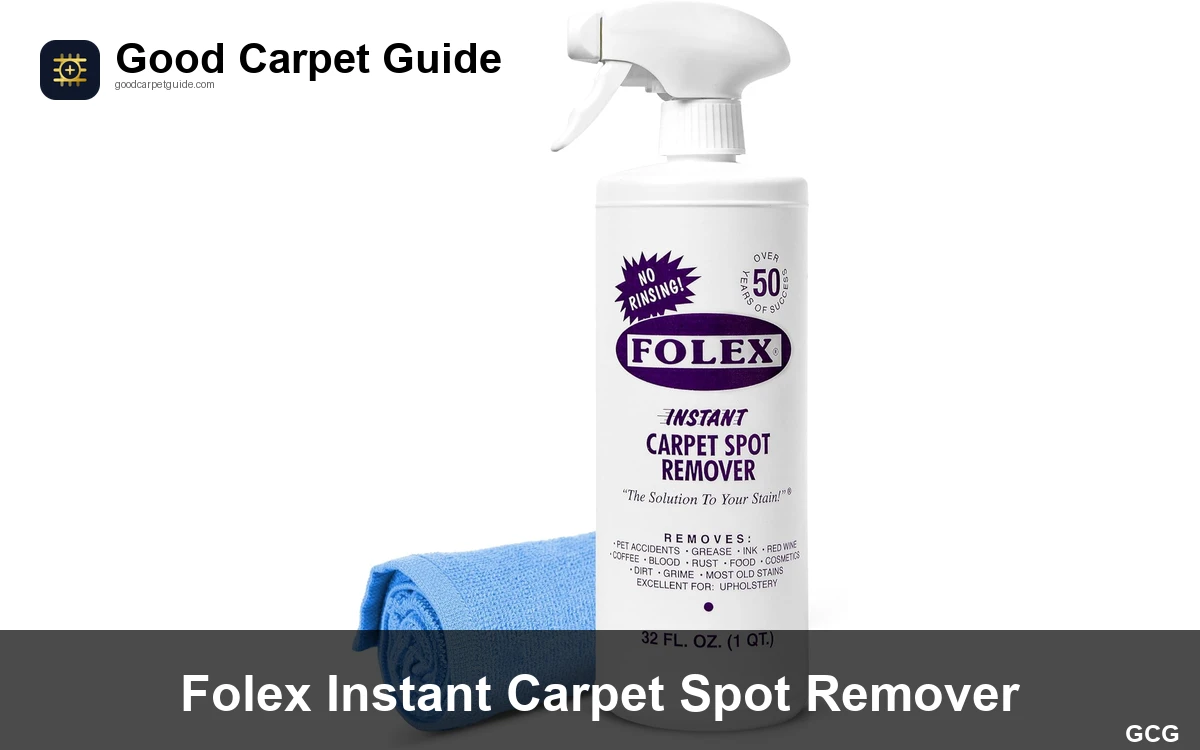
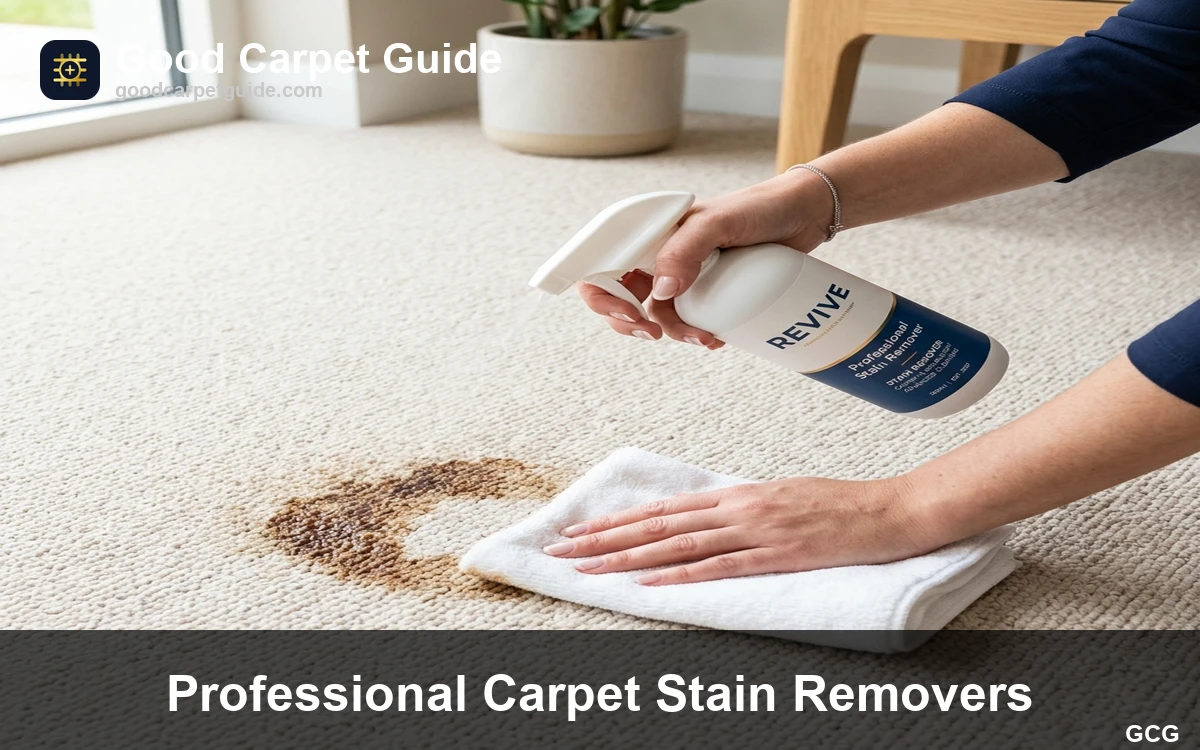
Folex Instant Carpet Spot Remover
Frequently recommended by homeowners for removing fresh organic carpet stains without leaving sticky residue.
Check Price on Amazonhow to remove dog pee stains from the carpet
Dog urine removal requires reaching every contaminated layer instead of cleaning only the visible carpet surface.
Dog urine initially consists largely of water but dries into uric acid crystals embedded throughout carpet backing, padding, and subfloor materials. Rehydration later releases ammonia odor during humid conditions.
The most effective process follows these steps:
- Saturate the contaminated zone with an enzyme formulation.
- Allow the enzyme dwell time specified by the manufacturer.
- Extract dissolved contamination using hot-water extraction equipment.
- Dry the carpet and cushion rapidly.
- Reevaluate odor after complete drying.
The sequence addresses both biological residue and crystallized deposits.
Many homeowners incorrectly combine baking soda with vinegar. The chemical reaction neutralizes both compounds during visible fizzing, reducing cleaning effectiveness instead of increasing enzymatic digestion.
Another common source of confusion involves temporary odor intensification. Enzyme cleaners frequently create stronger ammonia smells during early treatment because dormant uric acid crystals become hydrated and biologically active while enzymes digest accumulated waste. Composite field reports identify this temporary increase as evidence that decomposition has begun.
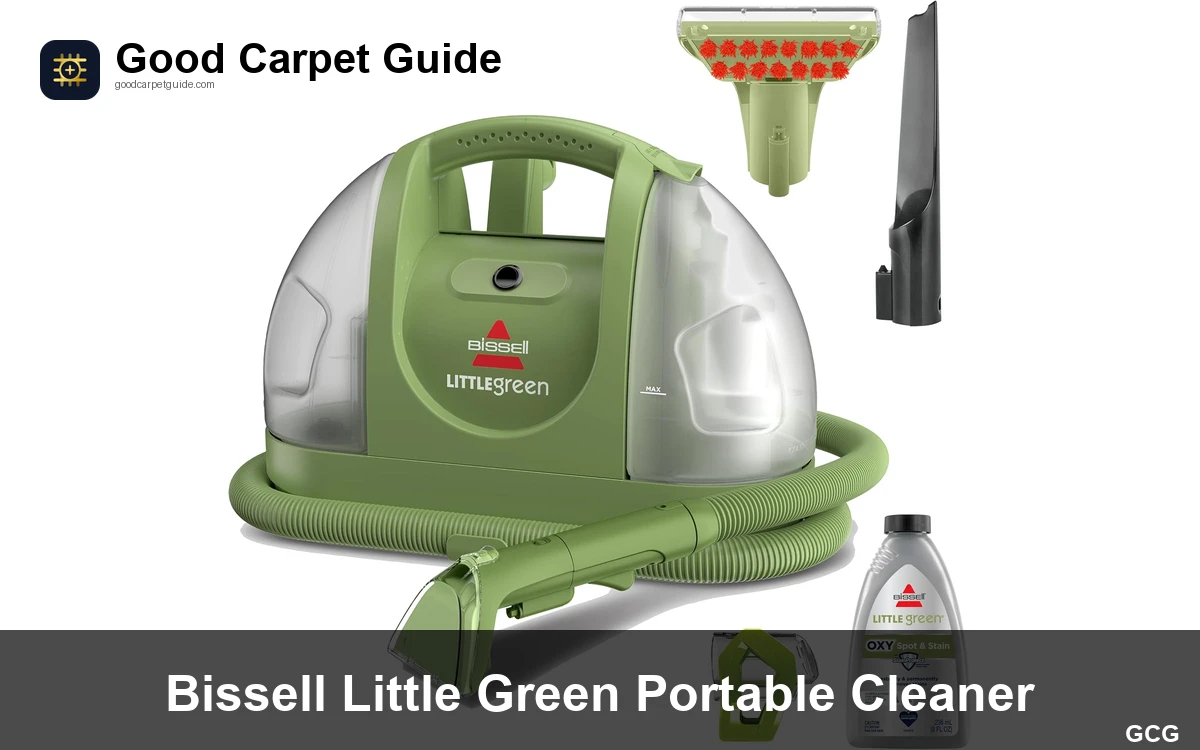
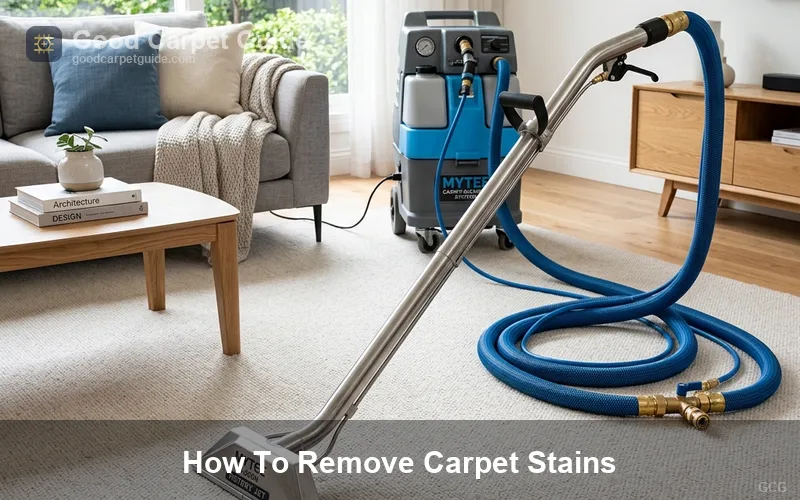
Bissell Little Green Portable Carpet Cleaner
Portable extraction equipment removes dissolved contaminants before residues dry back into carpet fibers.
Check Price on Amazonhow to remove rabbit urine stains from carpet
Rabbit urine removal requires dissolving mineral deposits before biological cleaning.
Rabbit urine differs chemically from dog and cat urine because rabbit urine contains elevated calcium carbonate concentrations that dry into hard white scale. Protein enzyme cleaners alone do not dissolve calcium mineral deposits.
A weak acidic solution such as white vinegar dissolves calcium accumulation before secondary cleaning removes remaining residue.
The cleaning order matters:
- Apply diluted white vinegar to dissolve mineral scale.
- Allow contact time for calcium breakdown.
- Blot dissolved residue.
- Rinse thoroughly.
- Extract remaining moisture.
- Dry completely.
The procedure removes mineral accumulation before secondary odor treatment begins.
how to remove old pet stains from carpet
Old pet stain removal requires determining whether contamination remains inside the carpet, cushion, or structural floor.
Surface discoloration represents only one indicator. Odor persistence after repeated cleaning frequently indicates penetration into padding or plywood.
The inspection criteria include:
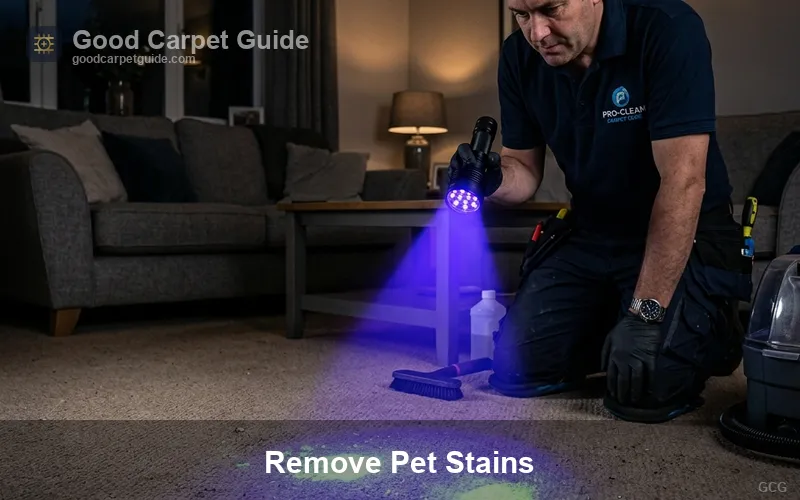
- Examine ultraviolet fluorescence.
- Examine tack strip staining.
- Examine padding discoloration.
- Examine subfloor moisture damage.
- Examine persistent ammonia odor.
The inspection determines whether cleaning remains economically justified or replacement produces lower lifetime cost.
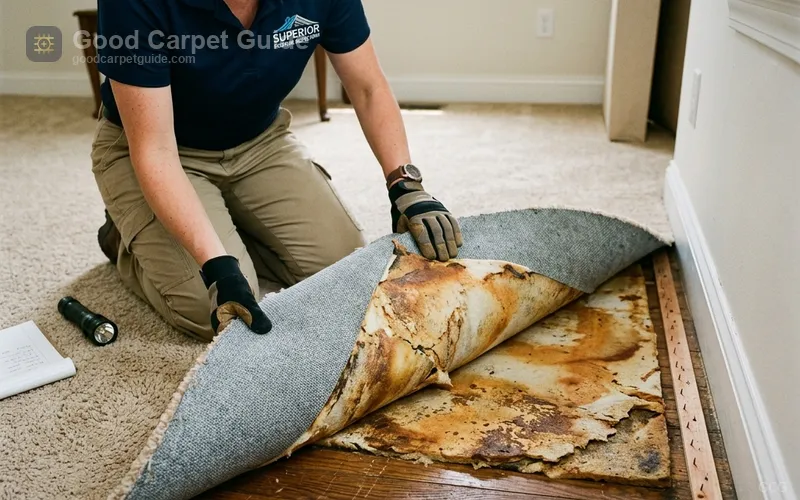
Caption: Carpet lifting reveals whether visible staining extends into underlayment and structural flooring before restoration decisions are made.
Severe contamination sometimes requires replacing carpet cushion and sections of plywood. Composite installer reports repeatedly identify structural replacement as the only reliable solution once urine saturates wooden panels.
how to remove yellow cat vomit stains from carpet
Yellow cat vomit removal focuses on rapid pigment removal before protein fixation occurs.
Cat vomit frequently contains bile pigments, stomach acid, partially digested food, and medication residue. Medication containing turmeric dramatically increases yellow staining potential.
Prompt extraction limits permanent discoloration. Delayed scrubbing increases pigment penetration deeper into the pile.
Natural wool presents elevated risk because acidic pigments chemically interact with wool proteins more aggressively than with hydrophobic synthetic fibers.
how to remove dog poop stains from the carpet
Dog feces removal begins with physical removal before moisture application.
Removing solids first limits lateral contamination across neighboring fibers.
The recommended sequence includes:
- Remove solids carefully.
- Blot remaining moisture.
- Apply enzyme cleaner.
- Extract dissolved contamination.
- Dry completely.
The process reduces bacterial residue while minimizing permanent discoloration.
how to remove deep pet stains from carpet
Deep stain removal requires subsurface extraction rather than surface shampooing.
Subsurface extraction tools flush contamination beneath the backing while simultaneously vacuuming dissolved residue upward.
Professional technicians frequently perform urine pad flushing over localized 3-by-3-foot sections at approximately $30 per treated area. Standard warranty-compliant hot-water extraction commonly begins around $175 mobilization plus approximately $50 per standard room.
The economics frequently favor professional intervention once contamination reaches carpet padding.
what do real homeowners report about removing pet stains from carpet
Composite homeowner reports consistently identify recurring patterns rather than isolated failures.
The most frequently reported observations include:
- Report temporary odor increases after enzyme treatment.
- Report persistent smells despite surface cleanliness.
- Report unexpected plywood contamination beneath carpet.
- Report dramatic success using portable extraction equipment.
- Report surprising ultraviolet fading of turmeric discoloration.
The combined reports indicate that contamination depth determines success more than cleaning product selection.
One repeatedly shared observation describes Folex as seemingly making stains disappear without visible residue. Another repeatedly shared observation praises portable extraction devices such as the Bissell Little Green Machine for removing fresh vomit before pigment fixation occurs.
do carpet manufacturers and installers agree about pet stain protection
Manufacturers and installers disagree regarding moisture-barrier carpet padding performance.
Marketing materials promote moisture barriers as preventing liquid penetration. Experienced installers describe thousands of staple penetrations created during installation that perforate waterproof films and permit urine migration beneath the barrier.
Liquid trapped below impermeable membranes evaporates slowly and remains hidden from visual inspection. Hidden saturation increases mold development and wood deterioration risk.
Warranty documentation also creates unexpected limitations.
The following comparison summarizes major warranty themes:
| Warranty topic | Typical limitation |
|---|---|
| Pet urine stains | Frequently covered on premium products |
| Pet vomit stains | Frequently excluded on selected warranties |
| Pet feces stains | Frequently excluded on selected warranties |
| Odor removal | Commonly excluded |
| Stair installations | Frequently excluded |
The comparison demonstrates that stain coverage differs substantially from odor coverage.
Products marketed under Mohawk SmartStrand receive positive attention because all-pet warranties include urine, vomit, and feces under qualifying conditions, while selected nylon programs restrict protection to urine staining only.
Quick-dry bonnet systems create another conflict. Major manufacturers generally require periodic hot-water extraction for warranty compliance, while installers warn that aggressive rotary bonnet systems compress fibers and accelerate wear.
Readers evaluating replacement projects should also review the carpet delamination guide , the best carpet for stairs guide , the best carpet for basement guide , and the best carpet for bedrooms guide because backing construction and installation environment directly affect stain recovery outcomes.
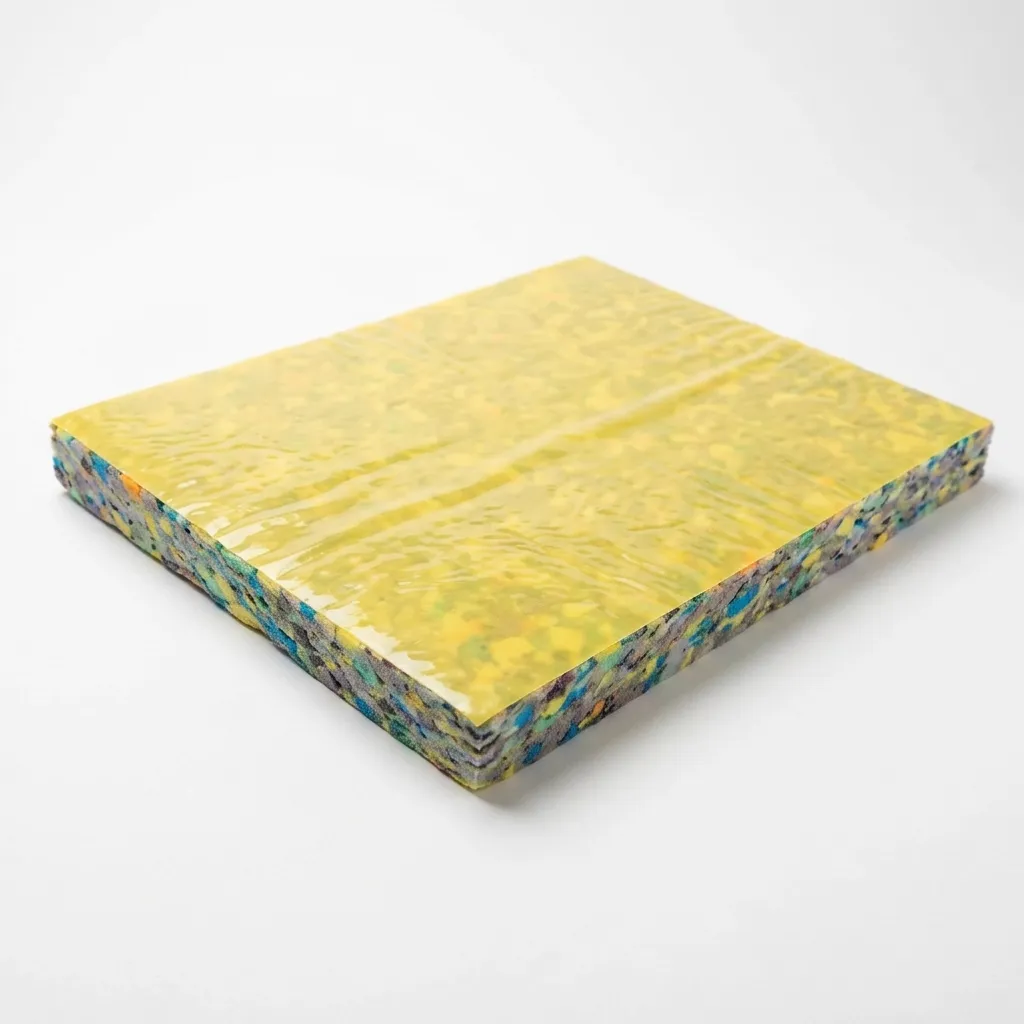
Mohawk SmartCushion Premium Carpet Padding
Premium carpet cushion designed to improve moisture management and support long-term carpet performance.
Check Price on Amazonwhat does removing pet stains from carpet cost
Cleaning costs depend primarily on contamination depth rather than stain diameter.
The table below summarizes commonly reported service pricing.
| Service | Typical cost |
|---|---|
| Professional mobilization | $175 |
| Standard room hot-water extraction | $50 per room |
| Localized urine pad flush | $30 per 3×3 ft area |
| Standard 8 lb rebond padding | About $0.45 per sq ft |
| Premium local dealer rebond padding | About $0.39–$0.60 per sq ft |
| Big-box memory foam padding | Up to $2.64 per sq ft |
The pricing data also highlights another economic factor. Local flooring dealers frequently hand-measure projects with approximately 10% waste allowances, while automated measurement systems used by large retailers may include roughly 20% waste allowances, increasing purchased material quantities.
frequently asked questions
does baking soda and vinegar remove pet urine permanently?
No. Mixing baking soda and vinegar neutralizes both compounds during the visible reaction and does not replace enzyme digestion of uric acid crystals.
why does enzyme cleaner smell worse before smelling better?
Enzyme cleaner rehydrates dormant uric acid deposits. Rehydration temporarily increases ammonia release while biological digestion progresses.
should wool carpet be installed in homes with dogs that frequently vomit?
Natural wool performs poorly under repeated acidic bile exposure because stomach acid promotes permanent yellow pigment bonding with wool proteins.
when should carpet padding be replaced instead of cleaned?
Replace carpet padding once urine saturation reaches the cushion and persistent odor remains after extraction because compressed contaminated padding continues releasing odor into indoor air.
is professional cleaning cheaper than replacement?
Professional hot-water extraction costs substantially less than carpet replacement when contamination remains above the cushion. Structural contamination reaching plywood frequently shifts the financial advantage toward localized demolition and replacement.