pet urine carpet padding damage overview
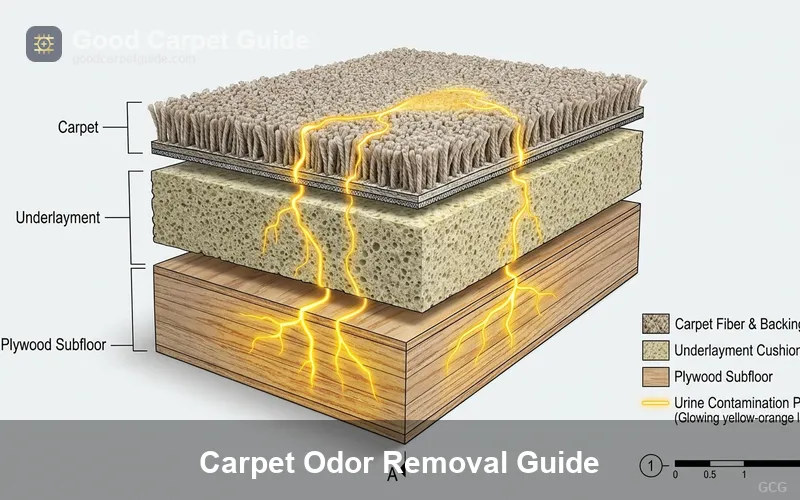
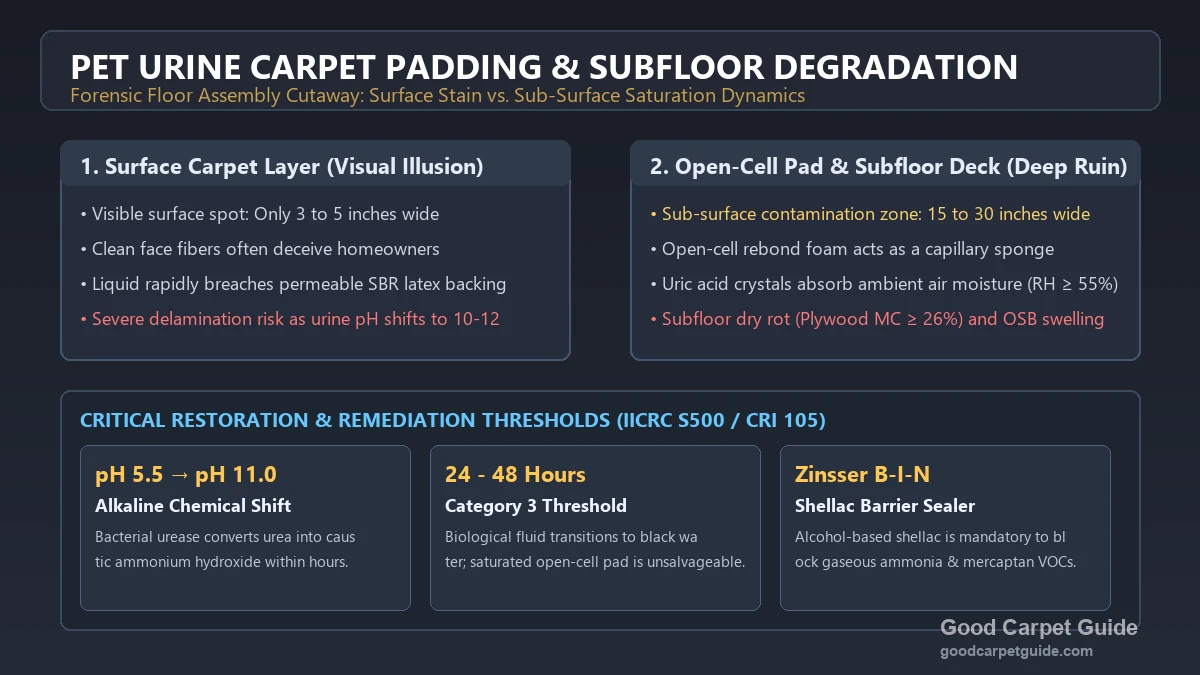
Pet urine carpet padding damage occurs when animal liquid waste penetrates the carpet face, passes through the latex backing, and pools inside the porous cushion and structural subfloor below. In residential flooring inspections, we routinely see homeowners scrub surface fibers until stains vanish, unaware that gravity forces liquid downward into an expansive sub-surface reservoir.
  [ Surface Stain: 3 to 6 Inches Wide ]
                │
                ▼ (Penetrates Permeable Latex Backing)
  [ Padding Contamination: 15 to 30 Inches Wide ]
                │
                ▼ (Gravity Pools onto Subfloor Deck)
  [ Plywood Rot / OSB Swelling / Concrete Capillary Storage ]
When a dog or cat urinates on carpet, only a fraction of the liquid remains on the upper yarn. The liquid breaches the primary backing and spreads laterally through the open-cell foam cushion. A surface spot measuring 4 inches wide typically creates a contaminated pad zone measuring 15 to 25 inches in diameter.
Left unaddressed, decomposing biological proteins and alkaline salts destroy the physical integrity of the cushion. The polyurethane matrix breaks down, losing its resilience and releasing volatile chemical odors into the living space. Remediating this damage requires understanding the biochemical transition of urine, evaluating the subfloor condition, and selecting the correct replacement cushioning such as carpet padding .
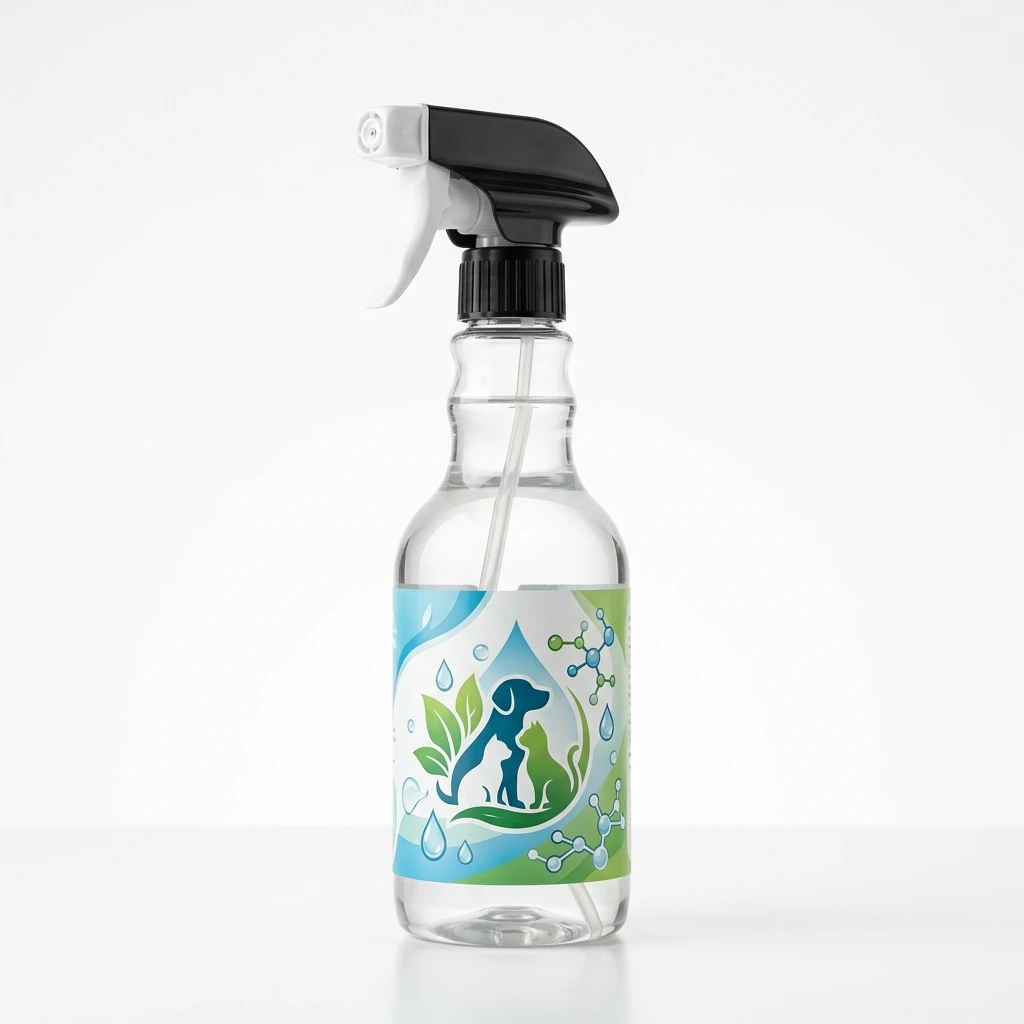
Nature's Miracle Advanced Stain & Odor Remover
Professional bio-enzymatic formula targeting severe pet urine messes, uric acid crystals, and stubborn odors.
Check Price on Amazonthe biochemical chain reaction of pet urine
Pet urine undergoes a rapid chemical transformation that turns a mildly acidic liquid into an aggressive alkaline compound. At the moment of excretion, fresh urine has a pH level between 5.0 and 6.0. In this initial stage, the liquid contains urea, uric acid, metabolic proteins, and creatinine dissolved in water.
If flushed and extracted immediately with cold water and neutral detergents, almost all residues can be removed before bonding with the floor. Within hours, environmental bacteria in the carpet fibers consume the urea.
These bacteria produce the catalytic enzyme urease, which hydrolyzes the urea into carbon dioxide and ammonia gas:
CO(NH₂)₂ + H₂O → CO₂ + 2NH₃
The free ammonia reacts with moisture inside the carpet pad to form ammonium hydroxide:
NH₃ + H₂O ⇌ NH₄⁺ + OH⁻
This chemical reaction drives the pH up to a caustic 10.0 to 12.0. High alkalinity damages the flooring assembly by dissolving the synthetic styrene-butadiene rubber (SBR) latex adhesive that bonds the carpet's primary and secondary backings, leading to permanent carpet delamination . The high pH also bleaches carpet dyes and hydrolyzes the polyurethane foam core into a brittle powder.
open-cell rebond vs closed-cell barrier padding
The physical construction of your carpet cushion determines whether pet accidents remain manageable or become structural disasters. Standard residential installations use bonded polyurethane foam, commonly known as rebond padding.
+-----------------------------+------------------------------------+-----------------------------------+
| Attribute                   | Standard Open-Cell Rebond Pad      | Breathable Barrier Cushion        |
+-----------------------------+------------------------------------+-----------------------------------+
| **Cell Structure**          | Porous, open-cell foam shreds      | High-density foam + top membrane  |
| **Liquid Permeability**     | Rapid downward and lateral wicking | Liquid impermeable from above     |
| **Vapor Permeability**      | Fully permeable                    | Breathable (MVTR ≥ 14.6 g/m²/24h) |
| **Extraction Efficiency**   | Low (requires 400+ CFM truckmount) | High (contained in face fibers)   |
| **Subfloor Protection**     | None (urine pools directly on deck)| Complete liquid barrier           |
+-----------------------------+------------------------------------+-----------------------------------+
the capillary action of rebond foam
Rebond cushion consists of recycled polyurethane foam pieces bonded under high heat and pressure. The open-cell structure creates millions of microscopic capillaries. When warm urine strikes the pad, these capillaries draw liquid inward and outward across the floor.
A single accident from a medium-sized dog delivers roughly 6 to 8 ounces of liquid. In an open-cell pad, this volume spreads across a broad footprint. Standard home vacuums generate only 50 to 100 cubic feet per minute (CFM) of airflow, which cannot pull viscous liquid out from deep within an 8-pound foam core.
engineered moisture-barrier padding
Specialized pet padding incorporates a copolymer top membrane laminated over a high-density (8-lb to 10-lb) polyurethane core. Products like Carpenter SpillGuard Deluxe and Leggett & Platt Scotchgard Plus stop liquids at the surface of the pad.
The liquid remains confined to the carpet pile, where residential hot-water extraction can reach it. Quality barrier pads maintain a moisture vapor transmission rate (MVTR) of at least 14.6 grams per square meter per 24 hours. For pet-heavy households, pairing these cushions with suitable best carpet for pets provides the strongest defense against odor entrapment.
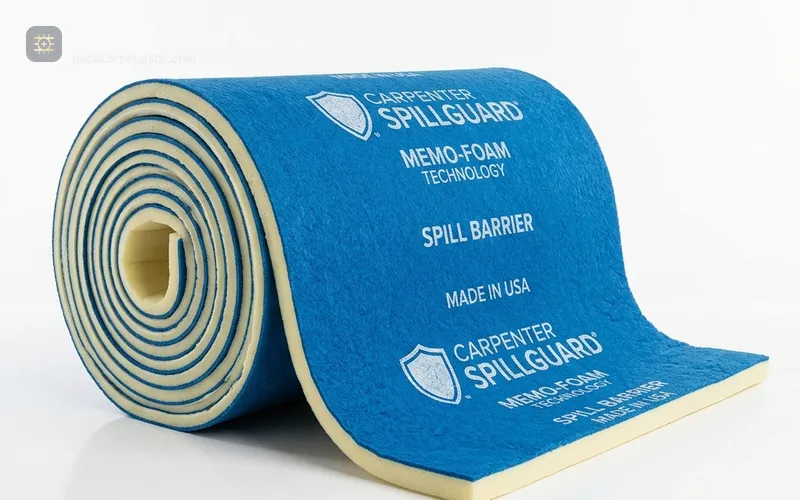
Carpenter SpillGuard Deluxe 8lb Carpet Cushion
High-density 8-pound polyurethane cushion with a breathable, liquid-impermeable barrier membrane.
Check Price on Amazonthe hygroscopic behavior of uric acid crystals
As urine dries, its water content evaporates, leaving behind concentrated urea, proteins, and uric acid salts (C₅H₄N₄O₃). These salts form stable, water-insoluble crystals that bind tightly to the porous cells of the carpet padding and the wood or concrete below.
                    [ Dry Indoor Conditions (< 50% RH) ]
                      ↳ Uric crystals remain dormant & odorless
                                      │
                                      ▼ (Humidity rises above 55% RH)
                    [ Hygroscopic Moisture Absorption ]
                      ↳ Crystals absorb airborne water molecules
                                      │
                                      ▼ (Bacterial reactivation)
                    [ Release of Off-Gassing VOCs ]
                      ↳ Ammonia & Methyl Mercaptan Odors Released
Uric acid crystals are highly hygroscopic, meaning they absorb moisture directly from the air. In winter or dry climates with relative humidity below 50%, the crystals remain dormant and produce little noticeable smell.
When summer arrives or indoor relative humidity rises above 55%, the crystals draw moisture from ambient air. This moisture dissolves a portion of the salt matrix and reactivates dormant bacteria. The bacteria resume decomposing residual organic matter, releasing pungent ammonia and sulfur-bearing methyl mercaptans.
subfloor degradation across wood and concrete
When pet urine passes through the cushion, it settles on the subfloor deck. The resulting structural damage depends on whether the substrate is plywood, oriented strand board (OSB), or concrete.
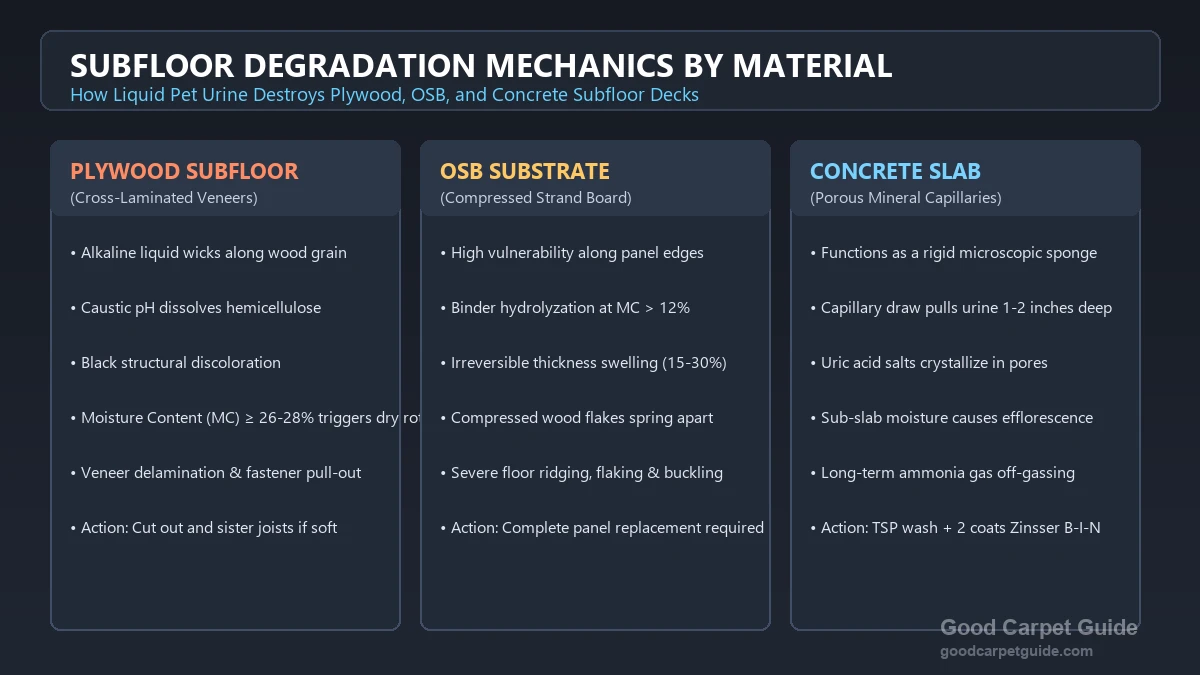
                  ┌─────────────────── Pet Urine Pooling ──────────────────┐
                  │                                                        │
                  ▼                                                        ▼
        [Wood-Based Subfloors]                                   [Concrete Slabs]
  ┌───────────────┴───────────────┐                                       │
  ▼                               ▼                                       ▼
[Plywood]                       [OSB]                           [Porous Capillaries]
Cellular collapse,          Hemicellulose binder             Uric salt crystallization,
Rot (MC ≥26-28%),           hydrolyzation, edge flaking,     Efflorescence, capillary
Black discoloration         Irreversible thickness swell     wicking, long-term off-gassing
plywood subfloor degradation
Plywood consists of cross-laminated wood veneers bonded with exterior-grade adhesives. When exposed to alkaline urine, the wood fibers wick the liquid along their grain.
The caustic ammonium hydroxide burns the wood, dissolving hemicellulose and leaving a dark, blackened surface. If pet accidents keep the wood moisture content (MC) above 26% to 28%, wood-decaying fungi take root. The veneers delaminate, soften, and lose their load-bearing capacity, requiring carpenter replacement.
osb swelling and flaking
OSB is manufactured from compressed wood flakes bound with synthetic resins and wax. While panel faces offer brief water resistance, panel edges and nail perforations are highly vulnerable.
When OSB moisture content exceeds 12%, standard internal binders begin to break down. Wood flakes absorb urine and expand, causing permanent edge swelling of 15% to 30%. The panel edges swell into visible ridges beneath the carpet and crumble into loose flakes.
concrete slab capillary storage
Concrete appears solid, but it is a porous substrate filled with microscopic capillaries created during hydration. Unsealed concrete absorbs liquid urine down to a depth of 1 to 2 inches.
The liquid travels through the capillary network and deposits uric acid salts deep inside the slab. Sub-slab vapor drive and rising ambient humidity cause these salts to migrate back toward the surface, producing a white mineral crust known as efflorescence. Installing new flooring over contaminated, unsealed concrete traps this moisture, forcing ammonia vapors directly into the living space.
tack strip corrosion and backing delamination
Pet urine damage extends beyond the cushion to surrounding installation components, including perimeter tack strips and carpet backing.
+------------------------------+---------------------------------------+--------------------------------------+
| Component                    | Chemical / Moisture Mechanism         | Visible Failure & Structural Impact  |
+------------------------------+---------------------------------------+--------------------------------------+
| **Carpet Tack Strips**       | Cyclical wet-dry laminate breakdown   | Plywood layer splitting, wood rot    |
| **Tack Strip Nails & Pins**  | Alkaline oxidation of steel pins      | Rust, pin snapping, loss of tension  |
| **Carpet Latex Backing**     | Hydrolysis of SBR adhesive compound   | Secondary backing separation (bubbles)|
| **Carpet Face Yarns**        | Denaturation of synthetic polymer     | Brittle fibers, fraying, pile crush  |
+------------------------------+---------------------------------------+--------------------------------------+
Pets instinctively mark perimeter walls, baseboards, and room corners. This natural behavior places tack strip assemblies directly in the splash zone.
In forensic inspections, tack strip condition reveals contamination history. Continuous moisture from a single plumbing leak causes wood to darken without separating.
However, repeated wet-dry cycles from recurring pet accidents break down glue lines between tack strip veneers, causing wood layers to split. High-carbon steel pins corrode and lose their holding strength. When pins rust through, the carpet pulls away from the wall, resulting in loose ripples and waves across the room.
remediation decision matrix: extraction vs replacement
Determining whether carpet padding can be salvaged or must be cut out depends on the area of contamination, the time elapsed, and the structural condition of the foam.
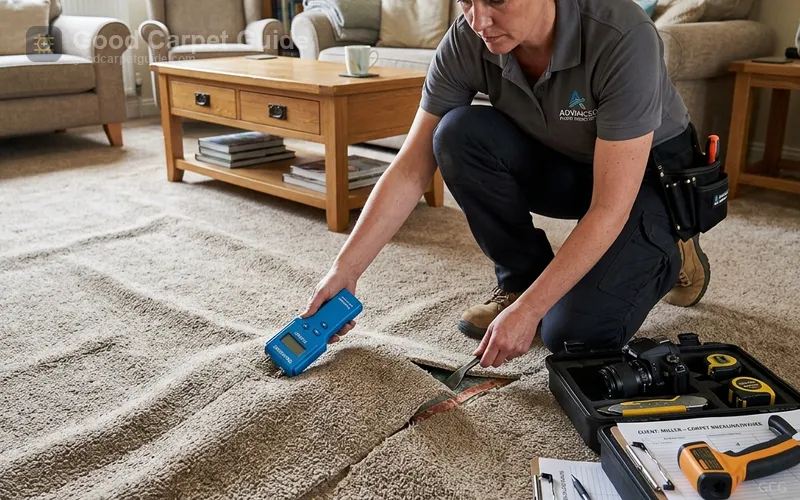
                                  [UV Blacklight / Moisture Probe Scan]
                                                    │
                   ┌────────────────────────────────┴────────────────────────────────┐
                   ▼                                                                 ▼
      [Minor/Moderate Localized Spots]                                  [Severe / Saturated Contamination]
                   │                                                                 │
    ┌──────────────┴──────────────┐                                   ┌──────────────┴──────────────┐
    ▼                             ▼                                   ▼                             ▼
[Pad is Structurally Sound]   [Pad is Degrading/Crumbling]     [Category 2 (<24-48 Hours)]   [Category 3 (>48 Hours) OR Hoarding]
    │                             │                                   │                             │
    ▼                             ▼                                   ▼                             ▼
*Sub-Surface Extraction*       *Localized Pad Excision*            *Sub-Surface Extraction*      *Mandatory Full Pad Excision*
(Water Claw, Flood Flush,     (Cut out contaminated pad,          (Attempt professional flood   (Tear out carpet/pad, replace tack
Enzyme Injection)              seal subfloor, replace pad)         and flush protocol)           strips, seal subfloor)
minor localized extraction
When contamination is limited to 1 to 3 isolated spots and the padding remains resilient, sub-surface extraction is viable. The accident must have occurred within the last 24 to 48 hours.
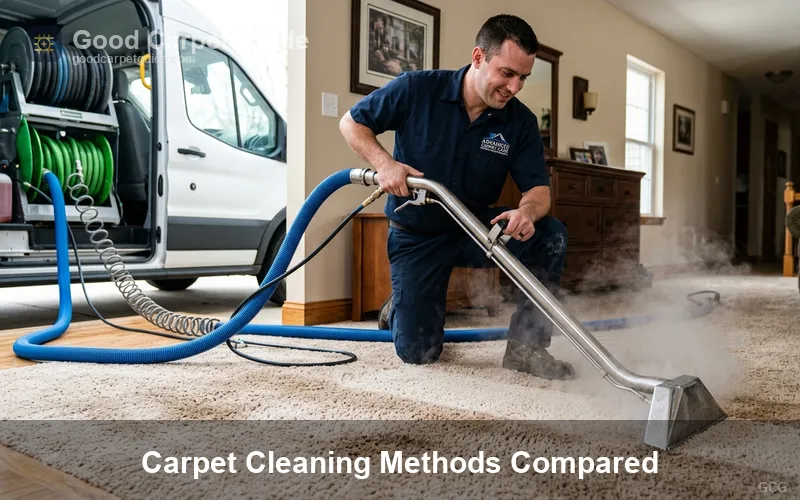
A professional technician uses a sub-surface extraction tool connected to a commercial truckmount unit delivering 400+ CFM. The area is saturated with an enzymatic solution to dissolve uric crystals, followed by high-vacuum extraction directly through the carpet and pad.
localized pad excision
When a few spots have dried repeatedly over weeks, the underlying pad becomes stiff, brittle, or discolored while the rest of the room remains clean.
In this scenario, disengage the carpet from perimeter tack strips and peel it back. Cut out the contaminated pad section with a utility knife, clean and seal the exposed subfloor deck, and install a matching piece of new padding secured with seaming tape.
mandatory full room excision
When biological fluids remain untreated beyond 48 hours, they transition from Category 2 gray water to Category 3 black water due to bacterial and fungal amplification. Mold species like Aspergillus and Chaetomium colonize the organic binders.
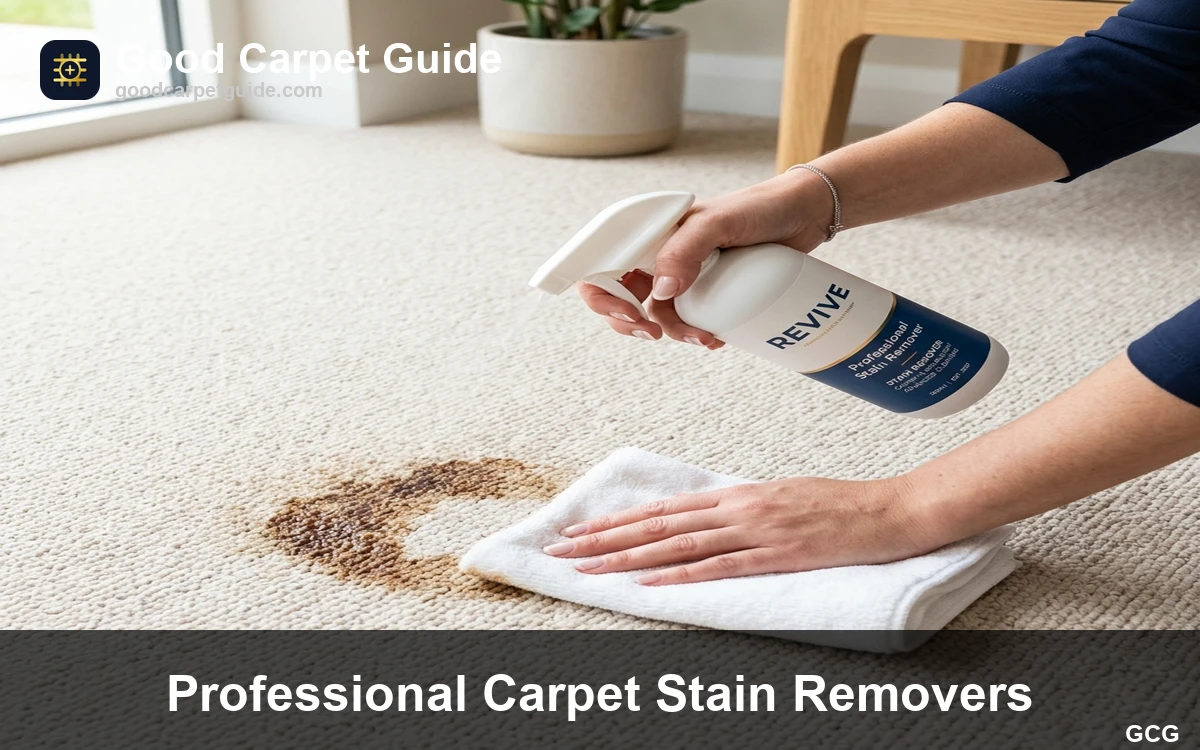
At this stage, open-cell padding cannot be sanitized and must be completely removed, bagged, and discarded. Learn more about effective fiber spotting techniques in our guide on how to remove pet stains from carpet .
step-by-step subfloor prep and shellac sealing
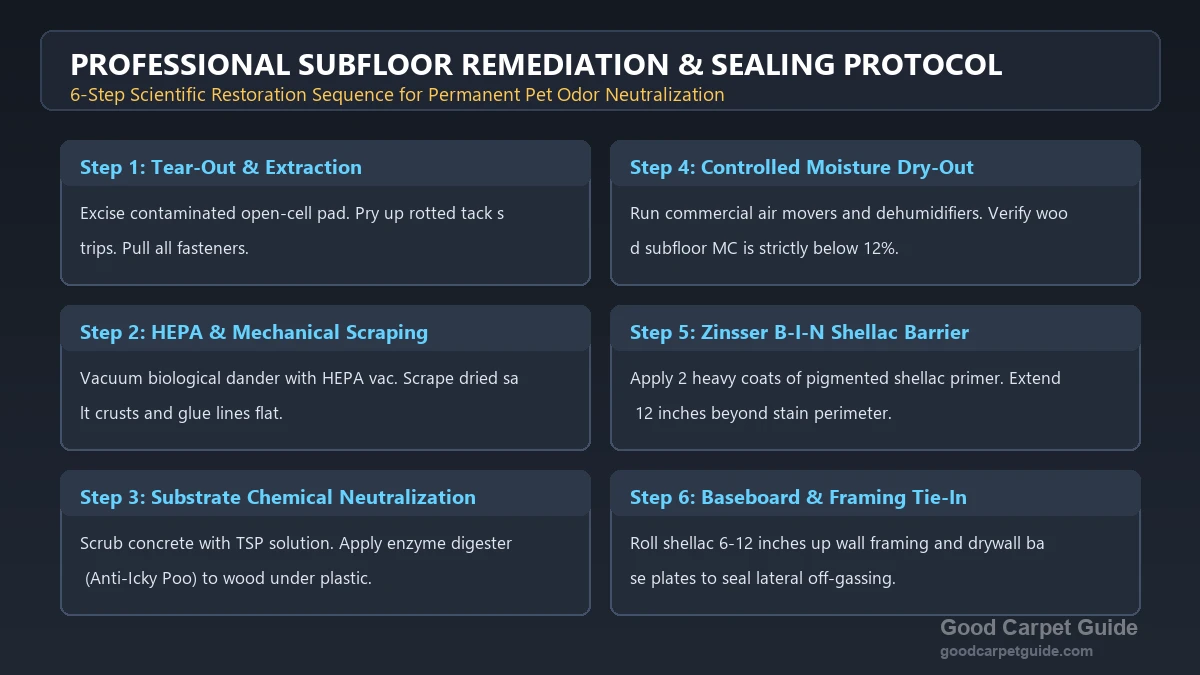
Replacing contaminated carpet padding without treating and sealing the subfloor guarantees that pet odors will penetrate your new flooring. Follow this field-tested restoration sequence to neutralize the subfloor permanently.
demolition and mechanical scraping
Pull back the carpet to expose the damaged area. Cut out saturated padding and discard it in sealed contractor bags.
Pry up all rusted tack strips and pull every staple out of the wood deck. Use a heavy-duty floor scraper to shave dried adhesives and urine salt crusts down to a clean substrate. Vacuum the entire room with a commercial HEPA vacuum to capture biological dander and dried salt dust.
subfloor neutralization treatment
For concrete subfloors, scrub the bare slab with a solution of trisodium phosphate (TSP) mixed at 1/2 cup per gallon of warm water. Work the solution into pores with a stiff nylon brush and extract immediately with a wet/dry vacuum. Never use muriatic acid on urine-soaked concrete, as it reacts violently with alkaline salts.
For wood subfloors, spray dark-stained plywood or OSB with a concentrated enzymatic treatment like Mister Max Anti-Icky Poo. Lay plastic painter's sheeting over wet wood for 12 to 24 hours to prevent evaporation. Remove plastic and run commercial air movers until a moisture meter confirms the substrate has dried below 12% moisture content.
barrier sealer application
Standard latex primers and water-based paints fail on urine-stained decks because water rehydrates dormant uric crystals, drawing smells through the paint film. You must use an alcohol-based shellac primer like Zinsser B-I-N.
Apply two generous coats of pigmented shellac using a 3/8-inch nap roller, waiting 45 minutes between coats. Extend the sealer at least 12 inches beyond the mapped perimeter of the stains. Roll the shellac 6 to 12 inches up drywall and over bottom wall framing plates to seal lateral off-gassing completely.
remediation cost breakdown and recommended products
Restoring a pet-damaged flooring system involves material costs, specialized cleaners, and labor. Below are real-world cost benchmarks for residential remediation projects.
+------------------------------------+------------------------+---------------------------------------+
| Project Phase / Material Component | Average Cost Range     | Key Cost Drivers                      |
+------------------------------------+------------------------+---------------------------------------+
| **Standard Rebond Cushion (8-lb)** | 0.35 –0.65 / sq ft  | Cushion thickness and foam density    |
| **Moisture Barrier Pet Cushion**   | 0.85 –1.50 / sq ft  | Copolymer membrane & antimicrobial core|
| **Pad Tear-Out and Disposal**      | 0.40 –0.90 / sq ft  | Dumpster fees, handling, transport   |
| **Subfloor Scraping & Prep Labor** | 0.75 –2.00 / sq ft  | Staple pulling, sanding, vacuuming    |
| **Shellac Sealer Application**     | 0.80 –1.40 / sq ft  | Zinsser B-I-N materials & roller labor|
| **Subfloor Wood Panel Replacement**| 4.50 –9.50 / sq ft  | Plywood materials & carpenter labor   |
| **Professional Sub-Surface Flush** | 250 –600 / room     | Truckmount extraction time and setup  |
| **Carpet Restretching & Resetting**| 60 –120 / room      | Power stretcher labor & seam repairs  |
+------------------------------------+------------------------+---------------------------------------+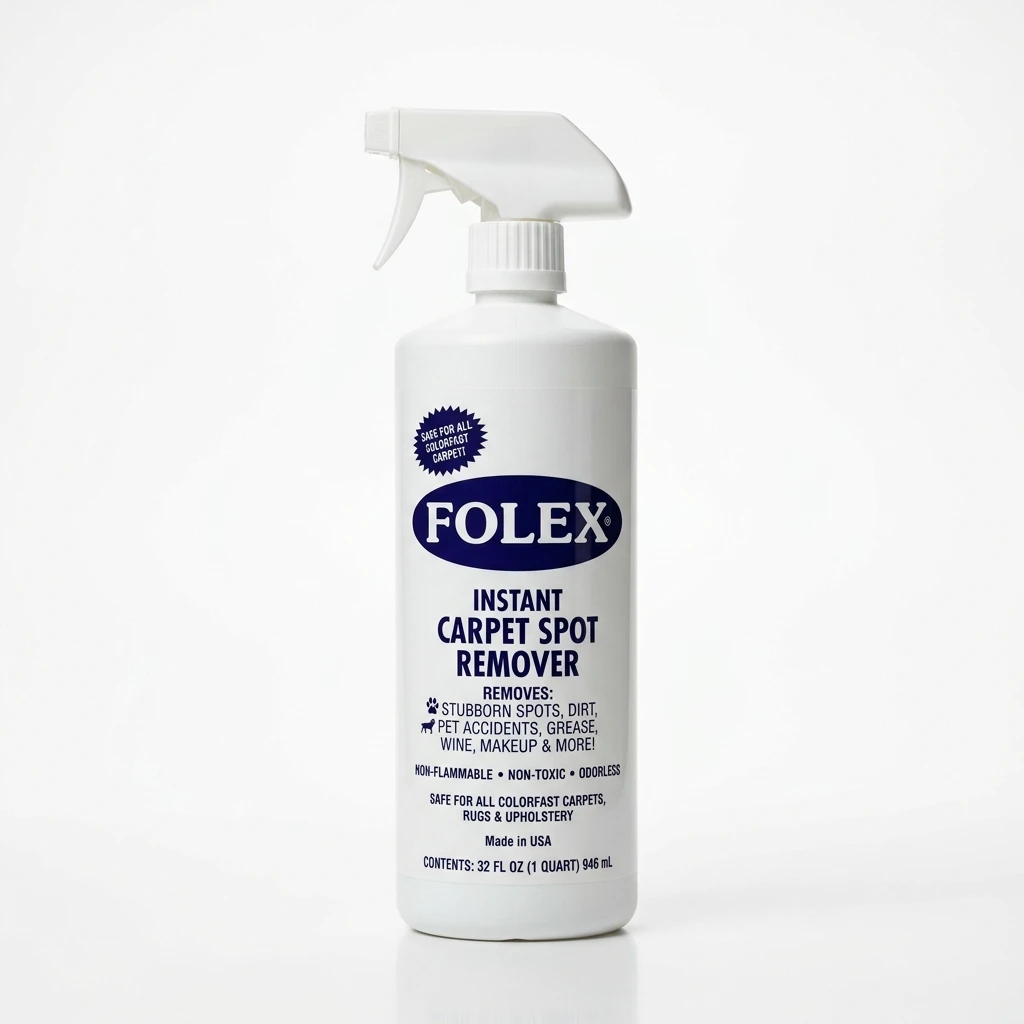
Folex Instant Carpet Spot Remover
Fast-acting surfactant spot remover for quick extraction of organic surface stains without fiber damage.
Check Price on AmazonInvesting in premium barrier padding increases upfront material expenses by roughly $0.50 per square foot compared to standard rebond cushion. However, this barrier protects the subfloor deck from future accidents, eliminating the need for costly wood replacement down the road.
critical installer facts and common DIY mistakes
Floor covering inspectors and restoration specialists frequently encounter homeowner mistakes that turn minor accidents into major flooring replacements. Review these trade insights before attempting repairs:
steam cleaners permanently set urine odors
The most common mistake homeowners make is renting a steam cleaner or using hot water extraction on old pet stains. Urine contains albumin and globulin proteins. Heating these proteins above 140°F (60°C) denatures their molecular structure.
The protein chains uncoil and bind chemically to synthetic carpet fibers, particularly nylon. This heat reaction bakes the stain and odor into the yarn, making them impossible to remove. Hot water extraction for pet stains should always be performed with lukewarm or cold water paired with enzymatic digesters.
uv blacklights detect porphyrins not uric odors
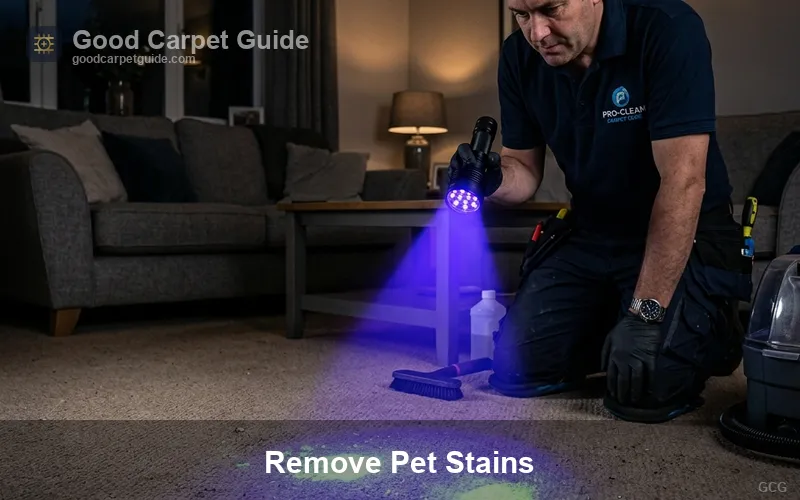
Under a 365-nanometer ultraviolet blacklight, pet accidents illuminate with a bright yellow-green glow. Many homeowners assume that once this glow disappears, the urine odor is gone.
In reality, the compound that fluoresces under UV light is porphyrin, an odorless organic pigment. Uric acid crystals and urea do not fluoresce. An enzyme treatment can digest uric acid crystals completely while leaving odorless porphyrin behind, which continues to glow.
water-based odor primers cause odor bleed-through
Painting urine-stained wood subfloors with standard latex wall paint or water-based primers is a guaranteed failure. The water inside the primer dissolves dried uric acid crystals on contact.
The dissolved salts travel through wet paint via capillary action and dry directly on top of the cured paint film. Within three to four weeks, the smell returns. Always use alcohol-based shellac (Zinsser B-I-N) or high-solids solvent primers to block odors permanently.
hydrogen peroxide neutralizes odor but spares crystals
Applying household hydrogen peroxide oxidizes foul-smelling methyl mercaptans and bleaches yellow urochrome pigments, providing immediate visual relief. However, peroxide does not dissolve dense uric acid crystals.
As peroxide breaks down into water and oxygen, remaining moisture reactivates unaffected uric acid salts in the padding. Oxidizers should be used only as an initial brightening step, followed by an enzymatic digester to break down the salt matrix completely.
frequently asked questions
These questions address the most common homeowner inquiries regarding pet urine contamination, subfloor damage, and pad replacement.
can pet urine damage in carpet padding be cleaned without pulling up the carpet?
Minor, fresh spills can sometimes be cleaned from above using specialized sub-surface extraction tools like a Water Claw powered by a commercial truck-mounted extractor. However, if the urine has soaked into standard open-cell rebond padding over multiple weeks, cleaning the surface will not remove the crystallized salts trapped in the cushion. The carpet must be pulled back to excise the damaged padding and seal the subfloor underneath.
how do I know if pet urine reached the subfloor beneath the carpet pad?
You can confirm subfloor penetration by using a 365 nm UV blacklight in a darkened room, followed by a non-invasive moisture meter or hydro-sensor probe. If the moisture meter shows elevated readings days after an accident, or if the carpet emits a strong ammonia smell when ambient humidity rises, the urine has soaked through the padding and pooled on the subfloor deck.
what is the best primer to seal pet urine on a plywood subfloor?
Zinsser B-I-N pigmented shellac primer is the industry gold standard for sealing pet-contaminated subfloors. Its alcohol-based natural shellac formulation creates an airtight, gas-impermeable barrier that prevents ammonia, sulfur compounds, and moisture from off-gassing through the floor. Standard water-based latex primers should never be used, as they rehydrate dormant uric salts.
why does my carpet smell worse after cleaning pet urine?
Carpet often smells worse after cleaning because water rehydrates dried uric acid crystals embedded in the padding and subfloor. The added moisture reactivates dormant bacteria, which begin decomposing residual urea and releasing volatile ammonia gases. If the padding was not extracted with high-vacuum equipment or replaced entirely, the moisture brings trapped odors back to the surface.
is pet urine-damaged carpet padding a health risk?
Yes. Aged pet urine releases concentrated ammonia gas, which can irritate the respiratory system, skin, and eyes, particularly in children and individuals with asthma. Furthermore, if urine-saturated padding remains damp for more than 48 hours, it fosters bacterial growth and fungal colonies such as Aspergillus and Penicillium, creating potential indoor air quality hazards.