🚨 THE BERBER ZIPPER ALERT (INSTALLER DANGER ZONE)
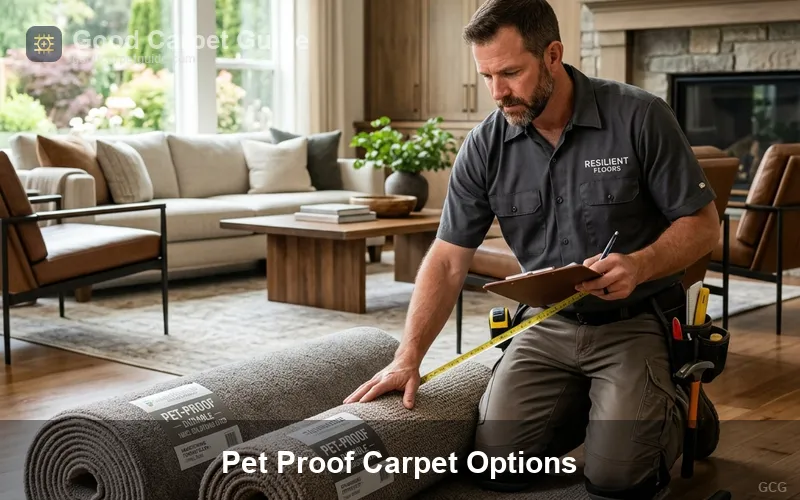
As an installer with years on the knees, here is the absolute first rule of pet flooring: Never install a continuous-loop Berber carpet if you have cats or dogs. One caught claw can zipper yards of yarn out of the backing in seconds, turning a $5,000 installation into trash.
The best carpet for pets is not the softest carpet in the showroom. The best carpet for pets is the carpet system that survives claws, urine chemistry, repeated cleaning cycles, and constant traffic lane abuse without structural failure. Most homeowners shop color and softness first, but installers see the failures underneath: zippering loops, rotten latex backing, urine-soaked rebond pads, delaminated seams, and crushed polyester traffic lanes that never recover. For cat owners dealing with unique doorway scratching and litter box challenges, review our specialized guide on installer-recommended carpet for cats .
A pet-friendly carpet system starts with cut-pile construction, not loop pile. It continues with the correct fiber chemistry, usually solution-dyed nylon or Triexta. For families managing dander and asthma, matching these fibers with the best carpet for allergies specifications protects indoor air quality while resisting traffic wear. It also requires a moisture-barrier cushion system that prevents urine from penetrating the pad and subfloor. The carpet itself is only half the system. The backing adhesive and underlayment determine whether the installation survives five years or fails in eighteen months.
What Is the Best Carpet for Pets?
The best carpet for pets is a cut-pile carpet made from solution-dyed nylon 6,6 or Triexta installed over a moisture-barrier cushion.
Pet households comparing fiber chemistry between brands should evaluate the Shaw LifeGuard and Mohawk SmartStrand performance differences before committing to either system.
Pet durability depends on three separate engineering systems working together:
- Prevent claw snagging with cut-pile construction.
- Prevent stain absorption with hydrophobic or solution-dyed fibers.
- Prevent backing rot with moisture-barrier underlayment systems.
Most carpet failures blamed on “bad pets” actually start with bad specification choices. Install continuous-loop Berber around cats and dogs, and the structure mechanically fails. Install cheap polyester over standard rebond pad, and the carpet physically crushes while urine migrates into the subfloor assembly.
Professional installers usually recommend textured Saxony or low-profile frieze constructions for active pet households. Those constructions hide traffic patterns, resist visible crushing, and allow claws to release safely between sheared tufts.
Read our full breakdown of fiber mechanics in nylon vs polyester carpet if you want to compare polymer performance at the molecular level.
Why Loop-Pile Berber Carpet Fails Around Pets
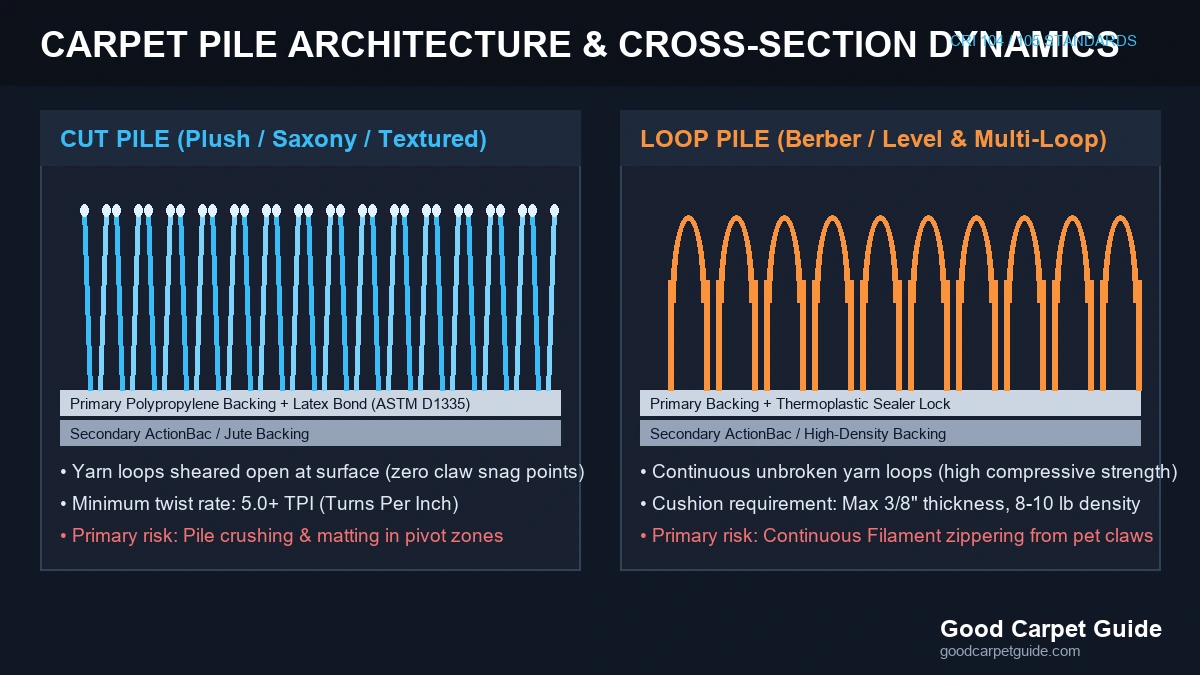
Loop-pile Berber carpet fails around pets because pet claws mechanically hook the exposed loops and initiate progressive unraveling called zippering.
Continuous-loop carpets use uncut yarn loops anchored directly into the primary backing. Those loops behave like tiny handles. A claw catches one loop, tension transfers to adjacent loops, and the yarn begins unraveling linearly across the room.
Installers call this a zipper run because the damage travels in a straight chain reaction.
Loop Pile (Berber) Snag Catch:
    [Claw]
      \ \
  _____\ \_____
 /     \ /     \   <-- Continuous Loop (Claw caught inside loop!)
/               \
=================  <-- Primary Backing (Structural anchoring)

Cut-Pile Safe Release:
   [Claw]
     | |
  |  | |  |
  |  | |  |        <-- Sheared Tufts (Claw slides out between vertical fibers)
  |  | |  |
=================  <-- Primary Backing
One partially pulled loop often stays hidden for weeks. Then the vacuum cleaner head grabs the loose yarn and strips yards of carpet in seconds. Installers routinely see entire stair sections destroyed from one damaged loop.
Why Cut-Pile Carpet Works Better
Cut-pile carpet works better because sheared tufts release claws instead of trapping them.
Cut-pile constructions include:
- Install Saxony carpet for smooth appearance and moderate durability.
- Install textured carpet for better traffic masking and active household use.
- Install frieze carpet for superior twist retention and aggressive claw resistance.
Frieze performs especially well in pet homes because the high-twist yarn structure resists visible crushing. The random yarn orientation also camouflages paw traffic and vacuum marks better than formal Saxony styles.
Read our guide to best carpet high traffic areas if you need deeper analysis on crush resistance and traffic lane durability.
Why Pet Urine Destroys Carpet Backing Systems
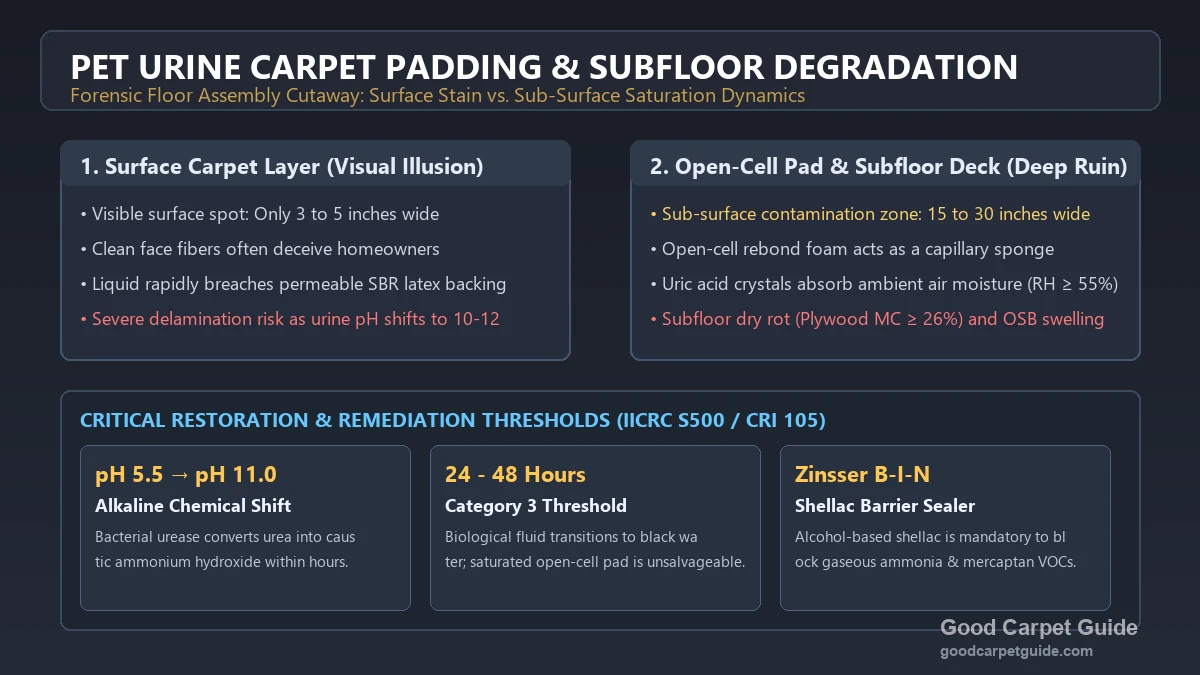
Pet urine destroys carpet backing systems because bacterial activity converts urine into highly alkaline ammonium hydroxide that chemically attacks SBR latex adhesive.
Most tufted carpets use Styrene-Butadiene Rubber (SBR) latex to bond the primary and secondary backing layers together. Fresh urine initially enters the carpet as mildly acidic fluid. The serious damage begins later.
Bacteria inside the carpet metabolize urea using the urease enzyme. That reaction converts urea into ammonia and ammonium hydroxide. Carpet pH can rise to approximately 10.5 to 11.5 during this process.
That extreme alkalinity initiates alkaline hydrolysis, also called saponification.
What Saponification Does to Carpet
Saponification breaks the polymer crosslinks inside the SBR latex adhesive.
The backing adhesive gradually changes from flexible rubber into dry chalk-like powder. Installers usually notice the failure during stretching or repair work because the backing begins flaking apart by hand.
Common field symptoms include:
- Develop wrinkles after repeated urine contamination.
- Develop bubbles after adhesive crosslink failure.
- Develop seam separation after dimensional instability begins.
- Develop delamination after latex powdering progresses.
At that stage, cleaning no longer solves the issue. The structural adhesive layer is chemically destroyed. The carpet cannot hold tension properly and usually requires full replacement.
Read our full technical guide on carpet delamination for deeper forensic breakdowns of SBR latex failure.
Why Standard Carpet Padding Fails in Pet Homes
Standard carpet padding fails in pet homes because rebond cushion acts like an open-cell sponge that traps urine permanently inside the floor system.
Traditional rebond pad consists of shredded foam fragments bonded together with adhesive. The structure contains interconnected air pockets that rapidly absorb liquids.
Urine penetrates through the carpet backing and disperses throughout the pad core. Once contamination reaches the subfloor, removal becomes extremely difficult.
Wood subfloors absorb odor compounds directly into porous cellulose fibers. Concrete slabs accumulate uric acid crystal deposits that reactivate during humid weather. Homeowners often smell old pet urine more intensely during summer humidity spikes because the crystals rehydrate and release odor molecules again.
Read our full engineering guide to carpet padding if you want to understand how standard cushion systems behave under moisture loads.
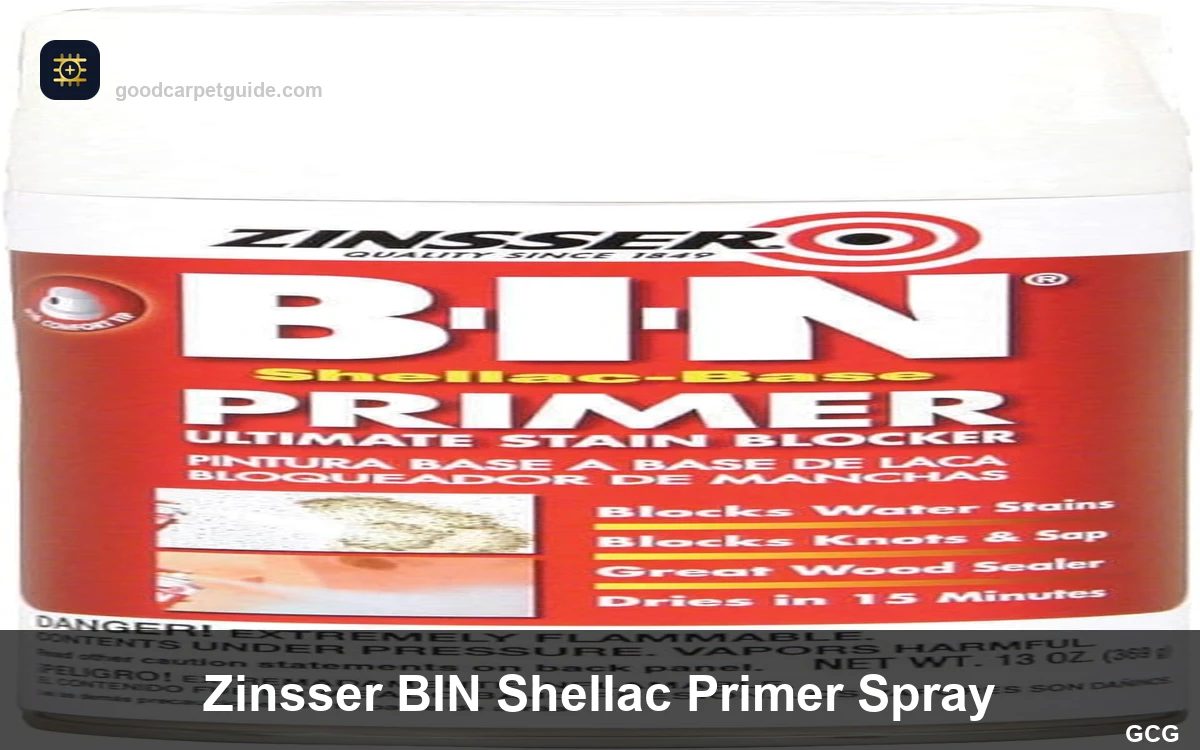
Zinsser B-I-N Shellac-Based Primer
The ultimate professional solution for permanent pet odor remediation. Seal wood or concrete subfloors with this shellac-based primer before laying new pad to block uric acid crystals and odors from resurfacing.
Check Price on AmazonWhy Moisture-Barrier Padding Changes Everything
Moisture-barrier padding changes everything because TPU membrane technology prevents urine migration into the cushion core and subfloor assembly.
Modern premium pet cushion systems use thermoplastic polyurethane membranes laminated across the pad surface. These membranes are micro-porous by design.
The pore structure performs two different functions simultaneously:
- Block liquid urine penetration through microscopic liquid exclusion.
- Allow water vapor transmission through controlled vapor permeability.
That engineering matters enormously in real-world installations. Concrete slabs naturally emit moisture vapor over time. Completely waterproof barriers can trap slab vapor and create mold problems underneath the floor system.
Micro-porous TPU membranes solve both problems at once.
How Extraction Works Better With Barrier Pads
Barrier pads improve extraction because urine remains trapped above the membrane instead of dispersing into the cushion core.
Hot water extraction equipment can recover contamination far more effectively when liquid stays localized inside the carpet backing layer. Standard rebond systems spread contamination vertically and horizontally through the pad.
Professional restoration crews strongly prefer moisture-barrier systems for pet households because cleaning efficiency dramatically improves.
Premium systems commonly include:
- Install Spillguard cushion for liquid-blocking performance.
- Install Stainmaster Premium cushion for moisture vapor permeability.
- Install TPU barrier systems for maximum extraction efficiency.
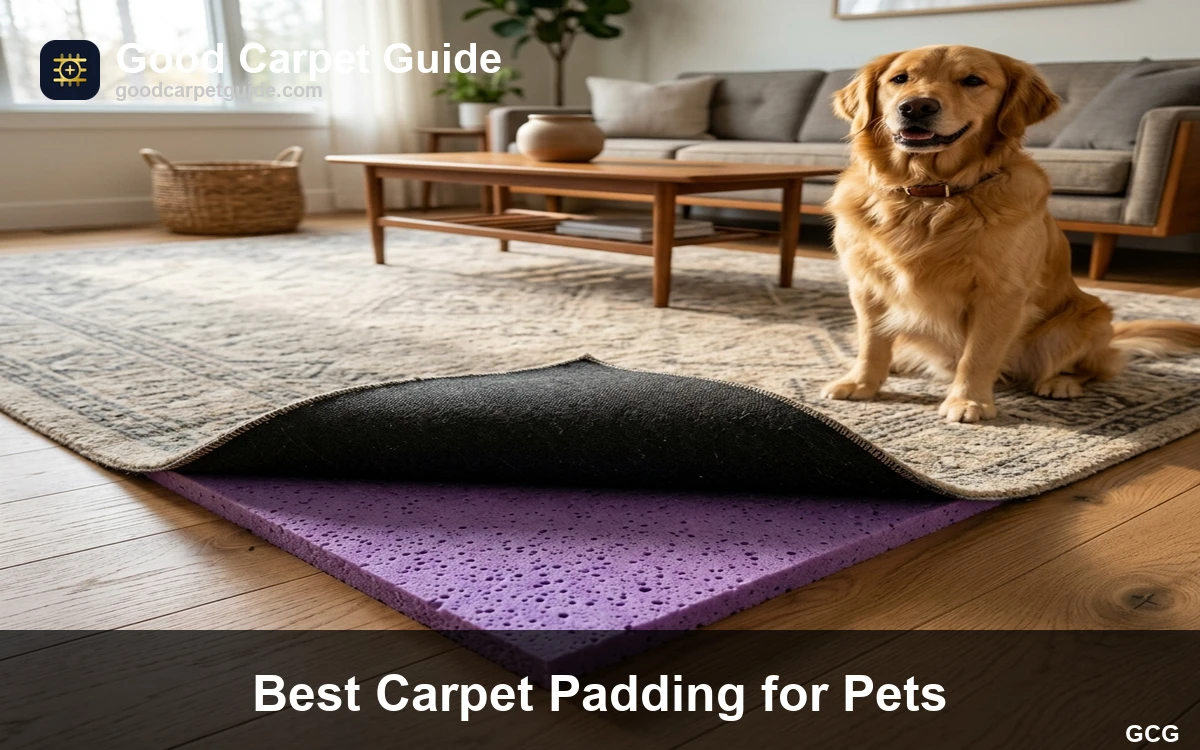
Read our dedicated guide to best carpet padding pets for full specifications and installation considerations.
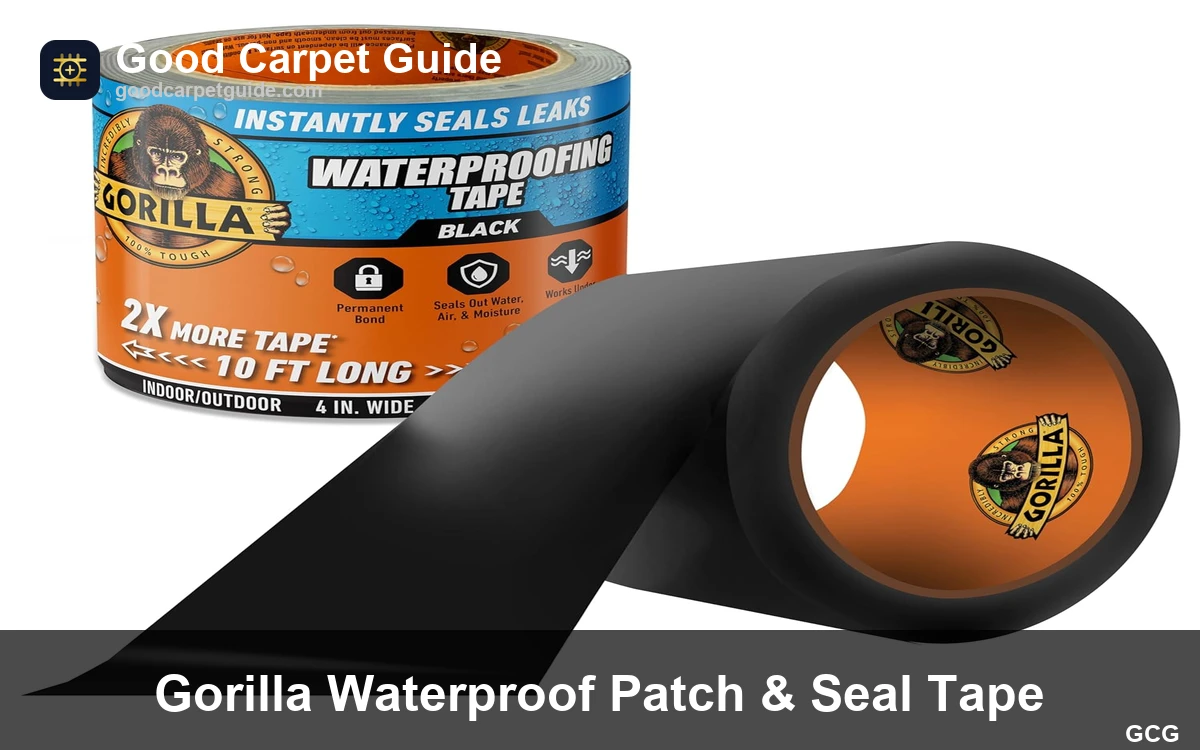
Gorilla Waterproof Patch & Seal Tape
Imperative for sealing moisture-barrier padding seams. Standard duct tape fails under moisture; this heavy-duty waterproof tape creates a permanent vulcanized seam seal to prevent urine bypass.
Check Price on AmazonWhich Carpet Fiber Performs Best Around Pets?
Solution-dyed nylon 6,6 and Triexta perform best around pets because both fibers resist staining while maintaining structural resilience under repeated traffic loads.
Fiber choice determines whether the carpet recovers after compression or permanently crushes into traffic lanes.
Why Solution-Dyed Nylon 6,6 Still Dominates
Solution-dyed nylon 6,6 still dominates because its molecular structure provides exceptional resilience and shape recovery.
Nylon contains strong hydrogen bonds between polymer chains. Those bonds help the fiber spring back after compression. Installers call this memory retention.
Standard nylon can absorb approximately 5% moisture through open dye sites. That characteristic normally increases stain risk. Solution-dyeing solves the issue by embedding pigment directly into the molten polymer during manufacturing.
That process creates:
- Maintain superior resilience under active pet traffic.
- Maintain color stability after repeated cleaning cycles.
- Maintain texture retention inside hallways and play zones.
Solution-dyed nylon remains the benchmark for long-term durability in aggressive households.
Why Polyester Creates Long-Term Regret
Polyester creates long-term regret because PET fiber lacks elastic recovery and permanently deforms under repeated compression.
Polyester initially feels soft in showrooms because the fiber bends easily. That softness becomes the problem later.
Repeated traffic physically flattens the fiber structure into permanent plastic deformation. The carpet begins matting, crushing, and showing dark traffic lanes.
Polyester is also strongly lipophilic. The fiber attracts skin oils, airborne oils, cooking residue, and environmental lipids. Over time, the carpet develops a greasy texture installers recognize immediately during cleaning work.
Traffic lanes often feel sticky even after shampooing because oils chemically bond to the fiber surface.
Why Triexta Performs So Well in Pet Homes
Triexta performs so well in pet homes because the fiber combines hydrophobic stain resistance with excellent compression recovery.
Triexta uses PTT polymer partially derived from corn glucose. The molecular chain naturally forms kinked spring-like geometry.
That structure creates:
- Maintain low moisture absorption below approximately 1%.
- Maintain strong texture retention after compression.
- Maintain permanent stain resistance inside the polymer itself.
Triexta behaves closer to nylon than polyester in practical field performance. Many installers now consider it the safest middle-ground option for families balancing stain resistance with durability.
Which Carpet Types Create the Most Customer Complaints?
Certain carpet brands and constructions consistently generate more installer callbacks in pet households.
Field installers usually notice recurring failure patterns long before consumers see them discussed online.
Why Dreamweaver Polyester Often Mats Down
Dreamweaver standard polyester often mats down because soft PET fibers lack structural resilience under repeated pet traffic.
The initial showroom appearance usually looks impressive. The carpet feels plush, dense, and comfortable underfoot. After one to two years, high-traffic areas often begin flattening permanently.
Common field complaints include:
- Develop greasy traffic lanes from lipophilic oil attraction.
- Develop permanent matting after repeated compression cycles.
- Develop dark shading patterns after fiber collapse.
Installers frequently see severe wear around pet sleeping areas and hallway turns where dogs repeatedly pivot on the same fiber paths.
Why Mohawk SmartStrand Generates Fiber-Pulling Complaints
Mohawk SmartStrand generates fiber-pulling complaints because some constructions experience yarn fraying and visible filament extraction under aggressive claw interaction.
SmartStrand uses Triexta chemistry, which generally performs very well chemically. The complaints usually involve construction mechanics rather than stain resistance.
Field complaints often include:
- Develop loose yarn pulls near stairs and transitions.
- Develop visible fraying after repeated claw scraping.
- Develop filament fuzzing inside high-activity zones.
Not every SmartStrand installation fails this way. The issue appears more commonly in softer, looser residential constructions with long exposed yarn structures.
Dense textured constructions usually perform substantially better than loose plush styles.
What Carpet Padding Thickness Works Best for Pets?
Medium-density low-profile cushion works best for pets because excessive softness accelerates carpet flex fatigue and backing stress.
Many homeowners assume thicker padding automatically improves comfort and quality. Excessive cushion thickness actually increases carpet movement under traffic.
That movement creates:
- Increase backing flex stress during repetitive motion.
- Increase seam tension across traffic lanes.
- Increase wrinkle formation during aging cycles.
Most installers prefer 7/16-inch or thinner high-density pet-rated cushion systems.
The Carpet and Rug Institute commonly recommends denser low-profile support structures for active households because dimensional stability improves substantially.
How Much Does the Best Carpet for Pets Cost?
The best carpet for pets usually costs more upfront but dramatically reduces replacement frequency and restoration expenses.
Cheap carpet systems often become expensive after odor remediation, seam repair, or full replacement work.
| Carpet System | Typical Installed Cost | Real-World Performance |
|---|---|---|
| Polyester (PET) | $3.00-$5.00/sq ft | Soft initially but prone to crushing and grease retention |
| Solution-Dyed Nylon 6,6 | $5.00-$7.00/sq ft | Best long-term resilience and traffic durability |
| Triexta (PTT) | $5.00-$8.00/sq ft | Excellent stain resistance with strong texture recovery |
| Moisture-Barrier Padding | $0.75-$1.50/sq ft | Prevents urine penetration into pad and subfloor |
Most professional installers would rather install a mid-grade nylon over premium cushion than install luxury polyester over cheap rebond pad. The cushion system controls odor survival and subfloor contamination risk.
Which Carpet System Actually Survives Pets Long-Term?
A dense cut-pile carpet paired with moisture-barrier cushion survives pets long-term because the system prevents both mechanical failure and chemical contamination.
The safest specification usually looks like this:
- Install textured cut-pile nylon for maximum resilience.
- Install dense Triexta frieze for stain-focused households.
- Install moisture-barrier cushion for urine containment.
- Install low-profile dense pad for dimensional stability.
- Install professional hot water extraction maintenance every 12-18 months.
Avoid loop-pile Berber completely around cats and active dogs. Avoid cheap polyester in hallways and pet traffic lanes. Avoid standard rebond cushion if odor prevention matters long-term.
Professional installers rarely fear the visible stain. The invisible damage underneath the carpet destroys most pet installations first.
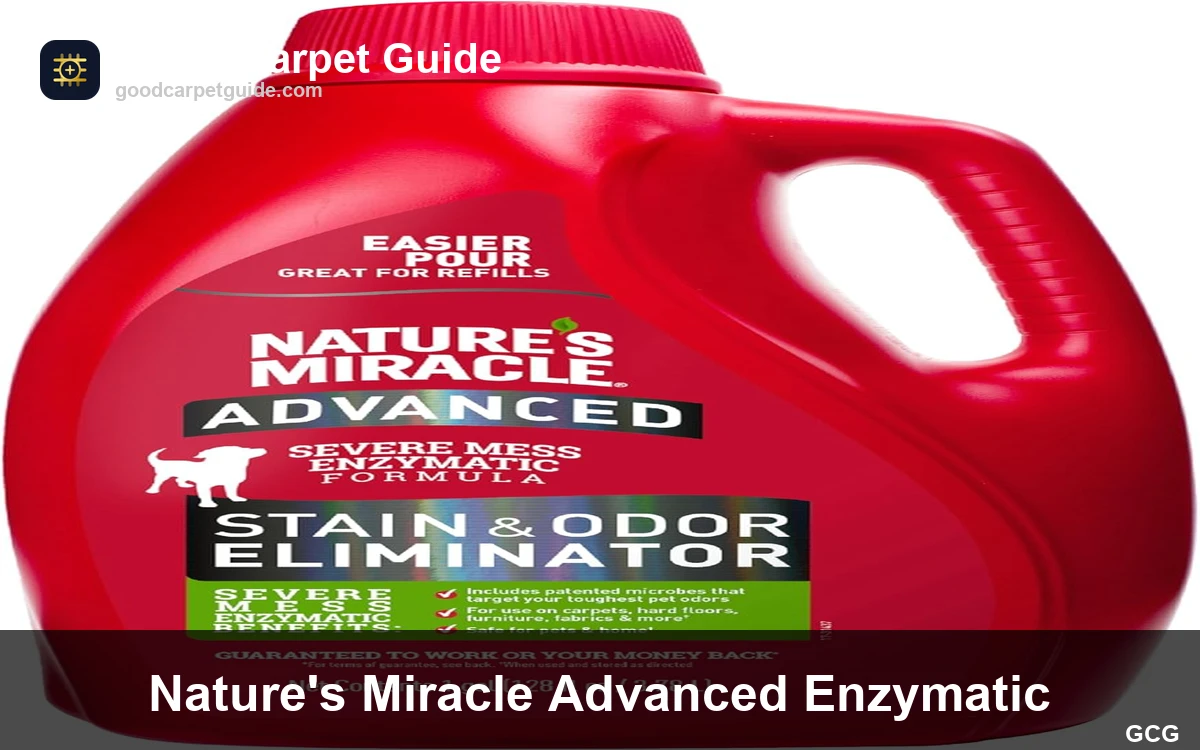
Nature's Miracle Advanced Enzymatic Cleaner
An absolute necessity for active pet households. Uses advanced enzymatic action to target and fully biodegrade pet organic waste, preventing alkaline salt buildup and carpet backing saponification.
Check Price on Amazon