Carpet buckling is not a cosmetic quirk or a minor annoyance. When a wall-to-wall broadloom carpet develops ridges, waves, or bubbles across a room, it signals a systemic failure in mechanical tension, backing chemistry, or environmental equilibrium. A buckled carpet presents an immediate trip hazard, accelerates fiber wear along the apex of each wave, and destroys the acoustic and thermal benefits of the flooring assembly.
Most homeowners assume ripples appear simply because their carpet is old. In the field, forensic inspections tell a very different story. Over 75% of severe carpet buckling claims occur on carpets less than three years old, frequently within months of initial occupancy or following a routine hot water extraction cleaning. The carpet did not stretch itself out of shape through ordinary foot traffic; rather, it was never anchored under drum-tight mechanical tension in the first place, or its internal backing structure has suffered chemical breakdown.
Resolving carpet buckling requires understanding the structural mechanics of broadloom textiles. You cannot flatten a wave by walking on it, pushing it with heavy furniture, or spraying it with adhesive through a syringe. This forensic guide breaks down the physical anatomy of broadloom backings, analyzes the six primary root causes of rippling, details the diagnostic tests that distinguish restretchable carpet from permanent delamination, and provides the step-by-step restoration protocol mandated by industry standards.
The structural anatomy of tufted carpet backing
To diagnose why carpet ripples develop, you must examine how modern tufted broadloom is constructed. Carpet is an engineered composite consisting of three distinct structural components bonded into a unified sheet:
- The primary backing: A woven or non-woven grid, typically manufactured from extruded polypropylene (olefin) slit-film tapes. Face yarns (nylon, polyester, triexta, or wool) are punched through this primary backing by thousands of reciprocating needles during the tufting process.
- The secondary backing: A coarse, dimensionally stable woven mesh, historically fabricated from natural woven jute fibers but overwhelmingly constructed from woven polypropylene (often referred to under trade names such as ActionBac) in modern manufacturing. The secondary backing provides tensile strength, dimensional stability, and resistance against lateral skewing.
- The laminating adhesive compound: A compound matrix consisting of carboxylated styrene-butadiene rubber (SBR) synthetic latex heavily filled with inorganic mineral extenders, predominantly pulverized calcium carbonate (CaCO3). This compound serves a dual mechanical role: it encapsulates the tuft binds to lock the face fibers into place (tuft bind strength), and it creates a permanent structural weld bonding the primary backing to the secondary backing.
+-------------------------------------------------------------+
|               FACE YARNS (Nylon / Polyester)                |
+-------------------------------------------------------------+
|    PRIMARY BACKING (Woven Polypropylene Slit-Tape Mesh)     |
+=============================================================+
| SBR LATEX COMPOUND (Styrene-Butadiene Rubber + CaCO3 Filler)|  <-- Hydrolysis / Mechanical Failure Point
+=============================================================+
|    SECONDARY BACKING (Woven Polypropylene / ActionBac Mesh) |
+-------------------------------------------------------------+
                              |
                              v  (Frictional Grip / 150-250 psi Heel Strike)
+-------------------------------------------------------------+
|      CUSHION / PAD (8-10 lb Bonded Polyurethane Rebond)     |
+-------------------------------------------------------------+
|         SUBFLOOR (Plywood / OSB / Concrete Slab)            |
+-------------------------------------------------------------+
When broadloom is properly installed over installer-grade carpet padding , the entire assembly remains under continuous, omnidirectional biaxial tension. The secondary backing grips the angled steel pins of the perimeter tackless strips, suspended taut across the room like a drumhead.
If that tension drops below a critical mechanical threshold, or if the SBR latex adhesive loses its structural cohesion, the broadloom relieves its internal stress by bulging upward, creating visible ripples and parallel buckles.
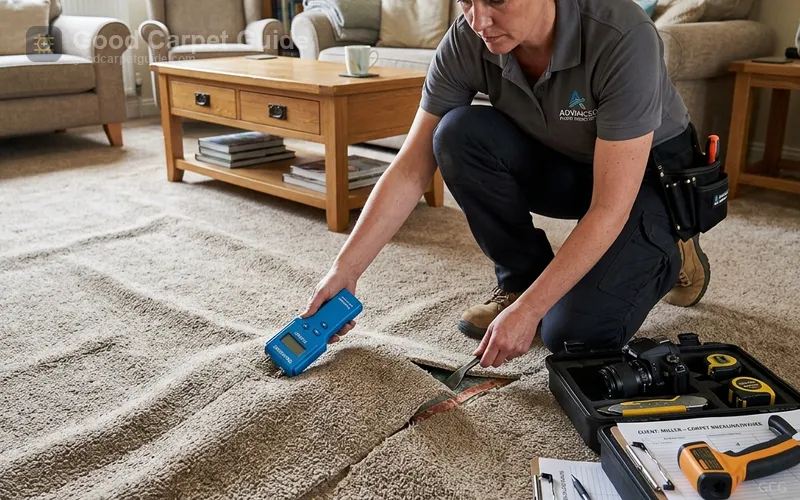
Pronounced parallel carpet buckles running perpendicular to the primary traffic pattern, indicating significant loss of mechanical tension.
6 primary root causes of carpet buckling
Carpet buckling does not happen at random. In forensic flooring investigations, field failures trace back to six specific mechanical, chemical, and environmental mechanisms.
1. Inadequate mechanical tension during installation (the knee-kicker shortcut)
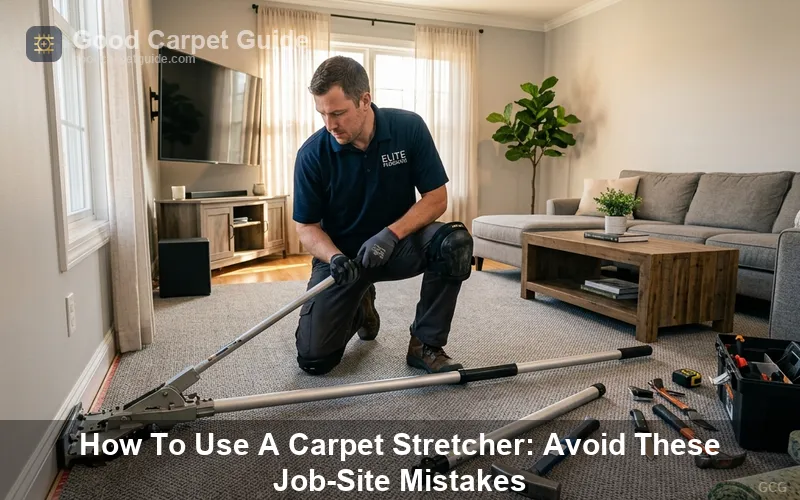
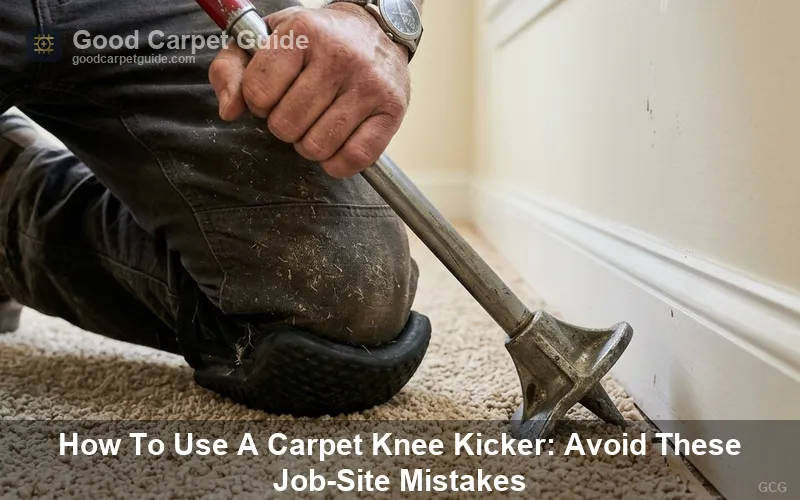
The single most common cause of carpet rippling in residential construction is installer malpractice: relying exclusively on a manual knee-kicker instead of a mechanical power stretcher.
According to the Carpet and Rug Institute's CRI 105 Standard for Installation of Residential Carpet, power stretching is mandatory for all stretch-in broadloom installations. Section 8 of CRI 105 explicitly stipulates that broadloom must achieve a drum-tight mechanical stretch between 1.0% and 1.5% elongation across both the length (warp) and width (weft) dimensions.
A manual knee-kicker is an invaluable positioning tool designed to set carpet onto tackless strip pins in small closets, hook stair treads, or adjust seam alignments. It generates an intermittent, localized lateral impulse of roughly 30 to 50 pounds of force over a tiny radius. A human technician kicking a pad cannot overcome the frictional resistance of a 12-foot or 15-foot broadloom roll resting against open-cell polyurethane padding.
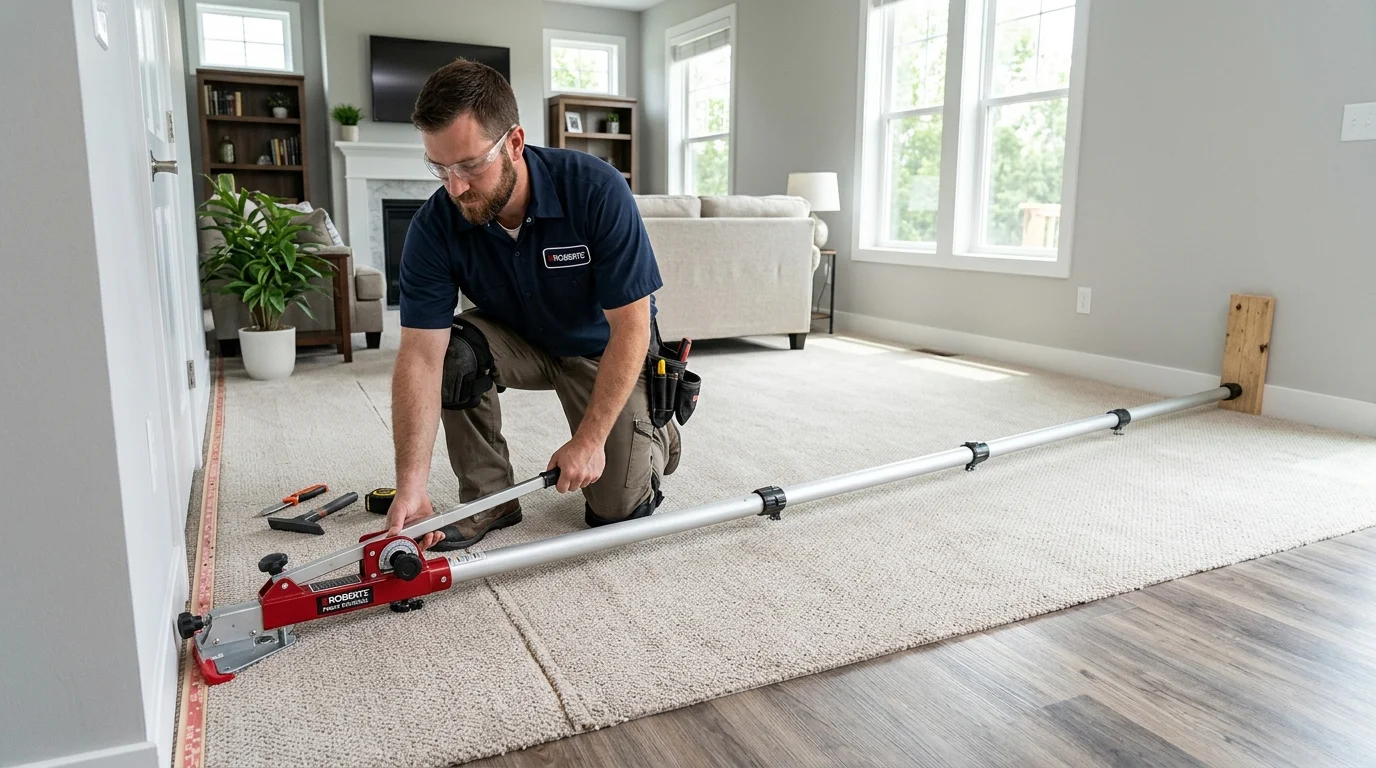
In contrast, a commercial lever-action mechanical power stretcher anchors against the opposite wall framing, utilizing steel extension tubes to exert between 300 and 500 pounds of controlled, continuous mechanical force across the entire span of the room.
When an installer relies only on a knee-kicker:
- The broadloom is merely hooked onto the perimeter pins in a relaxed, non-elongated state.
- The secondary backing retains internal elasticity that has never been engaged.
- Within 6 to 18 months, regular foot traffic, humidity fluctuations, and furniture movement cause the un-tensioned backing yarns to relax and creep inward.
- The loose broadloom lifts off the cushion, forming waves that grow progressively taller over time.
2. Backing delamination and SBR latex breakdown
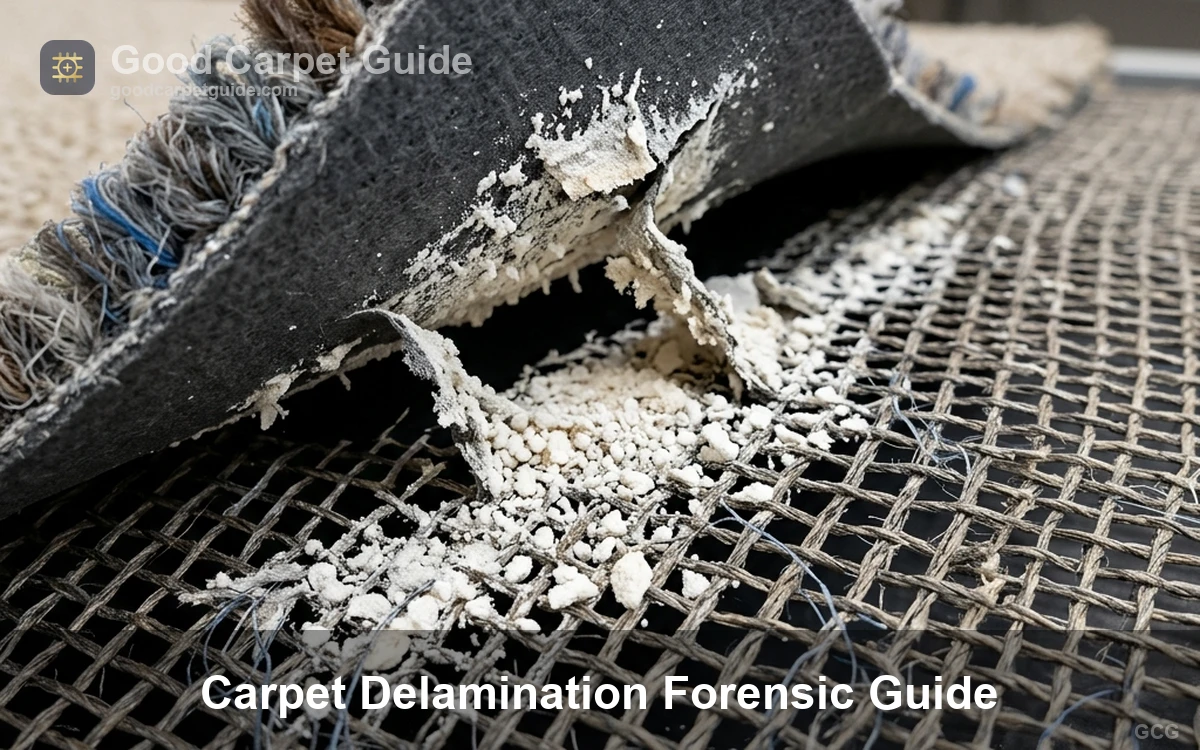
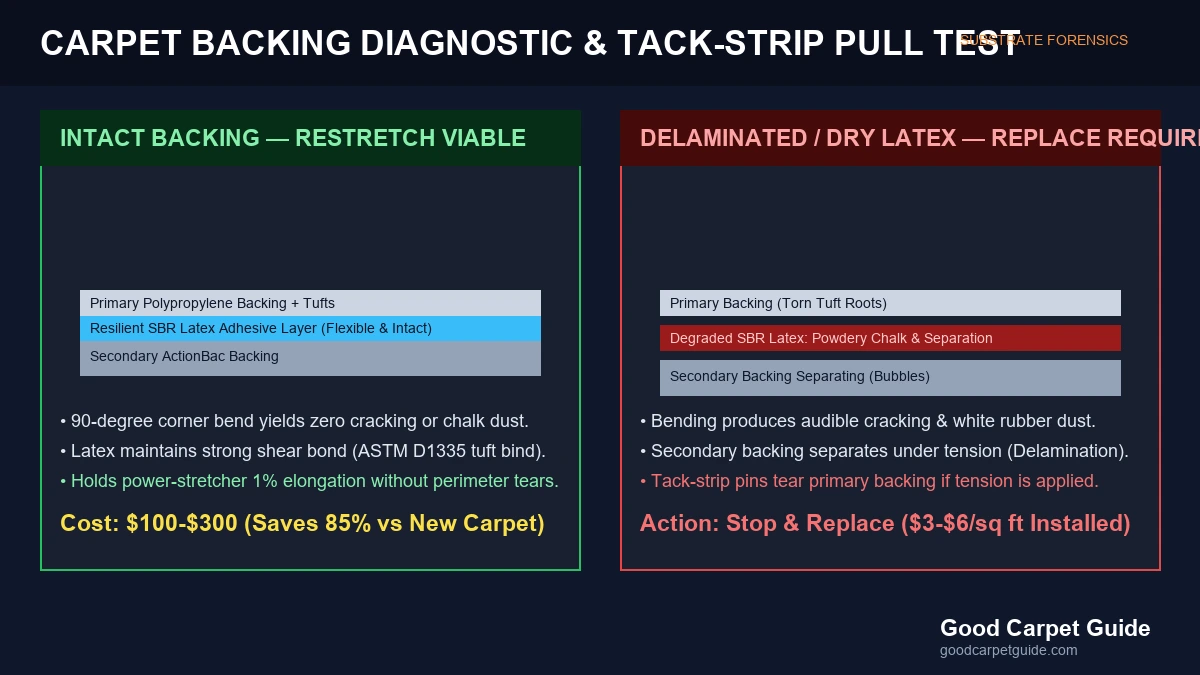
When broadloom ripples cannot be flattened even with aggressive mechanical tension, the failure is chemical rather than mechanical. This condition is known as carpet delamination , defined as the structural separation of the secondary backing from the primary backing due to the breakdown of the SBR latex adhesive bond.
The SBR latex layer is susceptible to three destructive degradation pathways:
- Chemical Hydrolysis: When high-temperature water (exceeding 160°F) or highly alkaline cleaning solutions (pH 10.0 or higher) linger in the carpet backing, the water molecules chemically cleave the polymer chains in the synthetic latex.
- Oxidative Aging: Over decades, atmospheric oxygen, heat, and ultraviolet radiation degrade the flexibility of the latex. The calcium carbonate filler grains separate from the synthetic rubber matrix, turning the adhesive into a brittle, powdery white dust.
- Pet Urine Enzymatic Attack: Cat and dog urine undergo bacterial decomposition, forming caustic ammonium hydroxide (pH 10–12). This alkaline spike directly dissolves the latex binder, permanently severing the bond between the backing layers.
Once delamination occurs, the primary backing (holding the face yarns) floats freely above the secondary backing. The top layer buckles independently of the bottom layer, producing soft, squishy air pockets and irregular wrinkles. No amount of mechanical stretching can fix a delaminated carpet; pulling tension on a delaminated broadloom simply tears the face fabric away from the perimeter pins.
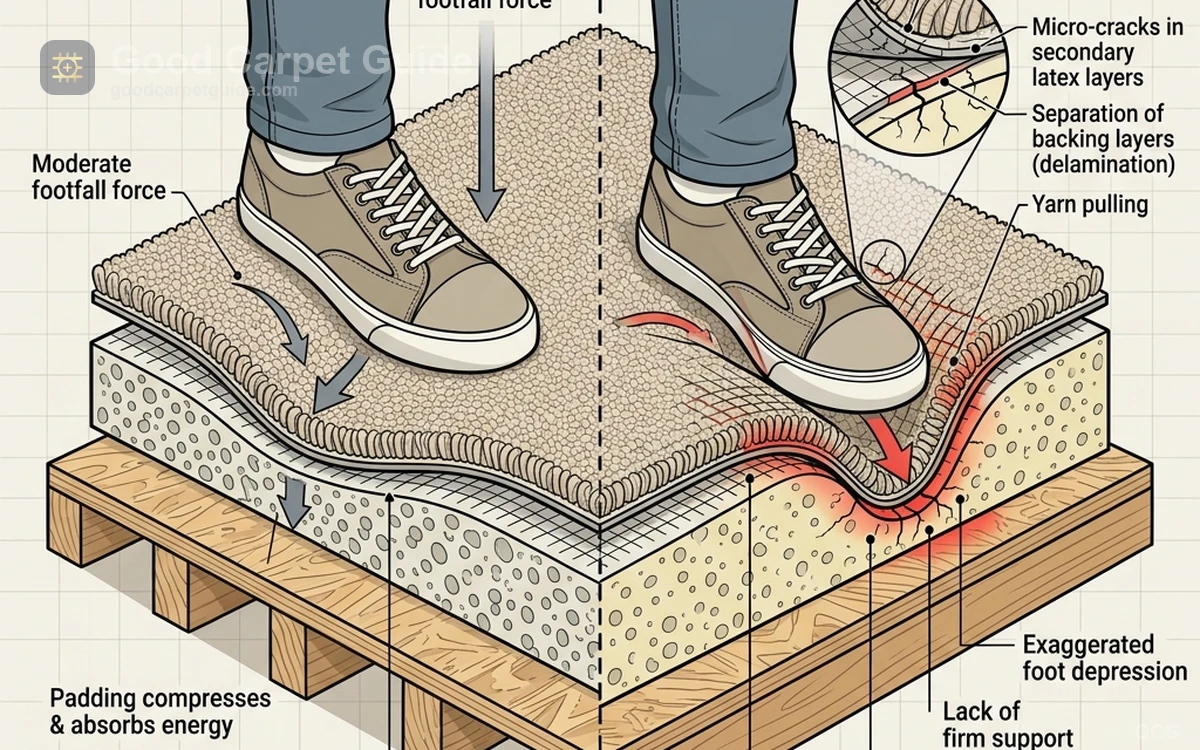
Microscopic cross-section showing calcium carbonate adhesive degradation and secondary backing separation that creates permanent carpet bubbles.
3. Thermal shock and hygroscopic moisture expansion
Carpet fibers and backing yarns are hygroscopic materials that absorb and release atmospheric water vapor in direct response to ambient relative humidity (RH).
- Polypropylene (Olefin): Virtually hydrophobic, absorbing less than 0.1% moisture by weight.
- Nylon 6 and Nylon 6,6: Moderately hygroscopic, absorbing between 4.0% and 8.0% moisture by weight under high humidity.
- Jute (Found in vintage carpets and specialty backings): Highly hygroscopic, expanding significantly along its warp yarns as humidity climbs.
When ambient relative humidity rises above 65% (common during sweltering summer months or when air conditioning systems fail), the nylon face fibers and secondary backing absorb water molecules from the air. The molecular structure of the fibers swells, increasing in diameter and elongating in length. If the carpet was installed in the dead of winter in a heated, bone-dry room (e.g., 20% RH) without adequate mechanical pre-tension, the summer humidity surge expands the broadloom beyond the holding capacity of its perimeter tack strips. The excess fabric buckles into parallel waves.
Conversely, when relative humidity drops in the autumn, the fibers desorb moisture and shrink. In mild cases caused strictly by humidity swings, minor ripples may flatten out naturally once indoor environmental equilibrium is restored (between 30% and 50% RH). However, if the carpet was walked on while buckled, the backing yarns become permanently creased and will not recover on their own.
#### The critical role of site acclimatization
CRI 105 mandates that broadloom, cushion, and adhesives must acclimatize in the conditioned installation space at temperatures between 65°F and 80°F (18°C to 27°C) and relative humidity between 30% and 60% for a minimum of 24 to 48 hours prior to cutting or installation.
Installing carpet rolled straight off a delivery truck on a freezing 20°F January morning guarantees massive buckling by July. The cold backing is stiff and resistant to stretching during installation; once heated to 72°F indoors, the thermoplastic backing softens, stretches out, and bulges off the floor.
4. Over-wetting and poor extraction during steam cleaning
Professional hot water extraction (commonly called steam cleaning) is the industry-standard method for deep soil removal. However, improper cleaning techniques by untrained operators or underpowered consumer rental machines are among the most prolific triggers of sudden carpet buckling.
Two catastrophic operator errors cause post-cleaning ripples:
- Excessive Solution Pressure and Flooding: Consumer rental extractors and uncalibrated truck-mounts inject high-pressure water directly through the primary backing and into the cushion layer. Liquid polyurethane rebond foam acts like a sponge, holding gallons of water underneath the broadloom.
- Inadequate Vacuum Recovery Passes: For every wet injection pass, a professional technician must perform two to three dry vacuum passes to recover 85%+ of the applied water. Skipping dry passes leaves the backing submerged in stagnant water.
When broadloom stays wet for more than 24 hours:
- The water-swollen backing yarns expand dramatically, creating massive ripples within 12 hours of the cleaning service.
- The moisture reactivates latent alkaline detergent residues from prior DIY cleaning attempts, initiating SBR latex hydrolysis.
- The customer assumes the cleaning technician "ruined" the carpet. In reality, the flood of water merely exposed an installation that lacked proper mechanical tension from day one.
In a carpet that possesses legitimate CRI 105 power-stretch elongation, transient rippling caused by moisture expansion will contract and pull completely flat within 24 to 48 hours as industrial air movers dry the room below 40% RH. But if the carpet remains buckled after 72 hours of total drying, the secondary backing has lost its elasticity, or the initial installation lacked proper tension.
5. Incorrect cushion density and excessive thickness
A widespread misconception among retail consumers is that a thicker carpet pad automatically equals a more luxurious, higher-quality floor. In flooring mechanics, the exact opposite is frequently true. Installing a thick, low-density cushion is a guaranteed recipe for premature broadloom buckling.
When a pedestrian walks across a carpeted room, each heel strike concentrates between 150 and 250 pounds per square inch (psi) of dynamic downward force.
- High-Density Cushion (8 to 10 lbs/cu ft): The cushion compresses slightly, absorbs the impact energy, and immediately rebounds, providing a firm, resilient foundation that keeps the carpet backing flat and stable.
- Low-Density Cushion (4 to 5 lbs/cu ft): The soft foam crushes completely flat under the heel. The carpet backing plunges downward into the crater created by the footstep.
IMPACT DYNAMICS: HIGH-DENSITY VS LOW-DENSITY CUSHION

[ High-Density 8-lb Pad (Firm) ]        [ Low-Density 4-lb Pad (Sponge) ]
        Heel Strike (200 psi)                   Heel Strike (200 psi)
               |                                       |
               v                                       v
    +----------------------+                +----------------------+
    | === CARPET PILE ===  |                | \   CARPET PILE   /  |  <-- Backing Flexes & Stretches
    +----------------------+                +--\----------------/--+
    | [8-lb Rebond Pad]    |                |   \ [4-lb Pad]   /   |  <-- Deep Vertical Crater
    +----------------------+                +----+------------+----+
    |////// SUBFLOOR //////|                |////// SUBFLOOR //////|
     (Deflection: < 1/8")                    (Deflection: > 3/8" -- Shear Failure)
As the foot steps forward, this extreme vertical deflection creates intense horizontal shear stress across the broadloom backing. The secondary backing is repeatedly flexed back and forth across the perimeter tackless strip pins.
Over time:
- The tack strip pins tear micro-slits in the secondary backing fabric.
- The perimeter anchors lose their grip.
- The carpet stretches past its elastic yield point and pools into permanent ripples throughout high-traffic corridors.
CRI 105 establishes strict maximum thickness limitations:
- Residential Cut-Pile Carpet: Maximum thickness of 7/16 inch (11 mm), with a minimum density of 6 pounds per cubic foot (8 to 10 pounds recommended for maximum durability).
- Berber and Commercial Loop-Pile Carpet: Maximum thickness of 3/8 inch (9.5 mm), with a minimum density of 8 pounds per cubic foot. Soft, thick padding under a looped carpet allows excessive movement, causing backing delamination and catastrophic yarn "zippering" along the rows.
6. Dynamic rolling loads and dragging heavy furniture
Carpet is designed to withstand vertical static compression (such as the legs of a stationary sofa) and vertical dynamic impacts (human foot traffic). It possesses very poor resistance against heavy lateral shear loads.
- Office Chairs with Hard Casters: A 200-pound person sitting in an office chair concentrates an immense rolling shear load on four or five tiny 2-inch plastic wheels. As the chair rolls across the floor, the casters pinch the broadloom fabric against the cushion and push a rolling wave of loose fabric ahead of them. This action mechanically rips the backing off the tack strip pins along the nearest baseboard. An unanchored carpet in an office will develop deep ripples within three months without a rigid polycarbonate chair mat.
- Dragging Solid Furniture: Pushing a 300-pound oak dresser or refrigerator across broadloom rather than lifting it creates horizontal pulling forces that far exceed the shear strength of perimeter tack strip nails. The broadloom hooks disengage from the pins on the trailing side, leaving large buckles across the middle of the room.
Inspection of perimeter tackless strip. Note the upward and outward angle of the steel pins required to hold mechanical broadloom tension.
Field diagnostic tests: Restretching vs irreversible delamination
Before attempting to fix a buckled carpet, a technician or homeowner must perform a diagnostic evaluation. Stretching a carpet that has suffered chemical delamination will destroy the face yarns and rip the primary backing apart.
Use this three-step field diagnostic procedure to determine whether a buckled carpet can be saved:
| Diagnostic Test | Execution Method | Restretchable (Passed) Result | Irreversible Delamination (Failed) Result |
|---|---|---|---|
| 1. The Backing Pinch Test | Grasp a prominent ripple between your thumb and index finger. Squeeze firmly and rub the layers back and forth. | The carpet feels like a single, solid, stiff plate. No internal sliding or friction between layers. | You feel two distinct layers sliding freely against each other. The ripple feels soft, hollow, or baggy like a loose shirt. |
| 2. The Sound and Dust Test | Kneel down next to the buckle, place your palm on the apex, and press firmly while twisting your hand. | Quiet compression of the cushion. The backing remains flexible and silent. | A distinct, crunchy, crackling sound (like stepping on dried leaves). Fine white chalk-like dust puffs out of the backing (crystallized latex binder failure). |
| 3. The Underside Visual Check | Disengage the carpet from the tack strip near the buckle using an oyster knife or pliers. Inspect the underside. | Secondary ActionBac mesh is firmly adhered to the primary backing. Latex film is continuous, smooth, and amber/tan. | Secondary mesh has peeled away from primary tufts. Yellowed, flaking, broken latex with bare exposed yarn loops visible. |
The Diagnostic Rule of Thumb: If the carpet passes the Pinch Test and Sound Test, it is simply loose broadloom that can be restored to showroom flatness via professional mechanical restretching. If it fails either test, the SBR latex adhesive has failed. Restretching will not hold; the affected carpet section must be cut out and patched, or the room must be replaced.
Complete step-by-step mechanical restretching protocol
If your carpet passed the diagnostic tests, it can be permanently re-tensioned using the four-wall quadrant power-stretching sequence detailed in our comprehensive how to stretch carpet yourself guide .
Restretching is not a matter of randomly pulling on the carpet. It requires a mathematically defined sequence of anchor walls, diagonal tension vectors, and perimeter trimming.
THE 4-WALL MECHANICAL RESTRETCHING QUADRANT SEQUENCE

               WALL 2 (Secondary Anchor Wall)
         [Knee-kicker hooked & locked down]
     +-----------------------------------------+
     | ^        ^         ^         ^        ^ |
     | |        |         |         |        | |
W    | |        |         |         |        | |  W
A    | |        |         |         |        | |  A
L    | |        |         |         |        | |  L
L    | |        |         |         |        | |  L
     | |        |         |         |        | |
1    | |        |         |         |        | |  3
     | |        |         |         |        | |
(    | |        |         |         |        | |  (
A    | |        |         |         |        | |  T
n    | +--------+---------+---------+--------+ |  a
c    |                                         |  r
h    |  ----->   ----->   ----->   ----->   -> |  g
o    |                                         |  e
r    |   (Power Stretcher 45-Degree Vectors)   |  t
)    |                                         |  )
     +-----------------------------------------+
               WALL 4 (Final Target Wall)
       [Power Stretcher Head - Cut & Tuck Gully]
Phase 1: Room preparation and clearing
- Remove all furniture from the room. You cannot power-stretch a carpet around sofas, bed frames, or dressers. The weight of furniture anchors the broadloom to the subfloor, preventing tension vectors from traveling across the room and creating concentrated tears around furniture legs.
- Inspect all doorway transitions (metal clamps, vinyl reducers, wooden thresholds). Unscrew or pry up transition strips where the carpet meets tile, hardwood, or adjacent carpeted rooms.
Phase 2: Disengaging target perimeters
- Leave Wall 1 (the longest uninterrupted wall) and Wall 2 (adjacent wall) fully engaged on their tackless strips. These serve as your rigid mechanical anchors.
- Using a carpet awl or needle-nose pliers, gently pry the broadloom off the tackless strip pins along Wall 3 and Wall 4 (the target walls toward which the ripples will be pushed). Never yank the carpet violently upward; jerking the fabric can shred the secondary backing or snap the wooden tack strips off the subfloor.
Phase 3: Inspecting tack strips and perimeter gully
- Inspect the bare tackless strips along the target walls. Every strip must be firmly nailed or screwed into the subfloor, with pins angled backward toward the wall at roughly 60 degrees.
- Verify the perimeter gully width. The gap between the tack strip and the baseboard must equal approximately two-thirds of the overall carpet thickness (typically 1/4 inch to 3/8 inch). If the gully is too wide, the carpet edge will pull out of the tuck; if the gully is too narrow, the carpet backing cannot fold downward, preventing the pins from biting into the fabric.
- If any tack strip has rusted pins, rotted wood, or loose nails, replace it immediately before applying tension.
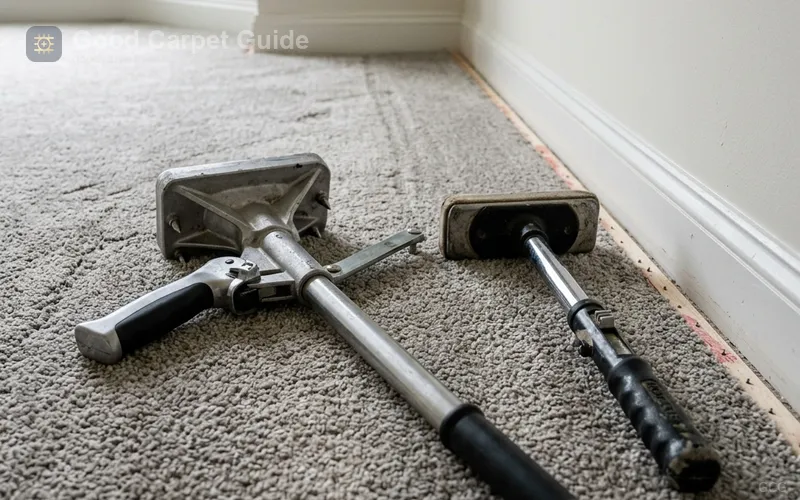
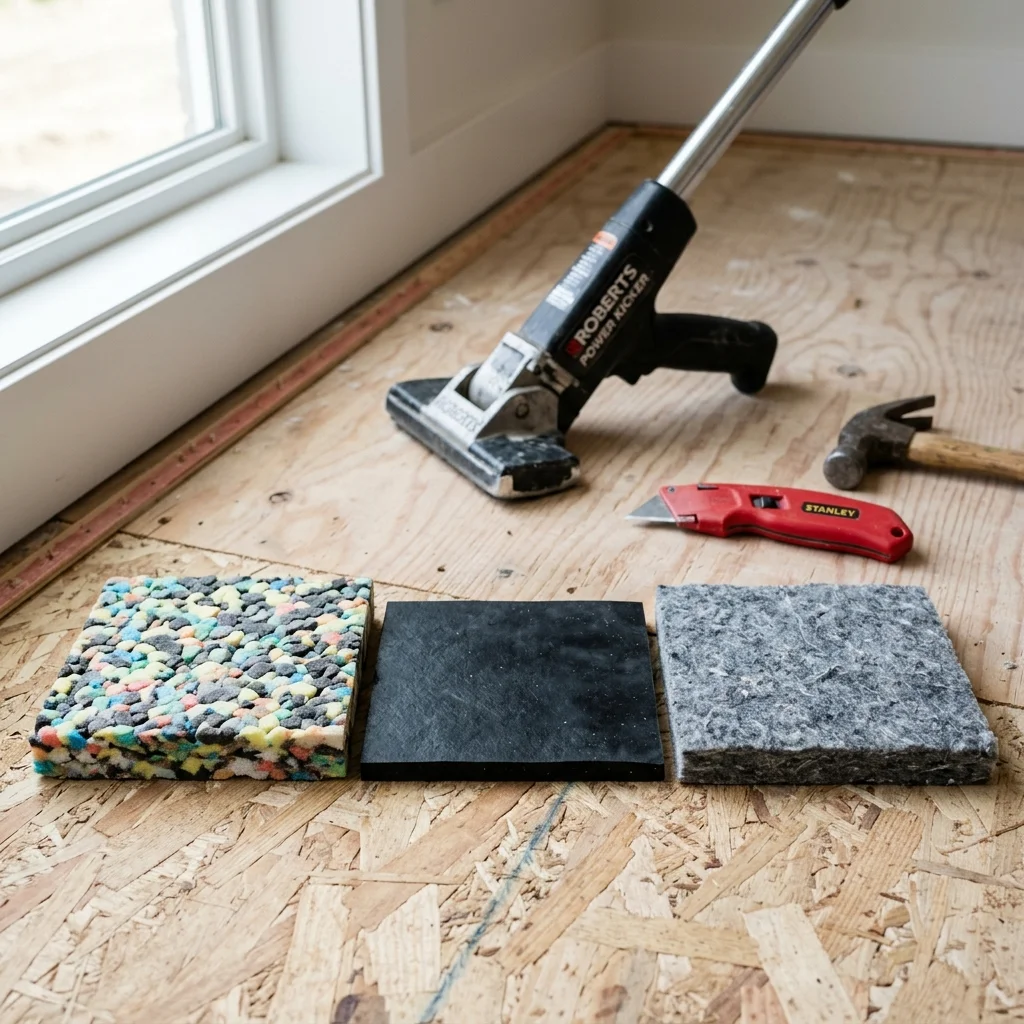
Essential tools for broadloom re-tensioning: commercial power stretcher with extension poles, knee-kicker for perimeter positioning, and carpet wall trimmer.
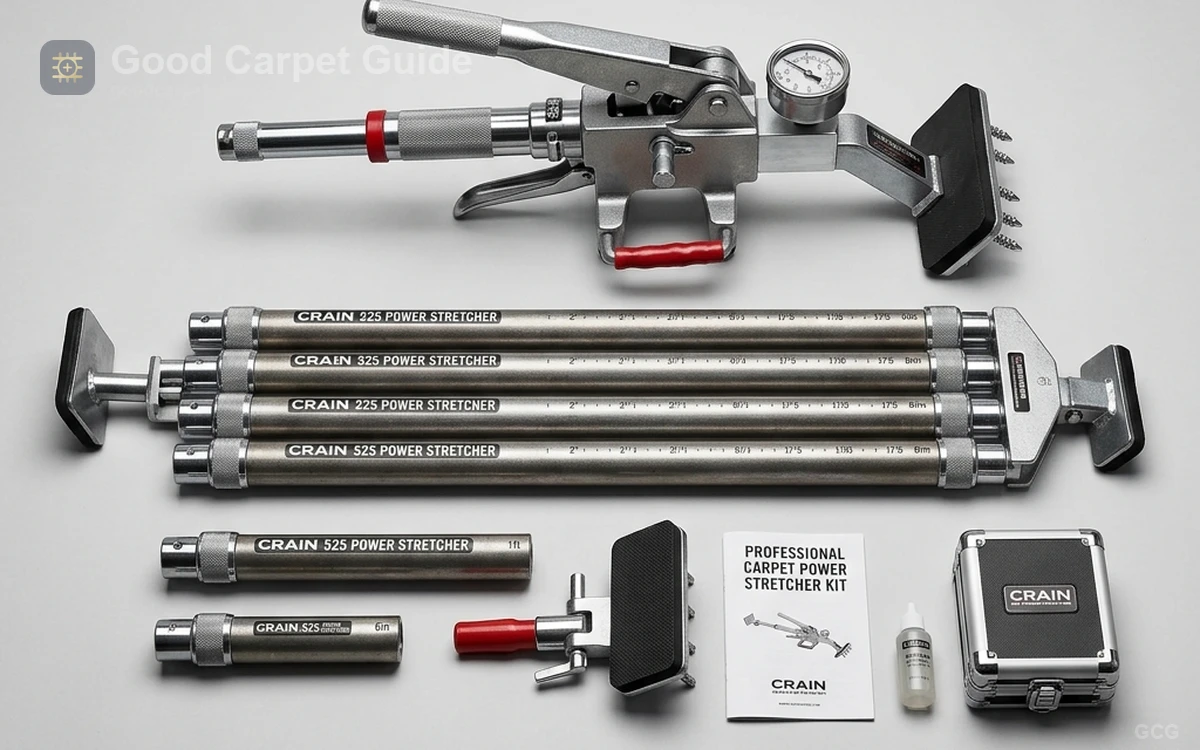
Roberts 10-254 Professional Power Carpet Stretcher
Commercial lever-action power stretcher providing drum-tight mechanical elongation per CRI 105 standards.
Check Price on Amazon
Roberts 10-505 Deluxe Knee Kicker
Adjustable-depth pin kicker designed exclusively for positioning and perimeter tack strip hooking.
Check Price on AmazonPhase 4: Setting up the mechanical power stretcher
- Position the base plate of the power stretcher against the baseboard of Anchor Wall 1.
- Place a smooth 2x4 scrap lumber block (at least 24 inches long) between the stretcher base plate and the baseboard. This block distributes the 400+ pounds of thrust force across multiple wall studs, preventing the steel plate from punching holes through the drywall.
- Assemble the tubular steel extension poles across the room so the power head reaches within 6 inches of Target Wall 3.
- Adjust the pin depth dial on the power head. The steel pins should penetrate completely through the primary backing to grab the secondary mesh without driving deeply into the underlying cushion.
Phase 5: Power-stretching tension vectors
- Push down on the mechanical handle to lock the power head in place. You will see the ripples flatten as the fabric elongates toward the wall.
- While the stretcher holds full mechanical tension, use a manual stair tool or carpet tucker to firmly seat the stretched backing onto the tackless strip pins.
- Release the handle, advance the stretcher head 18 to 24 inches along the wall, and repeat the process. Work methodically from the center of the room outward to the corners, driving the excess fabric toward Target Wall 3 and Target Wall 4.
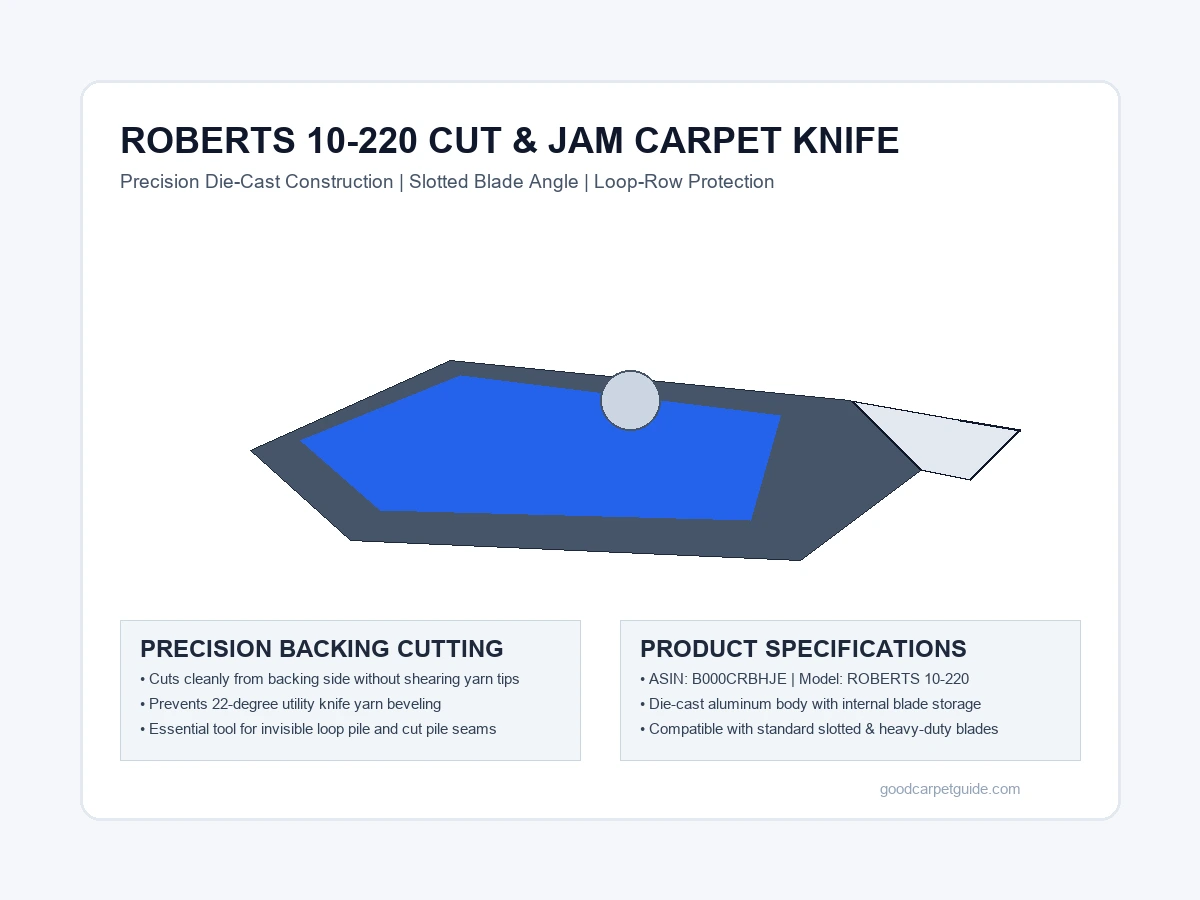
Roberts 10-146 Cushion Back Carpet Cutter
Dual-blade precision trimmer for clean row-following cuts on excess broadloom.
Check Price on Amazon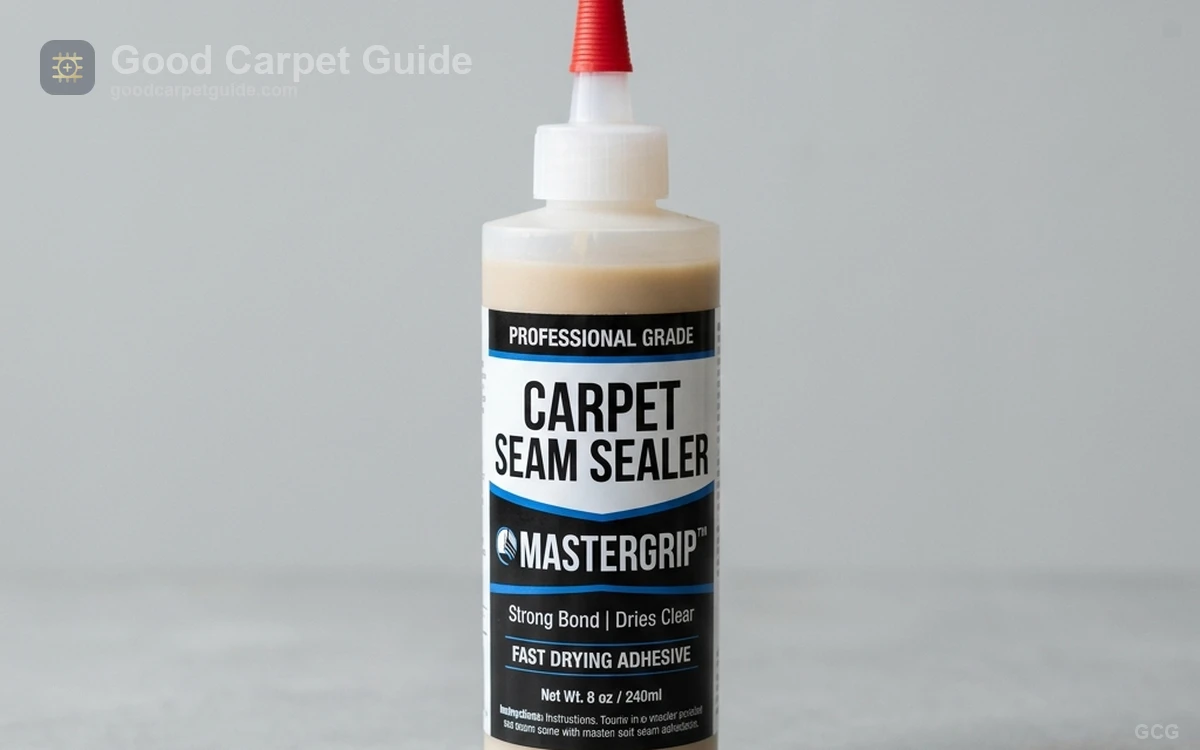
Roberts 8015 Universal Carpet Seam Sealer
Thermoplastic edge adhesive preventing fiber loss and unraveling along cut edges.
Check Price on AmazonPhase 6: Precision edge trimming, sealing, and tucking
- After power-stretching, you will have between 1/2 inch and 2 inches of excess broadloom bunching up against the target baseboards.
- Using a specialized carpet wall trimmer (or a Roberts cushion-back cutter), trim the excess broadloom, leaving exactly 1/4 inch to 3/8 inch of carpet extending past the tackless strip.
- Apply a thin, continuous bead of thermoplastic edge seam sealer (such as Roberts 8015) along the freshly cut raw edge. Seam sealer encapsulates the cut backing yarns, preventing fraying, fiber loss, and backing delamination over time.
- Use a wide-blade carpet tucker to firmly drive the sealed edge down into the perimeter gully between the tack strip and the wall. The folded edge locks behind the angled pins. This ensurings the carpet cannot creep backward under foot traffic.
- Re-anchor all doorway transition strips. This ensurings the stretch tension remains uniform across adjacent rooms as covered in our carpet repair master guide .
When carpet buckling requires subfloor or backing repair
In certain structural failure scenarios, simple mechanical restretching will fail to keep the carpet flat. Homeowners must watch for these compounding issues:
1. Rotted or delaminated subfloor panels
If an unconditioned crawl space or plumbing leak introduces moisture beneath the flooring, plywood subfloor panels can delaminate, or oriented strand board (OSB) can swell along its tongue-and-groove joints. When the subfloor swells upward by 1/4 inch, it pushes the cushion and carpet up with it, creating a rigid ridge that cannot be stretched out. The carpet and cushion must be folded back, the damaged subfloor cut out with a circular saw, and a new plywood panel screwed flush into the joists before the carpet is reinstalled.
2. Concrete slab moisture emissions and efflorescence
On ground-floor or basement concrete slabs, high hydrostatic pressure drives water vapor upward through the slab pores. When this moisture hits the underside of the carpet pad, it carries dissolved mineral salts (calcium sulfate and sodium carbonate). These salts crystallize into a white, caustic crust (efflorescence) that destroys the tackless strip masonry nails and attacks the carpet's SBR latex adhesive. On concrete slabs, a subfloor moisture vapor test (calcium chloride test per ASTM F1869 or in-situ relative humidity probe per ASTM F2170) is mandatory before reinstalling broadloom.
3. Split or peaked seams
When carpet ripples run directly parallel to a seamed joint, the heat-activated seaming tape underneath has likely failed. If the original installer used low-melt residential seaming tape on a high-traffic broadloom or failed to seal the seam edges, tension pulling across the seam will cause the joint to "peak" into an raised V-shaped ridge. Peaked seams must be sliced open, the old adhesive tape scraped away, and a new 4-inch premium commercial hot-melt tape applied with an electric seaming iron before restretching.
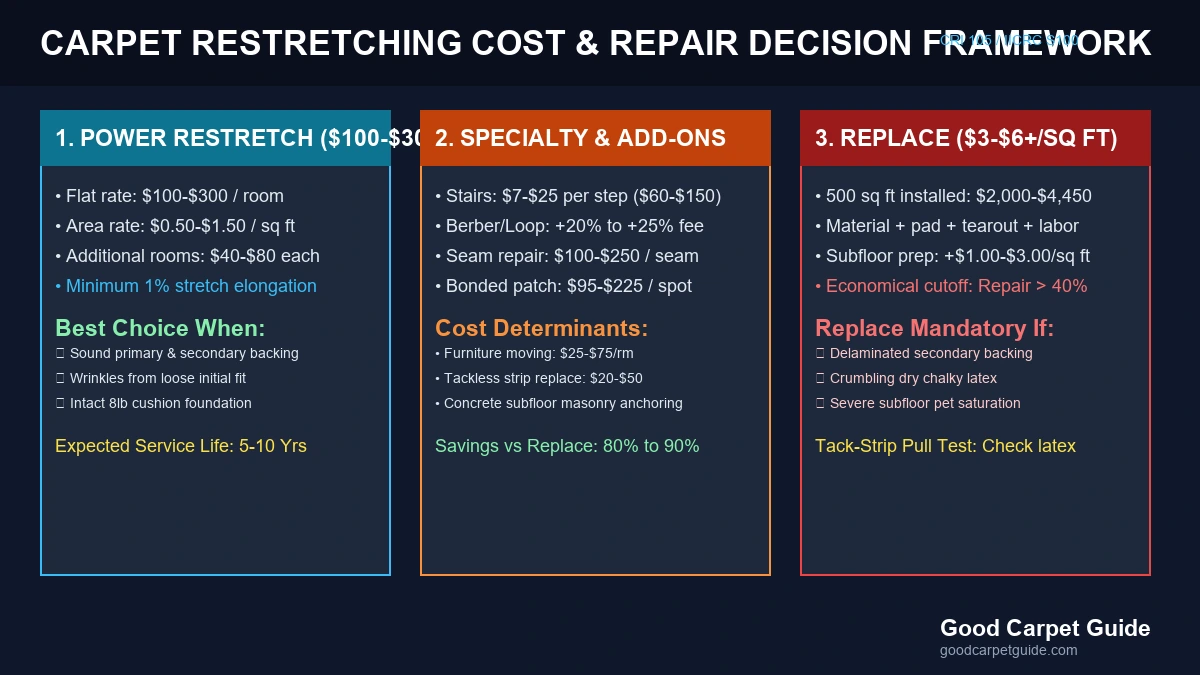
Remediation and restretching cost breakdown
When evaluating carpet buckling repairs, homeowners face three service paths: DIY tool rental, professional restretching labor, or full replacement.
| Service Scope | Estimated Cost | Work Performed | Best Application |
|---|---|---|---|
| DIY Tool Rental & Restretch | 75 –150 total | Rental of power stretcher, knee-kicker, and wall trimmer for 24 hours. Owner provides labor and furniture moving. | A single rectangular bedroom with minor ripples and structurally sound backing. High physical labor requirement. |
| Professional Restretching (Single Room) | 125 –250 per room | Certified flooring technician resets perimeter, applies 1.0–1.5% mechanical power stretch, trims, seals, and tucks edges. | Standard residential rooms (up to 200 sq ft) with sound backing where furniture is minimal. |
| Multi-Room / Whole-House Restretch | 350 –750 total | Comprehensive re-tensioning across 3 to 5 interconnected rooms, resetting transitions, power-stretching through doorways. | Homes with widespread buckling caused by original knee-kicker installation shortcuts. |
| Cushion Tear-Out, Subfloor Prep & Restretch | 1.75 –3.50 per sq ft | Pulling carpet, removing failed low-density pad, securing loose subfloor panels, installing new 8-lb rebond, and re-tensioning. | Carpets buckled due to low-density sponge pad failure or moderate water damage without broadloom delamination. |
| Full Carpet & Pad Replacement | 3.50 –11.00 per sq ft | Complete disposal of failed broadloom and pad, subfloor prep, new high-performance carpet and premium cushion installed per CRI 105. | Carpets showing extensive SBR latex delamination, crunchy backing dust, or severe permanent fiber creasing. |
Pricing Note: Most professional flooring contractors require a minimum service fee of 150 to200 to dispatch a crew with power-stretching equipment. Emptying the room of all furniture prior to the technician's arrival can save between 50 and150 in furniture-moving surcharges.
Long-term prevention checklist for homeowners
Preventing carpet buckling begins long before the first ripple appears. Follow this contractor checklist during installation, cleaning, and daily maintenance:
- [ ] Verify Power Stretcher Use on Site: When hiring a carpet installation contractor, explicitly write into the contract: "Installation must strictly comply with CRI 105 Section 8 using a mechanical power stretcher." If the crew arrives carrying only a knee-kicker and a utility knife, stop the job immediately.
- [ ] Enforce 24-to-48 Hour Acclimatization: Never allow broadloom to be installed immediately after being unloaded from a delivery van in extreme cold or sweltering heat. Store the rolls flat in the conditioned home with the HVAC system running at 68°F–72°F for at least 24 hours.
- [ ] Demand 8-lb Density Cushion: Specify an 8-pound to 10-pound density rebond polyurethane cushion with a thickness between 3/8 inch and 7/16 inch. Reject soft, low-density 4-lb or 5-lb prime foam pads regardless of showroom sales pitches.
- [ ] Maintain Indoor Climate Control: Maintain year-round indoor relative humidity between 30% and 55% and temperatures between 65°F and 80°F. If your home experiences humid summers, operate a whole-house dehumidifier or central air conditioning to prevent hygroscopic nylon fiber expansion.
- [ ] Control Cleaning Extraction Dynamics: When scheduling professional hot water extraction, hire certified IICRC technicians who utilize truck-mounted extraction and verify that they perform dual dry vacuum passes. Ensure high-volume air movers operate until the carpet is completely dry to the touch within 6 to 12 hours.
- [ ] Equip Rolling Chairs with Hard Floor Mats: Never allow office chairs with standard plastic casters to roll directly on broadloom carpet. Install thick, beveled-edge polycarbonate or tempered glass chair mats to distribute dynamic caster loads across a wide surface area.
- [ ] Lift, Never Drag, Heavy Furniture: When rearranging furniture, utilize smooth PTFE furniture slides under heavy legs, or lift the piece completely off the floor. Dragging heavy wardrobes or entertainment centers exerts devastating shear force on perimeter tackless strips.
Conclusion: Restoring the drumhead tension plane
Carpet buckling is a mechanical warning light. Whether triggered by an installer who cut corners with a knee-kicker, a flood of cleaning solution that softened the SBR latex binder, or an underspecified cushion that bottomed out underfoot, wrinkles indicate that your carpet has lost its functional tension plane.
Do not ignore carpet ripples or wait for them to resolve on their own. Every footstep over a raised buckle causes the face fibers along the ridge to grind sideways, creating permanent wear lines and fiber crushing that remain visible even after the carpet is eventually pulled flat.
Perform the Backing Pinch Test to confirm your carpet's structural integrity. If the backing is solid, hire a professional equipped with a mechanical power stretcher to restore drum-tight CRI 105 elongation. By securing the perimeter with proper gully geometry, trimmed edges, and thermoplastic seam sealer, you eliminate trip hazards and extend the functional lifespan of your broadloom flooring by a decade or more.