Carpet fraying stops when the exposed backing is mechanically trimmed, chemically encapsulated, and mechanically secured at vulnerable transitions. A 5-degree bevel on cut-pile carpet reduces the visible backing gap, while a continuous 1/8" (3 mm) bead of high-solids seam sealer locks the backing yarns together. Doorway edges require a tack-strip or Z-bar connection because foot shear and vacuum loads repeatedly pull against the raw edge.
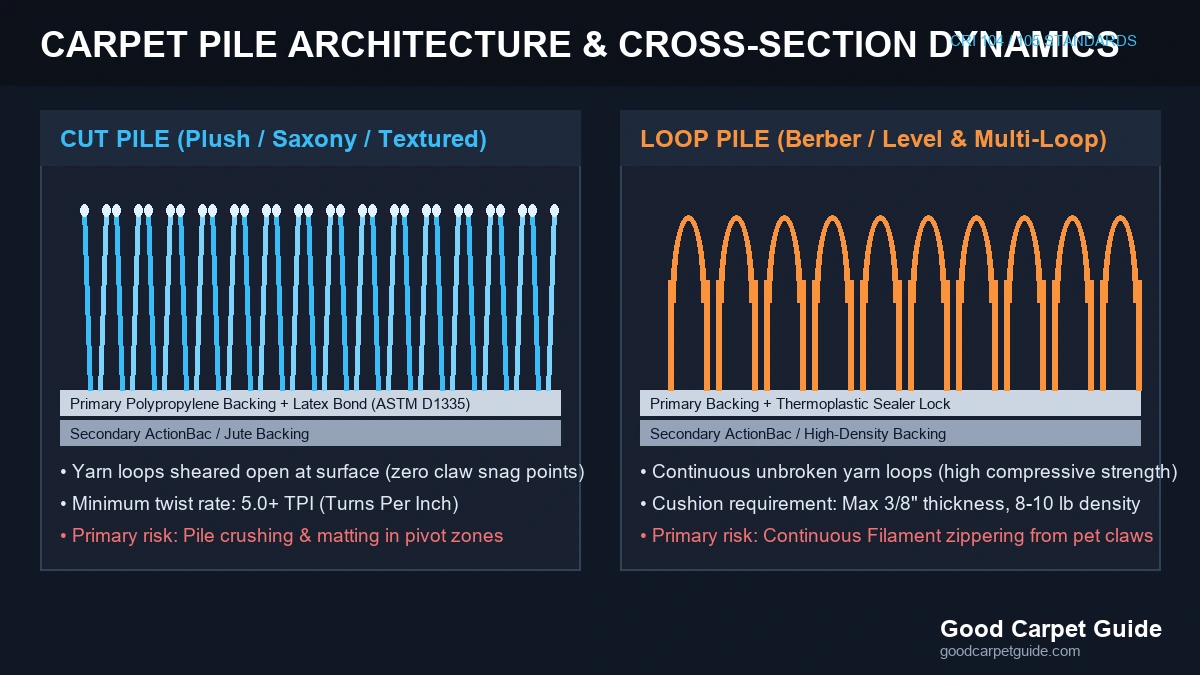
Berber and other loop-pile carpets require a different cutting method because each loop can remain structurally connected to the next yarn segment. A standard straight cut can release an entire row and create a zipper-like run. A loop-pile cutter with a row guide separates the rows before cutting the backing. Professional edge stabilization therefore depends on pile construction, backing chemistry, location, and mechanical loading.
why carpet edges fray and unravel
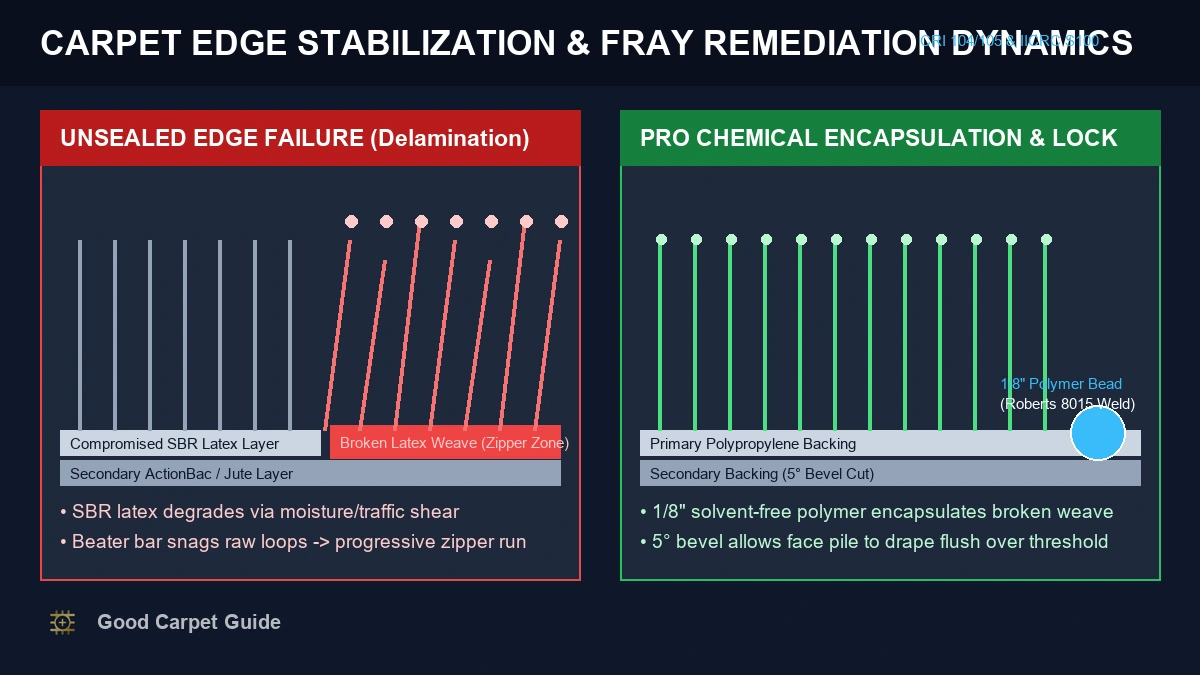
Carpet edge failure is primarily a backing-adhesion and yarn-retention problem, with SBR latex bonding the primary and secondary backing layers and physical shear progressively exposing the cut matrix. The backing commonly consists of woven polypropylene or natural jute bonded with filled styrene-butadiene rubber latex, and calcium carbonate is commonly used as a filler in that adhesive layer.
The carpet construction determines what happens after an edge is cut. Face yarns are tufted through the primary backing, while the secondary backing provides dimensional stability. When the SBR bond remains intact, the backing resists yarn movement. When the adhesive matrix deteriorates or the woven backing is mechanically cut, individual backing yarns can begin to unravel.
Moisture and chemistry can accelerate backing degradation. Slow-drying wet cleaning can keep the backing damp for extended periods, while alkaline contamination such as pet urine can contribute to hydrolytic degradation of susceptible adhesive systems. The resulting delamination reduces the mechanical anchor available to face yarns. See the carpet delamination guide for the broader failure mechanism.
Doorways receive particularly high mechanical loading. A vacuum cleaner brush roll can snag a loose edge and pull several yarns at once. Repeated foot traffic applies lateral shear across the transition. Pet claws can catch an already-loose corner and mechanically tear the backing toward the subfloor.
Loop pile presents the highest consequence from a single snag. Continuous or semi-continuous loop yarns can transfer tension along a row. A damaged loop can therefore develop into a longitudinal run rather than remaining an isolated defect.
The repair principle is simple: remove unstable material, anchor the remaining backing, and protect the edge from recurring mechanical loads. Chemical sealing handles yarn retention, while tack strips, Z-bars, binding systems, or serging provide the mechanical edge structure.
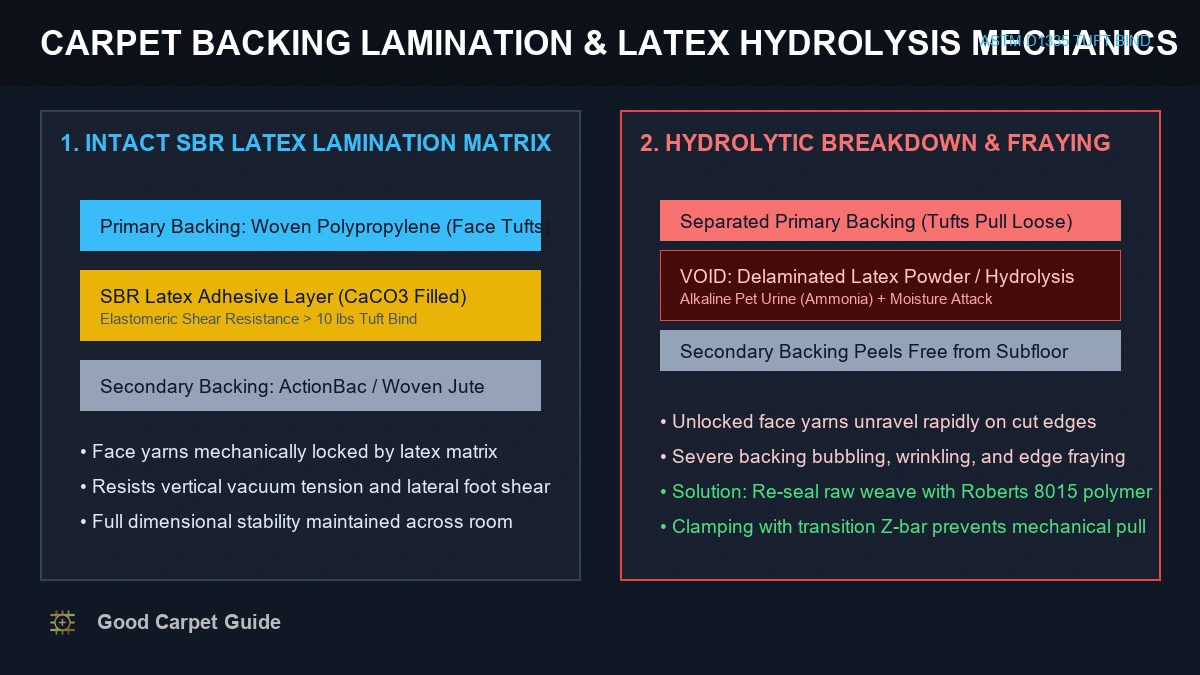
Microscopic cross-section of carpet backing showing how SBR latex degradation triggers yarn pull-out and how polymeric sealers encapsulate cut edges.
trimming cut pile versus berber loop carpet
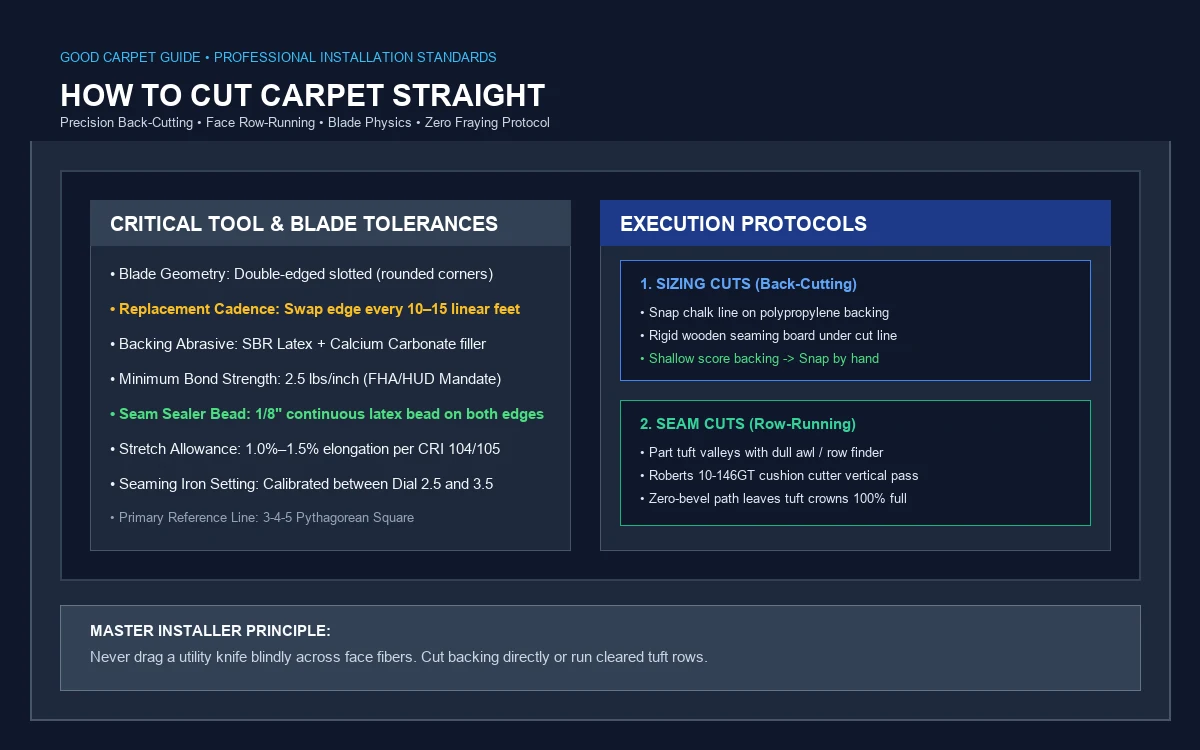
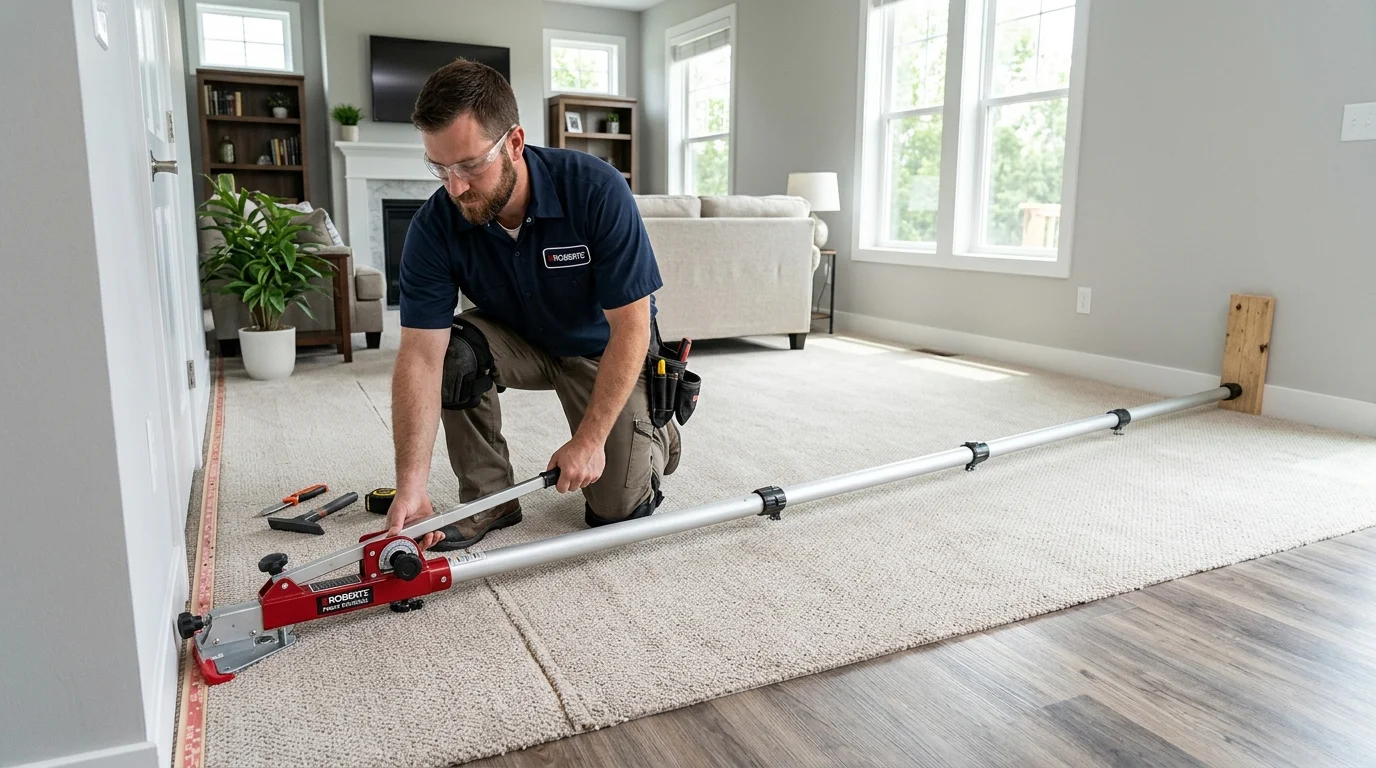
Cut-pile carpet should be trimmed with approximately a 5-degree bevel so the secondary backing terminates slightly behind the face yarns and the pile can cover the edge. Berber and other loop-pile carpet requires a row-guided loop cutter because cutting through a continuous loop row can release a zipper-like run.
A straight cut through cut pile often exposes a visible strip of secondary backing. The problem becomes more pronounced when two pieces must form a butt joint. A beveled cut changes the geometry of the edge so the face fibers can bloom toward the adjoining piece.
A practical field method is to hold the carpet knife at approximately 5 degrees and remove damaged backing without unnecessarily shortening the face yarns. Duckbill napping shears can then remove isolated protruding fibers without gouging the backing.
Berber requires greater control. A standard utility knife can cross the yarn row and sever continuous loop structure. A Roberts 10-152GT loop-pile cutter uses a dual-blade guide that rides between rows. The operator follows the existing row and cuts the backing rather than randomly slicing through the loop structure.
The distinction is important when deciding between repair and replacement. The cut pile vs loop pile carpet comparison explains why the same trimming technique cannot be applied safely to both constructions.
Do not repair an active loop run by simply snipping the visible loose loop. The loose section may be connected to a longer yarn path beneath the surface. Stabilize the row and secure the backing before removing damaged fibers.
Once the damaged edge is trimmed, apply the appropriate seam or edge sealer. Cutting alone creates a new exposed backing edge, so the repair remains vulnerable unless the cut matrix is chemically anchored.
ROBERTS 10-146-3 Cushion Back Carpet Cutter
Adjustable-blade precision edge cutter engineered for clean beveled trimming of secondary backing.
Check Price on Amazonprofessional edge stabilization methods compared
Professional carpet edge stabilization combines a specific material with a specific loading condition, with polymer seam sealer providing chemical encapsulation and Z-bar or gripper systems providing immediate mechanical compression. The correct method depends on backing composition, pile type, edge location, and expected traffic.
| Method | Primary mechanism | Typical application | Set or cure | Relative durability |
|---|---|---|---|---|
| PVA/synthetic polymer sealer | Chemical encapsulation of backing yarns | Raw seams, doorways, transitions | Roberts 8015: about 10 min tack-free; 12–24 hr full cure | High |
| Natural rubber latex | Flexible aqueous rubber bond | Jute, wool, cotton rugs | About 1–2 hr set; 24 hr cure | High |
| Instabind edge binding | Adhesive flange plus polyamide hot-melt bead | Remnants, runners, custom rugs | About 5–10 min initial set | Moderate to high |
| Z-bar/metal gripper | Mechanical compression and steel-tooth retention | Carpet-to-hard-surface transitions | Immediate mechanical lock | Very high |
| Professional serging/overcasting | Continuous stitched edge | Premium rugs and wool | Machine-finished | Very high |
Roberts 8015 Universal Seam Sealer is suited to synthetic carpet edge stabilization because it forms an elastomeric bond around the exposed backing. The supplied field specification gives a 1/8" bead and approximately 10-minute tack-free period, with full cure in 12–24 hours.
Roberts 8502 natural rubber latex is better suited to natural materials such as jute, wool, and cotton rugs. Its aqueous rubber-emulsion structure provides flexibility where the substrate itself requires a more flexible edge treatment.
Instabind creates a finished binding edge rather than simply sealing raw backing. Its acrylic adhesive flange attaches the binding to the underside, while a high-temperature polyamide hot-melt bead fills the channel between the piping and face fibers.
Z-bars and metal gripper systems address a different failure mode. Steel teeth physically retain the carpet while the transition hardware compresses the edge. This makes the system particularly useful where vacuum cleaners and rolling loads repeatedly contact the threshold.
Professional serging uses continuous stitching to create a finished textile edge. It is generally selected for high-end rugs and wool pieces where appearance carries more value than a quick field repair.
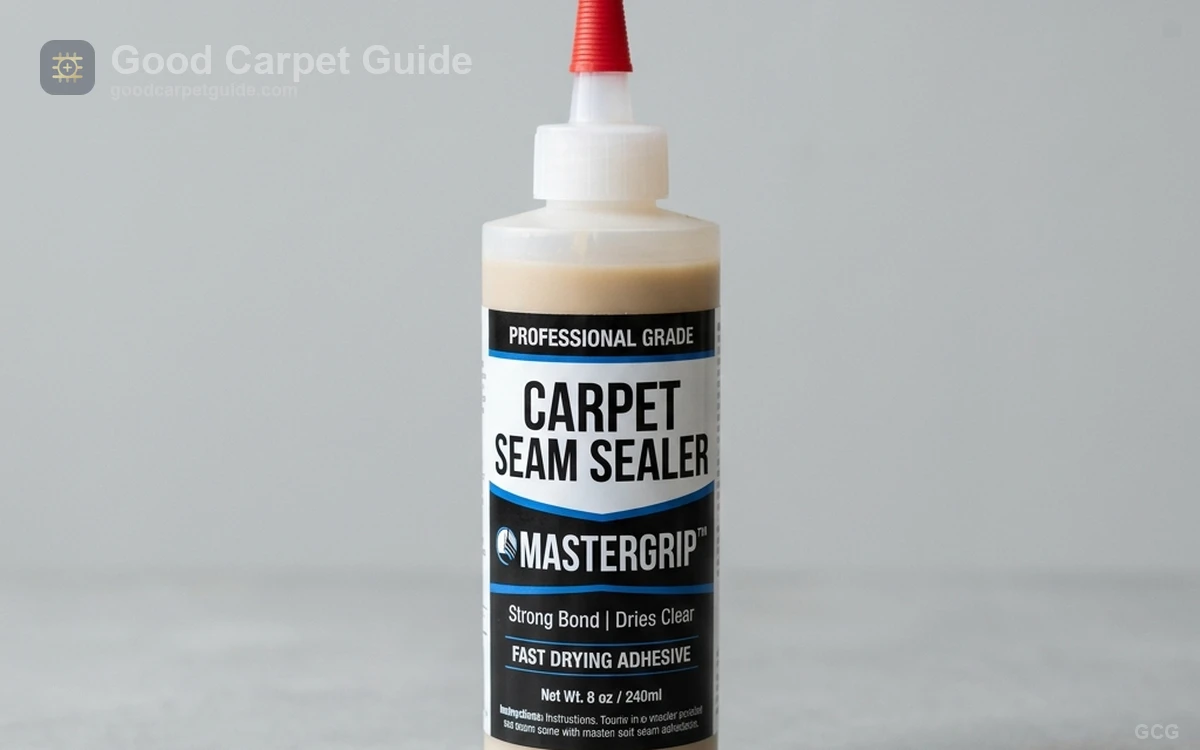
ROBERTS 8015 Universal Carpet Seam Sealer
Commercial-grade solvent-free latex seam adhesive designed to prevent edge unraveling and zipper seams.
Check Price on Amazonstep-by-step guide to repairing frayed doorway transitions
A frayed doorway transition should be rebuilt by trimming unstable backing, applying a continuous 1/8" sealer bead, retensioning the carpet, and mechanically clamping the edge into the transition. This sequence restores both yarn retention and resistance to vacuum and foot-traffic shear.
Start by exposing the carpet edge. Use pliers to pull the carpet back from the tack strip pins and inspect the transition area. A functioning tuck gully should provide approximately 1/4" of space for the carpet edge to enter beneath the hard-surface transition.
Remove loose and delaminated backing before applying adhesive. Use a slotted knife, cushion-back cutter, or duckbill shears to create a controlled edge. On cut pile, maintain approximately a 5-degree bevel rather than cutting the edge vertically.
Clean the tuck gully thoroughly. Loose dust and debris can interfere with the sealer bond and prevent the backing from reaching the required depth.
Apply a continuous 1/8" (3 mm) bead of Roberts 8015 into the gully. The bead should remain continuous along the repaired section. A discontinuous application leaves portions of the woven backing mechanically exposed.
Use a knee kicker to restore carpet tension over the tack strip. The carpet should reach the required position without excessive stretching that distorts the pile or backing.
Use a carpet tucker to force the raw backing edge into the sealer-filled gully. The objective is complete encapsulation of the exposed backing layers. Surface contact between sealer and backing matters more than applying a visually thick adhesive layer.
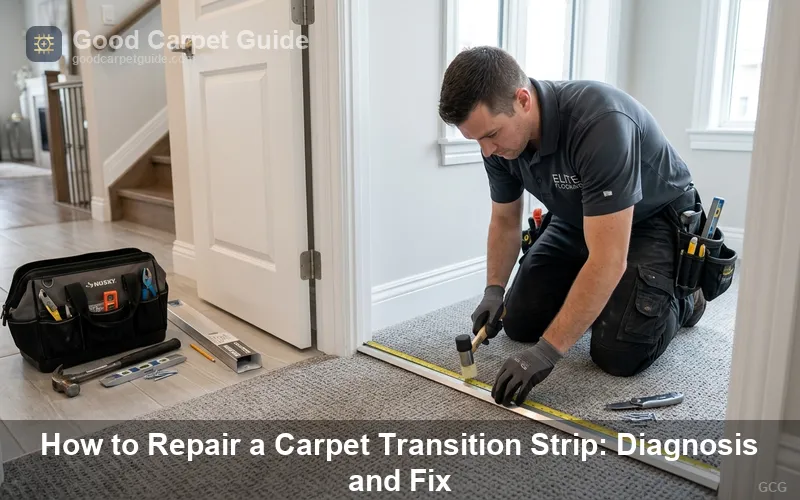
Install the Z-bar or metal transition hardware after the edge is properly positioned. Use a wood block and rubber mallet to seat the aluminum transition without directly striking a finished surface.
The completed transition should hold the carpet edge below the primary walking surface. The mechanical hardware takes the repeated loading that would otherwise be transferred directly to the sealed carpet edge.
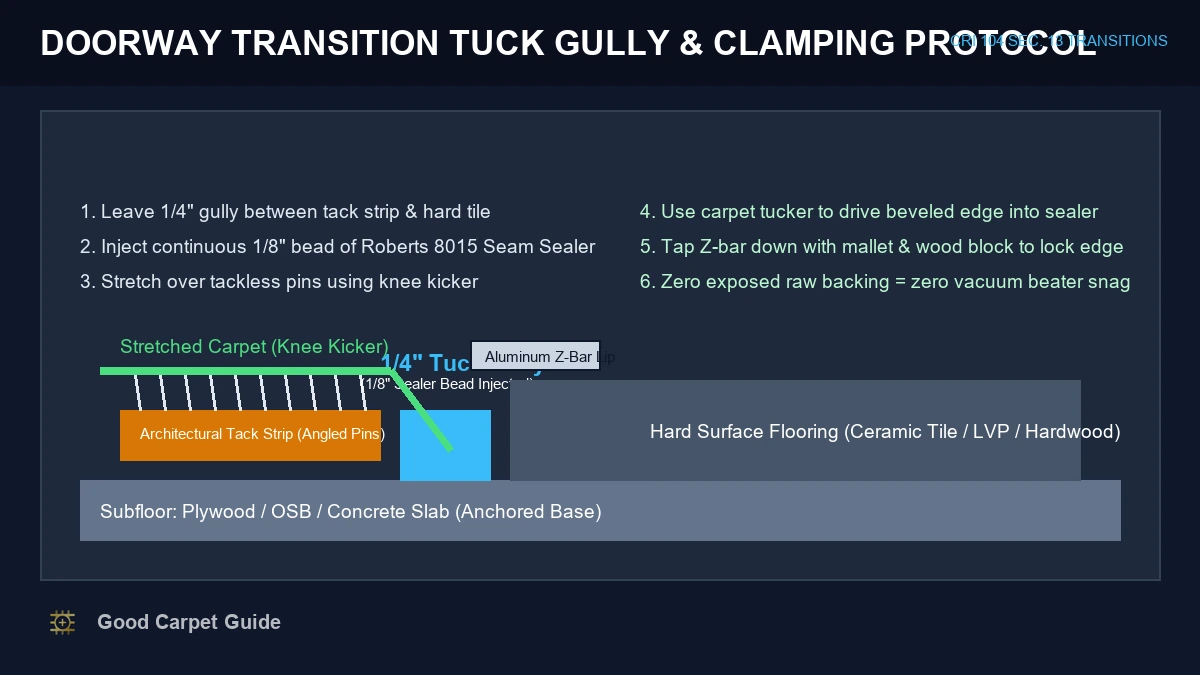
Proper 5-degree beveled carpet edge being tucked into a latex sealer bead along a ceramic tile transition gully.
For more detailed threshold work, the carpet transition strip repair guide covers the hardware and mechanical-retention portion of this process.
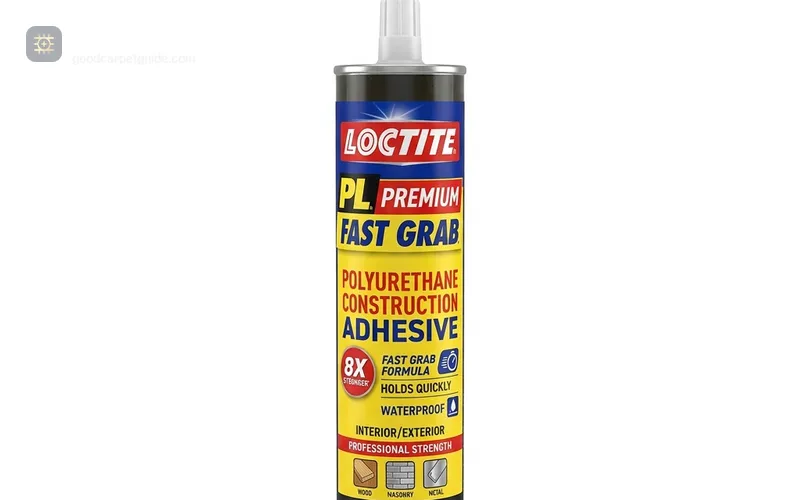
Loctite PL Premium Polyurethane Construction Adhesive
Heavy-duty polyurethane adhesive for anchoring transition tracks and Z-bars to concrete subfloors.
Check Price on Amazonhow to bind cut carpet remnants into custom rugs
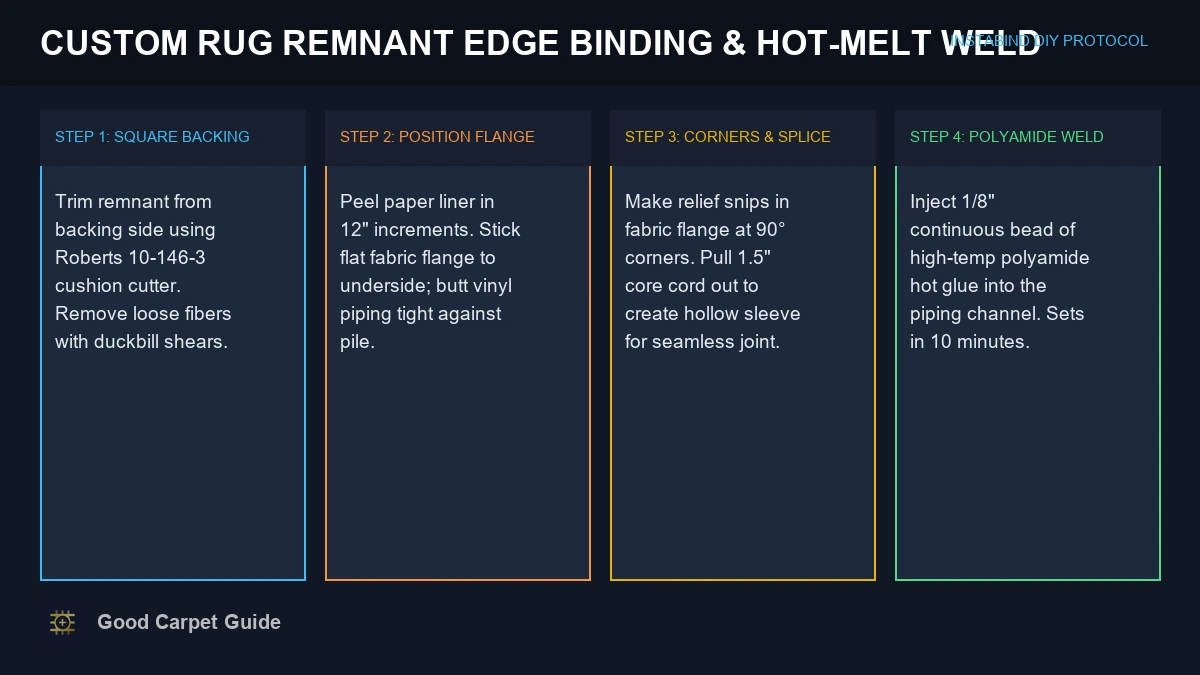
A carpet remnant becomes a durable custom rug when its backing is squared, its edge is covered with binding, and the binding channel receives a continuous high-temperature polyamide bead. Instabind combines an adhesive fabric flange with a raised piping edge to create the finished perimeter.
First, square the remnant from the backing side. A Roberts 10-146-3 Cushion Back Carpet Cutter allows controlled blade-depth adjustment for cutting secondary backing without unnecessarily damaging the pile.
Prepare the Instabind before removing its full release liner. Wrap clear tape around the starting end so the internal core cord remains controlled while the binding is applied.
Peel the paper backing in approximately 12-inch increments. Position the flat fabric flange beneath the carpet edge and bring the vinyl piping flush against the pile face. Working in short sections prevents the adhesive from becoming contaminated before the carpet reaches its final position.
Corners require relief cuts. At a 90-degree corner, make controlled relief snips in the flat flange so the binding can change direction without bunching. The relief cuts should affect the flange rather than the visible piping.
The starting and finishing ends require a concealed splice. Pull approximately 1.5 inches of core cord from the starting joint to create an empty fabric sleeve. Insert the finishing end into that sleeve before completing the hot-melt weld.
Inject a continuous 1/8" bead of high-temperature polyamide hot glue into the channel between the round piping and face fibers. The adhesive bead should fill the channel without creating a hard ridge above the pile.
Allow approximately 10 minutes for the hot-melt assembly to set before subjecting the edge to normal handling.
Application of Instabind edge binding tape showing the precise injection of a 1/8-inch polyamide hot-melt bead into the piping channel.
This method is especially useful for remnants that would otherwise have exposed woven backing around the entire perimeter. It produces a finished edge while adding a physical barrier against repeated vacuum contact.
tools, sealers, and material cost breakdown
Professional carpet-fray repair requires a cutter, edge sealer, tensioning tool, trimming shears, and transition hardware, with the listed field equipment ranging from approximately 7.49 for seam sealer to88.20 for a knee kicker. Prices vary by supplier and date, so these figures represent the supplied cost references rather than fixed retail prices.
| Tool or material | Supplied price | Primary function |
|---|---|---|
| Roberts 8015 Universal Seam Sealer | 7.49–10.13 | Chemical edge and seam stabilization |
| Instabind Carpet Edge Binding | About $2.83/ft | Finished remnant and runner binding |
| Roberts 10-146-3 Cushion Back Cutter | 29.53–33.47 | Controlled secondary-backing cuts |
| Roberts 10-152GT Loop Pile Cutter | $37.05 | Row-guided Berber cutting |
| Roberts 10-586-3 Duckbill Napping Shears | $27.97 | Controlled pile trimming |
| Roberts 10-410 Knee Kicker | $88.20 | Carpet tensioning |
| Loctite PL Premium | 6.48–10.98 | Transition-track bonding |
| M-D aluminum transition/Z-bar | 10–20 per 8 ft | Mechanical edge retention |
Roberts 8015 has a stated yield of approximately 165–660 linear feet from the referenced package sizes when applying a 1/8" bead. The actual yield depends on bead consistency and packaging size.
The Roberts 10-146-3 is the practical choice for controlled cushion-back trimming. Its adjustable blade depth reduces the risk of cutting too deeply into the face structure.
The Roberts 10-152GT is the appropriate specialized cutter for loop pile because its guide follows the space between rows. This is substantially safer than using a standard utility blade across the face.
A knee kicker becomes important when a doorway repair requires the carpet to be resecured to tack strips. Without adequate tension, the carpet can sit loose even when the transition hardware appears firmly installed.
A transition track bonded to concrete may require a polyurethane construction adhesive such as Loctite PL Premium. The adhesive anchors the metal hardware to the substrate; it does not replace the carpet seam sealer.
maintenance practices to prevent future edge wear
Carpet edge maintenance depends on reducing repeated mechanical contact, with vacuum height, threshold geometry, and carpet retention determining how much load reaches the edge. Correcting these three conditions can prevent a sealed edge from becoming damaged again.
Set the vacuum cleaner height according to the carpet manufacturer's recommended operating position. A brush roll that sits too aggressively against a transition can repeatedly catch loose fibers.
Avoid dragging vacuum heads directly across exposed carpet edges. This is particularly important for loop pile because a rotating brush can catch one loop and pull tension into adjacent yarns.
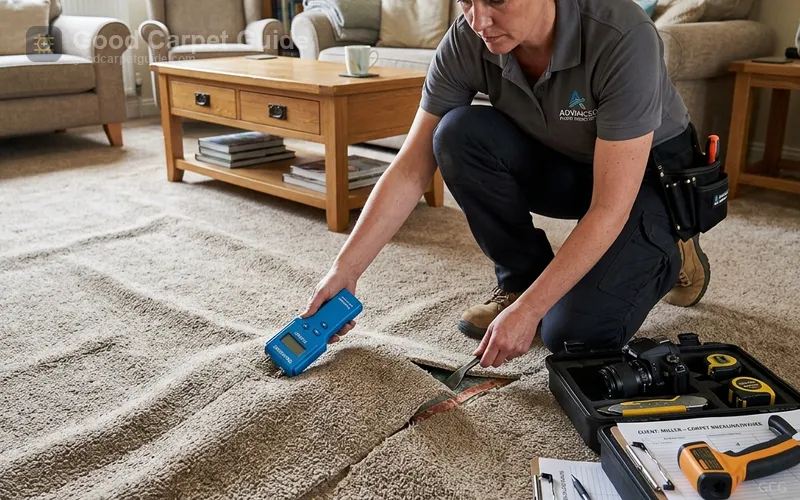
Inspect doorway transitions periodically. A small loose corner should be stabilized before the vacuum or foot traffic enlarges the defect.
Use appropriate rug pads beneath bound remnants and area rugs. The pad reduces sliding and therefore reduces lateral shear transmitted into the bound edge.
Keep transition hardware firmly seated. A loose Z-bar or transition strip can expose the carpet edge to direct rolling and vacuum loads.
Stairs require additional inspection because the carpet experiences vertical deflection and lateral foot shear around nosings and riser transitions. Any loose edge at a stair nose should be repaired before the backing begins to separate further.
common edge repair mistakes to avoid
The most damaging carpet-edge repair errors are excessive heat, oversized adhesive beads, inappropriate household glue, and cutting loop pile across the yarn rows. Each mistake changes either the carpet's polymer structure or its mechanical retention.
Polypropylene backing has a melting range of approximately 160°C–165°C (320°F–330°F). Direct exposure to a household iron or uncontrolled heat gun can melt synthetic fibers, produce shiny flattened areas, and cause backing shrinkage.
Professional seaming irons operate at substantially lower working temperatures, with the supplied field specification placing typical settings around 120°C–140°C at low-and-slow settings. KoolGlide induction systems weld from the underside and can complete a bond in approximately 6–9 seconds without directly scorching surface fibers.
Do not compensate for poor edge preparation by applying a very thick glue bead. Excess adhesive can cure into a hard lump that changes the transition profile and creates a new snag point.
Do not use ordinary household glues as substitutes for carpet seam sealers. Carpet backing requires an adhesive system compatible with polypropylene, jute, urethane, or the specific backing construction.
Do not cut Berber loops straight across with a general-purpose knife. Use a row-guided loop-pile cutter and preserve the yarn-row structure.
Do not simply trim a loose strand and leave the backing untreated. The cut backing remains mechanically exposed, so vacuum agitation and foot traffic can continue the same failure mechanism.
Do not place transition hardware over unstable delaminated backing. Remove the failed material and establish a sound edge before clamping the carpet.
frequently asked questions about carpet fraying
Field-tested answers to the most common questions regarding carpet edge fraying, backing stabilization, and DIY repair techniques.
how do you stop carpet from fraying at the edge?
Carpet edges are stabilized by trimming damaged backing, applying a continuous 1/8" bead of compatible seam sealer, and mechanically securing the edge. Doorways commonly require tack-strip retention or Z-bar compression.
can you use super glue to stop carpet from fraying?
Super glue is not a specified replacement for carpet seam sealer. A purpose-designed carpet seam sealer provides the flexible backing encapsulation required for repeated carpet movement.
how do you stop berber carpet from unraveling?
Berber should be cut with a row-guided loop-pile cutter rather than a standard utility knife. The repair should preserve the yarn rows and chemically stabilize the exposed backing.
why does carpet fray at doorways?
Doorways concentrate vacuum contact, foot shear, and transition movement at a relatively small carpet edge. An unsealed cut edge therefore receives repeated mechanical loading that can pull backing yarns loose.
can you fix a frayed carpet edge without replacing the carpet?
Localized fraying can often be repaired when sufficient sound carpet remains for trimming and mechanical retention. Severe delamination or a long active loop run may require replacement of the affected section.
what angle should you cut carpet edges?
Cut-pile edges are trimmed at approximately a 5-degree bevel in the supplied field protocol. The bevel positions the secondary backing behind the face yarns and reduces the visible gap at the finished edge.
does carpet seam sealer prevent fraying?
A compatible seam sealer encapsulates exposed backing yarns and reduces their ability to unravel. It works best when combined with appropriate trimming and mechanical edge retention.
how long does carpet seam sealer take to cure?
The supplied Roberts 8015 specification gives approximately 10 minutes to tack-free condition and 12–24 hours for full cure. The repaired area should remain protected during the curing period.
is heat safe for carpet backing?
Heat must remain within the temperature range appropriate for the carpet construction. Polypropylene can melt around 160°C–165°C, so uncontrolled household irons and heat guns can permanently damage synthetic carpet.
what is the best way to finish a carpet remnant?
A bound edge provides a finished perimeter for most carpet remnants. The supplied Instabind protocol uses an adhesive flange and a continuous 1/8" polyamide hot-melt bead around the piping channel.
can carpet fraying be repaired on stairs?
Localized stair-edge fraying can be repaired when the backing remains structurally usable. Stair repairs require particular attention to mechanical retention because foot shear and vertical deflection repeatedly load the edge.
when should a frayed carpet edge be replaced?
Replacement becomes more appropriate when the backing has extensive delamination, the loop structure has developed a significant run, or insufficient sound material remains to form a mechanically secure edge.
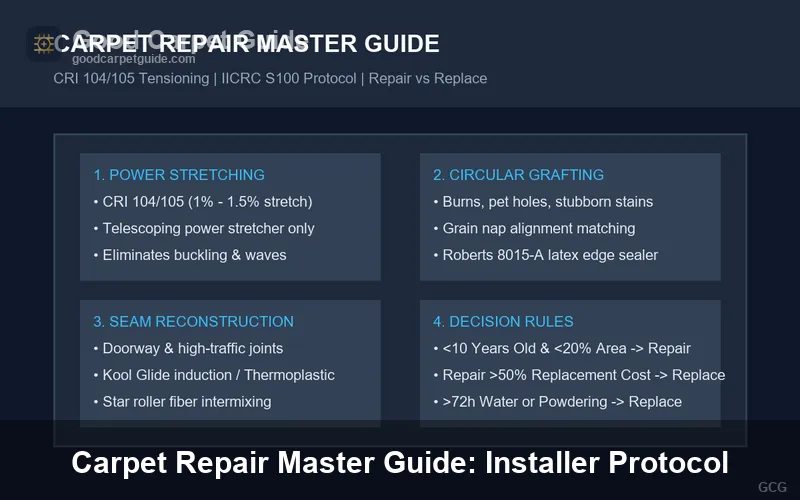
The repair decision should follow the physical failure mechanism. A chemically sound cut edge can be stabilized with seam sealer, a doorway under repeated traffic benefits from mechanical clamping, a carpet remnant requires finished binding, and a Berber edge demands row-controlled cutting before stabilization. The carpet repair master guide provides the broader repair framework for defects that extend beyond edge fraying.