understanding carpet pile construction: cut pile versus loop pile mechanics
Cut pile and loop pile carpet differ at the yarn level, and that construction difference determines how each carpet handles compression, claws, vacuuming, stains, seams, and long-term traffic. Cut pile generally offers better resistance to visible snagging and easier repair, while loop pile can provide strong wear performance with lower visible pile crushing when its construction, cushion, and yarn are correctly specified.
For homes with dogs or cats, the decision becomes more specific. A loop can catch a claw and pull an entire row of continuous-filament yarn. A cut pile has no exposed loop to unzip, although low-density cut pile can develop permanent matting in hallways and pivot zones.
The best choice depends on fiber, pile density, twist, backing, cushion, traffic pattern, and household behavior, rather than the label "Berber," "plush," or a manufacturer's durability claim.
Quick verdict:
- Choose cut pile for bedrooms, living rooms, stairs, and households where snag repair and pet-claw resistance matter.
- Choose loop pile for active traffic areas when low-profile construction, structured appearance, and resistance to crushing are priorities.
- Avoid continuous-filament loop pile where dogs or cats regularly dig, scratch, or catch their claws.
- Avoid soft, thick cushion under loop pile because excessive backing movement can contribute to delamination and warranty problems.
For a typical active household, a properly specified 40–50 oz carpet with appropriate cushion can provide roughly 12–15 years of service, while premium 60+ oz constructions can exceed 20 years under suitable conditions.
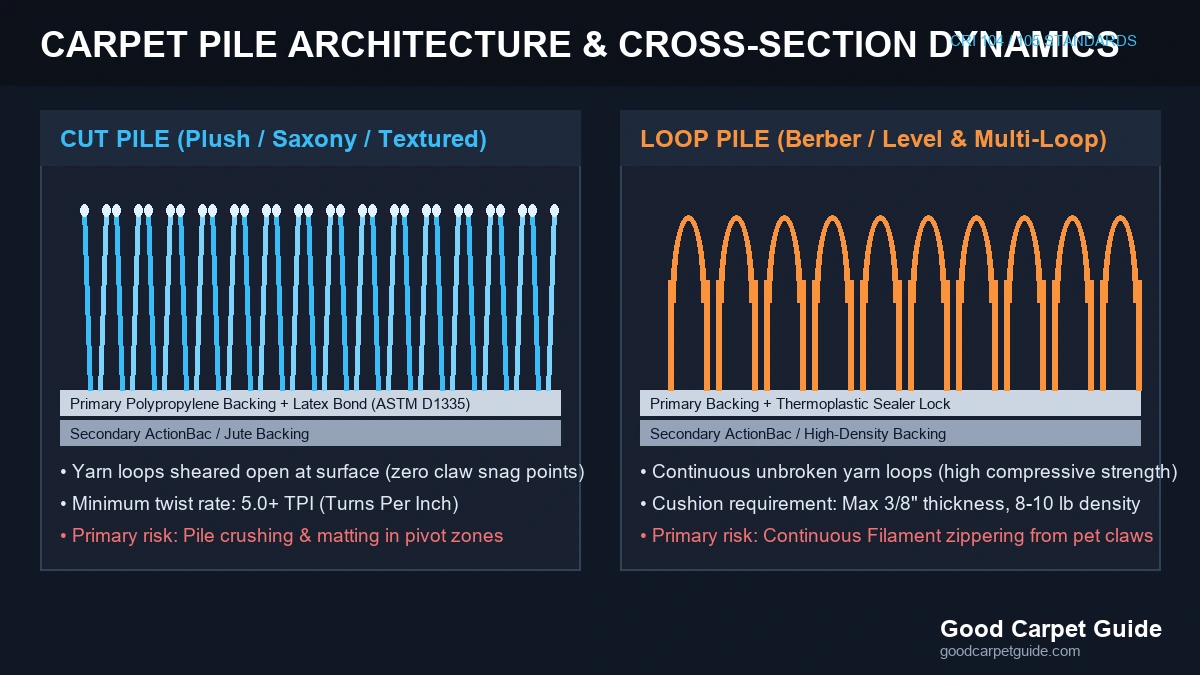
Cut pile carpet has yarn loops cut at the surface, while loop pile carpet retains those loops intact; this structural difference controls how the surface responds to compression and mechanical pulling. In cut pile, the yarn enters the primary backing, forms a tuft, and is cut so individual yarn tips remain exposed. The resulting surface can range from dense and velvety to textured and highly twisted.
Loop pile retains the yarn in continuous loops. Depending on the construction, loops may have uniform heights or several heights that create a patterned surface. A cut pile generally fails through compression fatigue, matting, tip wear, and color change caused by pile direction. Loop pile resists compression effectively, but its exposed loops introduce a mechanical snag pathway.
Fiber selection matters as much as construction. Nylon has high resilience and recovers from compression better than lower-density polyester. Triexta provides strong residential performance with built-in stain resistance. Wool offers natural resilience and a distinctive surface response.
The comparison between synthetic fibers becomes clearer in our guide to nylon vs polyester carpet , particularly when the carpet will receive repeated compression from footsteps, furniture, or rolling traffic. "Berber" describes a visual and construction family that commonly uses loop pile rather than a specific fiber grade. Two carpets can both be called Berber while having very different tuft bind, density, yarn quality, backing, and resistance to pet damage.
loop pile vulnerabilities: the continuous filament zippering hazard
Loop pile carpet has a mechanical snag vulnerability that becomes severe when continuous-filament yarn forms an uninterrupted row; one pulled loop can initiate zippering across multiple tuft locations. Continuous-filament yarn has the advantage of long fiber structure, which reduces the fuzzing and shedding associated with short staple fibers.
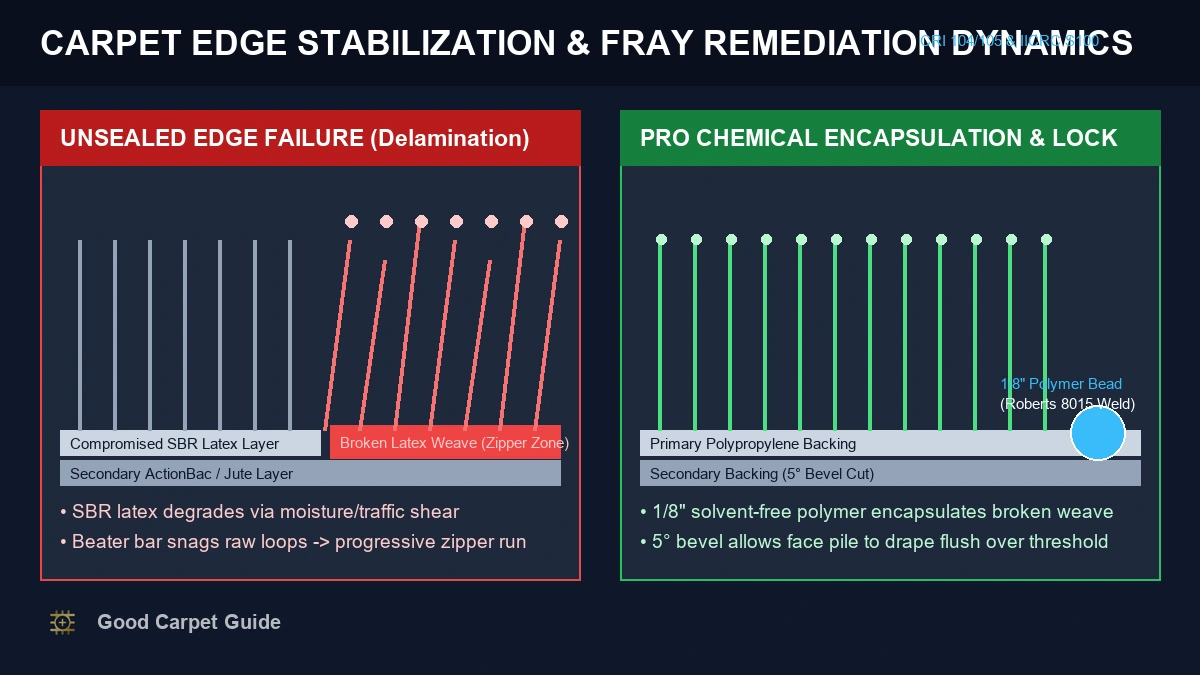
However, that continuity creates a distinct failure pathway. When a pet claw catches a continuous-filament loop, the claw pulls yarn from the primary backing. If adjacent loops connect through the same continuous yarn system, the damage propagates across the floor plane in a run that resembles an unzipped zipper.
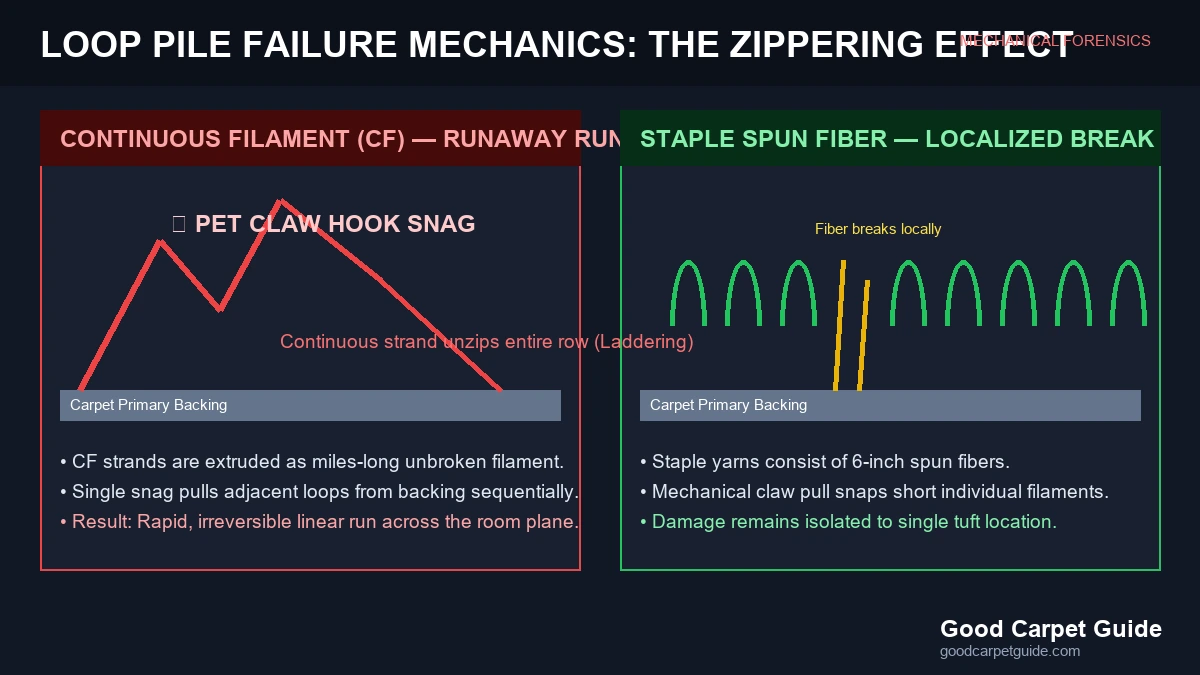
This represents a structural failure rather than a cosmetic defect. Staple-fiber loop pile behaves differently because its yarn consists of shorter fibers spun together. A snag can still damage the carpet, but the pulled fiber generally breaks locally rather than creating an extended zippering path across the room.
That does not make staple loop carpet completely immune to pet damage. Dogs and cats can still catch claws in exposed loops, especially where the loop height is relatively large. For households with animals, loop height and yarn construction deserve direct inspection before purchase.
A useful test is straightforward: examine the carpet sample closely and confirm whether the loop yarn is continuous filament or staple. A generic statement such as "pet friendly" provides less useful information than the actual yarn construction. The detailed advantages and disadvantages of Berber construction are covered in our guide to Berber carpet pros and cons .
cut pile failure modes: pile crushing, matting, and tip blooming
Cut pile carpet primarily degrades through compression fatigue, with low-density constructions showing visible crushing sooner in repeated traffic zones. Cut pile eliminates the exposed loop snag pathway, but introduces its own failure mechanisms.
The primary failure mode is pile crushing. When people repeatedly walk through the same corridor, turn beside a kitchen island, stand at a desk, or pivot at the bottom of stairs, downward pressure bends and compresses the upright yarn tips. Over time, the fibers lose their mechanical ability to return to their original vertical orientation.
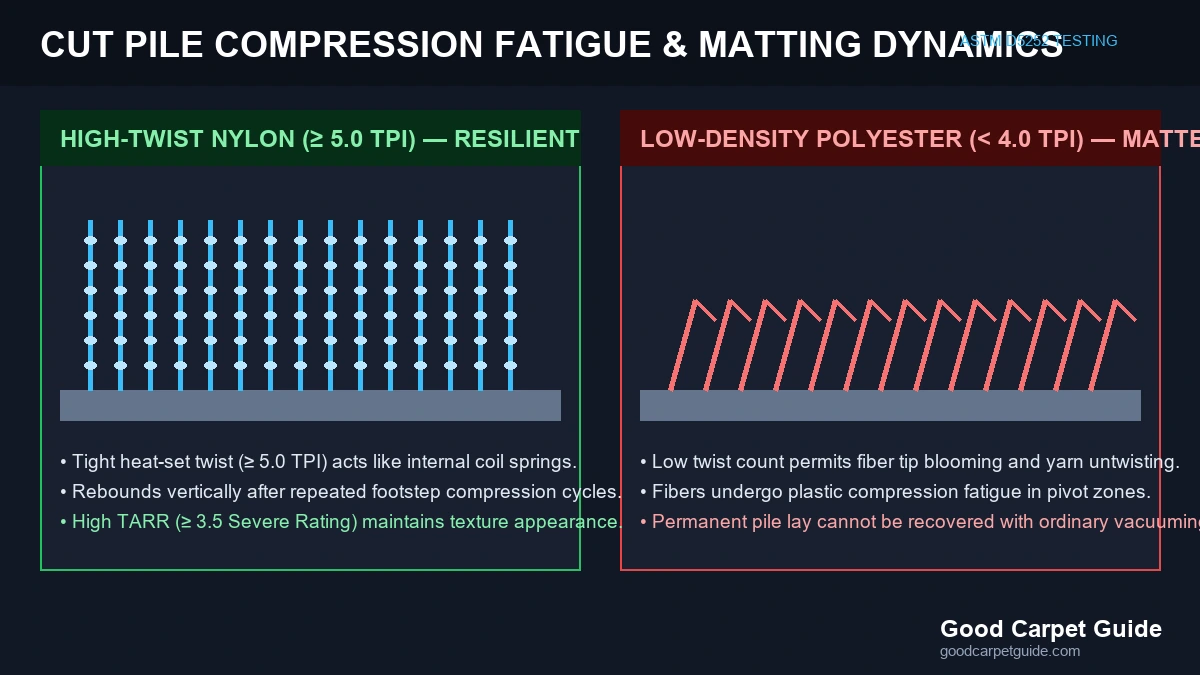
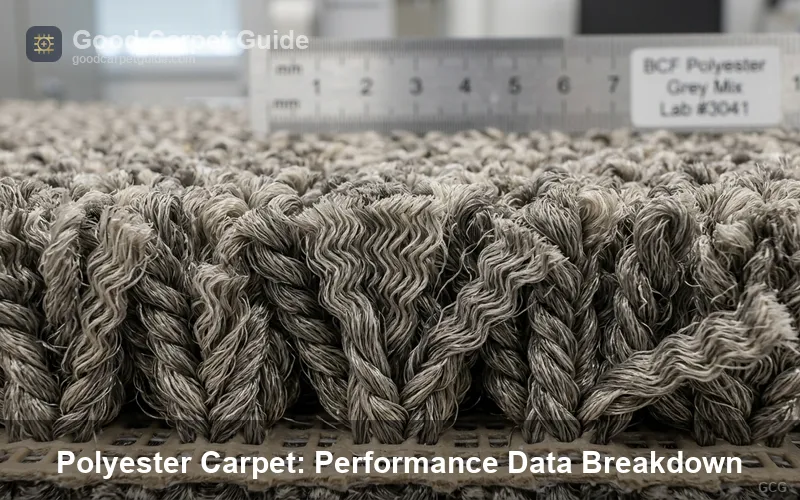
This condition is especially pronounced in low-density polyester carpet. High-twist nylon cut pile maintains superior resilience because the tightly twisted yarn structure creates mechanical resistance to flattening. A minimum twist rate of 5.0 turns per inch is an essential benchmark when evaluating residential cut pile.
Density also governs performance, as carpet with more yarn packed into a given volume provides greater resistance to permanent deformation. A related condition is sprouting, where an individual tuft settles and rises above the surrounding pile surface. The correct repair is trimming the sprout flush with sharp shears, whereas pulling the yarn disturbs the primary backing.
Matting differs from a temporary directional change. If the carpet appears flattened after furniture is moved, some of that compression can recover through moisture, controlled steam cleaning, and mechanical grooming. Permanent crushing requires a different approach, and our guide on how to fix carpet matting and crushing covers recovery protocols and physical limitations.
aesthetic behavior: light reflection, watermarking, and pile shading
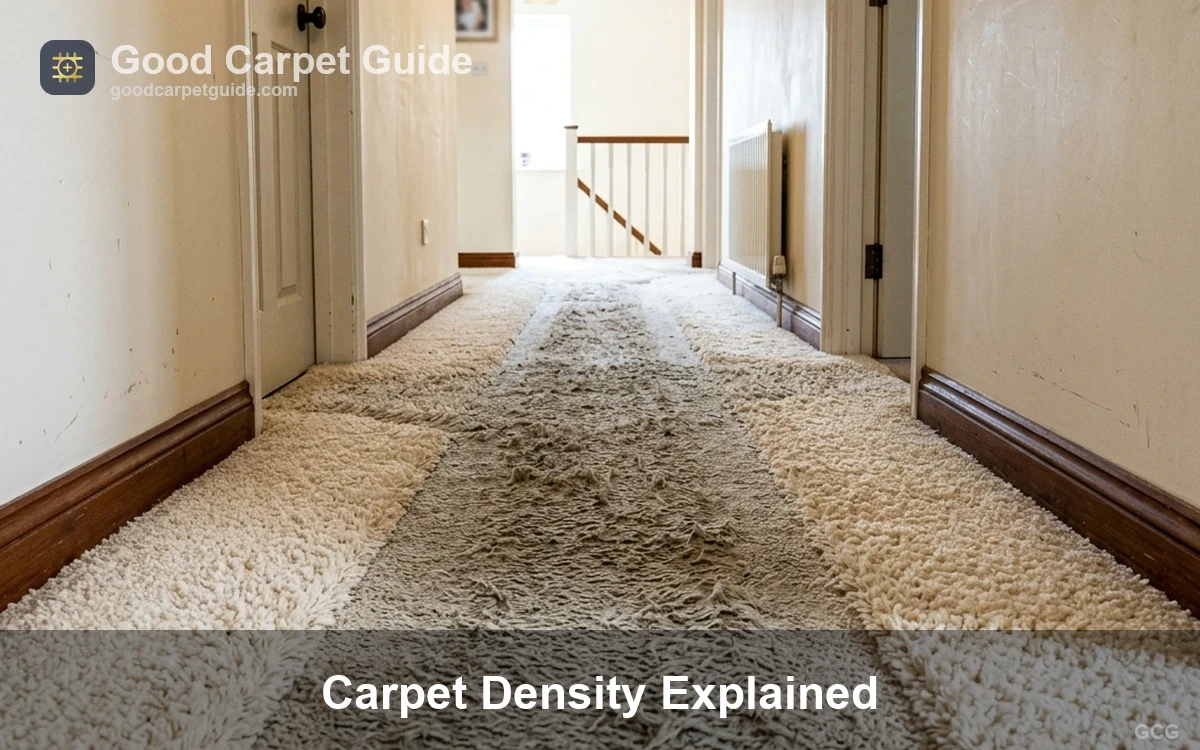
Dense plush cut pile produces visual shading because pile direction changes how incident light reflects from the yarn surface. This optical phenomenon is frequently mistaken for localized soil or water damage by homeowners.
When sections of cut pile bend in different directions under foot traffic, the yarn tips reflect light at opposing angles. One area appears dark while the adjacent section appears light. The resulting visual contrast resembles a watermark or pooling effect even when the carpet is completely clean.
This phenomenon is commonly known as shading or pooling. It occurs naturally in dense plush cut pile and becomes noticeable after ordinary walking. Vacuuming temporarily alters the appearance by realigning the pile direction with the cleaning stroke.
Loop pile produces a more structured visual surface because the intact loops break up directional reflection. Patterned loop constructions also disguise localized traffic patterns effectively. Cut pile provides a softer, velvety feel, but comes with greater sensitivity to directional pile lay.
A homeowner expecting a plush carpet to maintain a single uniform color from every viewing angle will frequently misinterpret normal shading as a product defect. For this reason, pre-purchase carpet samples should always be evaluated under the actual lighting conditions of the target room.
pet claws, vacuums, and daily household hazards compared
Pet safety favors low-snag surfaces, while carpet longevity depends on how mechanical forces interact with the yarn construction. For dogs and cats, cut pile provides a decisive structural advantage because there is no exposed loop for a claw to hook.
That does not mean every cut pile is completely pet-proof. Dense plush surfaces can collect shed hair, and deep pile can trap small debris. Low-density cut pile also crushes under repeated animal traffic along favorite running paths.
Loop pile presents the opposite trade-off. Its low-profile construction performs well under foot traffic, but exposed loops remain vulnerable to claw snags. Vacuum selection is critical for both carpet constructions to prevent surface damage.
A vacuum with an aggressive, non-adjustable beater bar can fray and fuzz delicate loop pile. A height-adjustable vacuum with CRI certification provides necessary control over cleaning head contact and airflow suction.
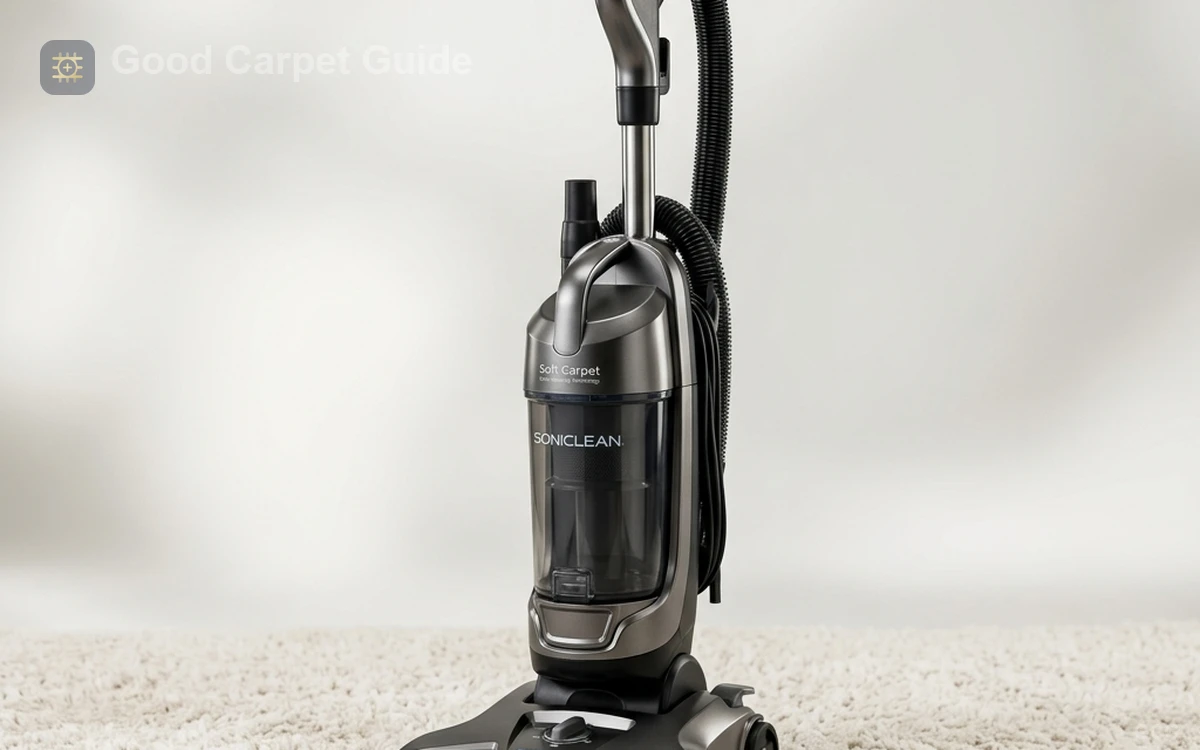
Soniclean Soft Carpet Upright Vacuum Cleaner
CRI-certified vacuum with adjustable venting preventing beater-bar snagging on delicate loop and plush piles.
Check Price on AmazonStain removal requires equal consideration. Dense cut pile holds spills within the face yarn until liquid can be extracted from the backing. A water-based spot cleaner removes localized organic spills effectively without leaving surfactant residue that accelerates re-soiling.
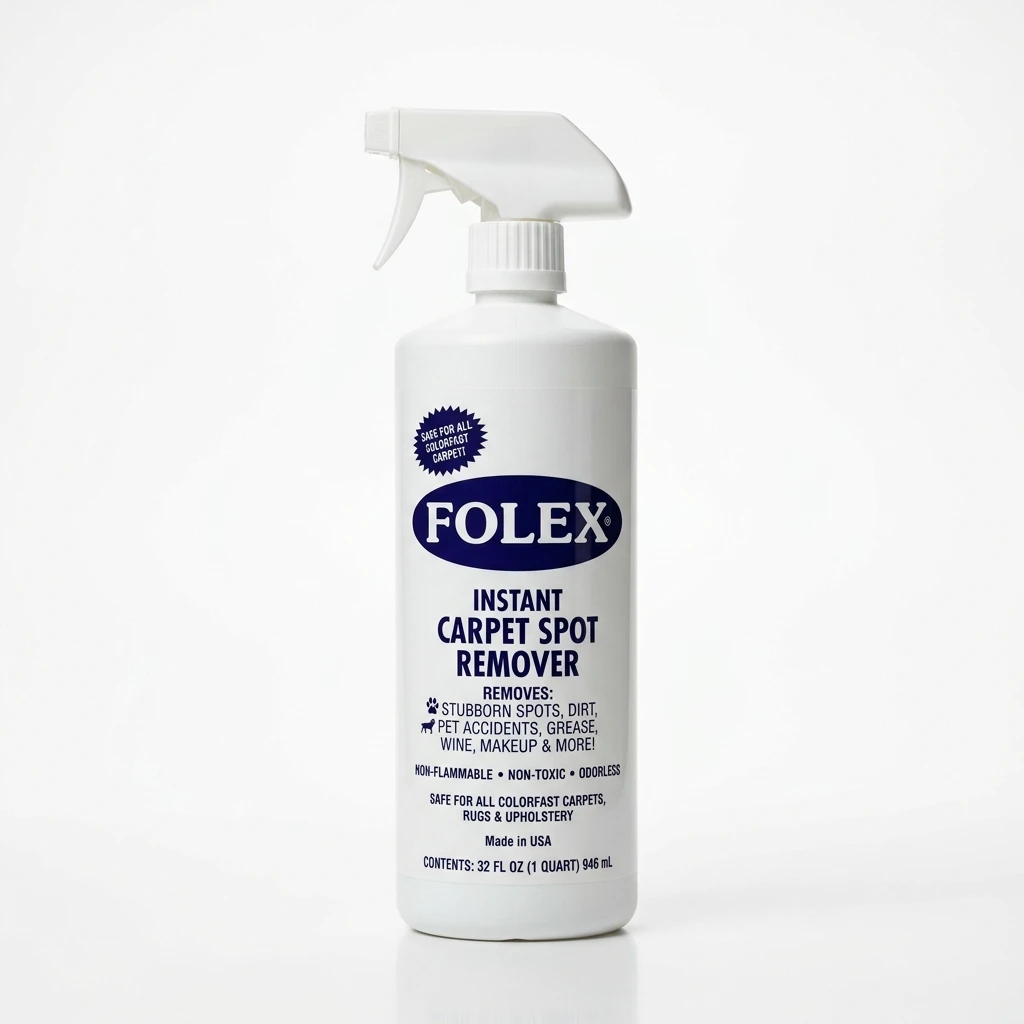
Folex Instant Carpet Spot Remover
Water-based surfactant formula removing organic stains from dense cut pile without leaving sticky residue.
Check Price on AmazonFor pets and household layout, the practical suitability ranking is summarized below:
| Household Condition | Recommended Construction |
|---|---|
| Dogs with long claws | Cut pile |
| Cats that scratch carpet | Cut pile |
| Low-snag requirement | Cut pile |
| Heavy foot traffic | Quality loop or high-twist cut pile |
| Hallways and pivot zones | Dense loop or high-twist cut pile |
| Plush appearance | Cut pile |
| Structured Berber appearance | Loop pile |
| Maximum tolerance for pet snagging | Cut pile |
installer specifications: cushion density, seam sealing, and tool selection
Carpet cushion affects dimensional stability, and CRI 105 and HUD UM 72a specifications establish distinct thickness and density requirements for cut and loop constructions.
For standard residential cut pile, industry standards specify cushion thickness up to 7/16 inch with 6–8 lb density. For Berber and commercial loop pile, the specified cushion is thinner at a maximum of 3/8 inch with a minimum density of 8–10 lb.
| Carpet Construction | Maximum Cushion Thickness | Cushion Density |
|---|---|---|
| Standard residential cut pile | 7/16 inch | 6–8 lb |
| Berber / loop pile | 3/8 inch | 8–10 lb |
The reason for this distinction is mechanical. A soft, thick pad under loop pile permits excessive deflection beneath the carpet plane. The backing flexes excessively under footfalls, placing severe strain on the tuft bind and secondary backing bond, which leads to delamination and voided manufacturer warranties.
Site environmental conditioning is equally important. Industry standards require maintaining 65–95°F and maximum 65% relative humidity for a 120-hour window (48 hours before installation through 72 hours following completion).
Seaming requires specialized technique with loop pile. Installers must cut rows using a dedicated loop pile cutter from the backing side rather than slicing through face fibers with a standard utility knife. Improper cutting angles shear adjacent yarn loops and create permanent seam visibility.
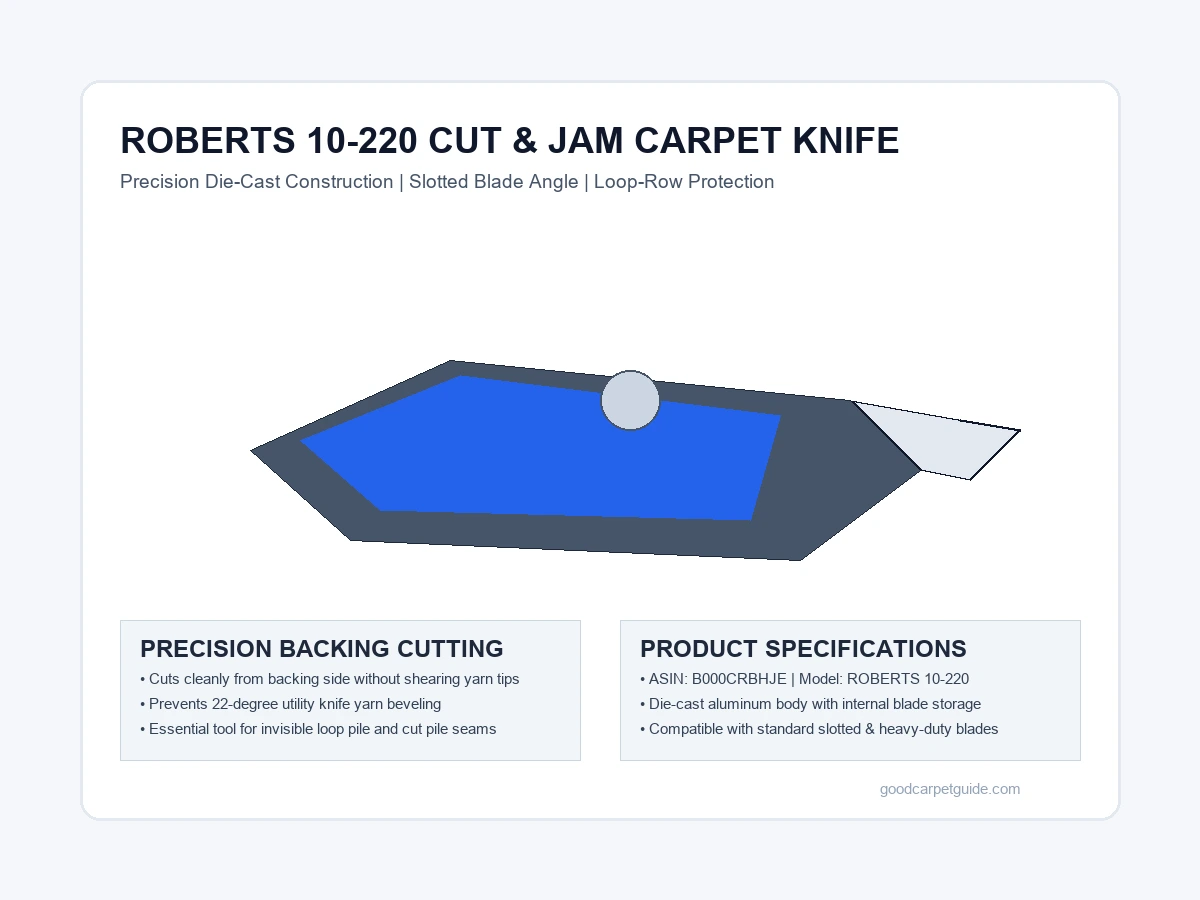
ROBERTS 10-220 Cut & Jam Carpet Knife
Professional die-cast carpet knife engineered for precision row-cutting without shearing loop pile yarns.
Check Price on AmazonSeam-iron temperature and transit speed also require careful monitoring. Applying the "low and slow" technique prevents excessive heat exposure from causing seam peaking along the join. For wool installations, petroleum-based foam cushions must never contact jute backing, as chemical interactions cause sulfurous odors and backing breakdown.
durability metrics: hexapod wear testing, twist rates, and tuft bind strength
Carpet durability is measurable through standardized wear testing, yarn construction metrics, and tuft retention values rather than face weight alone.
ASTM D5252 utilizes a hexapod drum test with a 3.8 kg studded tumbler rotating for 12,000 revolutions over the test specimen. The resulting Texture Appearance Retention Rating (TARR) provides an objective measure of surface retention. A TARR rating of 3.5 or higher indicates severe traffic capability, while ratings below 2.0 suit only light-traffic guest rooms.
Tuft bind strength provides another critical durability metric. ASTM D1335 measures the tensile force required to pull an individual tuft from the backing assembly. A residential durability benchmark of 4–8 lb minimum pull force ensures adequate resistance to daily foot traffic and vacuuming stress.
Face weight provides useful guidance when evaluated alongside pile density and fiber chemistry:
| Face Weight | Typical Service Expectation | Appropriate Context |
|---|---|---|
| 30–35 oz | About 8 years | Medium residential traffic |
| 40–50 oz | About 12–15 years | High traffic / active households |
| 60+ oz | 20+ years | Premium construction |
These service expectations represent realistic engineering ranges. Factors including subfloor preparation, cleaning frequency, pet activity, and cushion selection influence final longevity.
This is why understanding carpet density is necessary during product evaluation. Face weight measures the total ounces of yarn per square yard, whereas density calculates how tightly those fibers are packed into the pile height. For cut pile, look for twist rates of 5.0 turns per inch or higher to ensure long-term vertical rebound.
room by room selection guide: matching construction to traffic zones
Room suitability depends on traffic concentration, mechanical hazards, and desired tactile comfort rather than a single universal choice between cut and loop pile.
bedrooms
Cut pile represents the ideal selection for bedrooms. These rooms experience low foot traffic and benefit from the soft hand and sound-dampening qualities of plush or textured cut pile. Compression fatigue remains minimal because pivot traffic is limited.
living rooms
Both constructions perform well in living rooms depending on lifestyle. Choose cut pile when family comfort and barefoot softness are priorities. Choose loop pile when the space experiences concentrated traffic and the homeowner prefers a clean, modern aesthetic.
hallways
Hallways require loop pile or dense, high-twist cut pile. These transitional spaces create concentrated linear traffic lanes that cause rapid crushing in low-density cut pile. A dense loop pile maintains its surface profile under repeated footfalls.
stairs
Cut pile is generally easier to install and maintain on stairs. The absence of exposed loops eliminates snag hazards when shoes catch stair nosings. High-twist cut pile also withstands the repeated compression forces concentrated along step edges.
home offices
Home offices require careful planning around chair movement. Rolling casters exert severe concentrated directional shear that rapidly crushes high-pile cut carpets. A dense, low-profile loop pile or a commercial-grade low cut pile paired with a polycarbonate chair mat provides optimal durability.
homes with dogs and cats
Cut pile holds the clear advantage in homes with active pets. A pet claw cannot unzip a cut surface in the way it can pull a continuous yarn loop.
basements and moisture-prone areas
Basements require evaluating the complete flooring assembly including cushion and moisture barriers. Synthetic loop piles made from solution-dyed olefin or nylon resist moisture well, provided the subfloor has been tested and properly prepped against vapor emissions.
installed cost comparison and lifecycle value
Installed carpet cost varies across fiber categories and manufacturing grades, with typical residential pricing spanning 2.00 to12.00+ per square foot.
| Market Tier | Example Construction | Installed Cost / Sq. Ft. | Expected Life |
|---|---|---|---|
| Entry | EverStrand PET / PureColor | 2–4 | 5–7 years |
| Mid-range | SmartStrand Triexta | 5–7 | 10–15 years |
| Mid-range | Shaw LifeGuard Nylon | 5–7 | 10–15 years |
| Premium | SmartStrand Silk Reserve | 7–8 | 15–20 years |
| Luxury | Karastan Wool | 10–12 | 20+ years |
| Luxury | Anderson Tuftex Type 6.6 Nylon | 8–12+ | 20+ years |
The lowest upfront price can become the most expensive option over time if replacement occurs every five to seven years. A 3.00-per-square-foot installation lasting six years results in an annualized cost of0.50 per square foot per year.
A 6.00-per-square-foot installation lasting 12 years yields the identical annualized cost of0.50 per square foot per year while providing superior appearance retention and fewer disruption cycles.
In high-traffic family spaces, investing in resilient fiber and higher density delivers measurable economic value. In low-use guest rooms, premium specifications yield little practical return on investment.
The central purchasing question remains straightforward: how much mechanical workload will this room exert over the expected ownership timeline?
real homeowner and installer experiences
Field failure reports illustrate how yarn physics governs long-term performance under residential conditions.
"The hallway looked flat long before the rest of the carpet did."
— Homeowner report, r/Flooring
This observation illustrates localized compression fatigue. Hallways concentrate thousands of footfalls along a narrow two-foot walking lane. Without adequate yarn twist or sufficient pile density, synthetic fibers undergo plastic deformation.
"One loop caught on the dog's claw and the damage traveled farther than expected."
— Homeowner observation, r/HomeImprovement
This report demonstrates the continuous-filament zippering mechanism. Tension applied to a single loop propagates down the row because the unbroken yarn strand pulls neighboring tufts from the primary backing.
"The carpet looked like it had water stains, but cleaning did nothing."
— Residential inspection case note
This condition describes optical pile reversal or shading. In dense plush cut piles, localized changes in pile lay reflect light differently across adjacent sections, creating visual pools that cleaning cannot alter.
Flooring professionals distinguish between soil accumulation, staining, compression crushing, sprouting, shading, and backing delamination before determining whether remediation or replacement is appropriate.
definitive buying framework: which pile type should you choose
Cut pile is the reliable choice for households with pets and homeowners seeking snag resistance, while loop pile excels where low-profile wear and structured aesthetics outweigh snag risks.
Choose cut pile when:
- You have dogs or cats with active claws.
- Pet-claw snagging is a primary concern.
- You prefer a plush, soft surface underfoot.
- The installation includes stairs or complex pivot zones.
Choose loop pile when:
- The household experiences heavy foot traffic without pet claw hazards.
- You prefer a tailored, architectural aesthetic.
- Crushing resistance is more important than plush softness.
- You are pairing the carpet with a firm, high-density cushion.
Reject a carpet when:
- The retailer cannot verify the yarn type (continuous filament vs staple).
- A loop pile is packaged with a soft, overly thick pad exceeding 3/8 inch.
- The manufacturer warranty excludes your intended cushion density.
- Durability claims rely exclusively on face weight without citing twist count or density.
Matching the carpet construction to the room's mechanical demands ensures long-term appearance retention and protects your flooring investment.