Carpet matting and crushing are the two most common pile-appearance complaints, and each one calls for a different repair approach. Furniture dents respond to slow-hydration ice cube lifting. Flattened traffic lanes recover under a damp towel and steam iron. Fiber entanglement from heavy foot traffic needs mechanical grooming with a pile rake. Choosing the wrong method wastes time, so diagnosis is always the initial priority.
Crushing versus matting: how to tell them apart
Crushing happens when carpet pile takes a static or dynamic load and the fiber bends under viscoelastic compression. A sofa leg presses down for months, the tufts fold flat, and in a resilient fiber like nylon 6,6 the polymer chain retains a memory of its upright shape. Add moisture and heat, and the chain relaxes back toward that original position. This is why a wet towel and a warm iron can lift a dent that furniture left behind for years.
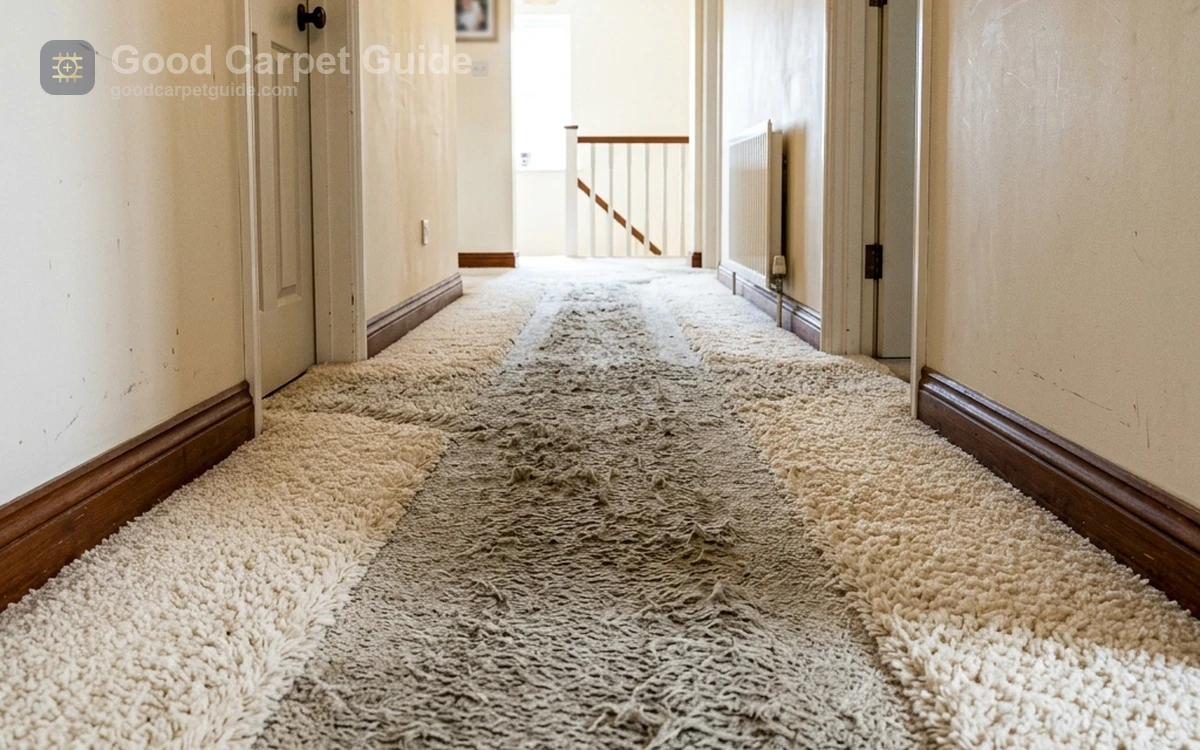
Matting is a different mechanical event. Repeated foot traffic twists and untwists each tuft until the individual fibers lose their spun structure and splay outward at the tip, a condition carpet mills call tip bloom. Once the fibers separate and interlock with their neighbors, no amount of heat or moisture restores the original twist. The yarn has physically reorganized itself into a tangled mat, and reversing that requires mechanical separation or, in extreme cases of fiber fusion, cutting and carpet repair .
Mechanical wear is a third, separate condition that inspectors sometimes confuse with crushing or matting. Wear means the carpet has lost more than 10 percent of its original face weight through abrasion; the fiber material has been ground away and is gone. Crushing and matting leave the fiber mass intact. Wear does not.
These distinctions explain why flattened carpet almost never qualifies for a manufacturer warranty claim. Standard broadloom wear warranties define coverage around that 10 percent face weight loss threshold. A sofa dent or a matted traffic path in front of a recliner has lost no fiber mass at all, so the mill's inspector marks the claim as normal wear and tear, a use condition rather than a manufacturing defect.
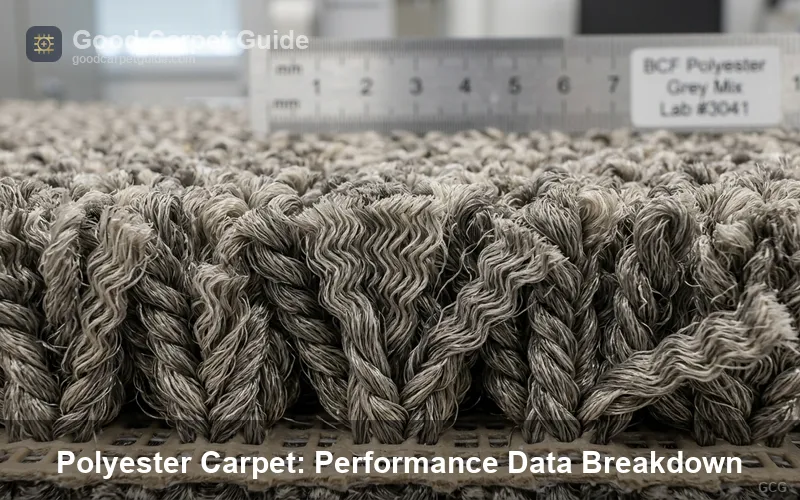
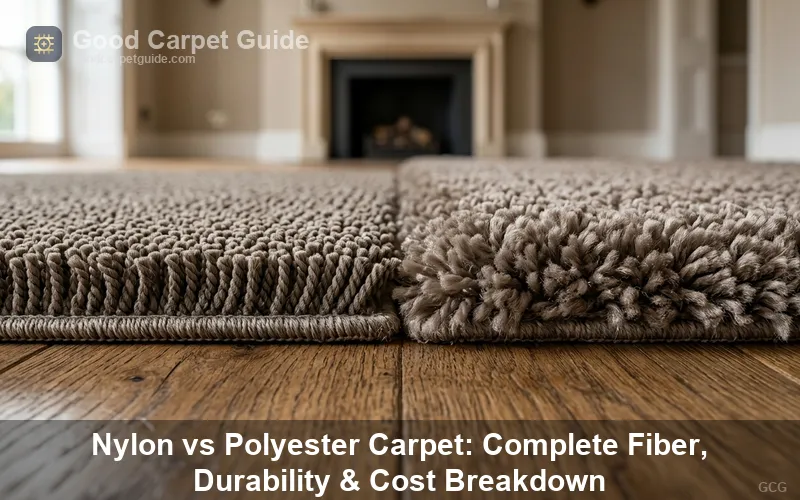
Fiber type also decides how fast matting sets in. Polyester carpet in a busy family-room walkway commonly shows visible traffic-lane matting far sooner than nylon under the same foot traffic, while nylon 6,6 tends to hold its texture appearance longer before matting becomes visually obvious.
Three proven methods to revive crushed and matted carpet
Professional flooring restorers use three primary techniques to lift compressed tufts depending on the scope and cause of pile flattening. Selecting the appropriate protocol protects fiber backing while maximizing vertical recovery.
Method 1: the slow-hydration ice cube technique
This method targets localized furniture dents, true crushing, and it works because the slow melt rehydrates the fiber gradually without pooling liquid on the subfloor.
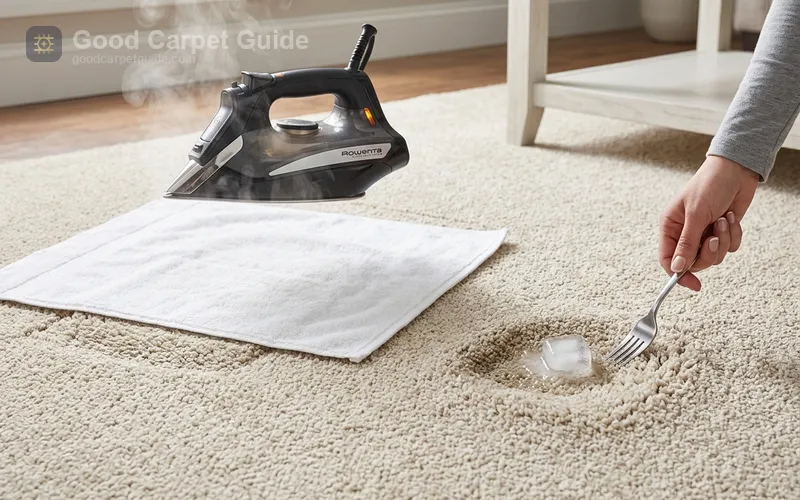
Place one standard ice cube directly on the center of the dent. Let the cube melt undisturbed for 4 to 12 hours depending on pile height and room humidity. As the ice melts, water moves into the fiber through capillary absorption rather than pooling on the surface.
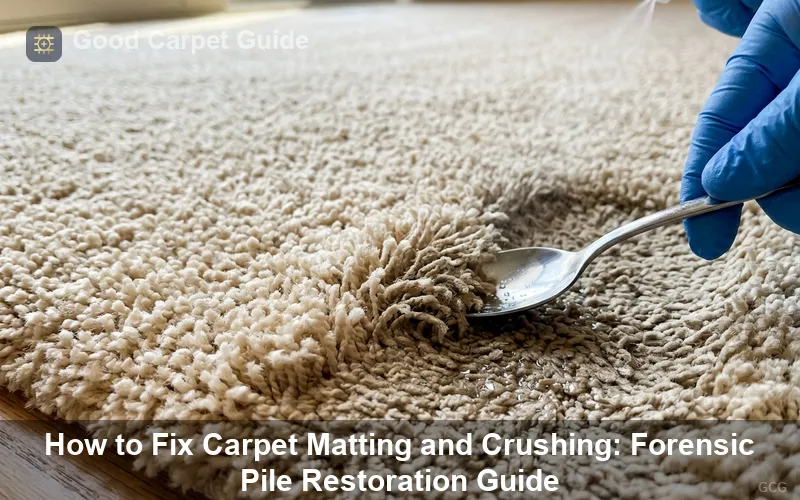
Once the cube is gone, blot any residual moisture with a dry cotton cloth. Lift the flattened tufts upright using the edge of a spoon or a coin, working gently against the direction of the flattening. Let the spot air dry fully before walking on it.
Do not use multiple cubes or pour water directly onto the dent. Oversaturating the pad and backing creates a mold risk. Mold can begin to establish in damp carpet padding within roughly 24 to 48 hours, so a single melting cube that the fiber absorbs gradually stays well under that window, while a soaked pad does not.
Method 2: the damp towel and steam iron protocol
This method suits wider crushed areas such as traffic paths, furniture rows, or rolled-up carpet creases where ice cubes would take too long.
Lay a plain damp cotton towel over the crushed section. Cotton holds moisture evenly and will not melt or transfer dye the way synthetic towels can. Set a steam iron to low or medium steam, never high, and never rest the plate directly on the carpet or the towel.
Hover the iron just above the towel, or rest it lightly and lift immediately, in passes of 10 to 15 seconds. The steam penetrates the towel and delivers controlled heat and moisture to the fiber, which relaxes the polymer chains that were locked into the flattened position.
Fluff the pile with a brush or your fingertips immediately after each pass while the fiber is still warm. Repeat over several passes rather than holding heat in one spot. Never let the iron plate touch the fiber directly, because direct contact fuses synthetic fibers into a glazed plastic sheet that cannot be reversed.
Method 3: mechanical grooming with a professional rake
Matted low-pile or looped carpet, including Berber, often responds better to mechanical separation than to heat or moisture. Two tools cover most residential jobs. A carpet grooming rake, such as the Grandi Groom, is built for taller cut pile and uses a push-pull motion that separates entangled tufts without pulling them from the backing. A softer carpet grooming brush is sized for loop pile and Berber, where a rake's teeth would snag the loops.
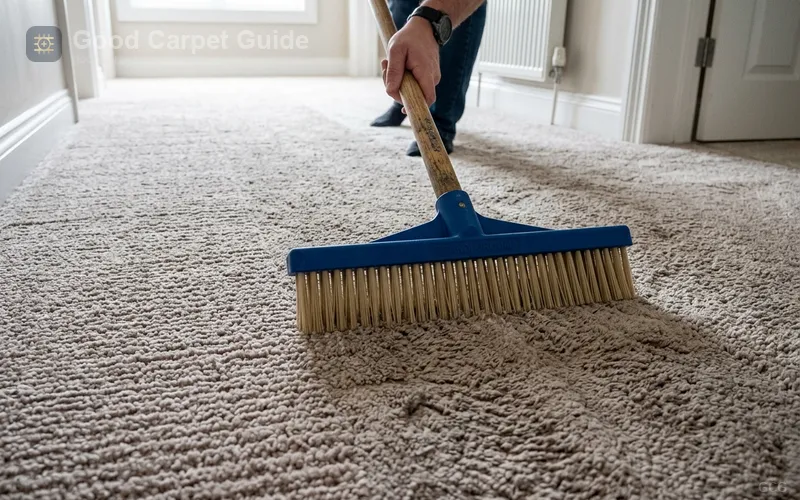
Work in one direction across the matted area, then cross-groom at a perpendicular angle to fully separate tip-bloomed fibers. Mechanical grooming will not repair matting that has progressed into permanent fiber entanglement, but it restores the appearance of moderately matted pile and is standard practice after any carpet cleaning methods compared extraction treatment.
The molecular science: why nylon bounces back while polyester stays flat
Nylon 6 and nylon 6,6 are built on amide linkages, written as -CO-NH-, and those linkages are polar. Polar bonds attract water, which is why nylon carpet has a moisture regain of roughly 4 to 4.5 percent by weight, well above polyester. That absorbed water is a plasticizer inside the fiber. It loosens the crystalline domains responsible for nylon's shape memory.
Add heat from an iron or steam cleaner, and those domains reset toward their original molded shape, the same way a spring returns to form after you unbend it. That hydrogen-bond reset explains why the towel and iron method lifts nylon dents so reliably. For a complete chemical comparison, review our guide to nylon vs polyester carpet .
Polyester, chemically PET, is built on ester linkages, -CO-O-, which are nonpolar. Nonpolar bonds repel water, and PET's moisture regain sits under 0.4 percent. Heat and moisture barely penetrate the fiber, so there is no comparable hydrogen-bond reset available. Under sustained load, PET fiber instead undergoes chain slippage, a form of plastic creep where the polymer chains permanently shift position relative to each other.
Heat management around polyester also carries a specific trap. PET has a glass transition temperature, Tg, between roughly 67°C and 81°C, or 152°F to 178°F. Below that temperature the polymer stays rigid and dimensionally stable. Push heat above that range with an iron or a rental steam cleaner, and the polymer chains become mobile enough to lock existing compression permanently.
A separate chemical factor compounds matting on both fiber types. Human skin oils and sebum are oleophilic. Fatty compounds bind readily to synthetic fiber surfaces, and that oily film attracts and holds fine soil particles. The combination cements traffic-lane graying while adding an abrasive grit that accelerates tip bloom every time a shoe or bare foot passes over it.
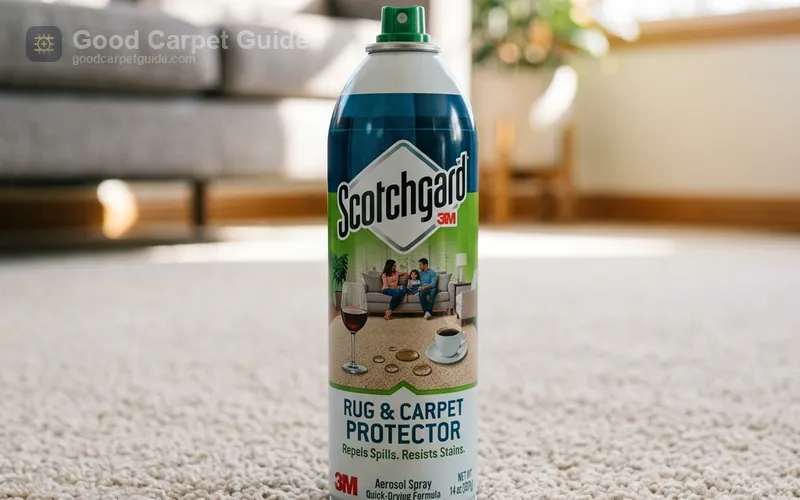
Scotchgard Rug & Carpet Protector Spray
Applied fluorochemical barrier that repels oily soils and sebum, preventing the abrasive grit accumulation that accelerates traffic-lane matting.
Check Price on AmazonPreventative engineering: underlayment density and point-load distribution
Carpet cushion is a shock absorber between the backing and the subfloor, and its density decides how much of a footstep's or furniture leg's force the pile itself has to withstand. A standard 6-lb rebond pad, common in older installations, compresses permanently under cyclic loading within a few years and stops returning force away from the fiber.
The current baseline for active household rooms is an 8-lb rebond pad at 7/16 inch thickness, in line with residential carpet padding standards. Stairs and other high-traffic zones call for a denser 10-lb rebond or felt pad, and viscoelastic memory foam cushion is not recommended on stairs because it compresses too slowly to support a moving foot safely.

Leggett & Platt 8-lb Rebond Carpet Cushion
High-density 8-lb rebond underlayment that provides essential vertical shock absorption to protect carpet pile from permanent crushing under foot traffic.
Check Price on AmazonCushion thickness has an upper limit as well as a density floor. Residential cushion guidance and the HUD UM 72a cushion standard commonly cap padding at 1/2 inch, with 3/8 inch to 7/16 inch as the practical target. Padding thicker than that creates a trampoline effect at the seams, straining the seam tape and accelerating both crushing and delamination.
Point loads from furniture legs concentrate enormous pressure per square inch onto a tiny fiber area. Heavy-duty plastic or rubber furniture caster cups spread that same total weight across a wider base, cutting the pressure the pile actually experiences and slowing crush formation under sofas, beds, and dining tables.
Four maintenance mistakes that permanently ruin carpet pile
Incorrect cleaning tools, excessive heat, and aggressive chemicals frequently turn temporary crushing into permanent structural damage. Avoiding these common homeowner errors extends pile lifespan.
Setting the vacuum beater bar too low
Homeowners often lower the beater bar thinking a tighter setting cleans more aggressively. In practice, a beater bar running too fast and biting into the pile sharply increases bending fatigue in nylon and surface fuzzing in polyester. The correct setting rides just above the pile surface, agitating dirt loose without repeatedly bending the tuft tips.
Using excessively hot water or true steam
True steam above 100°C, or 212°F, accelerates amide hydrolysis in nylon, chemically breaking the bonds responsible for its resilience, and degrades polyester fiber strength. According to IICRC S100 standards and manufacturer technical guidelines, safe fiber-surface temperatures remain under 43°C (110°F) for nylon and under 49°C (120°F) for polyester. Commercial hot water extraction equipment operated by certified technicians maintains temperature regulation to prevent thermal polymer degradation.
Applying high-pH cleaners or citrus and solvent spotters
Strongly alkaline detergents attack the amide bonds in nylon directly and reduce its crush resistance over time. Limonene- and glycol-based solvent spotters, common in citrus degreasers, swell the amorphous zones of polyester fiber and leave it structurally weaker. The safe cleaning range for both fiber types sits between roughly pH 6.5 and 7.2.
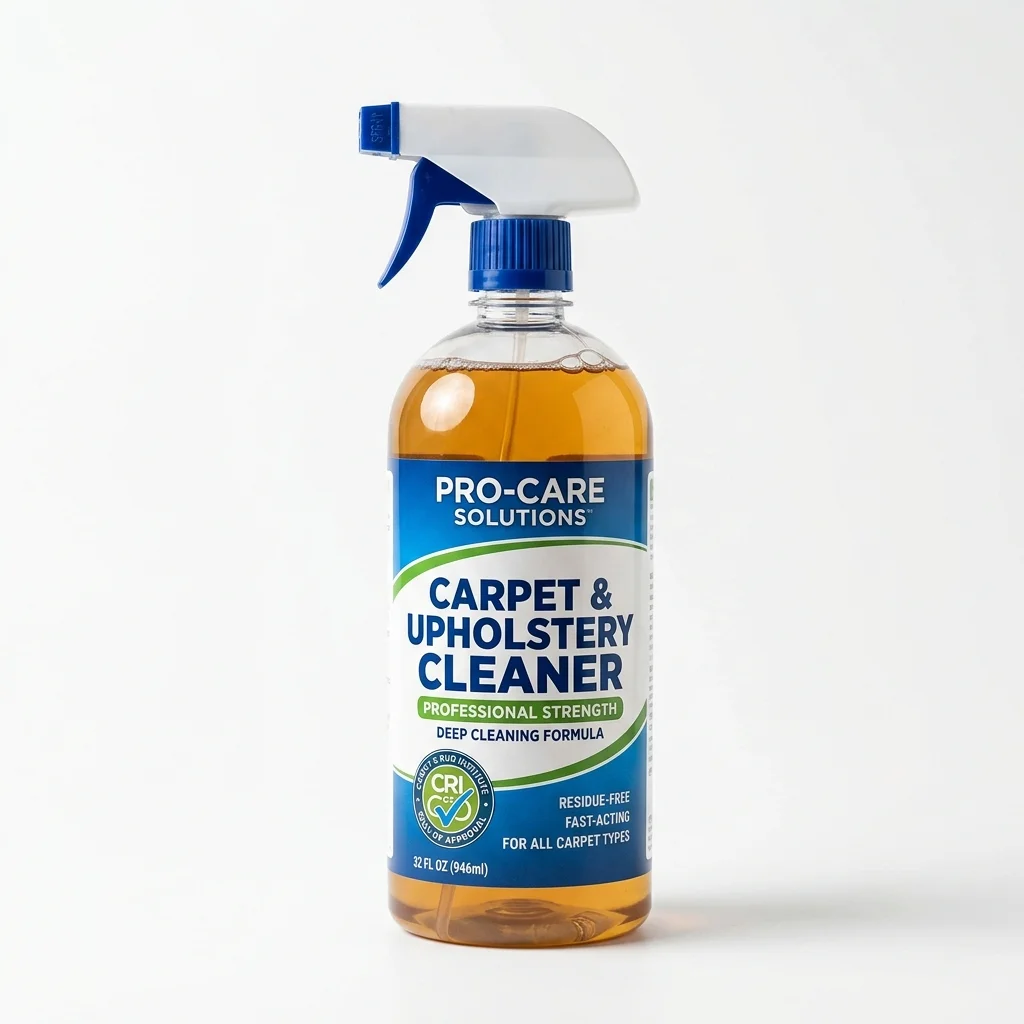
CRI-Approved Carpet & Rug Spot Cleaner
Formulated at neutral pH (6.5–7.2) to safely clean spills without hydrolyzing nylon amide bonds or dissolving synthetic fiber lubricants.
Check Price on AmazonWalking barefoot indoors
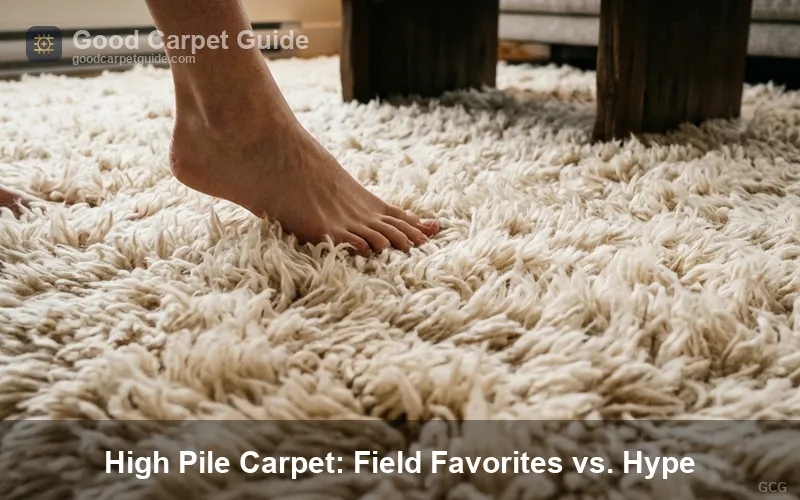
Bare feet deposit sebum and skin lipids directly onto the pile with every step. That oily residue binds airborne dust and tracked-in grit into an abrasive slurry that sits against the fiber surface and grinds it down with each subsequent footstep. A clean-socks-indoors policy measurably slows both graying and tip bloom in high-traffic rooms.
Carpet warranty fine print: what mills actually cover
Standard broadloom wear warranties cover abrasive fiber loss only. Furniture impressions and traffic-lane matting are explicitly excluded from nearly every mill's wear warranty because neither condition removes fiber mass from the carpet.
Texture retention, the industry's answer to matting complaints, is measured on a numeric appearance-change scale such as the ISO 9405-1990 scale, and mills set a minimum rating of 2.5 to 3.0 as the threshold for a texture-retention warranty claim. Major mills such as Shaw and Mohawk market texture-retention or no-mat/no-crush warranties built on this kind of rating.
Both of these warranties carry a maintenance condition that homeowners frequently miss. Coverage typically requires professional hot water extraction cleaning every 12 to 24 months, performed by a technician certified under the CRI Seal of Approval program, with documentation kept on file. Skip that maintenance schedule, and the mill has standing grounds to deny an otherwise valid texture-retention claim.
Comprehensive carpet fiber resilience comparison
| Parameter | Nylon 6 / 6,6 | Polyester (PET) | Triexta (PTT) | Wool |
|---|---|---|---|---|
| Bond chemistry | Polar amide (-CO-NH-) | Nonpolar ester (-CO-O-) | Modified polyester ester bond | Polar peptide (protein) |
| Moisture regain | ~4-4.5% | Under 0.4% | Approximately 0.4-0.6% | 13-18% |
| Crush recovery mechanism | Hydrogen bond reset via heat and moisture | Limited, relies on chain elasticity only | Mechanical bulk recovery, limited chemical reset | Natural crimp memory, strongest recovery of the group |
| Glass transition temperature | Higher, more heat-tolerant before deformation | ~67°C-81°C (152°F-178°F), narrow safe window | Similar range to PET | Not applicable, protein structure behaves differently |
| Stain resistance | Requires topical treatment | Naturally hydrophobic, resists water-based stains | Naturally hydrophobic, strong stain resistance | Absorbs stains readily without treatment |
| Texture retention | High, holds appearance well under traffic | Moderate, mats sooner under equal traffic | Moderate to high | High in quality wool blends |
Frequently asked questions about carpet matting and crushing
Homeowners dealing with flattened carpet frequently ask about DIY fixes, recovery timelines, and maintenance safeguards. Here are clear answers to common pile restoration questions.
Can crushed carpet be fixed without professional help?
Yes, for true crushing the ice cube method and the damp towel and steam iron method both work as homeowner DIY fixes. Matting that has progressed to fiber entanglement usually needs professional grooming or does not reverse at all.
How long does it take for carpet to un-crush itself?
Light crushing under a piece of furniture that gets moved can partially rebound within days as the fiber slowly absorbs ambient humidity. Deep, long-term crush marks need active moisture and heat intervention and do not resolve on their own in most cases.
Does vacuuming make matting worse?
A vacuum with the beater bar set correctly does not worsen matting. A beater bar set too aggressively, biting into the pile, accelerates the tip bloom that causes matting in the first place.
Is polyester carpet a bad choice because it mats faster?
Polyester carpet mats faster than nylon under the same traffic because its nonpolar fiber chemistry lacks a comparable heat-and-moisture reset mechanism, but its hydrophobic nature makes it far more forgiving of spills, and it costs less.
Should I replace my carpet pad when I replace crushed carpet?
Yes, if the old pad is a 6-lb rebond or has visibly compressed, install at minimum an 8-lb rebond pad at 7/16 inch thickness under new carpet. Reusing a collapsed pad under new carpet accelerates crushing in the replacement flooring.
Does steam cleaning cause matting?
Properly calibrated hot water extraction, kept under 43°C for nylon and 49°C for polyester at the fiber surface, does not cause matting and is required maintenance for most texture-retention warranties. Uncalibrated consumer steam cleaners that exceed these temperatures can trigger hydrolysis damage and worsen fiber condition over time.