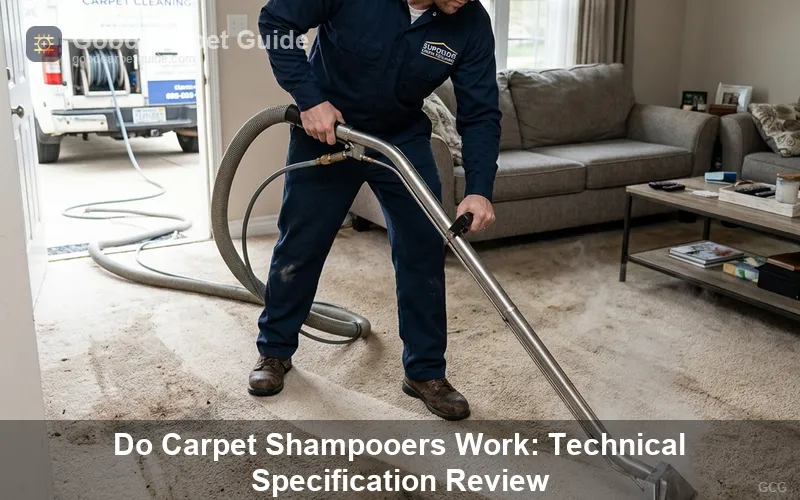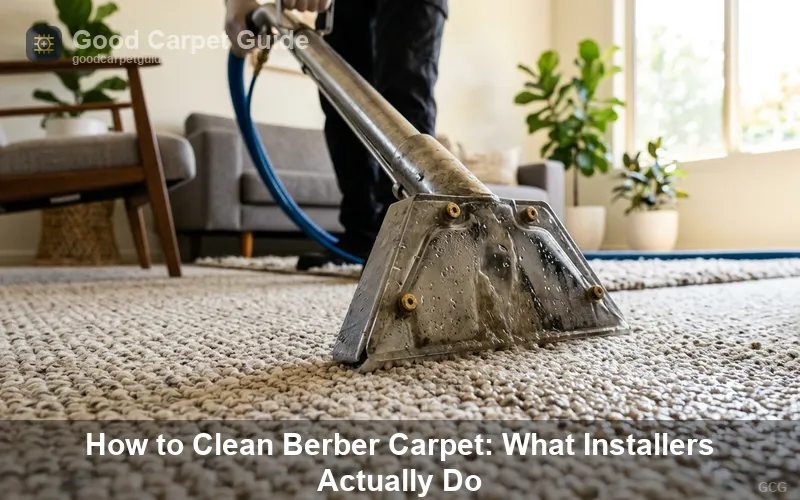
Two things decide whether a berber cleaning goes well. The first is fiber: olefin, nylon 6,6, triexta, and wool each react differently to heat and to cleaning chemistry. The second is the loop. A beater bar or a stiff scrub brush shreds looped pile that cut-pile carpet would shrug off, and one snagged loop runs down the row like a pulled thread in a sweater.
TL;DR recommendation matrix
| Situation | Recommended method | Tool needed | Time | Risk if done wrong |
|---|---|---|---|---|
| Fresh spill (under 10 minutes old) | Blot and cool-water extraction | White terry towel, spray bottle | 5-10 min | Wicking if not fully dried |
| Set-in stain or old spot | Enzyme pre-treatment, then extraction | Enzyme cleaner, extraction machine | 30-60 min | Backing discoloration |
| Dog or cat urine | Enzyme digestion, cool extraction, no steam | Enzyme cleaner, wet/dry vacuum | 1-2 hours plus dry time | Permanently set ammonia odor |
| Whole-room maintenance cleaning | Suction-only vacuum, hot water extraction every 12-18 months | Beater-bar-off vacuum, rental or pro extractor | 2-4 hours | Loop snags, wicking |
| Wool berber | Cool water, pH-neutral cleaner only | pH-neutral shampoo, extraction machine | 1-3 hours | Fiber shrinkage, alkali damage |
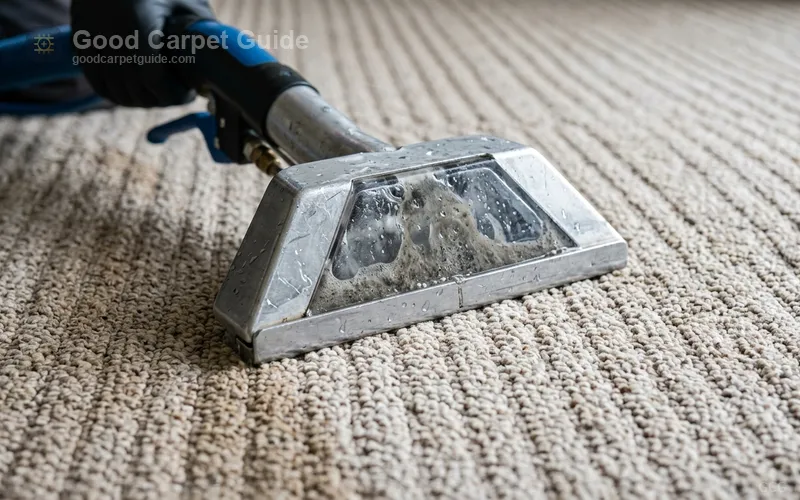
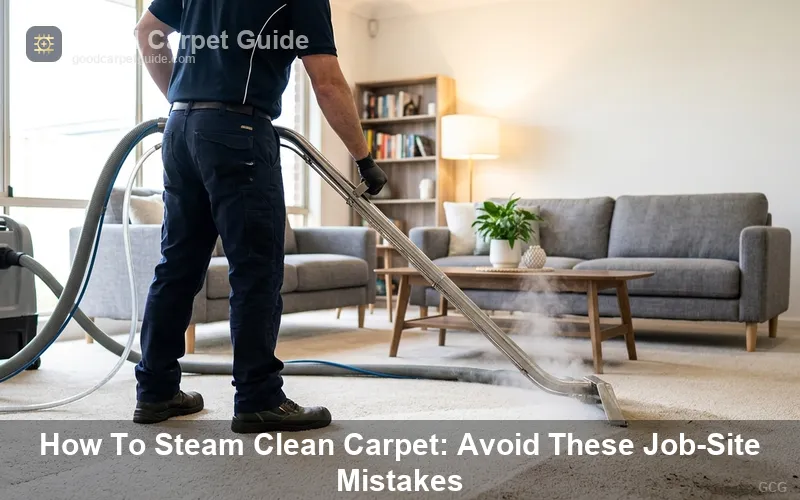
A low-profile wand pulled slowly along the loop rows, not across them.
What a professional berber cleaning actually involves
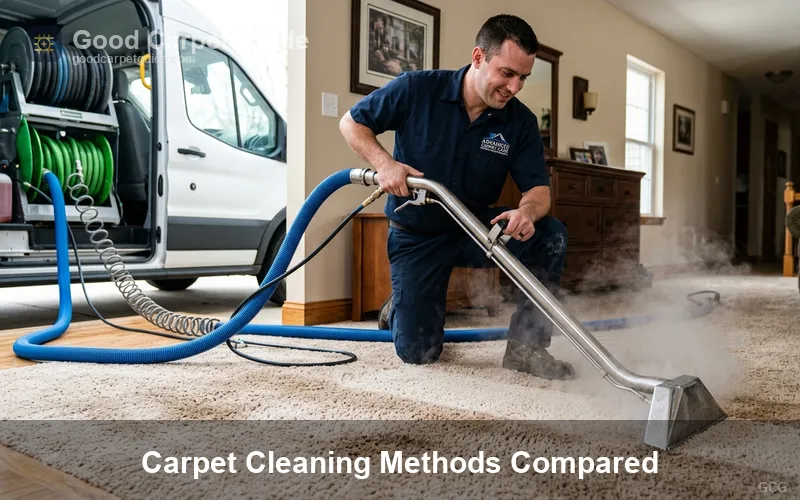
A professional job runs on IICRC S100 hot water extraction, adapted for loop pile by keeping the wand's vacuum slots parallel to the loop rows instead of crossing them at an angle. S100 sets out the sequence: pre-vacuum, pre-spray matched to fiber type, agitation with a soft-bristle groomer instead of a rotary brush, and cooler rinse water on anything with wool content.
The real difference is airflow. A truck-mount extractor moves far more air through the wand than a rented consumer unit, so it recovers more of the water it puts down and can bring a normal room to dry within a few hours. Without that airflow, plan on 12 to 24 hours and run fans or a dehumidifier. Skip that step and you set up the stain that comes back on Thursday.
Cleaning berber at home without a truck-mount
At home, the safer pairing is a suction-only vacuum pass followed by low-moisture cleaning, either bonnet or encapsulation, instead of a saturating shampoo. Encapsulation chemistry crystallizes soil into a dry residue that a second vacuum pass lifts out. Dry-compound and low-moisture systems such as Host and the Whittaker System use a fraction of the water hot water extraction needs.
Water volume is the whole point. Berber's woven or fusion-bonded secondary backing sits on a jute or synthetic scrim, and that scrim is where wicking starts. If you do run a full extraction at home, finish with several dry-only passes of a wet/dry shop vacuum to pull moisture back out of the pile before it can travel down.
Dog and cat urine on berber: enzyme first, water second
Urine needs an enzyme pre-treatment before water or steam touches it. Heat and alkaline shampoo denature urine proteins and bond them to the fiber and to the backing, which is why a spot still smells like ammonia and shows yellow after someone has already run a rental steam cleaner over it.
The order matters more than the product:
- Blot the spot dry with a white towel.
- Apply an enzyme cleaner formulated for pet urine (Rocco & Roxie and Nature's Miracle are the two most widely stocked).
- Let it dwell for the time printed on the label, usually 10-15 minutes.
- Extract with cool water only.
Leave the grocery-store carpet shampoo out of this one. Anything with a pH above 8 is built for general soil, not protein, and it drives the same setting reaction that heat does.
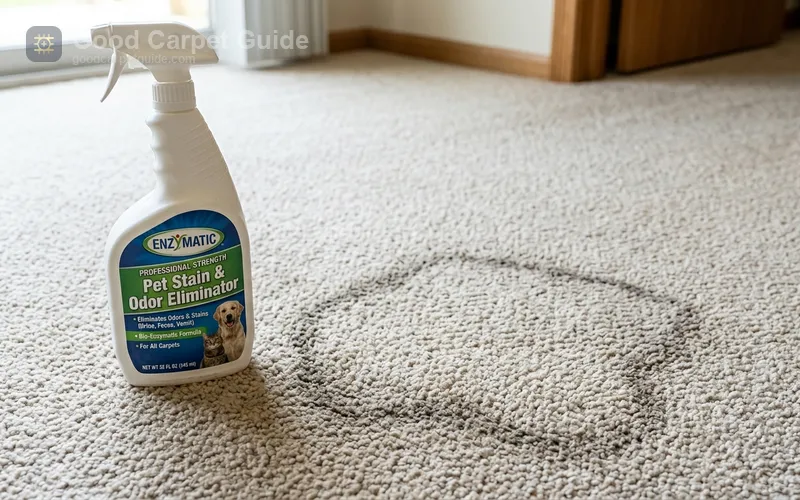
Enzyme first. Water and heat applied before this step bond the urine proteins into the fiber.
Machine settings that do not wreck the loops
A rental or owned extractor works fine on berber if you set suction to maximum and water flow to the lowest setting the unit offers. Over-wetting causes more berber failures than under-cleaning does.
Turn rotary brush agitation off. A spinning brush catches loops the same way a dog's claw does. After the wet pass, make two dry-only passes along the loop rows. A consumer unit such as a Bissell or a Rug Doctor will often leave more water in the pile on the first pass than it takes back out, and the dry-only pass is what closes that gap.
Old, set-in stains
Dried soil has already worked past the fiber surface into the twist of the loop, so old spots need a soak instead of a single pass. Apply an oxygen-based pre-spray (a sodium percarbonate solution such as OxiClean's carpet formula), let it dwell 15-20 minutes, then agitate gently with a soft groomer brush.
Olefin is the hard case. It is oleophilic, meaning it chemically attracts oil-based soil, so cooking grease, lotion, and body oil bind to it instead of sitting on top. A two-year-old grease mark on olefin berber fights back harder than the same mark on nylon. And if a spot survives two extraction passes on olefin, stop cleaning it. At that point you are usually looking at dye transfer or a bleach spot, and neither responds to more solution.
Vacuuming schedule and loop protection
Vacuum two to three times a week in a moderate-traffic home, using suction only or a brush roll raised to its highest, least aggressive height. CRI's Seal of Approval program certifies vacuums and cleaning solutions for soil removal and dust containment; it does not publish a household frequency schedule. The number that actually matters is the one in your own warranty document, since Shaw and Mohawk both condition wear claims on documented routine maintenance (Shaw Residential Carpet Care Guidelines & Mohawk Warranty Manual).
A beater bar set too low shreds loop tips row by row. That is the mechanism behind every "my berber is running" complaint. Find one loose loop and trim it flush at the pile surface with scissors. Pull it and you unravel the loops next to it.
Why loop pile behaves differently from cut pile
Loop pile has no cut fiber ends to fluff, so a spinning brush roll has nothing useful to do and can only catch and pull. Every looped construction shares that vulnerability, from big-box olefin berber to Karastan wool broadloom.
Seams need extra care. Row runners and knee kickers leave the loops under tension along a seam line during installation, and hard scrubbing there can loosen that tension enough to raise a visible ripple. Use lighter hand pressure near seams and let the extraction wand do the agitating.
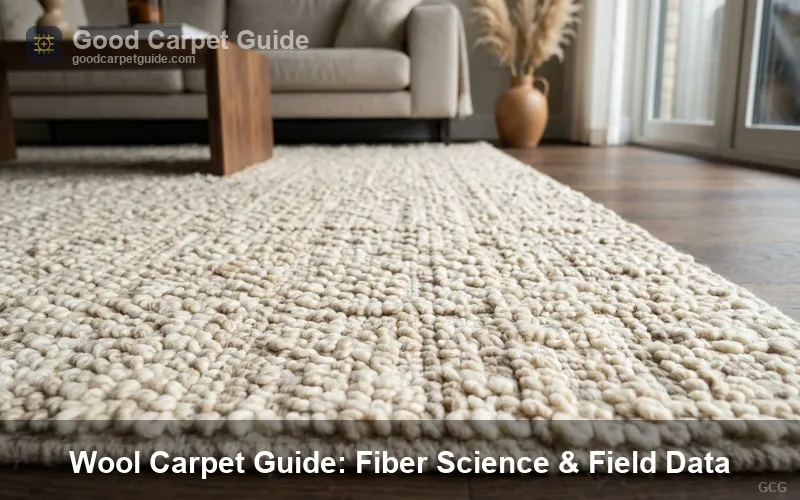
Wool berber: cool water, neutral pH, no steam
Wool shrinks and felts when alkaline pH above roughly 8 meets heat above roughly 120°F, because keratin breaks down under conditions that leave olefin and nylon fiber intact. Cool water plus a pH-neutral, wool-safe solution is the only safe combination.
Stanton and Karastan both specify professional cleaning with wool-safe, pH-balanced products in their care documentation, and both treat improper DIY steam cleaning as grounds for voiding fiber warranty coverage (Stanton & Karastan Wool Care & Warranty Specifications).
Not sure what you have? Snip a fiber from a closet corner and burn it. Wool singes and smells like burning hair. Olefin melts and beads up.
Spot cleaning: blot, work inward, rinse
Blot, do not rub. Press a white cloth straight down so moisture and soil come up instead of getting ground deeper into the loop twist. Work from the outer edge of the stain toward the center so you are not pushing the soil out across fresh loop rows.
Put the cleaning solution on the cloth, never straight onto the carpet. Direct application over-wets one small area, and that alone is enough to raise wicking risk in that spot while the carpet around it stays dry. Once the stain lifts, rinse with a cloth dampened in plain water. Leftover chemical residue re-attracts soil the moment foot traffic starts again.
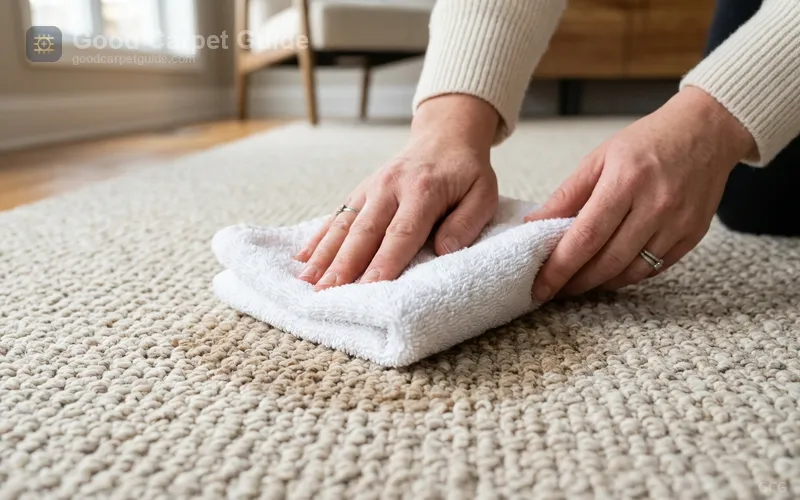
Press straight down, and work edge to center.
Wicking: why the stain comes back on day three
Wicking is a stain that reappears days after the job is done. Capillary action pulls residual moisture and dissolved soil up out of the backing and pad, through the loop fibers, to the surface. Moisture trapped in the jute or synthetic secondary backing has to evaporate somewhere, and the path of least resistance is the loop fiber itself, which carries the soil along with it.
Timing is the giveaway: 2 to 5 days out, once surface moisture has gone but backing moisture has not. That is why a floor that looked perfect on cleaning day shows a faint yellow-brown ring by the end of the week.
There are two defenses. Keep water volume down during the cleaning pass, and run fans or a dehumidifier for at least 24 hours afterward. If the same spot wicks back after several cleanings, the contamination sits at backing level, usually old pet urine, and no amount of surface work will clear it.
The padding argument: showroom feel versus installed life
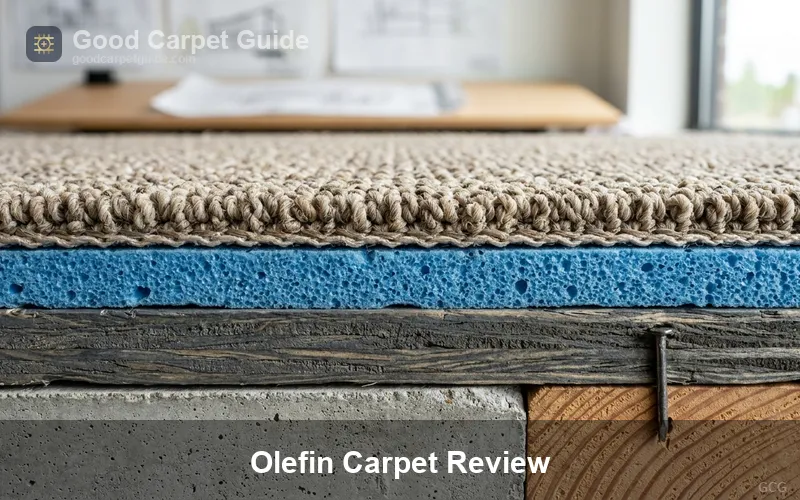
Retail floors sell on feel, and thick soft memory foam or heavy re-bond feels better in a showroom test than a thin high-density pad does. Installers spec the thin one anyway.
CRI 104 (residential) and CRI 105 (commercial) tie cushion selection to carpet construction. For loop pile, the field spec in common use is no more than 3/8 inch thickness at roughly 8 lb per cubic foot density. Check it against your carpet maker's own warranty sheet, since that is the document a claim gets judged against.
The reason is flex. Soft, thick padding lets the floor move vertically under foot traffic, and berber's stiffer secondary backing does not tolerate that movement the way a plush cut-pile backing does. Repeated flex stretches the backing and eventually delaminates it, which shows up as buckling and permanent wrinkles. Write "8 lb density, 3/8 inch maximum, felt or rubber" onto the sales order by name, because the default showroom sample is usually the softer, thicker product.
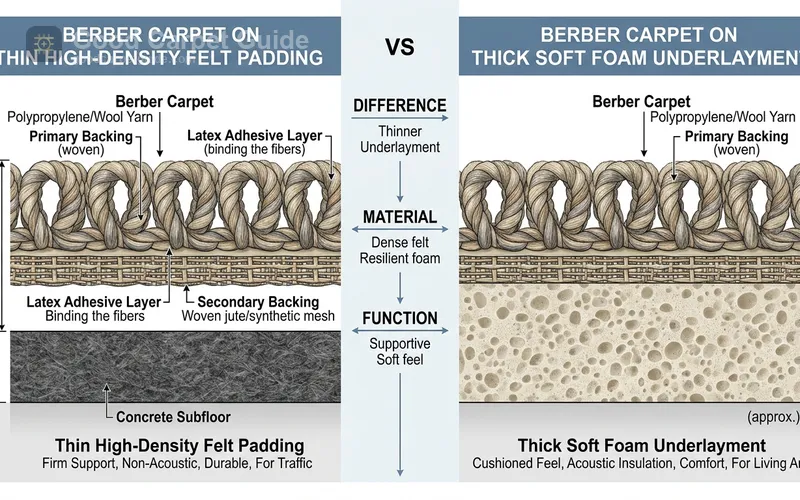
Thin and dense on the left, thick and soft on the right. Only one of them keeps berber's backing flat.
Fiber identification changes the whole method
Four fibers dominate the berber sold today: olefin (polypropylene), nylon 6,6, triexta (Mohawk sells it as SmartStrand), and wool.
- Olefin shrugs off water-based staining and attracts oil-based soil. Olefin berber in a kitchen shows grease before nylon does in the same spot.
- Nylon 6,6 tolerates a wider pH range during cleaning and survives more aggressive stain treatment before the fiber itself takes damage, a function of its polymer structure.
- Triexta has stain resistance built into the polymer, so it does not wear off the way a topical treatment does. It still needs the same suction-only vacuum care as any other loop.
- Wool is the one fiber that a cleaning method can genuinely destroy. Cool water and neutral pH, always.
Your retailer invoice or the manufacturer label near the tackless strip usually names the fiber. Where neither exists, the burn test settles wool versus synthetic.
Full-room cleaning, step by step
- Pre-vacuum with suction only or a raised brush roll, moving along the loop rows, before any liquid touches the carpet.
- Identify the fiber from the manufacturer label or a burn test on a hidden sample. Wool and synthetics need different chemistry.
- Pre-treat visible stains: enzyme cleaner for protein stains, oxygen pre-spray for general soil. Dwell 10-20 minutes per the label.
- Set the extraction machine to low water flow and high suction, and disable any rotary brush attachment.
- Extract in overlapping passes along the loop direction. Never cross the loops at an angle that could snag fiber.
- Run two dry-only passes to pull residual moisture out of the pile before it reaches the backing.
- Run fans or a dehumidifier for 12-24 hours.
- Re-vacuum once the carpet is fully dry, to lift anything that wicked up during drying.
Cost guide: professional versus DIY berber cleaning
| Service tier | Typical cost | What is included |
|---|---|---|
| DIY rental extraction | $30-45 per day, plus solution | Machine rental only, homeowner labor |
| Local carpet cleaning company | $120-250 per average room | IICRC-trained technician, truck-mount extraction |
| Big-box subcontracted cleaning | $89-150 flat promotional rate | Variable technician certification, standard extraction |
| Specialty pet-urine treatment add-on | $50-150 per affected area | Enzyme sub-surface treatment, odor sealant |
Local specialty companies are more likely to employ IICRC-certified technicians working to S100 protocol. Big-box promotional pricing often runs through subcontractors whose training varies (IICRC Certified Firm Directory & Field Inspections). The same specialty-versus-big-box gap shows up on the installation side, which is where this carpet delamination guide picks up for readers dealing with padding-related backing failures.
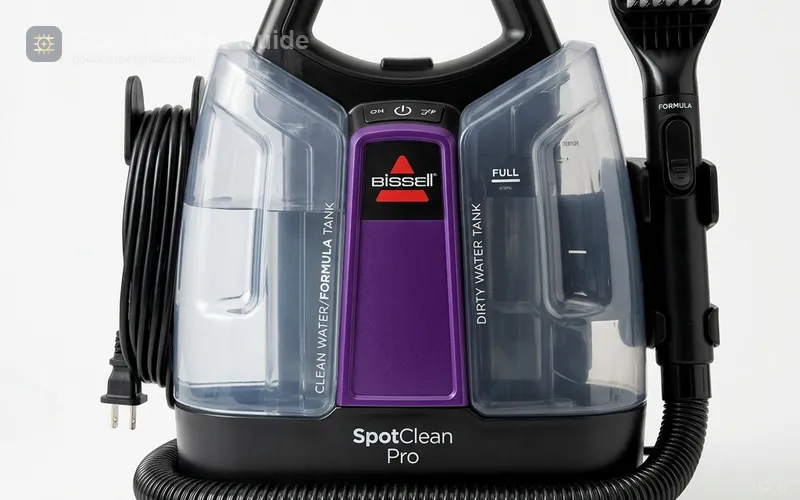
Bissell SpotClean Pro Portable Carpet Cleaner
A low-water-volume portable extractor suited to spot cleaning berber loops without saturating the backing.
Check Price on Amazon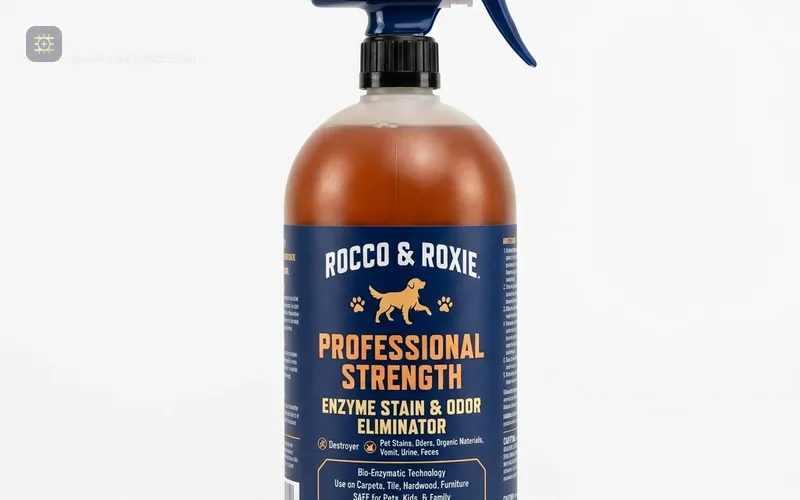
Rocco & Roxie Professional Strength Enzyme Stain and Odor Eliminator
An enzyme formula for pre-treating pet urine before any water or heat touches the stain.
Check Price on Amazon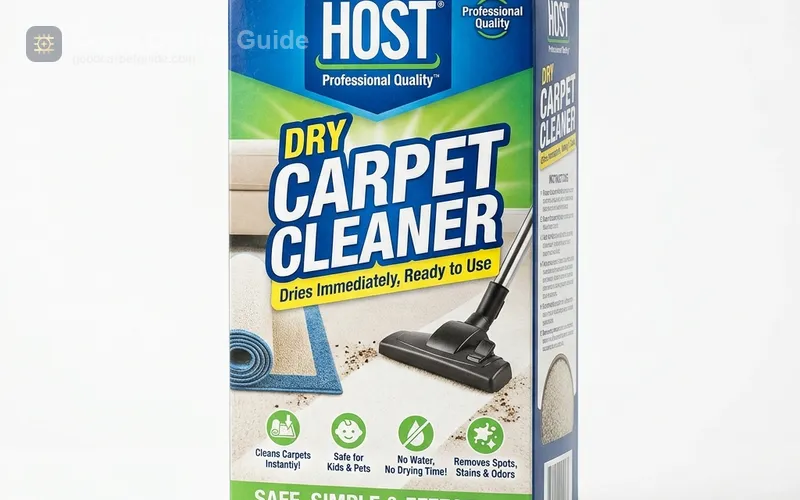
Host Dry Carpet Cleaner Powder
A low-moisture encapsulation cleaner for berber maintenance cleaning between full extractions.
Check Price on AmazonThe three failures behind most berber complaints
- The stain that comes back. The floor looks clean on the day of service, then a faint outline shows in the same spot three to five days later. The timing points at wicking from backing moisture or sub-surface contamination (IICRC S100 Cleaning Standard).
- Loop runs from vacuum damage. Beater bar too low, loop tips shredded row by row. Shaw and Mohawk warranty documents list improper vacuuming and inadequate maintenance among grounds for denying premature-wear claims (Mohawk Carpet Care & Warranty Terms).
- Padding substitution. The homeowner finds out only after backing failure that the installed pad was thicker and softer than the 3/8 inch high-density spec. Naming pad density and thickness on the sales order is the only reliable prevention.
bottom line
Match the chemistry to the fiber first: enzyme treatment for urine on any fiber, cool water and neutral pH for wool, low-volume extraction for olefin, nylon, and triexta. Vacuum weekly on suction-only. Book full hot water extraction on a 12-18 month cycle, because a tighter schedule buys wicking risk without buying a cleaner floor. With pets in the house, treat the enzyme pre-treatment as part of a standard cleaning and not an upsell, since untreated urine at backing level is the usual reason a spot keeps returning no matter how often the floor gets cleaned.
If cleaning has stopped solving the problem, compare loop-pile performance in our best carpet for basement guide or review our comprehensive how to remove carpet stains guide before committing to a full replacement.