TL;DR recommendation matrix
Install wool carpet over 18–20 lb frothed rubber or 40 oz felt underlayment, stretch it with a mechanical power stretcher, and clean it only with pH 5.5 to 8.5 solutions held below 104°F (40°C).
| Reader situation | Recommended wool specification | Required underlayment | Installed cost estimate (per sq ft) | Primary failure mode to manage |
|---|---|---|---|---|
| Master bedroom, low traffic | Cut pile, 100% pure new wool (Unique Carpets Bolero, $8.99/sq ft material) | 18–20 lb frothed rubber | $15.00 – $19.00 | Initial fiber flight for 60–90 days |
| Staircase | Woven wool or tight loop, pile direction running down the flight | 40 oz synthetic/wool felt, no thicker than 3/8 in | $19.00 – $26.00 | Backing grinning at nose radius |
| Hallway, high traffic | Woven Axminster or Wilton, dense low-pile construction | 20 lb frothed rubber | $22.00 – $28.00 | Seasonal buckling if knee-kicked instead of power stretched |
| Below-grade basement | Wool not recommended; test slab first per ASTM F2170 | Not applicable | Not applicable | Hygroscopic moisture uptake, wicking, browning |
| Chemical sensitivity | Undyed, untreated wool (Earth Weave Bio-Floor McKinley, $6.33–$6.75/sq ft) | Wool felt, no adhesive | $16.00 – $21.00 | Moth larvae, since no Permethrin treatment is present |
| Budget-constrained resale | Wool-blend loop (Stanton Timbers, 80% wool / 20% Polysilk, $10.50–$12.50/sq ft) | 18 lb frothed rubber | $17.00 – $22.00 | Pilling from beater-bar vacuums |
Three variables drive most reported wool carpet failures: cushion density, installation tension, and cleaning pH. The fiber itself rarely fails. Every recommendation below is conditional on traffic load, cleaning frequency, pile construction, and subfloor moisture content. Pricing figures are current United States dealer material prices, running from Karastan at $4.29/sq ft to Stanton Rosecore San Mateo at $22.79/sq ft.
What wool carpet is and how the fiber behaves under mechanical load
Wool carpet is a textile floor covering constructed from keratin protein staple fibers sheared from sheep, spun into yarn, then tufted or woven into a backing substrate. The distinction that governs every downstream maintenance decision is staple versus filament construction. Nylon and polyester carpets are extruded as bulk continuous filament (BCF), so each strand runs the full length of the tuft. Wool is spun from short discrete fibers averaging 25 to 40 microns in diameter for carpet-grade crossbred wools, which means loose fiber ends exist inside every tuft from the day of manufacture.
Keratin gives wool two measurable behaviors that synthetics lack. The fiber's crimped helical structure recovers compression at roughly 90 percent after sustained static load, which is why wool holds appearance rating under the ASTM D5252 Hexapod drum test at pile weights where polyester matts. That same protein chemistry is also the fiber's weak point: keratin dissolves in sodium hypochlorite and denatures above 40°C. Wool also carries a natural lanolin residue and an intact epicuticle scale layer, which together produce the fiber's soil-shedding characteristic and its resistance to spot penetration.
Moisture regain is the third governing property. Wool holds commercial regain values in the 13 to 16 percent range against roughly 4.5 percent for nylon and well under 1 percent for polyester, and ASTM D1909 tabulates commercial regain for textile fibers. The fiber absorbs and releases that water vapor without feeling damp to the touch. Hygroscopic behavior of this scale explains seasonal dimensional change in installed broadloom, and it explains the sulfurous wet-fleece odor that one homeowner forum post recorded as "Wool Carpet smells like death in our new home."
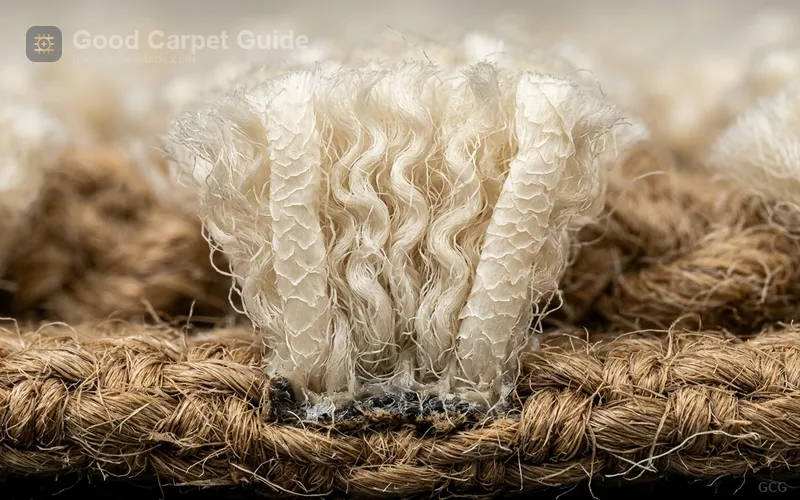
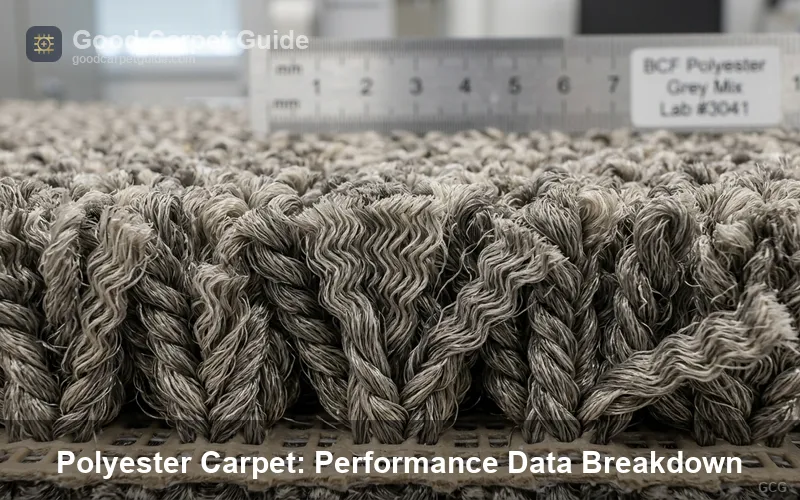
The crimped keratin staple fibers visible at left produce wool's 90 percent compression recovery, while the stiff jute secondary backing at right is why mechanical power stretching is not optional.
Is wool carpet a good choice for your specific room
Wool performs best in bedrooms, formal living rooms, and staircases, and worst below grade. Suitability tracks three variables: subfloor moisture content, traffic passes per day, and the cleaning chemistry the household will actually use.
Bedrooms are the easiest case. Cut pile at 40 oz/sq yd face weight is sufficient at low traffic and low spill frequency, and this best carpet for bedrooms reference breaks face weight down by room. Staircases suit wool well but punish sloppy execution, since nose radius abrasion and pile direction both govern the result and loop rows have to be parted with an awl before stapling; the tread-by-tread method appears in this best carpet for stairs breakdown. Hallways take wool only in woven construction, because tufted wool fuzzes at pivot points. Dining rooms are a moderate case governed by spill frequency and cleaner pH, and untreated wool browns from acidic food spills within 15 to 30 minutes. Bathrooms are out, since sustained saturation produces measurable fiber shrinkage.
Below-grade slabs need a test, not a rule of thumb. An in-situ relative humidity probe reading above 75 percent per ASTM F2170 rules out wool on that slab, and the same threshold applies on any floor of the building. Wool installs successfully above grade in humid climates when the plenum is conditioned and the slab is isolated. Synthetic alternatives for basements are compared in this best carpet for basement guide.
How to choose wool carpet: a seven-step selection sequence
Each step below constrains the one after it, so run them in order.
- Test the subfloor before shopping. Run a calcium chloride test to ASTM F1869 or an in-situ probe to ASTM F2170 on any concrete slab. A moisture vapor emission rate above 3 lb/1,000 sq ft/24 hr, the ceiling most flooring manufacturers publish in their installation specifications, disqualifies wool on that substrate.
- Fix construction before color. Woven Axminster and Wilton carpets integrate pile and backing in a single weaving operation, which produces higher tuft-bind values than tufted goods at equivalent face weight. Woven pricing starts near $15.49/sq ft (Fabrica Luxe) against $4.29/sq ft for tufted entry goods (Karastan Graceful Features).
- Match face weight to traffic load. Face weight is measured in oz/sq yd and describes fiber quantity only. Pile density (oz/cu yd) and twist count (turns per inch) are separate measurements, and a 50 oz carpet at low twist will untwist faster than a 40 oz carpet at high twist.
- Decide on moth treatment. Unique Carpets treats its Bolero line with Permethrin, which targets keratin-digesting larvae. Undyed lines from Earth Weave carry no insecticidal treatment by design, so households choosing untreated wool take on an active monitoring obligation.
- Confirm blend percentage. Stanton Timbers runs 80 percent wool with 20 percent Polysilk, a blend that reduces material cost to $10.50–$12.50/sq ft and alters cleaning tolerance, since the synthetic component responds differently to solvent spotters.
- Specify the cushion before signing. Wool manufacturers publish minimum density requirements, and Stanton and Nourison both void warranty coverage over noncompliant underlayment. The density thresholds and deflection figures are itemized in this carpet padding guide .
- Verify the installer holds power-stretching credentials. Ask for certification from the International Certified Floorcovering Installers Association (CFI), or documented CRI-105 compliance in writing, before paying a deposit.
How much does wool carpet cost, and why quotes run 2 to 3 times synthetic
Installed wool runs $15.00 to $28.00 per square foot in the United States market, against roughly $5.00 to $12.00 for a comparable synthetic installation. Homeowner forum posts read that spread as dealer opportunism, one describing local stores as "getting dollar signs in their eyes." Three line items account for it.
| Cost component | Range (per sq ft) | Driver |
|---|---|---|
| Broadloom wool material | $5.00 – $26.00 | Entry Berber through woven Axminster and Wilton |
| Specialized underlayment | $1.50 – $3.00 | 18–20 lb frothed rubber or 40 oz synthetic/wool felt |
| Professional labor | $2.50 – $4.50 | Power stretching, seam sealing, stair row-running |
| Labor-only rate, customer-supplied goods | $2.77+ ($25+/sq yd) | Installers price liability higher on material they did not source |
| Total turnkey installed | $15.00 – $28.00 | Average residential wool project |
Synthetic labor by comparison runs $1.00 to $2.00 per square foot, and standard 6 lb rebond pad runs well under $1.00. Labor carries the larger multiplier because wool broadloom is heavier per square yard, the stiff backing resists manipulation, and every cut edge requires latex seam sealer to prevent row unraveling.
Material pricing sorts into three tiers on current dealer sheets. Entry goods at $4.00 to $9.00 per square foot include Karastan Graceful Features at $4.29, Unique Carpets Santorini at $5.49, Earth Weave Bio-Floor McKinley at $6.33 to $6.75, Masland Hunter at $8.63, and Unique Carpets Bolero at $8.99. The $9.00 to $15.00 band covers Unique Carpets Kingston at $9.49, Masland Tracker at $10.99, Stanton Hibernia Villager at $11.79, Unique Carpets Grenoble at $11.99, Stanton Antrim Tucker at $12.09, Stanton Antrim Maren at $12.29, Stanton Hibernia Terrain at $13.99, and Fabrica Decor New Saba at $14.59. Above $15.00 sit Fabrica Luxe at $15.49, Stanton Crescent Yates at $15.99, and Stanton Rosecore San Mateo at $22.79.
Regional labor variance applies on top of these figures, and metropolitan coastal markets typically price installation at the upper end of the $2.50 to $4.50 band.
How to protect wool carpet from moths and carpet beetles
Moth control on wool takes three things: vacuum access to concealed areas, pheromone monitoring, and either factory Permethrin treatment or a post-installation residual application. Clothes moth and carpet beetle larvae digest keratin directly, which makes wool a food source. Reported outcomes go well past cosmetic. One Reddit post describes wool carpet with "several, large, bare patches now, where carpet moths had a lovely feast," and a buyer in a second thread received a wool rug "delivered infested with Carpet Beetles" that forced disposal of every rug in the house.
Field protocol runs in this order:
- Vacuum the perimeter, under furniture, and inside closet floors on the same schedule as open floor, since larvae feed in undisturbed low-light zones.
- Place pheromone traps for *Tineola bisselliella* at two per room during the first season to establish whether an active population exists.
- Specify factory-treated goods where monitoring will be inconsistent. Unique Carpets applies Permethrin to the Bolero line as a larvicidal treatment.
- Inspect any imported wool rug on delivery, before it enters the house.
- Treat an infestation as a whole-room event, since larvae migrate under tackless strip.
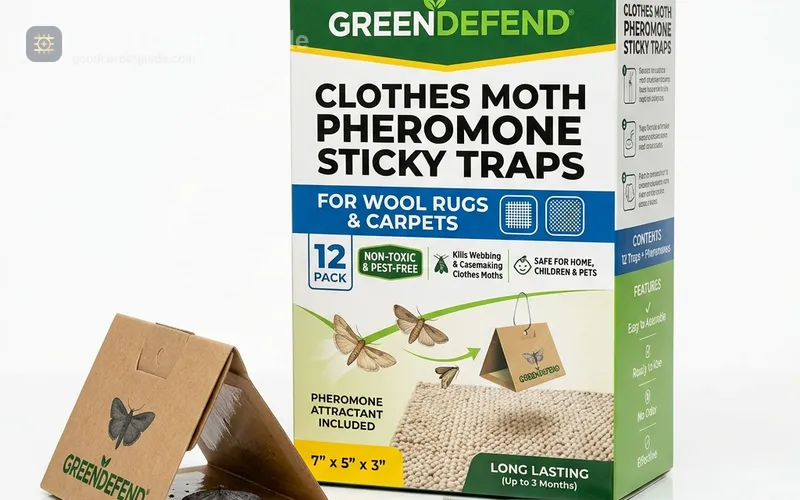
Clothes Moth Pheromone Traps for Wool Carpet, 12-Pack
Non-toxic sticky traps that capture adult male webbing clothes moths and confirm whether an active keratin-feeding population is present before visible bare patches develop.
Check Price on AmazonHow to clean wool carpet without stripping the lanolin layer
Hold cleaning solutions between pH 5.5 and 8.5 at temperatures below 104°F (40°C), and blot spills instead of scrubbing. Wool's protective epicuticle and lanolin residue are the fiber's soil-resistance mechanism, and high-alkaline chemistry removes both. Oxygen bleach products including OxiClean, along with high-alkaline supermarket detergents, have produced permanent bleaching within 15 to 30 minutes of dwell time [INSERT NAMED SOURCE for bleaching test results]. Chlorine bleach behaves worse, since sodium hypochlorite hydrolyzes keratin outright and leaves physical holes in the pile.
Temperature is the second control. Hot-water extraction above 40°C denatures the protein structure and produces measurable shrinkage along with dye migration, and IICRC S100 accordingly specifies reduced-temperature protocols for protein fibers. Over-wetting produces a separate failure: excess moisture carries jute backing tannins upward into the pile face as the carpet dries, which appears as brown wicking stains along seams and traffic lanes.
Working sequence for a fresh spill:
- Blot with white cotton toweling, working from the outside of the spill inward.
- Apply a WoolSafe-approved neutral spotter, never a general-purpose alkaline cleaner.
- Rinse with a mild acetic acid solution to return surface pH toward 6.0.
- Weight fresh toweling over the area and dry with airflow at room temperature.
- Schedule professional low-moisture extraction at 12 to 18 month intervals depending on traffic load.
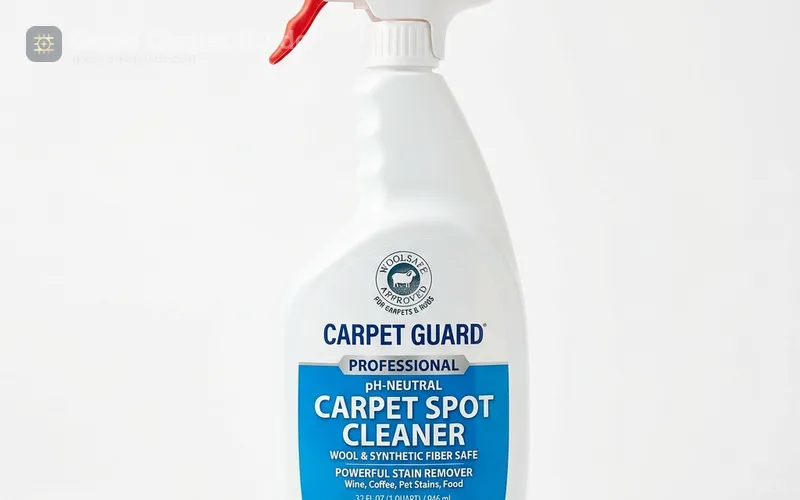
WoolSafe-Approved pH-Neutral Carpet Spotter
A pH-controlled spotting solution formulated for protein fibers, holding within the 5.5 to 8.5 range that leaves wool's lanolin and epicuticle layer intact.
Check Price on AmazonIs initial shedding normal, or is the carpet defective
Initial shedding is normal fiber flight from staple construction, and it typically resolves within 60 to 90 days on tufted wool. Because wool yarn is spun from short fibers rather than extruded as continuous filament, loose ends work to the surface under foot traffic until the reservoir depletes. Homeowners consistently misread this as product failure. One owner posted: "It's been 1 month and I vacuum with a Dyson every 2-3 days. And each time the vacuum is full of red fibers every time... Is my carpet going to be bald eventually?"
The answer turns on which vacuum is being used. Upright vacuums with rotating beater bars or turbo brushes mechanically abrade the keratin surface and untwist yarn tips, which converts finite initial flight into ongoing fiber loss and pilling. Another owner describes that exact progression: "Since then it severely pills and needs to be vacuumed every day... this seems ridiculous. Is this pilling going on this long normal?" Shedding that continues past 90 days at undiminished volume points to abrasive vacuuming, to low twist count in the specified goods, or to both.
Wool requires suction-only vacuuming, and beater-bar use voids coverage under most wool manufacturer warranties. Sample tags rarely carry that restriction, so most buyers learn it only after the pile has already fuzzed.
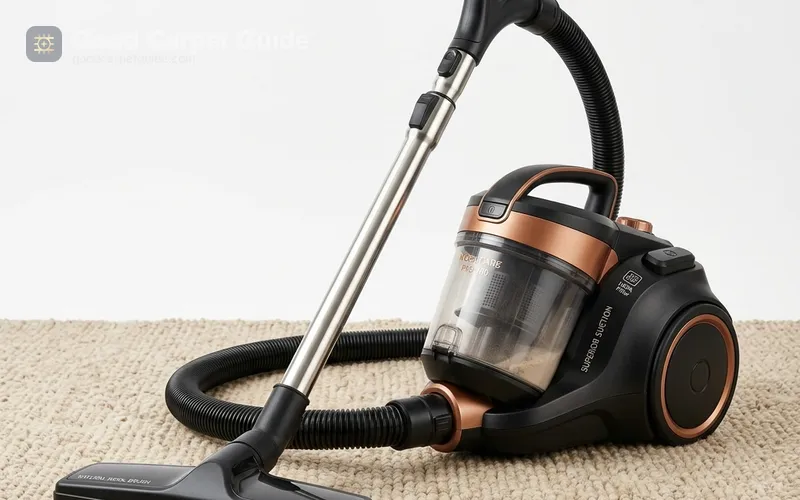
Suction-Only Canister Vacuum with Smooth Floor Tool for Wool Carpet
A canister vacuum with an unpowered suction head, which lifts loose staple fiber during the initial flight period without the rotating brush abrasion that causes permanent pile fuzzing.
Check Price on AmazonCan you install wool carpet yourself
Wool carpet installation is not a viable do-it-yourself project, because the single most important step requires a tool that costs more to rent than the labor saved. Wool broadloom is manufactured with stiff jute or woven secondary backings that lack the thermoplastic elasticity of synthetic backings. Knee-kickers cannot generate sufficient tension against that stiffness, so the carpet relaxes into ripples and buckles at the first seasonal humidity swing. CRI-105 and CFI installation standards both mandate mechanical power stretching for wall-to-wall wool broadloom.
Details that separate a compliant install from a callback:
- Standard 4 lb and 6 lb polyurethane rebond compresses unevenly under stiff wool backing, and manufacturers including Stanton and Nourison prohibit it outright. Compliant cushion is flat frothed rubber at 18–20 lb density (56 oz/sq yd) or synthetic and wool felt at 40 oz/sq yd minimum.
- Every cut made across loop rows unravels unless latex seam sealer goes onto the cut edge immediately.
- Loop pile has no nap to conceal fasteners, so installers part loop rows with an awl or row runner before driving staples, which avoids visible dimples.
- Looped wool stretched over a sharp tread radius exposes backing between loops, a condition called grinning, unless the pad is dense enough to soften the radius.
- Pile must lay downward on a staircase, since reversed pile reflects light at a contrasting angle on every riser.
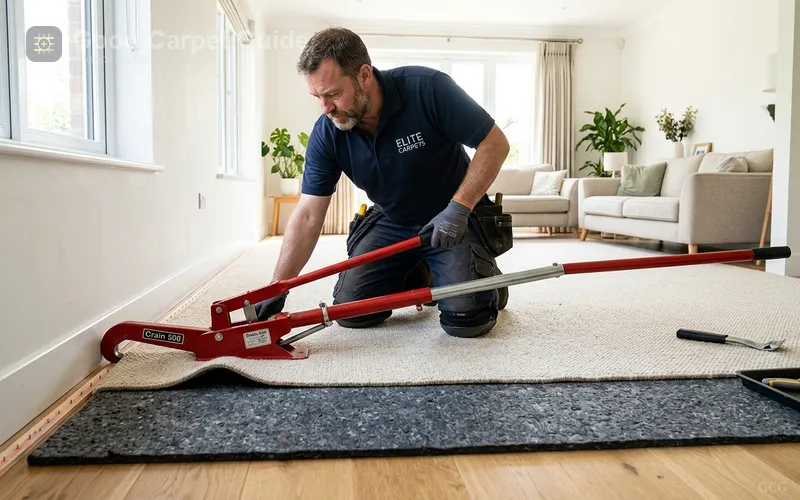
Mechanical power stretching against the stiff jute backing shown at the perimeter is what prevents seasonal buckling, and the 18 lb frothed rubber pad beneath it is the same cushion specification manufacturer warranties treat as a coverage condition.
Warranty fine print: what actually voids wool carpet coverage
Wool carpet warranties are conditional performance contracts, and four conditions void them. Manufacturers write coverage against abrasive wear and texture retention, then exclude the maintenance behaviors that cause most real-world claims.
| Voiding condition | Mechanism | Named manufacturer position |
|---|---|---|
| Beater-bar or rotating-brush vacuuming | Mechanical abrasion of keratin surface and yarn untwisting | Industry-wide wool position; verify against the specific brand warranty text |
| Noncompliant underlayment | Uneven compression under stiff backing, seam failure | Stanton and Nourison void coverage over improper cushion |
| Knee-kick installation without power stretching | Insufficient tension, seasonal buckling | CRI-105 and CFI installation standards |
| High-alkaline or chlorine cleaning agents | Lanolin stripping, keratin hydrolysis | IICRC S100 protein-fiber protocols |
Texture retention warranties also carry appearance-rating language tied to standardized testing, and ASTM D5252 Hexapod drum results are the reference method for that rating. Read the maintenance clauses before signing, since that is where most denied claims are decided.
How long does wool carpet last
Woven wool carpet commonly reaches 20 to 30 years of service in residential settings, while tufted wool at moderate traffic reaches roughly 10 to 15 years before appearance retention drops below acceptable [INSERT NAMED SOURCE for service-life figures]. Construction drives that gap: woven Axminster and Wilton goods lock pile into the backing structure during weaving. Both ranges are field expectations conditioned on traffic load, cleaning history, and cushion specification. Neither is a warranty term.
A realistic ownership timeline:
- Days 1 to 90: fiber flight at high volume, declining steadily. Suction-only vacuuming two to three times weekly.
- Months 3 to 18: flight resolves. First professional low-moisture extraction due at the 12 to 18 month mark under normal traffic.
- Years 2 to 5: traffic lane definition appears in tufted goods. Woven goods show minimal change.
- Years 5 to 12: tufted wool reaches replacement consideration in hallways and stairs while bedroom areas remain serviceable.
- Years 12 to 30: woven wool continues in service with periodic re-stretching after major humidity cycles.
Replacement is indicated when backing delamination appears, when tuft loss exposes backing across a measurable area, or when re-stretching no longer removes ripples. Pile crush alone does not justify replacement, since wool recovers compression.
Big box store versus local dealer sourcing
Local flooring dealers hold the sourcing advantage on wool: the party that sells the goods also carries the installation liability. Big-box retailers subcontract installation to third-party crews paid at volume rates, and volume rates do not accommodate the row-running, awl-parting, and seam-sealing steps that wool requires. Wool broadloom also occupies a narrow slice of national inventory, so Fabrica, Stanton, Unique Carpets, and Masland move through specialty dealer channels and rarely appear in big-box floor stock.
Installers also charge $2.77 per square foot and upward on customer-supplied wool, above their own dealer-supplied rate, because material they did not inspect carries defect-claim exposure they cannot pass upstream.
Regional performance differences in humid versus arid climates
Wool carpet holds tension least reliably in climates with wide seasonal humidity swings, because the fiber's hygroscopic behavior drives dimensional change in the installed assembly. Gulf Coast and Pacific Northwest installations expand during humid months and contract during heating season, so power stretching to full tension at installation matters more in those markets than anywhere else. Arid Southwest installations show the opposite pattern, with lower moisture-driven movement and higher static generation.
Subfloor moisture remains the disqualifying variable, while ambient humidity only affects tension retention. A slab tested to ASTM F1869 above 3 lb/1,000 sq ft/24 hr, or to ASTM F2170 above 75 percent internal relative humidity, will drive vapor into wool backing regardless of climate zone, and jute tannin wicking follows.
Frequently asked wool carpet questions
These questions address the most common technical and economic concerns homeowners bring to flooring dealers when considering wool broadloom.
Is wool carpet worth the cost premium?
Wool is worth the premium where the household will actually maintain it with suction-only vacuuming and pH-controlled cleaning, and where woven construction is specified. At entry tufted specification with beater-bar maintenance, a high-twist nylon delivers better appearance retention per dollar.
How does wool carpet compare to laminate on cost?
Installed wool at $15.00 to $28.00 per square foot runs several times the installed cost of laminate flooring. Laminate carries no compression-recovery or acoustic function, so the two products are not priced against the same job.
What do professional installers recommend for wool?
Power stretcher on every wall-to-wall installation, 18–20 lb frothed rubber or 40 oz felt cushion, latex seam sealer on every cut edge, and awl-parted loop rows before stapling.
Can wool carpet go in a basement?
Test the slab first. An ASTM F2170 reading above 75 percent internal relative humidity rules out wool, and the alternatives are covered separately.
Specific recommendations by use case
For a low-traffic master bedroom on a moisture-tested wood subfloor, specify 100 percent pure new wool cut pile at Unique Carpets Bolero pricing ($8.99/sq ft material) over 18 lb frothed rubber, and budget $15.00 to $19.00 installed. For a staircase, specify woven wool or tight loop with pile running down the flight over 40 oz felt no thicker than 3/8 inch, and confirm the installer will part loop rows with an awl before stapling. For a high-traffic hallway that must last past 20 years, woven Axminster or Wilton in the Fabrica Luxe to Stanton Rosecore San Mateo range ($15.49 to $22.79/sq ft material) is the only construction that supports that service life. For chemically sensitive households, Earth Weave Bio-Floor McKinley at $6.33 to $6.75/sq ft carries no Permethrin treatment, so moth control falls to the owner through pheromone monitoring.
Before signing any wool order, get three items in writing: the cushion specification the manufacturer requires, confirmation that the installer will power stretch, and the vacuuming restriction attached to the warranty. Those three decide more of the outcome than the fiber grade does.