[!WARNING]
INSTALLER'S DANGER ALERT
Install thick plush carpet with a soft rebond pad on a staircase and the tread turns into a springboard. Feet sink. Ankles roll. Socks slide across compressed pile. Elderly knees lose stability at the bullnose edge. Most stair injuries start with the wrong combination of pile height, pad density, and poor stretch tension. Stair carpet is a structural safety surface, not a decorative fabric.
The Staircase Physics: Why Stairs Destroy Showroom Carpets
Stairs concentrate body weight on the front 1 inch of the tread. Every footfall bends directly over the bullnose. Flat rooms distribute pressure across a broad surface. Staircases compress the same microscopic fiber zone thousands of times per month.
Texture collapse starts at the nose first. The carpet fibers lean downhill. Tufts separate. Backing exposure becomes visible under overhead lighting. Installers call this the “grin effect” or “smile effect” because the backing lines curve open along the stair nose like a grin.
Polyester carpet fails fastest on stairs. The showroom sample feels silky because PET fibers have a soft hand. The softness disappears after sustained compression cycles. Polyester lacks the molecular recovery memory that nylon carries inside its hydrogen-bonded structure. Most polyester stair installations develop dark traffic shading and flattened noses within two years. Installers call this the “Two-Year Regret.”
Low-density carpet compounds the problem. Loose tuft spacing bends apart around curved bullnoses and pie steps. The backing becomes visible during vacuum passes or side-angle daylight exposure. Study carpet density ratings before selecting any stair runner or full-wrap installation.
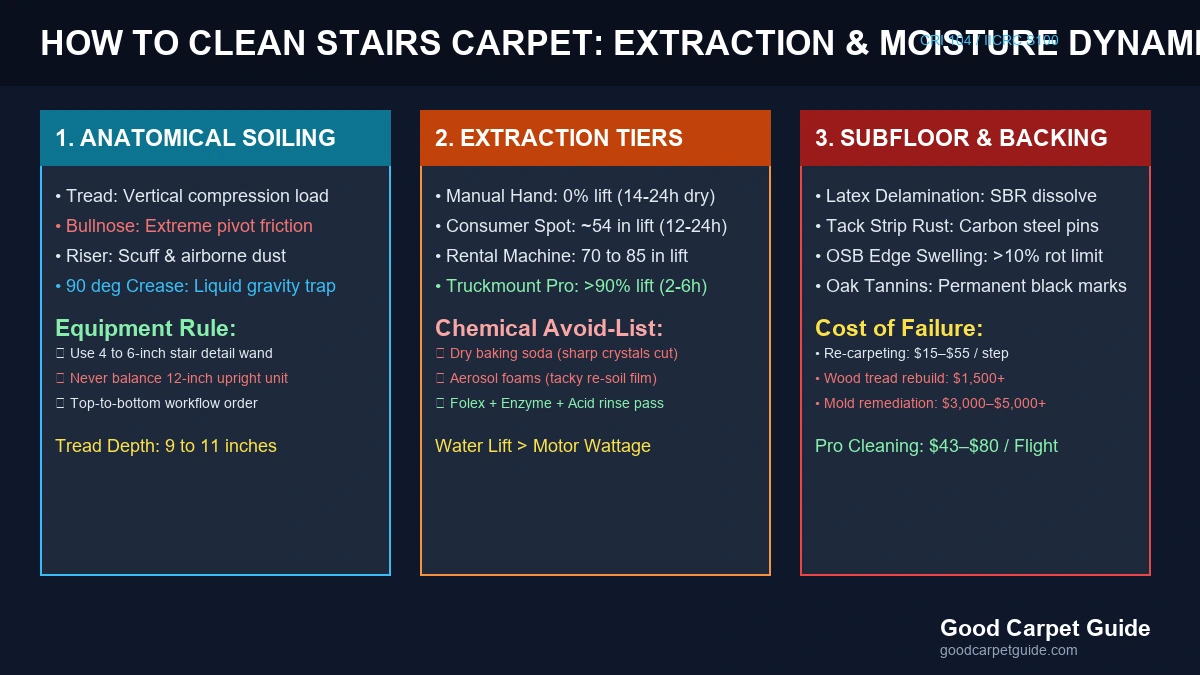
Liquid contamination behaves differently on stairs. Spills travel downhill through gravity channels inside the pile structure. Wicking pulls moisture back upward as the carpet dries. Coffee stains reappear after cleaning because dissolved residue migrates upward through the fiber shaft. Stair noses show this pathology faster due to concentrated compression and slower airflow.
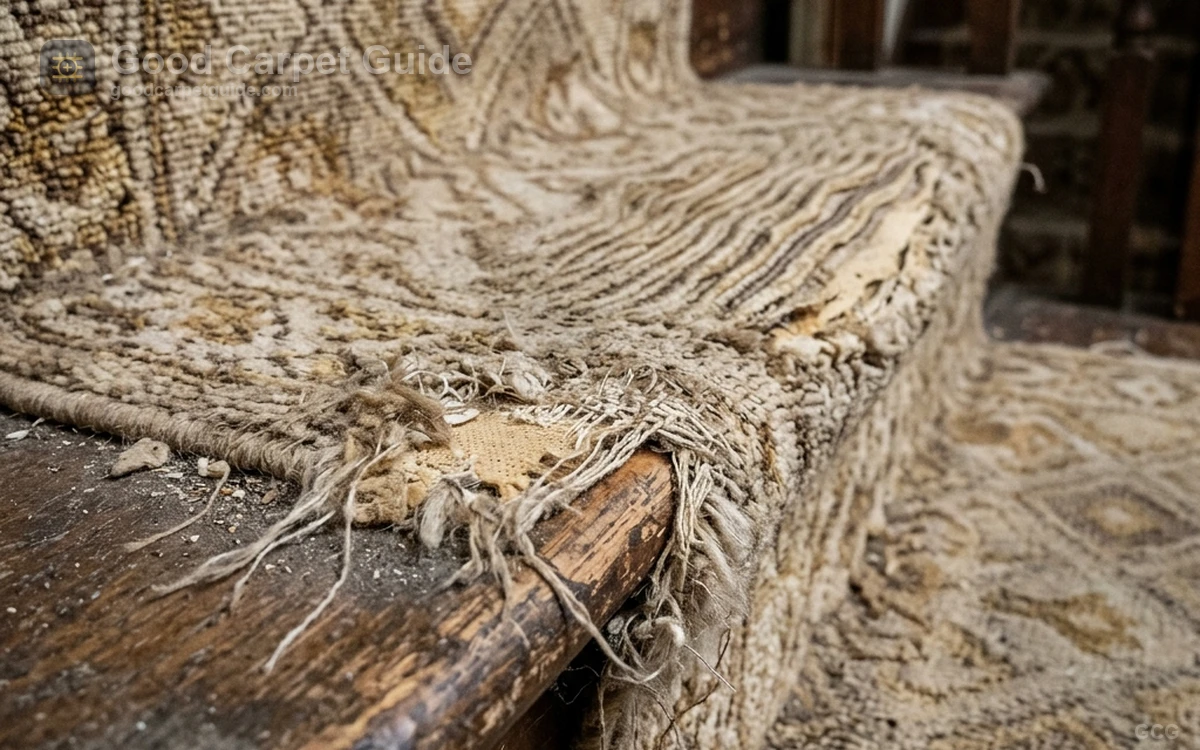
Severe wear on a low-density stair nosing where the backing curves open and fibers permanently crush under repeated foot impact.
Dense low-pile construction survives stair geometry better than plush tall pile. Tight twist yarns resist directional leaning. Short pile prevents edge collapse under repeated flexing. Most installers steer clients toward the same categories used for a durable carpet for high traffic areas .
Face weight alone does not determine durability. A 60-ounce loosely packed polyester still crushes faster than a dense 40-ounce nylon. Compare carpet face weight specifications alongside density and fiber chemistry instead of treating face weight like a standalone quality metric.
The Padding Density Paradox: Why Soft Pads Cause Stair Slips
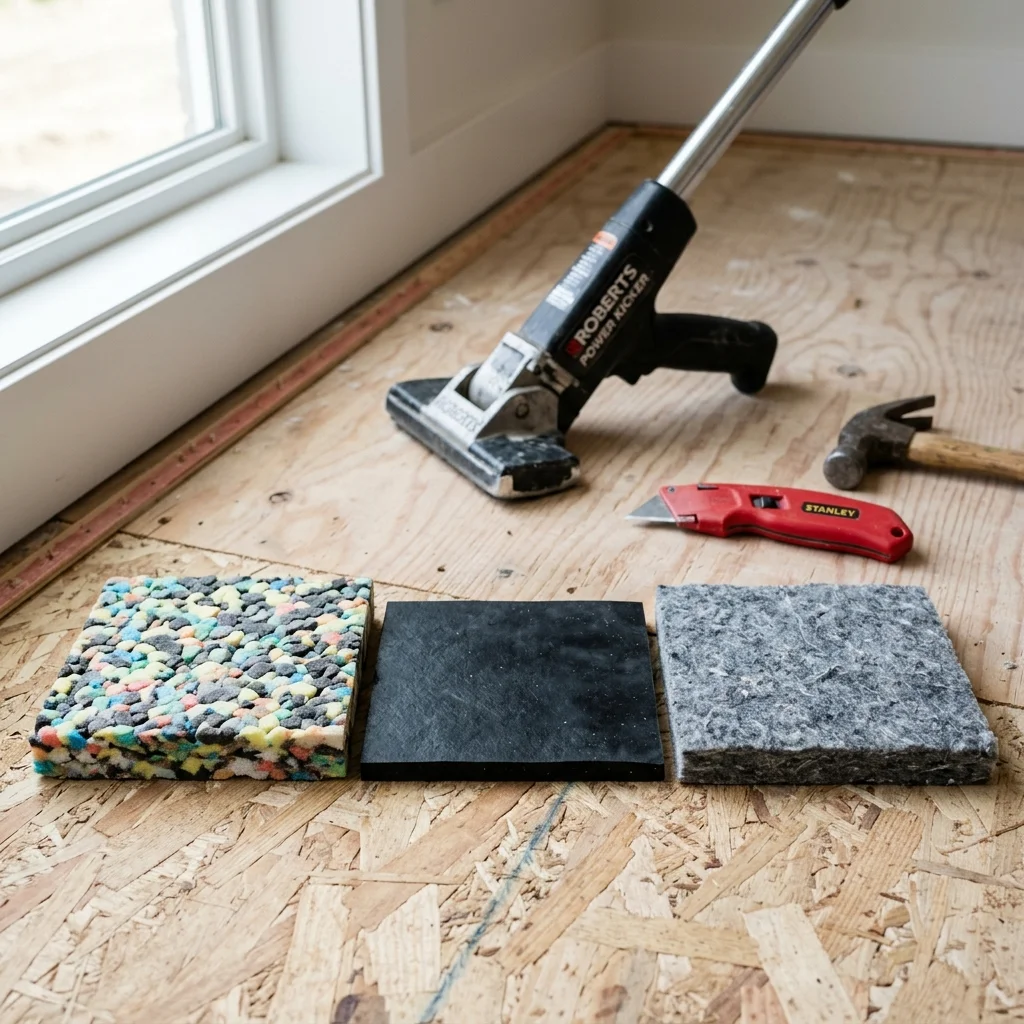
Use padding no thicker than 3/8 inch on stairs. Use dense 8lb or 10lb pad construction under every tread. Thick soft padding destabilizes foot placement and creates a trampoline effect under the carpet.
Soft pad compression shifts body weight forward during descent. The foot sinks deeper near the bullnose. The ankle rotates inward. Elderly users lose traction first because balance corrections happen slower during downward movement.
Thin dense pad stabilizes the tread. Dense pad keeps the carpet stretched tight against the stair geometry. Dense pad also reduces flex fatigue inside the secondary backing adhesive.
Delamination starts when the carpet backing repeatedly bends against excessive cushion movement. The latex bond between primary and secondary backing fractures under cyclical flexing. Ripples develop. Bubbling forms behind the nose. Seam integrity weakens near the tack strip.
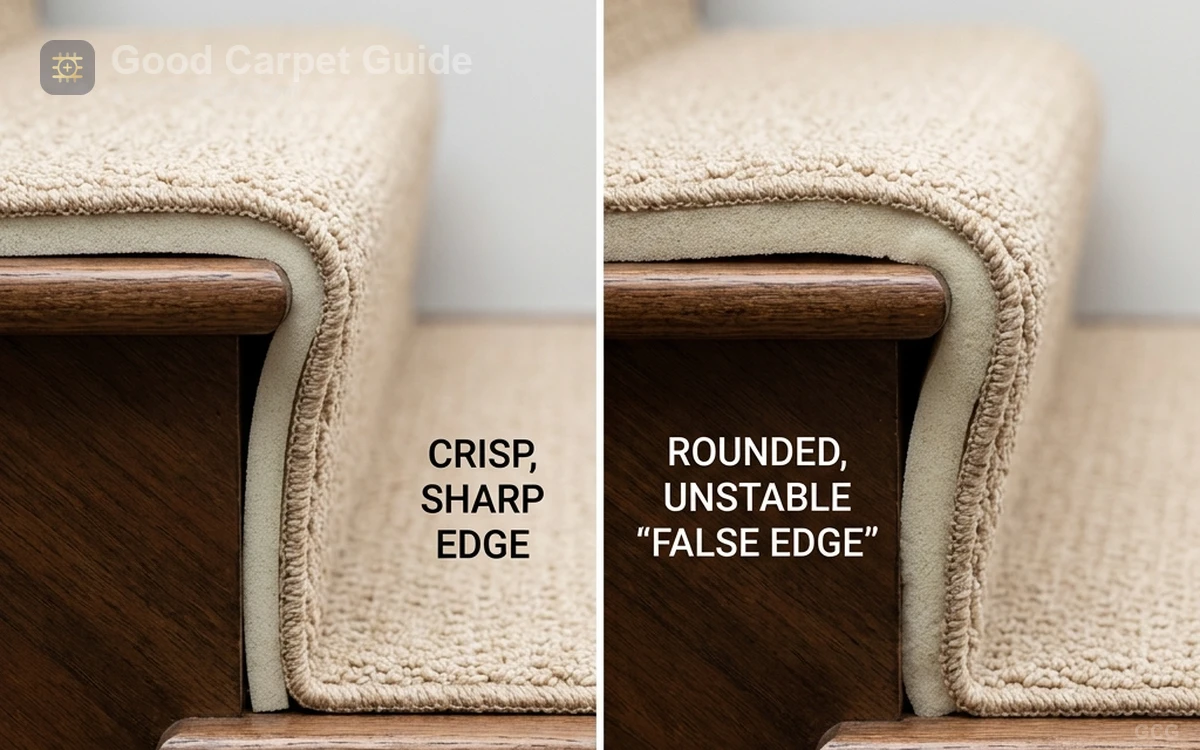
Thin high-density underlayment keeps the stair profile firm and stable, whereas thick sponge cushioning rounds the nose and causes carpet delamination.
Installers avoid thick memory-foam style pads on stairs because the carpet kicker cannot maintain stable tension over soft compression zones. Stretch consistency disappears from tread to tread.
Follow these installer standards for stair padding:
- Use 8lb rebond for balanced residential durability.
- Use 10lb rebond for heavy traffic staircases.
- Use waffle rubber only for low-profile commercial applications.
- Use thin pad thickness below 3/8 inch maximum.
- Use moisture-resistant pad for pet-heavy households.
Study the ultimate carpet padding guide before selecting underlayment. Compare stair-specific padding options for tread stability and wrapping performance. Analyze 8lb vs 10lb carpet padding density before approving installation materials.
Waterfall vs. Hollywood Installation: The Structural Showdown
Waterfall installation drops the carpet from tread to riser in one continuous cascade. Hollywood installation, also called cap-and-band, wraps the carpet tightly around the bullnose and staples underneath the nose before anchoring against the riser.
Hollywood mechanically locks the carpet at two structural points. Waterfall relies primarily on stretch tension and gravity contouring.
WATERFALL METHOD
====================

   TREAD
  _________
 /         \
/           \
             \
              \
               |
               |
               |
             RISER


HOLLYWOOD / CAP-AND-BAND
===========================

   TREAD
  _________
 /         \
/           \__
               \ <- Stapled under bullnose
                \
                 |
                 |
               RISER
Hollywood wrapping produces tighter geometry. The carpet hugs the stair profile without floating air gaps. Buckling resistance improves dramatically because the nose receives direct staple anchoring beneath the curvature.
Waterfall installs faster. Patterned carpets stay visually straighter because the installer avoids aggressive contour bending around the nose. Large geometric loops distort less during installation.
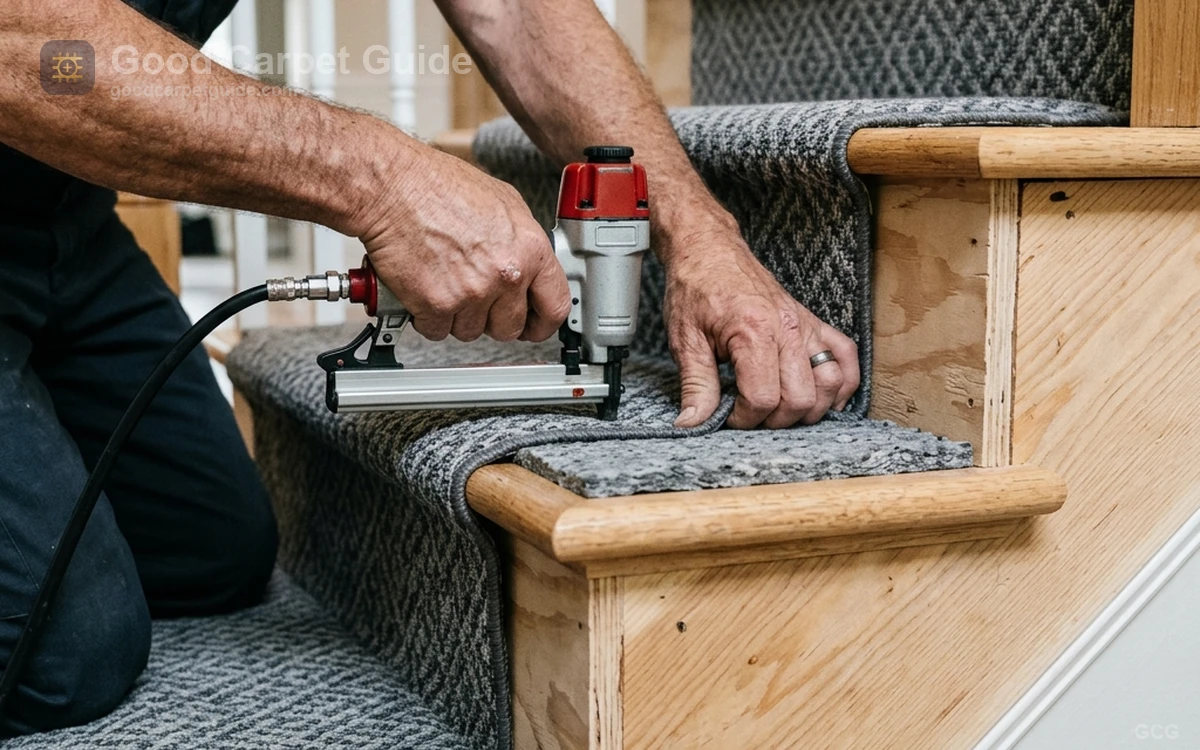
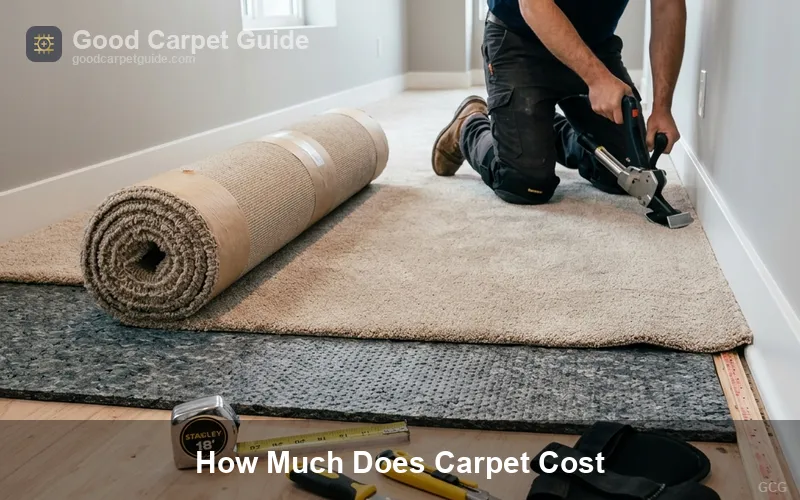
An installer tightly securing a Hollywood stair wrap, stapling directly beneath the bullnose curve to ensure zero air gaps and maximum durability.
Hollywood costs more because labor intensity rises sharply around spindles and curved steps. Straight stairs usually add $10 to $25 per step for detailed cap-and-band wrapping around railing posts and balusters.
Pie steps and winders increase labor further. Installers spend hours trimming relief cuts and balancing stretch angles around triangular treads. Power stretchers physically do not fit many curved staircases. Knee kickers and Stinger tools become mandatory in tight geometry, which is why mastering how to use a carpet knee kicker is key for stair tread alignment.
Waterfall develops bubbling more often over time. The unsupported air cavity under the nose slowly loosens as the backing relaxes. Hollywood installations maintain tighter long-term profile retention because the staple anchor prevents drift.
Pet owners encounter another problem with Hollywood wrapping. Hair accumulates inside the stapled crevice beneath the bullnose. Vacuum heads miss the compacted debris pocket. Installers call this “Muppet Feet” buildup because thick pet hair grows from the stair edge like fuzzy puppet fur.
Installers preparing stairs usually replace old tack strips before stretching new carpet. Review the process for installing new carpet tack strips before starting stair renovation work.
Fiber Battleground: Nylon, Wool, Triexta, and Polyester on Steps
Nylon 6,6 ranks first for overall stair durability. Wool ranks second for luxury resilience. Triexta ranks third for stain resistance. Polyester ranks last for structural recovery.
Stair Safety & Friction Scorecard
| Fiber Type | Friction (Socks & Paws) | Crush Resistance | Wrapping Compliance |
|---|---|---|---|
| Nylon 6,6 | 9/10 | 10/10 | 9/10 |
| Wool | 8/10 | 9/10 | 8/10 |
| Triexta (PTT) | 8/10 | 7/10 | 8/10 |
| Polyester (PET) | 6/10 | 4/10 | 7/10 |
Nylon (Type 6,6)
Nylon dominates staircase installations because the fiber rebounds after compression. Hydrogen-bonded molecular chains spring back after foot traffic crushes the pile. Dense nylon survives 10 to 15 years on active residential staircases.
Solution-dyed nylon adds stain resistance without sacrificing resilience. Twisted frieze nylon hides traffic lanes better than smooth saxony textures. Compare nylon vs polyester carpet performance before approving any PET stair installation.
Triexta (PTT / SmartStrand)
Triexta absorbs almost zero moisture. Pet urine stays closer to the surface instead of soaking into the fiber core. Families with dogs prefer Triexta because stain cleanup becomes easier.
Triexta still compresses faster than premium nylon under concentrated stair traffic. Dense construction improves lifespan significantly. Low-density Triexta still develops nose shading after sustained use.
Wool
Wool behaves like a microscopic coiled spring. The natural crimp inside the fiber creates exceptional resilience under foot traffic. Wool also regulates humidity and reduces static electricity.
Wool costs dramatically more than synthetic options. Sunlight fading appears faster near stair windows. Moth exposure becomes a maintenance concern in humid climates.
Polyester (PET)
Polyester fails mechanically on stairs faster than every major residential fiber. The softness impresses buyers in showrooms. The softness collapses under concentrated tread compression.
PET fibers lack strong recovery memory. Flattened traffic lanes stay visible permanently. Cheap polyester works acceptably in low-use bedrooms. Staircases destroy it quickly.
Berber Loop Warning for Cat Owners
Looped Berber handles foot traffic well because the continuous loops resist crushing. Cats destroy looped Berber by snagging individual loops with claws. One damaged loop unravels across multiple rows like a sweater thread pulling loose.
Installers regularly replace Berber stairs after cat damage spreads from one corner snag into full-width loop failure.
Stair Carpet Cost Breakdown: Real US Labor and Material Rates
A straight residential staircase with 12 steps averages roughly $650 installed. Most projects land between $430 and $780 depending on fiber type, pad upgrades, furniture movement, and stair geometry.
Material pricing breaks down roughly like this:
| Carpet Fiber | Material Cost Per Sq Ft |
|---|---|
| Polyester | $1.50 – $6 |
| Triexta | $3 – $8 |
| Nylon | $2 – $8 |
| Wool | $5 – $26 |
Labor costs climb sharply on detailed staircases. Straight stairs install quickly because stretch angles stay predictable. Curved staircases slow everything down.
Expect these labor premiums during stair work:
- Expect $10 to $25 extra per spindle step.
- Expect higher charges for pie steps and winders.
- Expect additional fees for furniture removal.
- Expect tack strip replacement charges on damaged wood.
- Expect extra labor for pattern matching and border runners.
Spiral staircases often cost between $500 and $1,500 because installers hand-trim almost every tread individually. Pattern alignment becomes extremely time-consuming on curved geometry.
Big-box “free installation” offers hide hidden labor categories inside the contract. Retail chains advertise free carpet labor then charge separately for tear-out, stair wrapping, tack strips, furniture movement, transitions, haul-away, and upgraded padding. The advertised free install price rarely reflects the real invoice.
Independent installers usually produce tighter stair wraps than subcontracted retail crews. Stair work exposes craftsmanship immediately because every bullnose remains visible at eye level.
The Warranty Fine Print Trap: What Flooring Brands Hide About Stairs
Manufacturers quietly restrict stair warranties because stairs destroy carpet faster than flat flooring. Read the exclusions before approving any purchase order.
Phenix Flooring excludes stair coverage entirely on many product warranties. The wording states that rugs and stairs are not covered under wear guarantees. Heavy stair traffic voids the protection immediately.
Tarkett Home limits stair coverage to partial restricted terms on selected products. Some collections only carry seven-year stair protection while retaining much longer room warranties.
Maintenance clauses create another trap. Most warranties require professional hot-water extraction every 12 to 18 months with retained receipts. Skip one documented cleaning cycle and the manufacturer rejects wear claims automatically.
Tool requirements create conflict between laboratory standards and field reality. Some manufacturers specify power stretching for warranty compliance. Winders and pie stairs physically prevent full power stretcher usage. Installers rely on knee kickers, stair tools, and Stinger stretch devices in tight geometry.
Manufacturers still deny claims if they discover non-approved stretching methods during inspection. The field installer absorbs blame for a geometry problem the manufacturer already understands.
Low-density plush carpet receives the highest denial rates because texture retention exclusions override visible wear complaints. The carpet technically remains intact while looking crushed and matted.
The Installer’s Verdict: Choosing Your Perfect Stair Carpet
Choose dense Nylon 6,6 with low pile and 8lb or 10lb pad for the best overall stair system. That combination survives traffic, holds stretch tension, and maintains safer traction under socks and pet paws.
Choose solution-dyed Triexta for pet-heavy households needing moisture resistance and easier cleanup. Keep the pile height low and avoid fluffy textures.
Choose woven wool for luxury homes prioritizing acoustic softness and premium appearance. Budget for higher maintenance and significantly higher installation cost.
Choose dense patterned loop or low-profile textured carpet for busy family staircases. Avoid plush saxony finishes that show every footprint and vacuum mark.
Choose Hollywood wrapping for long-term structural performance. Use Waterfall only when pattern alignment or budget limitations outweigh contour tightness.
Avoid these common stair mistakes:
- Avoid thick soft padding above 3/8 inch.
- Avoid loose low-density polyester construction.
- Avoid tall shag or plush pile on bullnoses.
- Avoid cheap builder-grade latex backing systems.
- Avoid looped Berber in homes with cats.
Staircases expose carpet weaknesses faster than any room inside a house. The bullnose acts like a stress test machine. Dense fiber, thin pad, aggressive stretch tension, and correct wrapping method determine whether the staircase stays tight for a decade or wrinkles within two winters.