Carpet padding on a concrete floor has to answer three slab-specific questions: how dense the cushion needs to be for the traffic it will carry, how thick it can be without compromising the carpet above it, and what happens to the water vapor the slab keeps releasing. Left unanswered, each produces its own failure mode: crushed pile, a voided carpet warranty, or a pad saturated from below. A 4 lb prime foam pad specified for a wood subfloor behaves differently on a below-grade slab than an 8 lb rebond or a flat SBR rubber pad, and the difference surfaces as flattening, crinkling noise, or ridging within the first few years. The selection sequence therefore begins with a slab moisture reading.
Can you put carpet padding on a concrete floor?
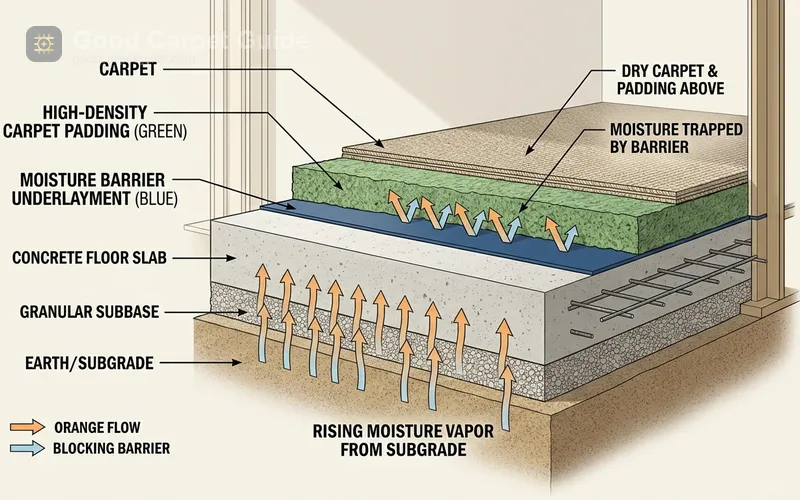
Yes, and the slab's moisture condition determines what kind. Concrete is porous and releases water vapor for years after the pour through moisture vapor emission. A pad set directly on an untreated slab in a below-grade basement sits in that vapor path permanently.
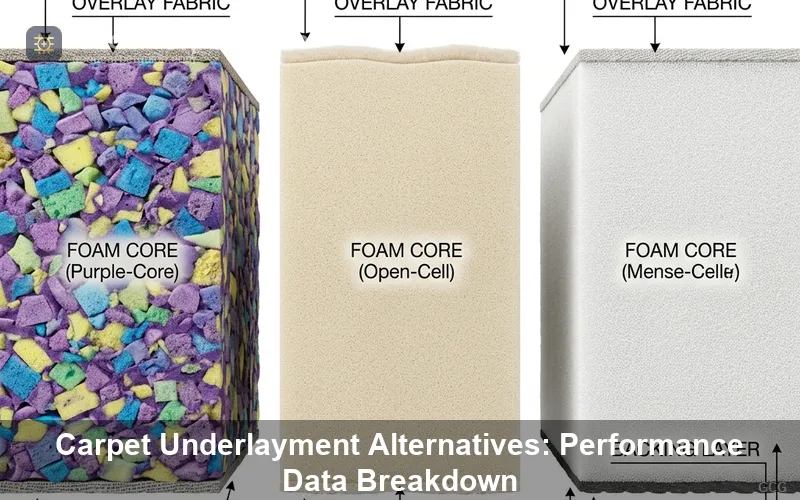
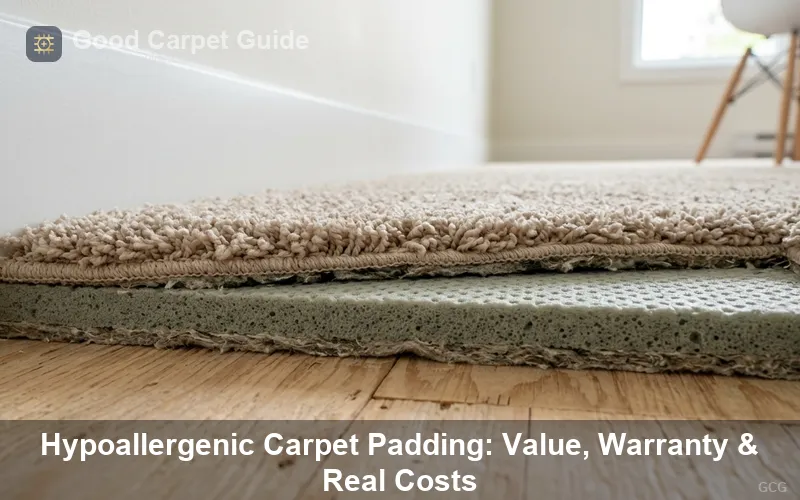
Dense, low-absorption cushions such as SBR rubber, frothed polyurethane, and breathable foam with micro-perforated skins tolerate that exposure. Standard prime polyurethane foam does not; it is engineered for wood subfloors with airflow underneath. Slab-on-grade homes in warm, dry regions carry lower risk than basements below the frost line, where soil moisture and a colder slab surface drive vapor upward year-round.
What causes the crinkling or crunching sound under carpet on concrete?
The noise comes from a plastic moisture-barrier layer inside the pad shearing against itself or against the carpet backing under foot pressure. Rebond and memory foam pads marketed for basements laminate a thin polyethylene or polypropylene film to one face as a spill barrier.
That film separates from the foam core after repeated flexing; abrasive latex dust from the carpet backing grinds against the membrane; and uneven adhesive distribution in lower-grade rebond leaves air pockets between the foam chips. The sound usually appears within the first two years and grows louder as the separation spreads across the sheet. Vacuuming has no effect, because the failure sits inside the pad.
What is the best carpet underlay for concrete floors?
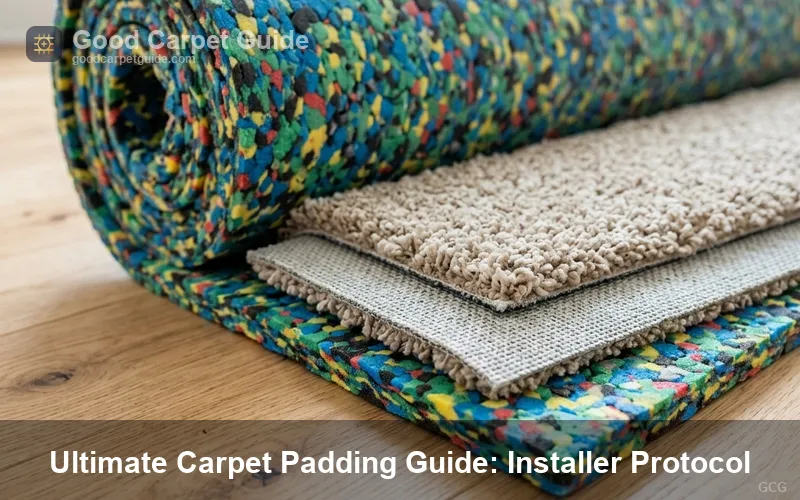
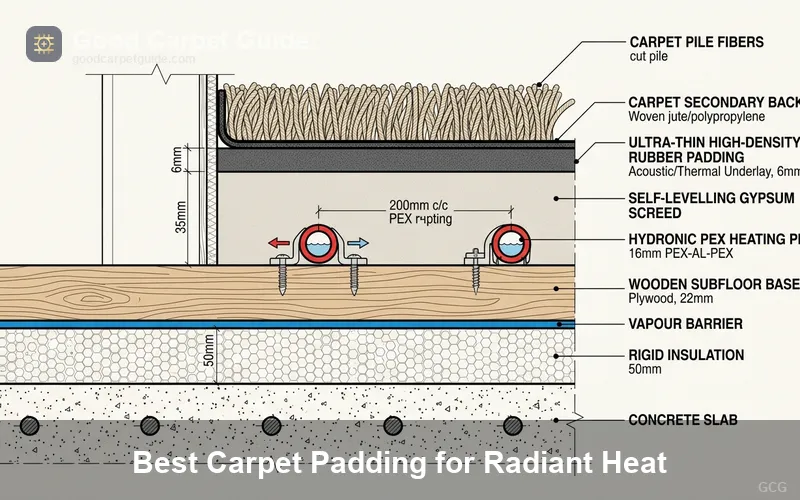
An 8 lb density synthetic rebond or a flat SBR rubber pad between 3/8" and 7/16" thick covers most concrete installations at a defensible cost. Flat rubber pads run roughly 0.400" to 0.425" thick at densities near 20 lb and above, and rubber conducts heat well enough that manufacturers list flat rubber as compatible with hydronic radiant floors.
On a tighter budget, a rebonded pad at 7/16" and 8 lb density meets the density most residential carpet warranties call for, without the vapor-trapping solid plastic skins found on cheaper prime foam. Recycled-content rebond falls in this class.
Carpet construction overrides budget in one case. Berber and loop-pile carpet require a thin, dense pad, because a thick or soft cushion flexes the loops and voids most manufacturer warranties.
| Pad type | Density | Thickness range | Best matched carpet | Concrete suitability |
|---|---|---|---|---|
| Flat SBR rubber | 20-24 lb | 0.400"-0.425" | Berber, loop, cut-loop | Excellent, generally radiant-heat compatible |
| Rebonded polyurethane foam | 6-8 lb | 3/8"-7/16" | Cut-pile, plush, frieze | Good, needs a breathable top skin |
| Frothed polyurethane | 8-10 lb | 3/8"-1/2" | Cut-pile, saxony | Very good, dense cell structure |
| Synthetic felted fiber | 32-40 oz/sq yd | 1/4"-3/8" | Berber, loop | Good, mold and mildew resistant per manufacturer |
| Prime polyurethane foam | 4 lb | 7/16"-1/2" | Cut-pile over wood subfloors | Poor, softens and traps vapor |
| Viscoelastic memory foam | 7-8 lb | 7/16" | Plush, frieze | Conditional, only with a micro-perforated barrier |

Leggett & Platt Arcadia Rubber Carpet Pad
Flat SBR rubber pad rated for concrete slabs and radiant heat installations.
Check Price on AmazonHow to remove carpet padding stuck to concrete floor
Cut the old carpet and pad into 3-foot strips with a utility knife to expose the adhesive layer before scraping. Rebond padding over concrete is usually set with a latex-based tack adhesive that degrades under years of alkaline moisture from the slab and leaves a black, tar-like residue behind.
A long-handled floor scraper with a fresh carbide blade takes off the bulk of the foam and adhesive; a rotary floor stripper with a scraper attachment speeds up large basements. Where the residue stays sticky, an adhesive remover formulated for cutback adhesive, applied in small sections and left to dwell for the manufacturer's stated time, softens it enough to lift. Pads that have degraded into powder call for a shop vacuum with a HEPA filter running throughout the scrape, because broken-down foam raises fine dust.
How to remove carpet padding glued to concrete floor
Full-spread glue-down padding takes mechanical removal first; chemicals only help with what is left behind. A walk-behind scraper with a tungsten-carbide blade, set at a low angle, shears the pad off the slab in strips.
Where the scraper leaves a thin adhesive film, a floor grinder fitted with a diamond cup wheel levels the residue flush with the slab and prepares the surface for a moisture-mitigation coating if one is planned. Do not glue new pad or carpet over old adhesive residue. Oxidized adhesive has lost most of its bond strength, and the new installation disbonds from it.
Do you need underlay for carpet on concrete floors?
Yes, for stretch-in installations. Direct glue-down of carpet to concrete without a cushion falls outside the warranty terms of most residential carpet lines and produces premature wear even in wool and nylon products rated for heavy traffic. With no pad, the carpet backing sits against cold, hard concrete with nothing to absorb foot-traffic impact, and the pile crushes and mats in high-traffic areas well before the carpet's rated life.
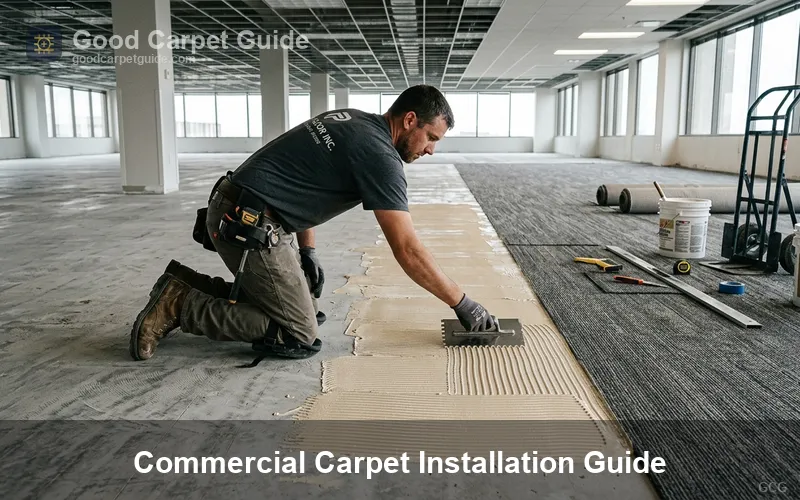
The Carpet and Rug Institute publishes CRI 104 for commercial carpet installation and CRI 105 for residential installation, and both address cushion selection. The terms that govern a warranty claim come from the carpet manufacturer's own installation instructions, so check those alongside the standard. Commercial-grade carpet tile with an attached cushion is the main product category that takes no separate pad.
How to install carpet padding on concrete floor
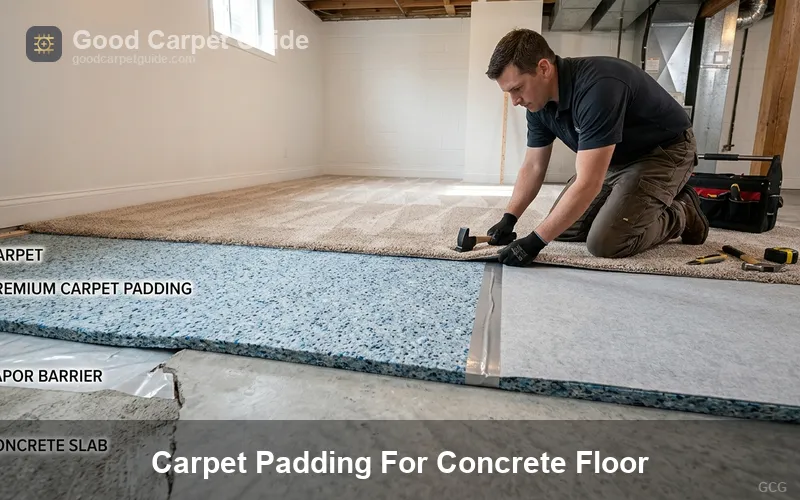
- Test the slab for moisture with a calcium chloride test (ASTM F1869) or an in-situ relative humidity probe (ASTM F2170) before selecting a pad or barrier system. Acceptable limits vary by product; published thresholds commonly fall between 3 and 5 lbs/1,000 sq ft/24 hrs on calcium chloride and 75% to 80% RH on an in-situ probe.
- Apply a moisture sealant where readings exceed the manufacturer's stated limit. Liquid-applied vapor-retarding membranes roll onto bare concrete and cure into a continuous film. Follow the coverage rate and cure time exactly; under-cured sealant traps solvent vapor beneath the pad.
- Install tackless strip roughly 3/8" from the wall, using masonry pins rated for concrete. The nails supplied for wood subfloors will not hold in a slab.
- Lay and trim the pad, butting seams tightly without overlap, and tape them with pad seam tape. Do not staple pad to concrete; staples cannot hold in a slab and create trip points.
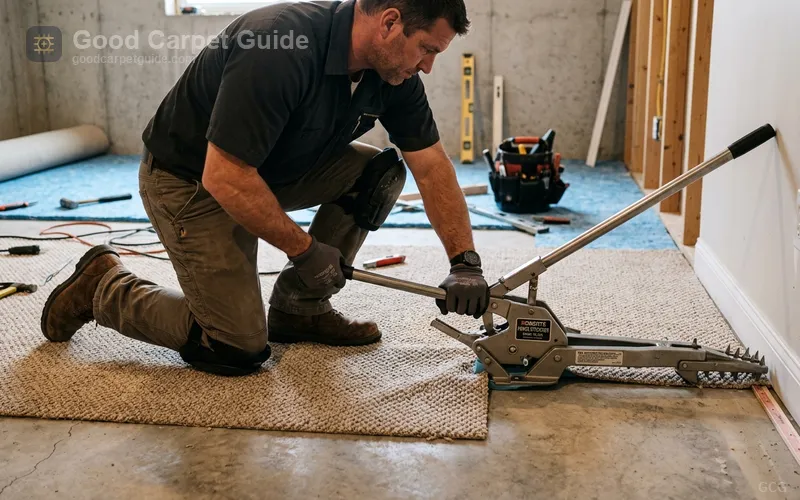
- Stretch and seam the carpet with a power stretcher. A knee kicker alone under-stretches spans over 12 feet, which shows up later as wrinkling across large basement rooms.
- Seam with a seam iron and hot-melt tape, then finish edges with a row runner or stair tool along the tackless strip.
Carpet padding for concrete basement floor
Below-grade slabs sit against soil on multiple sides, so vapor moves through the concrete more steadily than in an above-grade slab-on-grade room. That adds a vapor decision on top of the density decision. Two options handle it: a liquid-applied sealant under a conventional pad, or a dimpled air-gap membrane such as DMX 1-Step, which sits on the slab and channels vapor toward the room perimeter.
Ceiling height usually decides between them in a low basement. Rigid subfloor panel systems such as DriCore add close to an inch of total height and force door trimming and transition changes; a dimpled membrane adds roughly a quarter inch and generally clears existing door undercuts. Measure the current undercut before committing to either.
Do double-sided waterproof pads cause problems on unsealed concrete?
Yes, on a slab with active moisture vapor emission and no sealant. A double-sided moisture-barrier pad blocks spills from soaking downward, and it blocks the slab's vapor from escaping upward with equal efficiency. The trapped vapor condenses against the underside of the barrier film, saturates the foam from below, and builds pressure between the slab and the impermeable layer.
The visible symptom is ridging in the finished carpet, concentrated where the slab's moisture output runs highest, typically near exterior walls and floor drains. A calcium chloride or relative humidity test before installation, followed by a sealant coat where readings run high, prevents it. A residential moisture test costs a small fraction of pulling and replacing a failed pad and carpet.
Best carpet padding for concrete floor by use case
Room function decides which attribute carries the most weight.
- Basements, below-grade: 8 lb rebond or frothed polyurethane with a breathable, micro-perforated top membrane, over a tested and sealed slab.
- Stairs over concrete or plywood-over-concrete landings: 8 lb density minimum, 3/8" thickness maximum. Thicker pad allows excessive flex on the nose of each tread.
- Berber or loop-pile on concrete: flat SBR rubber or dense synthetic felt, 3/8" or thinner, 8 lb minimum. No memory foam.
- Radiant-heated concrete slabs: flat rubber pad. Its thermal conductivity avoids the insulating effect that reduces radiant output through foam.
- Rental basements and income properties: rebonded foam with recycled rubber content at 7/16" and 8 lb, on an 8 to 12 year replacement cycle that matches a typical hold period more closely than a 15-year rubber pad.
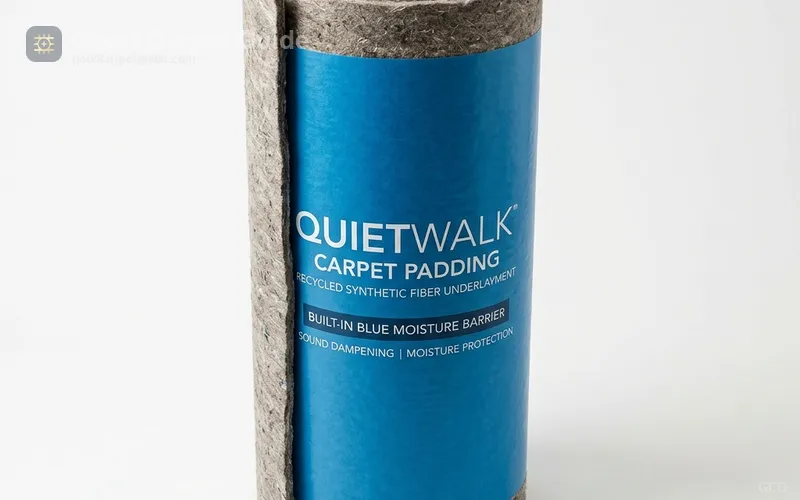
QuietWalk Premium Felt Carpet Underlayment
Recycled synthetic felt underlayment built for Berber carpet and concrete subfloors.
Check Price on AmazonCarpet padding cost for concrete floor installations
Density and construction drive padding cost more than thickness does, which is why two pads of the same height can differ by more than $2 per square foot. Installed figures below combine material with padding labor of $0.50 to $1.00 per square foot.
| Pad underlayment material | Material cost (per sq ft) | Total installed cost (per sq ft) | Average lifespan |
|---|---|---|---|
| Prime polyurethane foam | $0.25 - $0.75 | $0.75 - $1.75 | 3 - 5 years |
| Rebonded foam | $0.25 - $0.80 | $0.75 - $1.80 | 8 - 12 years |
| Synthetic / felted fiber | $0.35 - $1.25 | $0.85 - $2.25 | 10 - 15 years |
| Viscoelastic memory foam | $0.50 - $1.00 | $1.00 - $2.00 | 5 - 10 years |
| Waffle rubber | $0.50 - $1.00 | $1.00 - $2.00 | 5 - 8 years |
| Frothed polyurethane | $0.50 - $2.00 | $1.00 - $3.00 | 12 - 15 years |
| Flat SBR / synthetic rubber | $0.75 - $3.00 | $1.25 - $4.00 | 15 - 20 years |
Applied to a 12 x 15 foot room of 180 square feet, the table gives a padding-only installed cost of roughly $135 at the low end and $720 at the high end; a mid-range 8 lb rebond at about $1.25 per square foot lands near $225. Carpet and pad installed together, materials and labor, generally runs $3.00 to $11.00 per square foot depending on carpet grade and region, which puts padding at roughly a tenth to a fifth of the combined total. Demolition and disposal of old carpet and pad, including scraping dried adhesive, adds $0.50 to $5.00 per square foot, with most jobs in a tighter $0.70 to $1.60 band.
Run the lifespan-per-dollar math before defaulting to the cheapest option. Prime foam at $1.00 per square foot installed, with a 3 to 5 year life, needs three to four installations to cover 15 years: $3.00 to $4.00 per square foot in pad alone, plus carpet removal and re-stretch labor each cycle. A flat rubber pad at $2.50 per square foot installed covers the same 15 years once. 8lb vs 10lb carpet padding breaks down that density-to-cost tradeoff for buyers comparing specific weight classes.
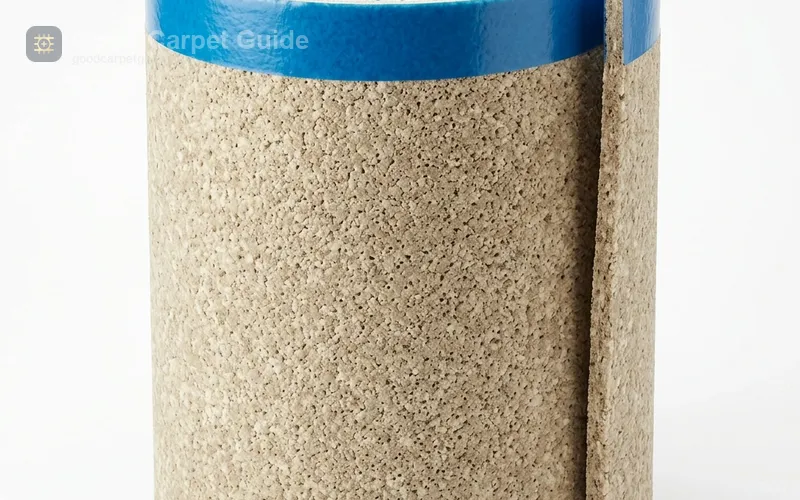
Future Foam StepAhead Rebonded Carpet Pad
8 lb density rebonded pad made with recycled rubber content for standard residential rooms.
Check Price on AmazonCommon failure patterns over concrete
Crinkling noise that appears months to years after installation and worsens over time traces to barrier-film delamination inside the pad. Memory foam that flattens in traffic lanes ahead of its rated life concentrates at stairwells and bedroom entrances, the highest-shear points in a typical floor plan; an 8 lb rebond or flat rubber pad holds its thickness better at those points. Black, tar-like residue on the slab when old rebond is pulled up comes from adhesive and foam breaking down under years of alkaline moisture exposure. All three trace back to slab condition or pad specification, which is where a diagnosis should start.
When to replace padding over concrete
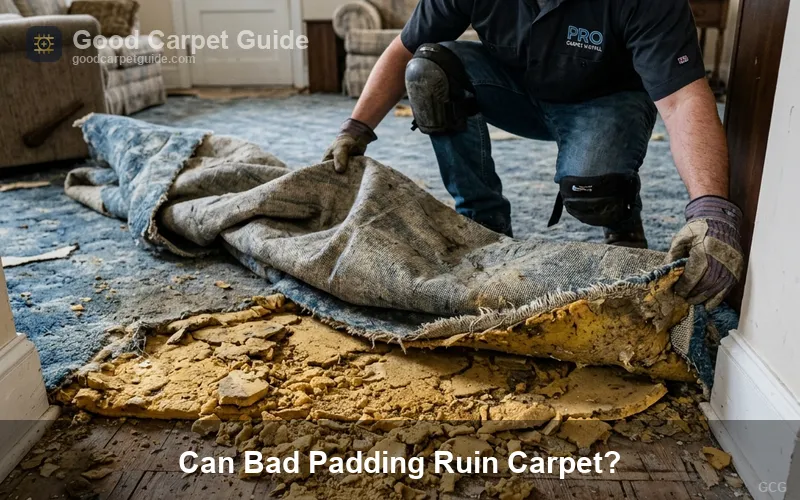
Replace padding once it stops springing back after weight is removed, holds visible moisture or odor when the carpet is pulled back, or sits under traffic lanes that stay crushed after cleaning. A permanently flattened pad no longer absorbs impact, and carpet pile wear accelerates while the carpet still looks serviceable from a distance. Replacement is also the moment to test and, if needed, seal the slab; re-covering an untested concrete floor repeats whatever moisture problem ended the first pad.
Slab conditions a concrete floor needs before carpet
A cured, level slab with moisture readings inside the carpet manufacturer's published limit gives padding and carpet their longest service life. Slabs poured within the past 90 to 120 days rarely meet those limits without mechanical drying or a sealant coat, because concrete keeps releasing mix water as it cures. Flatness matters nearly as much: variations greater than 3/16" over a 10-foot span telegraph through pad and carpet as visible dips and cause uneven wear. A slab that fails either test still takes carpet, once the moisture and flatness work is done first.
Bottom line by scenario
A below-grade rec room on a slab that has never been tested needs a calcium chloride or RH test and, if the readings call for it, a sealant coat before any money goes toward padding; an 8 lb rebond or frothed foam pad with a breathable top skin is the reasonable middle choice once the slab is handled. Berber, loop, and patterned carpet on any concrete surface protect their warranties only under a thin, dense SBR rubber or synthetic felt pad, at any price point. Stairs over concrete landings stay at or under 3/8" thickness and 8 lb minimum density. In a rental basement, an 8 lb rebonded foam pad in the $0.75 to $1.80 per square foot installed range recovers its cost within a typical hold period, while a premium rubber pad's extra life accrues to a later owner. The carpet padding guide covers density and thickness selection for subfloors beyond concrete, and buyers seeing separation between pad and backing after installation should check carpet delamination before assuming the pad is defective.