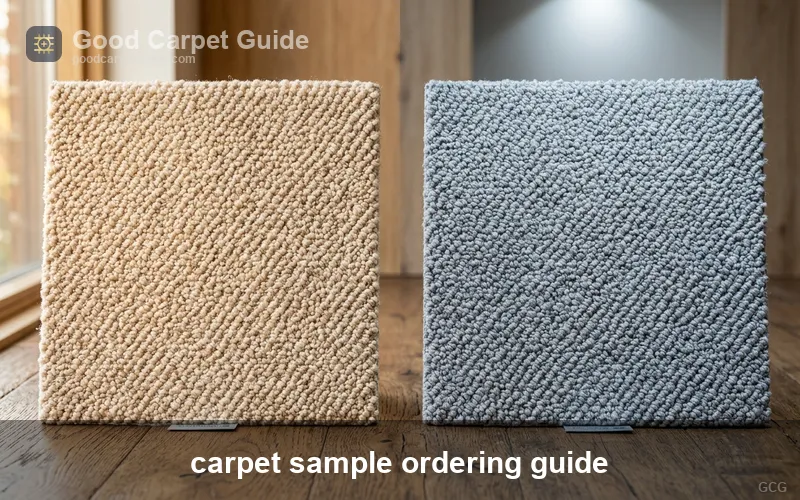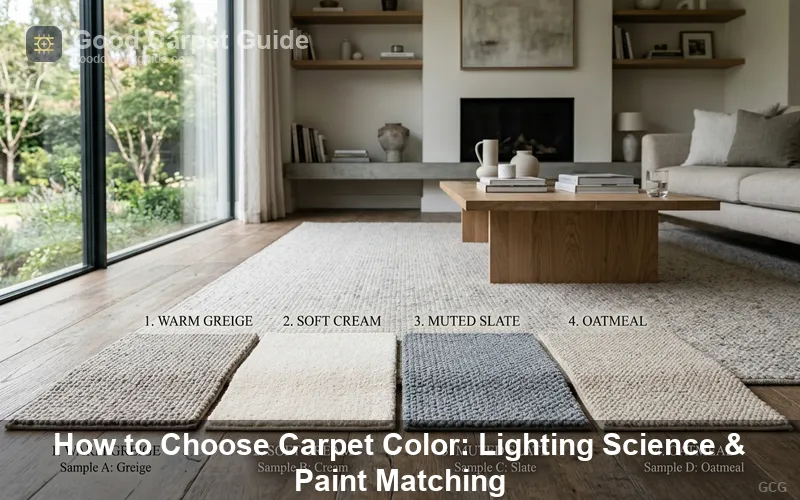
Carpet color selection depends on four measurable variables: light source Kelvin temperature, wall paint Light Reflectance Value, pile construction, and fiber dye chemistry. A carpet swatch that looks correct under a showroom's 4000K commercial LED can shift two to three shade values once installed under residential 2700K bulbs. The physics behind that shift—and the field-tested rules that prevent a costly mismatch—follow section by section below.
why does carpet color look different at home than in the showroom
Retail carpet showrooms typically run 4000K-5000K commercial fluorescent or LED fixtures with a Color Rendering Index (CRI) below 80. That lighting profile strips warmth from beige and cream fibers and pushes grey undertones toward blue. A residential living room lit at 2700K-3000K renders the same fiber with far more red and yellow content. The undertone a shopper sees on the showroom floor and the undertone that appears on the living room floor are two different optical events produced by two different spectra.
Skip the return showroom trip. Test physical samples inside the actual room, under the actual bulbs, at the actual times of day the room gets used. The full protocol appears in the testing section below.
how does light bulb kelvin temperature change carpet color
Correlated Color Temperature (CCT), measured in Kelvin (K), determines how much red, yellow, or blue content a bulb adds to a surface. The fiber chemistry stays constant; only the perceived undertone shifts.
- 2200K-3000K (warm white): Standard residential bulb range. Cool greys shift muddy or yellowish under this light. Warm beiges and greiges with red undertones flash pink or violet-purple.
- 3000K-3500K (soft white): The residential accuracy sweet spot. Spectrum balance is even enough that most fiber undertones read close to their true value.
- 4000K (cool white): An office and task-lighting range. Beige and cream lose warmth and read clinical, greenish, or flat.
- 5000K-6500K (daylight LED): A blue-white spectrum that strips red and gold content. Grey fiber reads icy blue. Warm blonde and brown fiber reads as dull concrete.
Color Rendering Index compounds this effect. A bulb with CRI below 80 distorts fiber dye regardless of its Kelvin rating. Specify high-CRI bulbs (90 or above) for any room where color accuracy against a matching test is a priority.
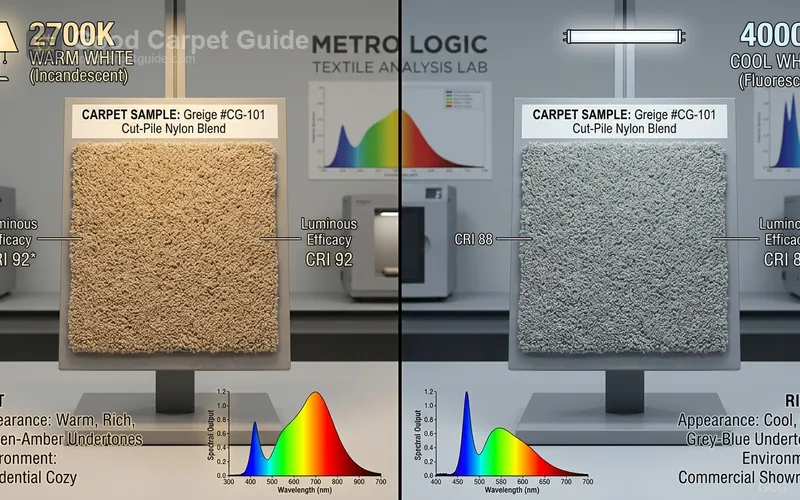
Correlated color temperature shifts how textile dyes reflect light, changing undertones between commercial showrooms and residential living spaces.
how does the direction a room faces change which carpet colors work
Natural daylight is directional, and each exposure imposes a different color cast on the room for most of the day.
- North-facing rooms: Receive cool, diffused, blue-tinted light continuously. This exposure pulls carpet colors darker and greyer. Icy greys intensify that cast; warm beiges, creams, and golden undertones counteract it.
- South-facing rooms: Receive intense, warm sunlight for most of the day. That warmth washes out pale creams. Cool greys, slates, and balanced blues hold their color under this exposure.
- East-facing rooms: Get warm morning sun that shifts to cool afternoon shadow. A fiber's undertone needs auditing across both halves of the day to catch a muddy afternoon read that a morning-only viewing would miss.
- West-facing rooms: Stay dim through the morning, then take intense golden-orange sunset glare in the late afternoon. Beige fiber with yellow or orange undertones oversaturates under that glare. The high UV load in west-facing rooms also calls for solution-dyed, UV-stable fiber regardless of color choice.
how do you match carpet color to wall paint
Carpet covers more of a room's visual plane than any wall or ceiling surface. That proportion makes the wall-to-floor contrast relationship the single largest factor in whether a room reads balanced or flat.
The 2-tone / 10-plus LRV rule dictates that carpet color should sit at least two paint shades, or 10 or more Light Reflectance Value (LRV) points, lighter or darker than the wall color. A carpet and wall pairing inside that narrow LRV band reads sterile and boxed-in, because the eye has no plane-to-plane contrast to register depth.
- Pure white walls (Sherwin-Williams Extra White, Benjamin Moore Chantilly Lace): Pair with slightly warm greiges, soft creams, or heathered taupes. Icy blue-grey carpet against a pure white wall reads cold and clinical.
- Creamy off-white walls (SW Alabaster, BM Swiss Coffee): Pair with warm beige, soft gold, or natural sand fiber. Cool blue-grey or clean pink carpet makes an off-white wall look dirty or yellowed by comparison.
- Cool grey and greige walls (SW Repose Gray, SW Agreeable Gray, BM Stonington Gray): Pair with crisp charcoal, slate, or a cool grey fiber carrying a distinct blue or violet base. Warm yellow-tan carpet clashes with the cool base of these walls.
- Warm taupe and earth-tone walls (SW Accessible Beige, BM Revere Pewter): Pair with mocha, espresso, forest green, or copper fiber. Cool silver-grey carpet clashes with the warm base of these walls.
the honey oak trim trap
Cool grey and icy blue carpet should not be paired with honey oak trim, doors, or cabinetry. Blue and orange sit as complementary opposites on the color wheel, and pairing them intensifies the orange cast of the wood grain. This pairing is a frequent installer callback documented by the Carpet and Rug Institute (CRI): a cool grey carpet installation makes surrounding walls read muddy brown and pushes honey oak trim toward a visibly orange cast.
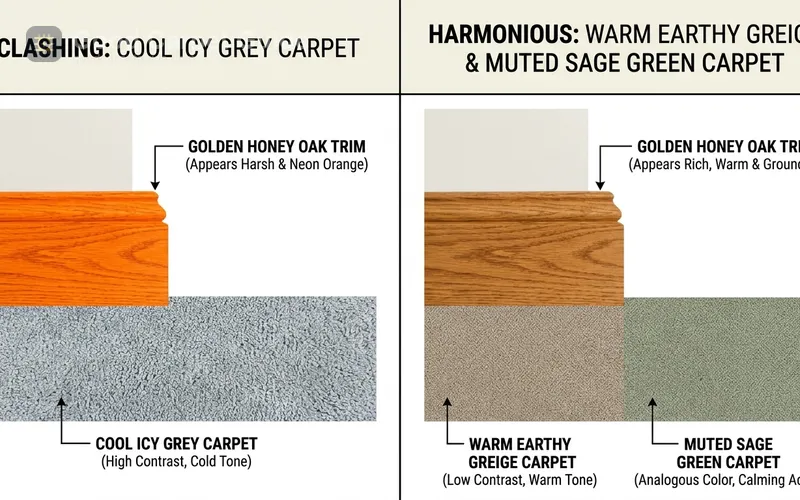
Complementary color physics explain why cool grey carpet clashes with honey oak trim, while warm greiges and sage tones balance orange wood grain.
The corrected pairing for honey oak trim is a warm, earthy greige, a muted biophilic green such as sage or moss, or a deep warm charcoal. All three neutralize the orange cast.
solid color or multi-tonal: which carpet color pattern hides dirt better
Solid-color carpet functions as a visual mirror. Light solid carpet shows every dark pet hair and soil particle. Dark solid carpet shows every speck of white lint, dust, and dry skin flake. Both directions of solid color expose debris that a multi-tonal fiber would scatter.
Multi-tonal fiber, spun with three or more tonal shades from the same color family, scatters incoming light across multiple axes. That multi-directional scatter camouflages the majority of everyday lint, pet dander, and foot-traffic marks under normal lighting. Heathered, tweed, and Berber-fleck constructions all use this same light-scattering principle.
how does carpet pile construction affect color and light reflection
Pile construction determines how the fiber shaft interacts with incoming light, and that interaction shows up as color consistency, or the lack of it, across the floor.
- Cut pile (Saxony, plush, velvet): Vertical cut shafts reflect light on their sides and absorb it at the cut ends. This construction is highly prone to temporary tracking, vacuum ridges, and shading as foot traffic bends the shafts in different directions.
- Loop pile (Berber, level loop): Continuous horizontal loops refract light uniformly across the surface. This construction is effectively immune to footprints, vacuum lines, and temporary shading.
- Cut-and-loop: Geometric relief patterns break up the light plane, which masks wear paths in corridors and other linear traffic zones.
permanent pile reversal shading
Permanent Pile Reversal Shading (also called watermarking or pooling) is the spontaneous, permanent reorientation of cut-pile yarn clumps into dark and light puddle-like shapes. This optical phenomenon results from yarn shafts settling into a new resting angle. It is unrelated to manufacturing or dye quality, and steam cleaning cannot reverse it. Loop pile, tight frieze twists, low-luster synthetic yarns, and lighter neutral colorways all reduce the visibility of this effect.
how does room size and ceiling height affect carpet color choice
Carpet color changes the perceived proportions of a room through basic light reflectance.
High-LRV light carpet bounces ambient light off the floor plane and pushes the perceived room boundary outward. This makes light carpet the correct choice for tight bedrooms, dark hallways, and basements with limited natural light.
Low-LRV dark carpet contracts the floor plane and anchors the room visually. This makes dark carpet the correct choice for soaring cathedral ceilings or large open-concept spaces that need grounding.
Color temperature also carries an emotional register worth factoring into room-by-room choices. Warm tones raise energy and appetite in living and dining rooms. Cool tones slow heart rate and sharpen focus, providing a better fit for bedrooms and home offices. The room by room carpet guide breaks this down by specific space, including sizing and color rules for carpet placed under a bed frame.
solution-dyed vs piece-dyed carpet: which holds color longer
Fiber dye chemistry determines how a carpet color performs against sunlight, cleaning chemicals, and years of wear. The trade shorthand for the two methods is "carrot" versus "radish."
- Solution-dyed fiber ("carrot"): Color pigment is added directly into the liquid polymer melt before the fiber is extruded. Color penetrates the fiber at the molecular level with zero empty dye sites remaining on the surface. This construction resists solar UV fading and can be cleaned with a diluted bleach solution without color loss.
- Piece-dyed fiber ("radish"): Clear or white yarn is woven into the carpet first, then dipped in a topical dye bath after construction. Color sits on the surface only. The open dye sites left on piece-dyed fiber absorb stains readily, and sunlight or harsh oxidizing cleaners strip the topical dye layer over time.
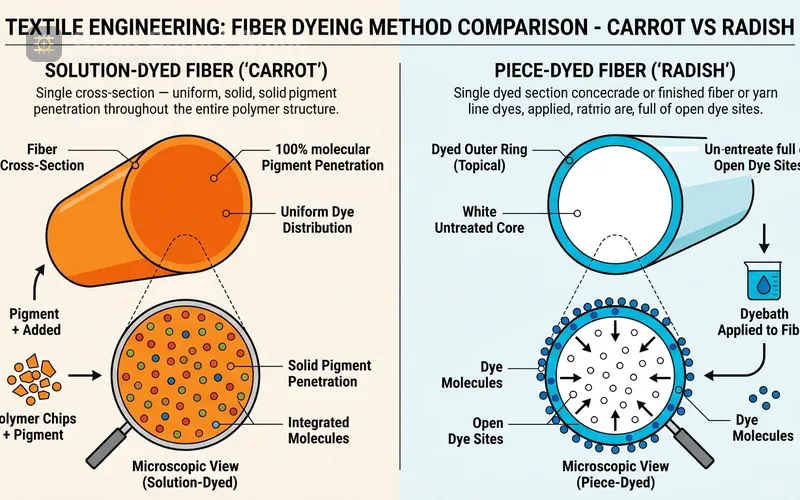
Cross-section comparison illustrating solid molecular pigment penetration in solution-dyed fiber versus topical surface coating in piece-dyed fiber.
| Fiber Type | Installed Cost | Expected Lifespan | Retention Standard | UV / Bleach Resistance |
|---|---|---|---|---|
| Solution-Dyed Nylon (SDN) | 5.00–7.50 / sq ft | 15–20 years | ASTM D5252 (Hexapod 4.5+ rating) | Full resistance |
| Triexta (PTT / SmartStrand) | 5.00–8.00 / sq ft | 15–20 years | Permanent molecular stain shield | High UV stability |
| Piece-Dyed Polyester (PET) | 3.00–4.50 / sq ft | 3–5 years on stairs | Low retention on stairs | Low UV stability, bleach destroys color |
Governing standards for color and appearance retention include ASTM D5252 (Hexapod Drum Appearance Retention), AATCC 16 (Colorfastness to Light), and AATCC 8 (Crocking and Color Bleed); CRI 104 (commercial) and CRI 105 (residential) cover power-stretcher installation. The nylon vs polyester carpet guide compares these fiber types on cost and longevity beyond color performance alone.
the 48-hour in-home carpet color testing protocol
A carpet color decision should never rest on a single showroom viewing or a single sample photo. The following four-rule protocol removes the variables that cause the most common color-matching failures.
- Secure four to five physical sample boards: Include your top choices plus at least one neutral wildcard sample outside your initial preference.
- Lay every sample flat on the floor: Never prop a sample upright against a wall. A vertical angle alters the optical reflectance angle enough to shift the perceived shade.
- Frame each sample in white printer paper: This isolation trick blocks competing color reflections bouncing off the old flooring and the surrounding walls, so you are judging the sample against a neutral field.
- Run the sample through a 48-hour, four-phase light audit:
- Phase 1: Cool morning daylight.
- Phase 2: Bright midday neutral light.
- Phase 3: Golden late-afternoon sunset light.
- Phase 4: Nighttime artificial fixture lighting, checked under both a 2700K and a 4000K bulb if the room has mixed fixtures.
A sample that holds its intended undertone across all four phases is a reliable choice. A sample that shifts dramatically between phases will cause the same shift once installed at full room scale.
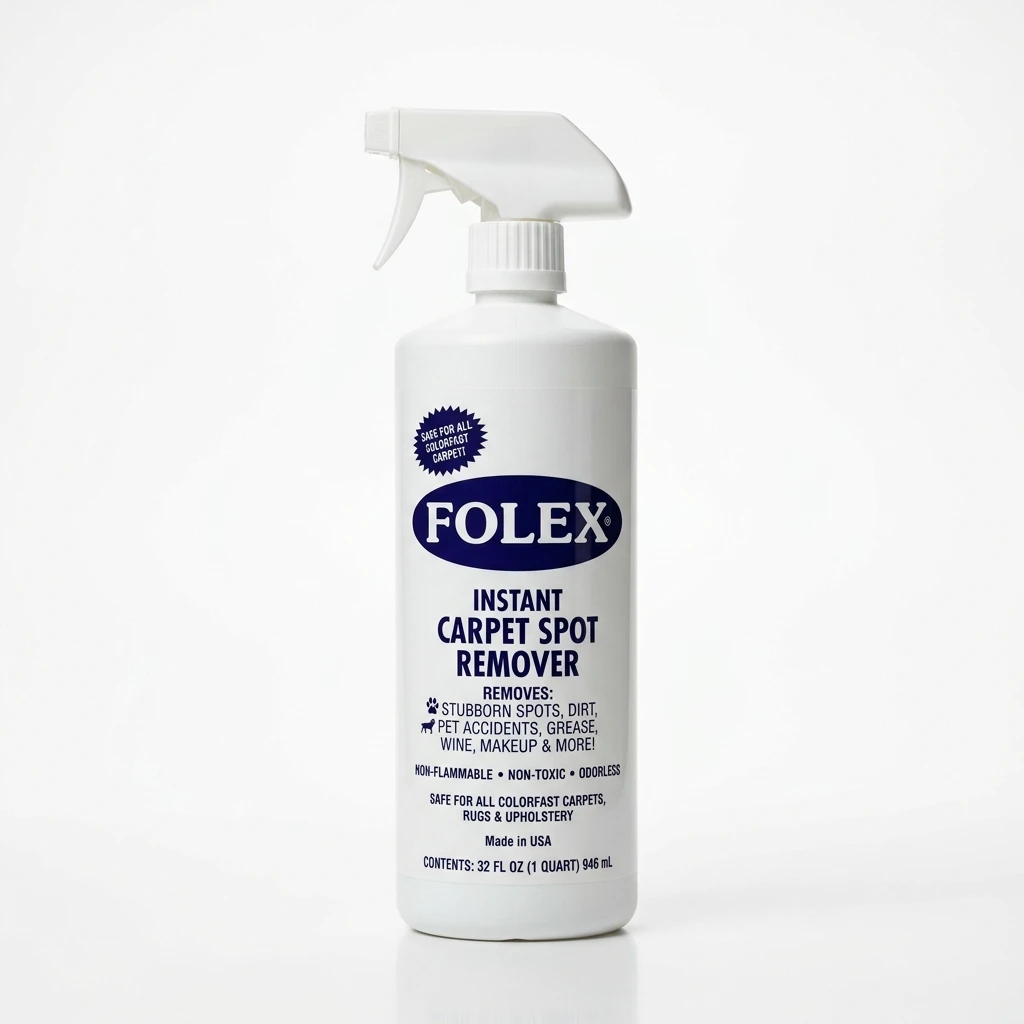
Folex Instant Carpet Spot Remover
Water-based, non-ionic surfactant spot cleaner that removes oil and water-based spots without stripping carpet dyes or leaving sticky surfactant residue.
Check Price on Amazoncommon carpet color selection failure cases
Documented field audits reveal four recurring failure patterns:
- Cool grey on honey oak trim: Cool grey carpet installed in a room with honey oak trim makes walls read muddy brown and oak trim read visibly orange, a direct result of the complementary-color clash described above.
- White or cream solid carpet on stairs: A pure white or cream solid-color carpet on a staircase shows grey traffic paths quickly, a predictable result of the visual-mirror effect on a high-traffic surface.
- Piece-dyed polyester on stairs: Polyester carpet installed on a staircase crushes flat and visibly discolors within months, consistent with polyester's low appearance-retention rating on stairs.
- Reverse roll installation: When an installer uses mixed dye lots or a reversed roll direction across a doorway threshold, the opposite pile-lay direction creates a visible two-tone "Neapolitan" line at the seam, an installation-direction error unrelated to color or dye.
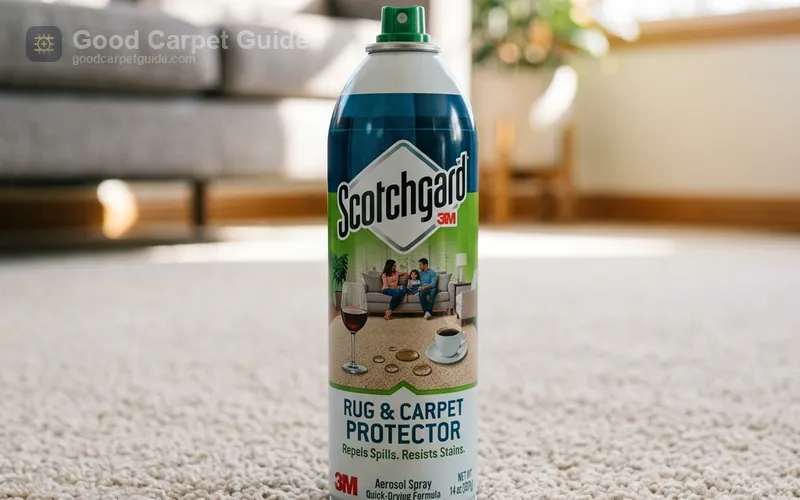
Scotchgard Rug & Carpet Protector
Fluorochemical barrier spray that surrounds carpet fibers to repel liquid spills and block UV-induced color degradation in sun-exposed rooms.
Check Price on Amazonsoil camouflage for pet households
Households with pets benefit most from multi-tonal, solution-dyed fiber. The multi-tonal weave camouflages shed hair and dander between cleanings, and the solution-dyed construction tolerates bleach-based disinfecting cleanups without color loss. The best carpet for pets guide covers fiber and color choices matched to specific pet-related wear patterns.
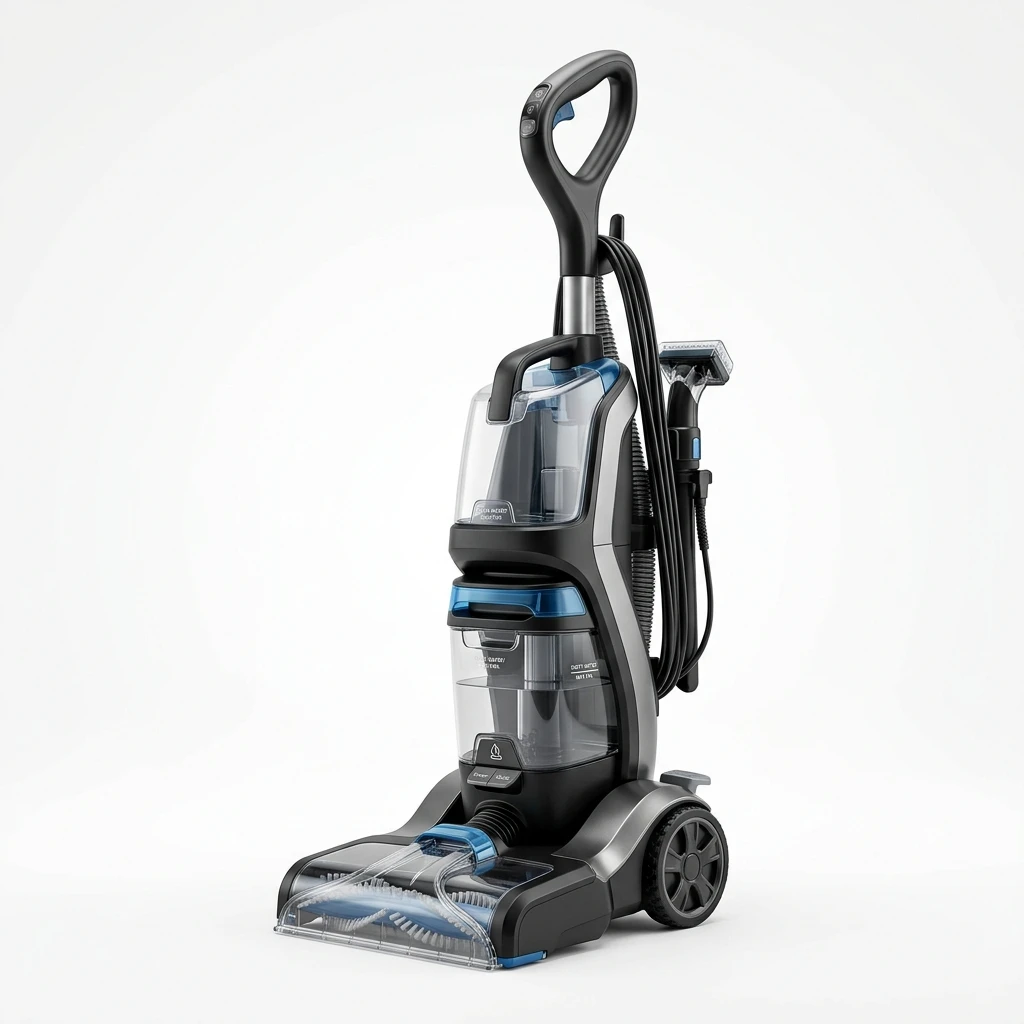
Bissell Little Green Multi-Purpose Portable Carpet Cleaner
Compact hot water extraction spot cleaner designed to lift deep traffic soiling from light-colored carpet fibers before dye binding occurs.
Check Price on Amazonsubfloor stability and fiber crush resistance
Carpet padding quality affects how long any chosen color and pile construction hold their appearance under foot traffic. Underpadding that is too soft accelerates fiber crush regardless of dye method or pile type, which shortens the effective lifespan of the color match established through this guide's testing protocol. The carpet padding guide sets out density and thickness specifications by traffic level.
frequently asked questions
Homeowners evaluating carpet swatches frequently ask about lighting variance, stain concealment, and dye durability across different residential spaces.
does carpet color look different in every room of the house
Yes. Each room's window exposure (north, south, east, or west facing) and each room's bulb Kelvin temperature both independently shift how a carpet color reads, so a color that reads correctly in one room can shift in another.
is a lighter or darker carpet better for hiding stains
Neither solid extreme performs well. Multi-tonal fiber in a mid-range LRV hides the widest range of debris types because its scattered light pattern camouflages both light and dark particles.
how long does solution-dyed carpet keep its color compared to piece-dyed carpet
Solution-dyed fiber such as SDN or Triexta typically holds full-strength color for 15-20 years under ASTM D5252 retention testing. Piece-dyed polyester on high-traffic surfaces such as stairs shows visible color and pile degradation within 3-5 years.