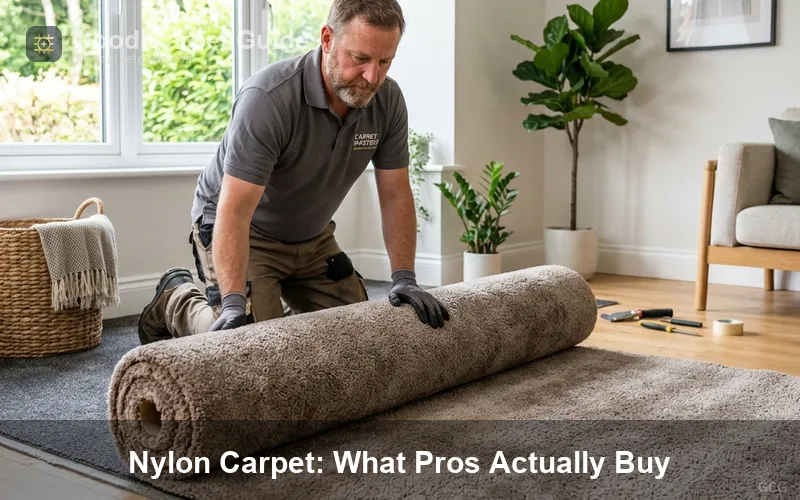
I pulled a five-year-old carpet off a stairway in a split-level home outside Columbus two winters ago, and the backing came apart in my hands before I got the knee kicker anywhere near it. The homeowner had bought a bargain roll of piece-dyed nylon carpet, laid it over a soft half-inch pad, and skipped the moisture-barrier pad the salesman recommended. Nylon carpet has a reputation for outlasting every other synthetic fiber on the market, but that reputation only holds when the fiber, the dye method, and the installation match the room. This guide breaks down the decisions that actually separate a carpet that looks new at year twelve from one that delaminates on the stairs at year three.
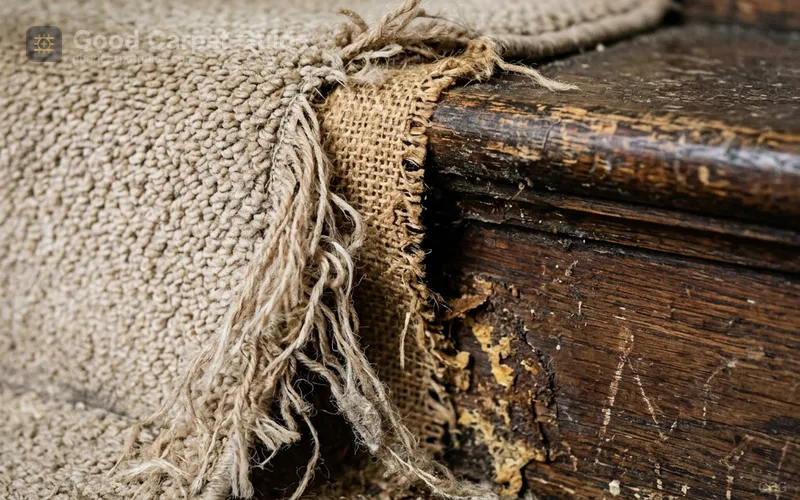
Backing delamination on a stairway, the failure point that starts this guide's discussion of nylon carpet durability and cushion selection.
how nylon carpet holds up on a real job
Nylon carpet performs best under moderate to heavy foot traffic when the fiber is a two-step extruded Nylon 6,6 or Nylon 6 with adequate face weight. The Carpet and Rug Institute's CRI 104 installation standard ties long-term appearance retention to three variables working together: fiber type, density, and cushion selection, not fiber type alone. A builder-grade nylon roll rated for light residential traffic will crush and mat within two to three years in a stairway or hallway, regardless of the "nylon" label on the sample.
Installers judge a roll by density before they judge it by brand name. A density under 2,500 (measured per square yard under ASTM D5252, the Hexapod tumble test used to predict matting and crushing resistance) is a bedroom-only product. Density above 3,200 is appropriate for stairs, hallways, and homes with dogs. The label rarely states this number plainly, so I ask the retailer for the spec sheet before I ask about color.
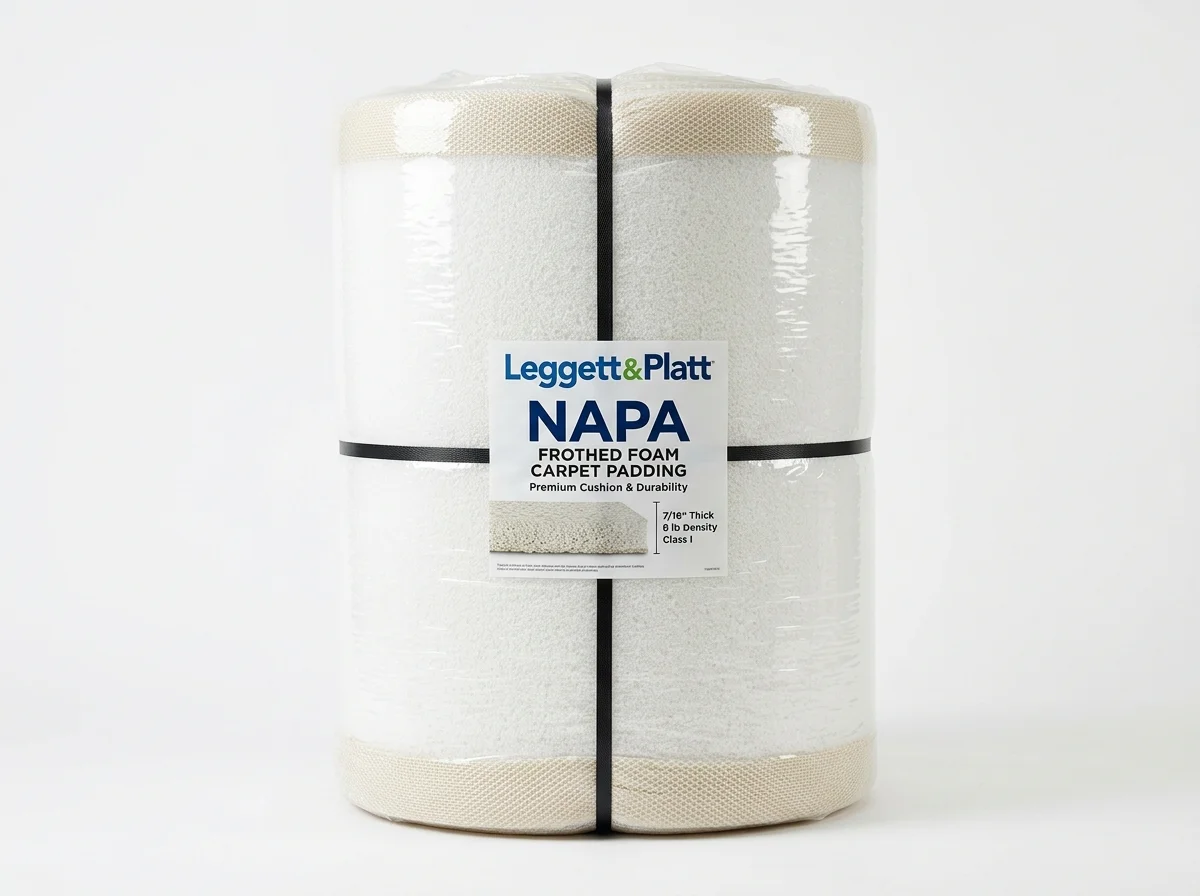
Leggett & Platt 8lb Density Carpet Cushion
High-density 8-pound rebond underlayment with moisture-barrier film designed to protect nylon backings from flexing and delaminating.
Check Price on Amazonnylon 6,6 versus nylon 6: what actually separates them
Nylon 6,6 (polyhexamethylene adipamide) and Nylon 6 (polycaprolactam) are chemically distinct polymers, and the difference shows up on the job within a few years. Nylon 6,6's symmetrical dual-monomer structure packs more tightly at the molecular level, which restricts chain movement under load to roughly 4.0 angstroms, compared to about 8.5 angstroms for Nylon 6. That tighter packing translates to a fiber surface that tests roughly 12 percent harder and elastic recovery close to 100 percent after 24 hours under 100 psi, versus about 82 percent recovery for Nylon 6.
What that means on a job site: Nylon 6,6 carpet in a family room with a recliner or a heavy sectional springs back overnight. Nylon 6 carpet under the same furniture often leaves a visible dent that a steam iron and a fork have to coax back into shape. Both fibers are legitimate residential products, but I steer clients toward Nylon 6,6 for any room with fixed furniture legs or daily traffic patterns.
| Property | Nylon 6,6 | Nylon 6 |
|---|---|---|
| Chain mobility | ~4.0 Å | ~8.5 Å |
| Fiber surface hardness | ~12% harder | Baseline |
| Elastic recovery (24 hr, 100 psi) | ~100% | ~82% |
| Best use case | Stairs, high traffic, heavy furniture | Bedrooms, light traffic |
is nylon carpet the best choice, or does polyester win on some jobs
Nylon carpet is not the correct choice for every room, and any installer who tells a homeowner otherwise is selling, not advising. Nylon resists matting and crushing better than polyester across nearly every published durability test, which is why it remains the standard for stairs, hallways, and high-traffic living rooms. Polyester carpet costs roughly half as much per square foot and resists water-based staining well when solution-dyed, which makes it a reasonable pick for a guest bedroom or a low-traffic formal living room that sees light use.
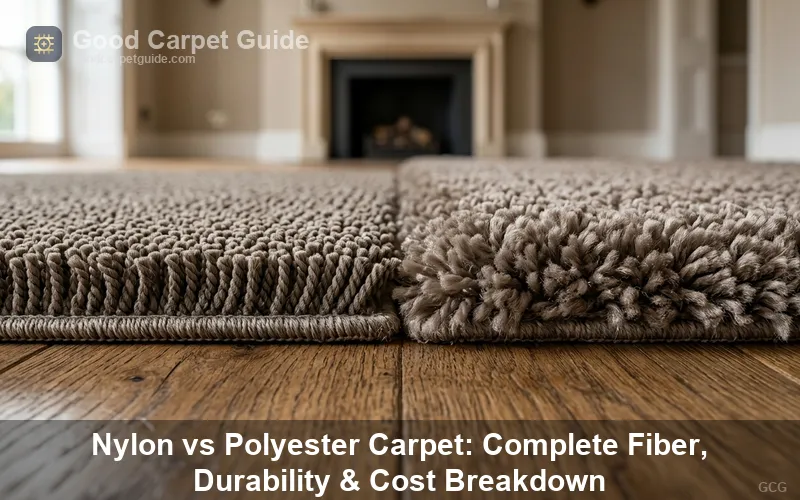
The oil resistance comparison surprises most homeowners. Standard nylon is hydrophilic and sheds body oils and cooking grease better than polyester. Polyester fiber has a chemical affinity for oils and behaves like a sponge for them, which is why polyester carpet in a kitchen-adjacent family room often develops dark, permanent traffic lanes within a few years even when it never gets stained by liquids. For a full side-by-side breakdown of fiber chemistry, cost, and wear patterns, see this nylon vs polyester carpet guide .
does nylon carpet fade in sunlight
Standard piece-dyed nylon carpet fades under sustained ultraviolet exposure. UV radiation breaks the covalent bonds in the nylon polymer chain over time, a process called photo-oxidative degradation, and the visible result is yellowing, color loss, and eventual fiber embrittlement in the exact strip of carpet that sits under a south-facing window or sliding glass door. Manufacturers address this with chemical UV stabilizers added during extrusion, and solution-dyed nylon resists fading substantially better than piece-dyed nylon because the pigment sits inside the fiber core rather than on the surface.
I have pulled up carpet samples from sunrooms where the covered section under a rug held full color while the exposed section had faded to a visibly different shade within four years. If a room gets more than a few hours of direct sun daily, ask specifically for a solution-dyed line with UV stabilization, not just any nylon.
piece-dyed versus solution-dyed: the framework that decides your stain resistance
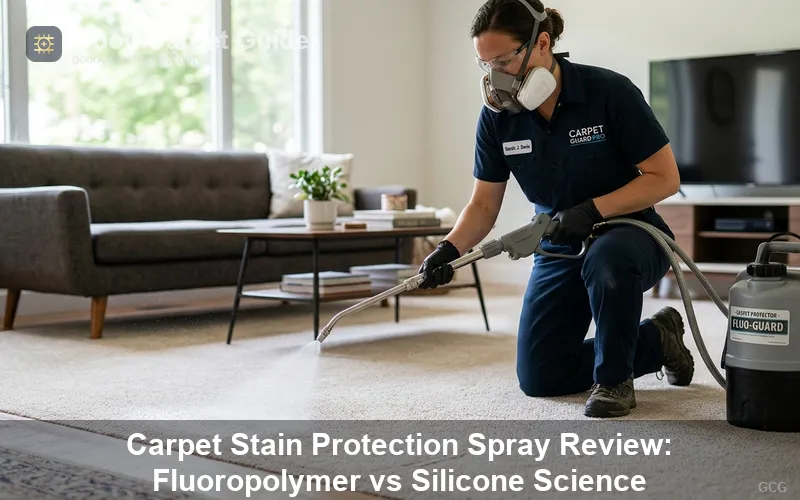
Piece-dyed nylon starts as raw white fiber that gets dyed after weaving. The color sits at the surface level, and the anionic dye sites in the fiber remain chemically active, which is exactly what makes the fiber absorb spills. Manufacturers apply topical fluorochemical stain treatments to compensate, but these treatments wear off with repeated cleaning and foot traffic, typically within five to seven years depending on cleaning frequency.
Solution-dyed nylon mixes pigment directly into the molten polymer before it gets extruded into fiber. The color runs through the entire cross-section of the fiber, and the dye sites that would normally absorb liquid are chemically neutralized during the process. This is why solution-dyed carpet lines can be sanitized with diluted bleach or hydrogen-peroxide cleaners without color loss, a property piece-dyed carpet does not share under any circumstances.
- Piece-dyed nylon: Unlimited custom colors and complex patterns, lower upfront cost, stain resistance fades over the life of the carpet.
- Solution-dyed nylon: Fixed color range set by the manufacturer, permanent stain and bleach resistance, holds up better in high-UV rooms and homes with pets.
Nature's Miracle Stain and Odor Remover
Enzymatic cleaner formulated to safely break down organic soils on solution-dyed nylon without stripping factory coatings.
Check Price on Amazonis nylon carpet good for stairs
Nylon carpet is the standard recommendation for stairs among installers, provided the cushion underneath is dense and thin rather than soft and thick. A soft, low-density half-inch pad allows too much vertical flex under the stiff carpet backing on a stair nosing, and repeated flexing splits seams and delaminates backing at exactly the point where the tread meets the riser, the failure I described at the start of this guide. A dense 8-pound rebond cushion, cut thin, keeps the backing rigid enough to survive the daily flex of foot traffic on stairs.
On the tools side, stairs get power-stretched and secured with a row runner along the tread edge, then tacked with shorter tackless strip pins than a flat room would use, since stair noses have less material to bite into. Seams on a stairway get sealed with latex seam sealer before the seam iron ever touches them, because a seam that opens on a stair is both a trip hazard and a warranty callback. For fiber and cushion pairings specific to stairways, see this best carpet for stairs guide .
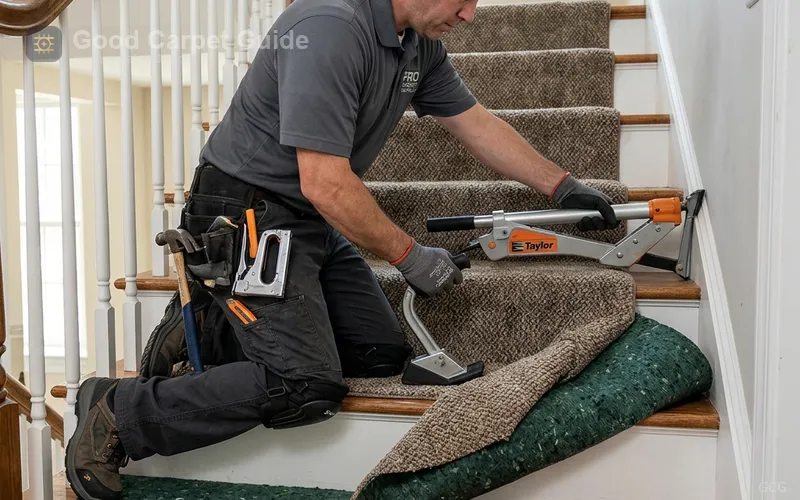
A dense 8-pound rebond cushion under nylon carpet on stairs, the pairing that prevents the backing flex problems covered above.
does nylon carpet show footprints, and does it cause static shocks
Footprint and vacuum-track visibility on nylon carpet depends on pile construction more than fiber chemistry. Cut-pile nylon in a plush or saxony style shows footprints and vacuum lines because the yarn tips bend directionally under pressure and catch light differently than upright yarn. Textured or frieze nylon constructions hide footprints because the yarn twist is irregular, which scatters light instead of reflecting it in one visible pattern. Homeowners who dislike footprint shadowing in a formal living room should ask for a textured or patterned construction rather than a smooth plush.
Static electricity is a separate issue tied to fiber chemistry and climate. Nylon generates triboelectric charge more readily than polyester or wool blends, and in dry winter climates with forced-air heating, budget nylon lines that skip continuous carbon-core grounding filaments produce noticeable shocks for both people and pets. Mid-range and luxury nylon lines from Anderson Tuftex and Shaw build these grounding filaments into the yarn bundle as a standard feature, so this is worth confirming on the spec sheet for any home in a low-humidity region.
is nylon carpet easy to clean, and how should you clean it
Nylon carpet responds well to routine hot-water extraction, commonly called steam cleaning, performed roughly every 12 to 18 months under IICRC S100 maintenance guidelines. Nylon is a hydrogen-bonded fiber with structural memory, and heavy foot traffic deforms those hydrogen bonds over time, flattening pile in walkways. Superheated water above 100°C temporarily plasticizes the fiber during extraction, which lets the deformed bonds release. As the fiber cools and dries, the hydrogen bonds reform closer to their original upright position, restoring pile height in traffic lanes that looked permanently matted before service.
Day-to-day cleaning depends on dye method. Solution-dyed nylon tolerates diluted hydrogen-peroxide or bleach-based spot cleaners without color loss. Piece-dyed nylon does not tolerate chlorine bleach under any circumstances; even brief contact causes instant, irreversible color loss and fiber weakening at the contact point. Vacuum weekly with a beater-bar vacuum on cut-pile nylon and a suction-only setting on looped constructions to avoid fiber distortion.
brands installers actually see on the truck
Shaw Anso Nylon is a Type 6 nylon engineered with a modified fiber cross-section that diffuses light to help hide soil between cleanings. The yarn uses Shaw's CrossBond technology to hold twist longer under traffic and ships with an R2X stain and soil repellent treatment. Shaw's Pet Perfect line pairs Anso nylon with a LifeGuard waterproof backing system, which keeps pet accidents and spills from reaching the pad and subfloor, a detail that matters most in homes with dogs or young kids.
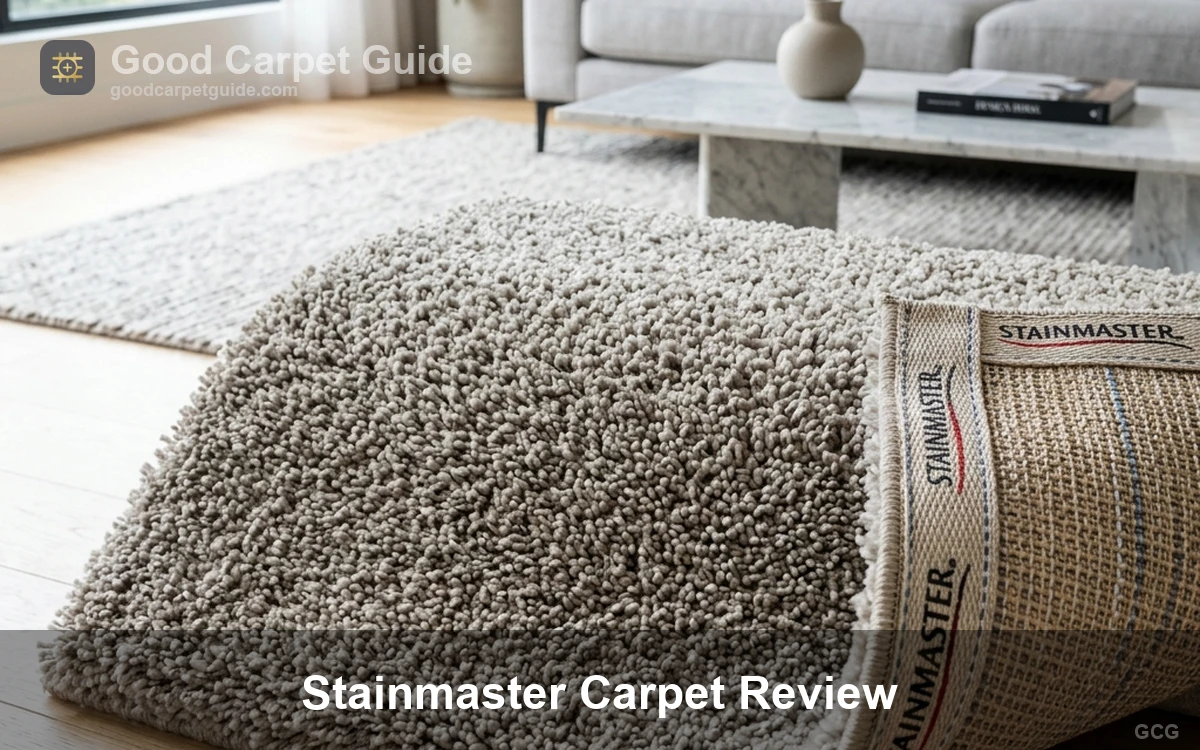
Stainmaster PetProtect built on SuperiaSD solution-dyed Nylon 6,6 remains a benchmark for permanent stain resistance, since the color and stain protection get sealed in during the heat-setting stage of manufacturing rather than applied topically. It resists pet hair cling for easier vacuuming and tolerates hydrogen-peroxide sanitizing. Homeowners should confirm the specific fiber content on any Stainmaster-branded product before buying: since Lowe's acquired the trademark, the name has appeared on lower-grade polyester lines as well, and those do not carry the same Nylon 6,6 durability profile long-time buyers expect from the brand.
Karastan Cashmere Nylon targets the luxury end of the market with ultra-dense yarn construction built to mimic the soft hand of wool while keeping nylon's wear characteristics. Face weights run 50 to 70 ounces, treated with EasyClean soil protection, over tight woven backings rated for a 15-to-20-year service life under normal residential traffic.
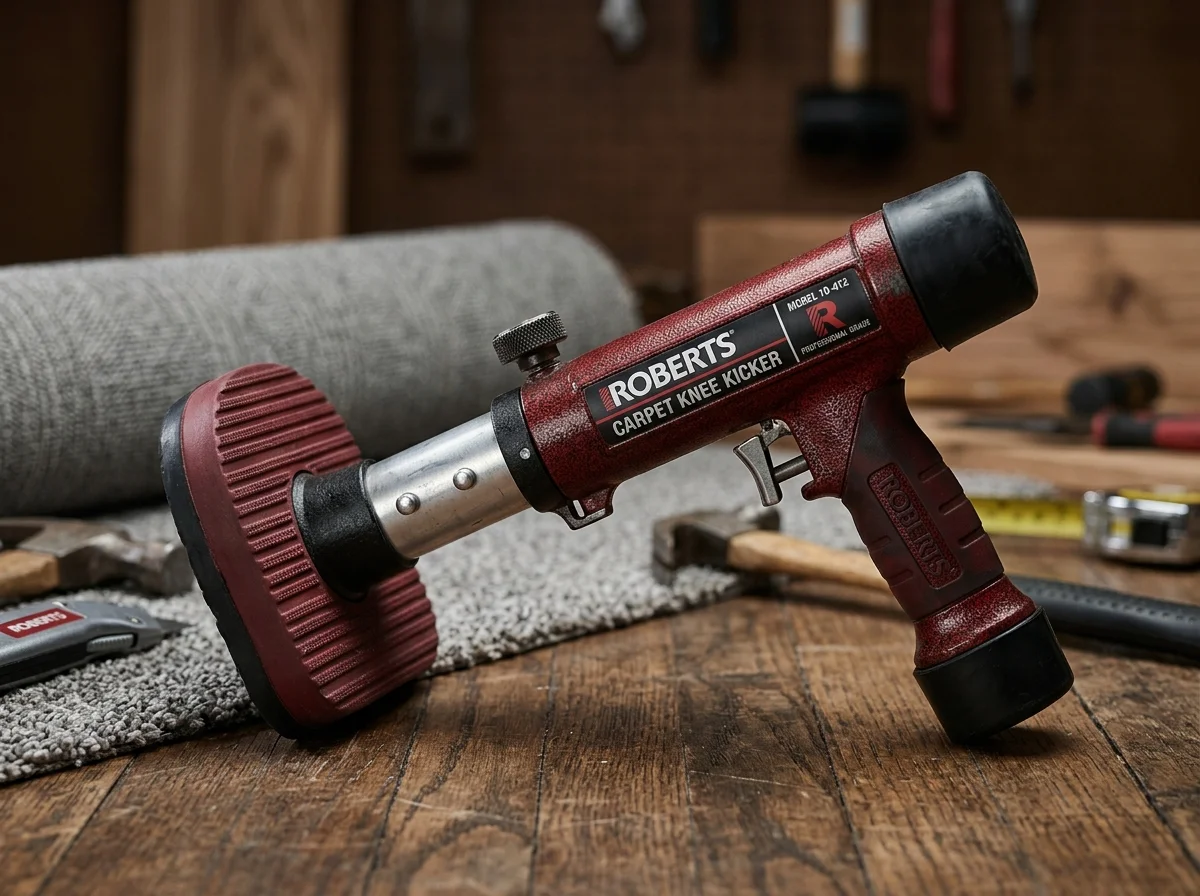
Roberts 10-254 Power-GTI Power Stretcher
Heavy-duty professional carpet stretcher for securing stair and hallway rolls without backing flex.
Check Price on Amazonwhat nylon carpet actually costs, installed
Material cost tracks polymer type and construction density closely, and installed pricing adds cushion and labor on top of the roll price.
| Tier | Material only (per sq. ft.) | Notes |
|---|---|---|
| Basic builder-grade | $0.50 – $1.50 | Low face weight, piece-dyed, density under 2,500 |
| Value-driven | $2.00 – $3.50 | Type 6, piece-dyed, density under 2,500 |
| Mid-range | $3.50 – $5.50 | Solution-dyed Nylon 6 or R2X treated, density 2,500-3,200 |
| Luxury / high-design | $5.50 – $9.00+ | Face weight over 50 oz, solution-dyed Nylon 6,6, density over 3,200 |
Cushion adds $0.25 to $1.00 per square foot depending on density and moisture-barrier features, and standard professional installation labor runs $0.50 to $1.50 per square foot before stair cuts or furniture-moving fees. All-inclusive, a basic nylon job lands around $3.00 to $5.50 per square foot installed, a mid-range job (the sweet spot for most active households) runs $6.25 to $7.20 per square foot, and luxury lines from Karastan or Anderson Tuftex push installed pricing to $8.00 to $12.50 or higher per square foot.
Nylon costs roughly twice what polyester costs at comparable construction quality, driven largely by raw nylon pellet scarcity as automotive manufacturing competes for the same material supply. For bedroom-specific budget guidance where lighter traffic can justify a lower tier, see this best carpet for bedrooms guide .
questions installers get asked that manufacturers do not answer clearly
A few questions come up repeatedly on job sites and in homeowner forums, and manufacturer literature rarely addresses them directly.
- Vacuum compatibility with waterproof backings: Dense nylon paired with a waterproof backing system like Shaw's LifeGuard, or with a moisture-barrier pad, can trap airflow underneath the vacuum head and create a suction seal that locks the vacuum to the floor. Ask the flooring retailer for a demo unit before buying a vacuum for a newly installed waterproof-backed carpet.
- Nylon and Triexta blend stair lifespan: Blended lines marketed as combining nylon's resilience with Triexta's stain resistance are common on showroom floors, but published lifespan data specific to stair applications for these blends is limited. Check against the specific manufacturer's warranty terms rather than general marketing claims.
- Topical sealants over factory treatments: Applying a secondary topical sealant like Microseal over a factory-applied treatment such as Shaw's R2X can interfere with the factory coating's bonding rather than improve protection. Ask the manufacturer's technical support line before applying any aftermarket treatment, since this varies by product line.
- PFAS content in pet-line treatments: Buyers concerned about PFAS or PFOA content in built-in soil and odor protectants on pet-focused carpet lines should request the specific chemical data sheet from the manufacturer, since manufacturers have shifted formulations in recent years and general web claims about "forever chemicals" in carpet often lag behind actual product changes.
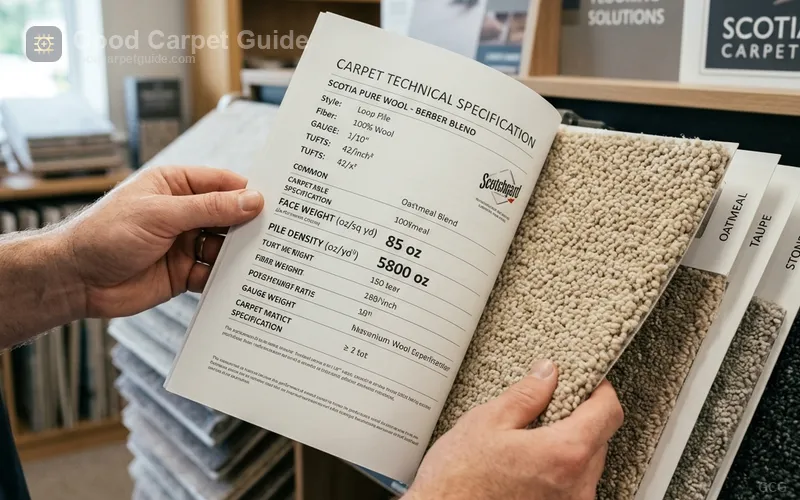
Checking a manufacturer spec sheet for density and treatment details, the step that answers most of the forum questions covered above before the carpet ever reaches the truck.
VOC off-gassing and new-carpet safety
New nylon carpet releases volatile organic compounds during the first 72 hours after installation as adhesives, backing materials, and factory treatments cure. This off-gassing can cause dizziness, headaches, or upper respiratory irritation in sensitive individuals, particularly infants, elderly residents, and people with asthma. Ventilating the installed rooms with open windows and running exhaust fans for the first three days reduces indoor concentration significantly. Homes with a family member in a high-risk group should schedule installation for a period when the space can stay ventilated and unoccupied for those first few days.
final recommendations
For stairs and high-traffic hallways, choose solution-dyed Nylon 6,6 with a density above 3,200 over a dense 8-pound rebond cushion, and confirm the retailer can show the CRI density spec sheet before you buy. For homes with pets or kids, a solution-dyed line like Stainmaster PetProtect's Nylon 6,6 construction or Shaw's Pet Perfect with LifeGuard backing handles accidents and sanitizing far better than any piece-dyed option regardless of price point. For a low-traffic guest bedroom or formal room used a few times a year, mid-range piece-dyed nylon or even a solution-dyed polyester keeps the budget reasonable without sacrificing much practical performance; check this carpet density guide to verify exact specifications. Whatever the room, get the density number in writing before the roll ships, since that single spec predicts more about how the carpet holds up than the brand name printed on the sample.