tl;dr recommendation matrix
| Service / Condition | Typical U.S. Cost | Best Choice When | Avoid When |
|---|---|---|---|
| Professional restretch, one room | 100–300 | Carpet is structurally sound but loose or rippled | Backing is delaminated or severely brittle |
| Additional room | 40–80 | Several rooms can be completed on one service visit | The contractor charges a separate minimum for every room |
| Hallway | 50–120 | Slack is concentrated along a narrow transit path | Carpet is worn through at perimeter edges |
| Stairs | 7–25 per step | Carpet is loose on treads but pile and backing remain sound | Tack strips, cushion pad, or backing have failed |
| Berber / loop pile | +20% to +25% premium | Loops remain intact and primary backing accepts tension | Loops are frayed, snagged, or backing is separating |
| Bonded carpet insert | 95–225 | Localized burn, pet-chewed section, or localized tear | No matching donor remnant exists |
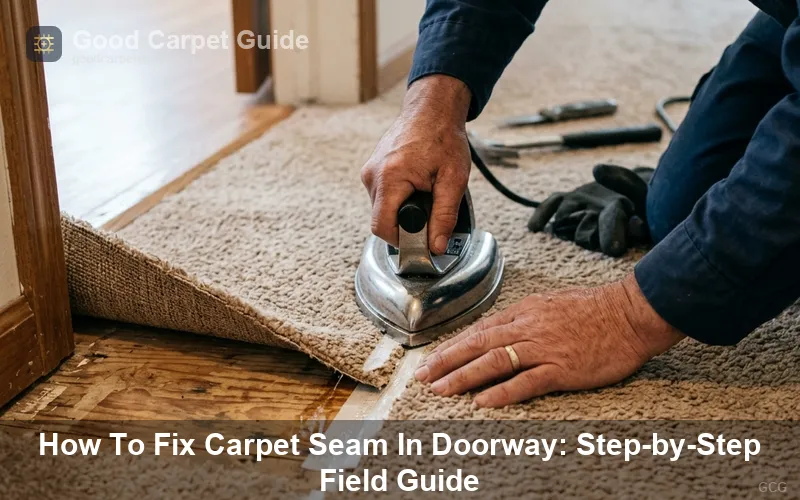
| Seam repair | 100–250 | A seam has split or peaked while surrounding carpet is usable | Broadloom backing or latex adhesive is disintegrating |
| Full replacement | 3–6 / sq ft installed | Carpet has reached structural or fiber wear limits | Wrinkles and slack are the only meaningful defects |
how much does carpet restretching cost?
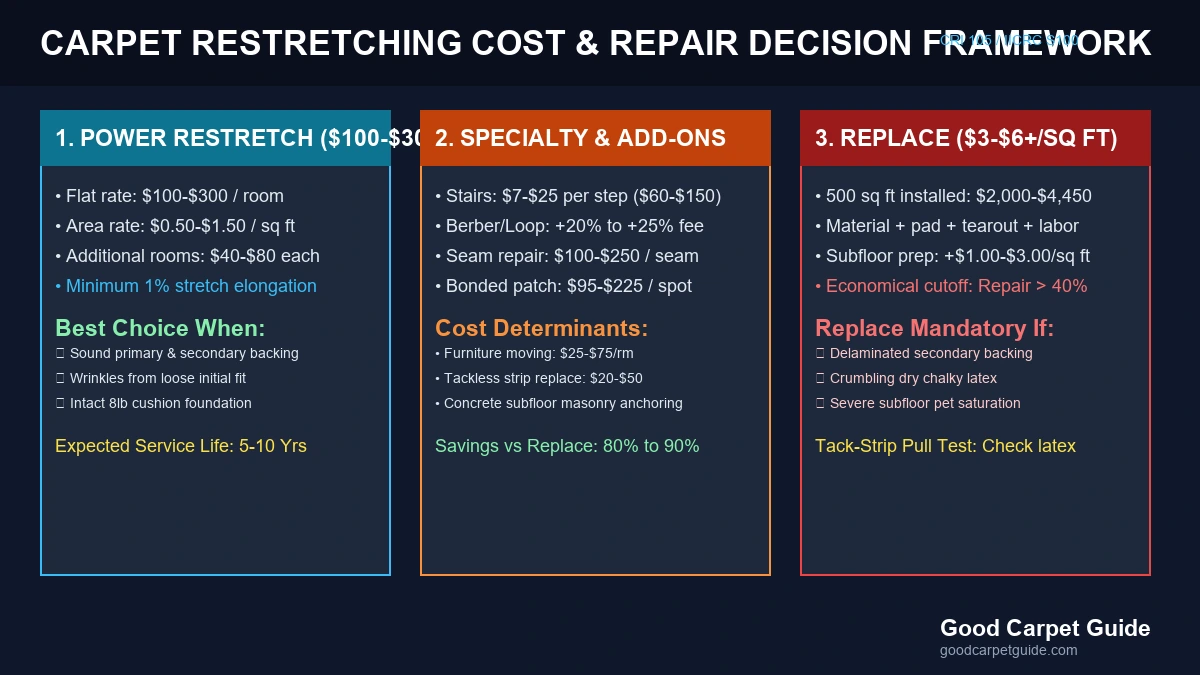
Professional carpet restretching cost is typically 100–300 for a single residential room, with published contractor pricing placing full-house mechanical stretching around 0.50–1.50 per square foot. The true carpet restretching cost depends on site variables including furniture moving, doorway seams, stair transitions, Berber loop construction, perimeter tack-strip replacement, and secondary backing integrity. ( Angi )
The practical buying decision is straightforward: restretch structurally sound carpet when looseness and wrinkles are the primary defects; repair or replace carpet when the latex backing, pile fibers, or cushion pad have crossed their mechanical limits. The CRI 105 Standard for Installation of Residential Carpet mandates power stretching for all wall-to-wall installations and notes that failure to power stretch contributes directly to wrinkling, buckling, edge unraveling, and secondary backing delamination. ( Carpet and Rug Institute )
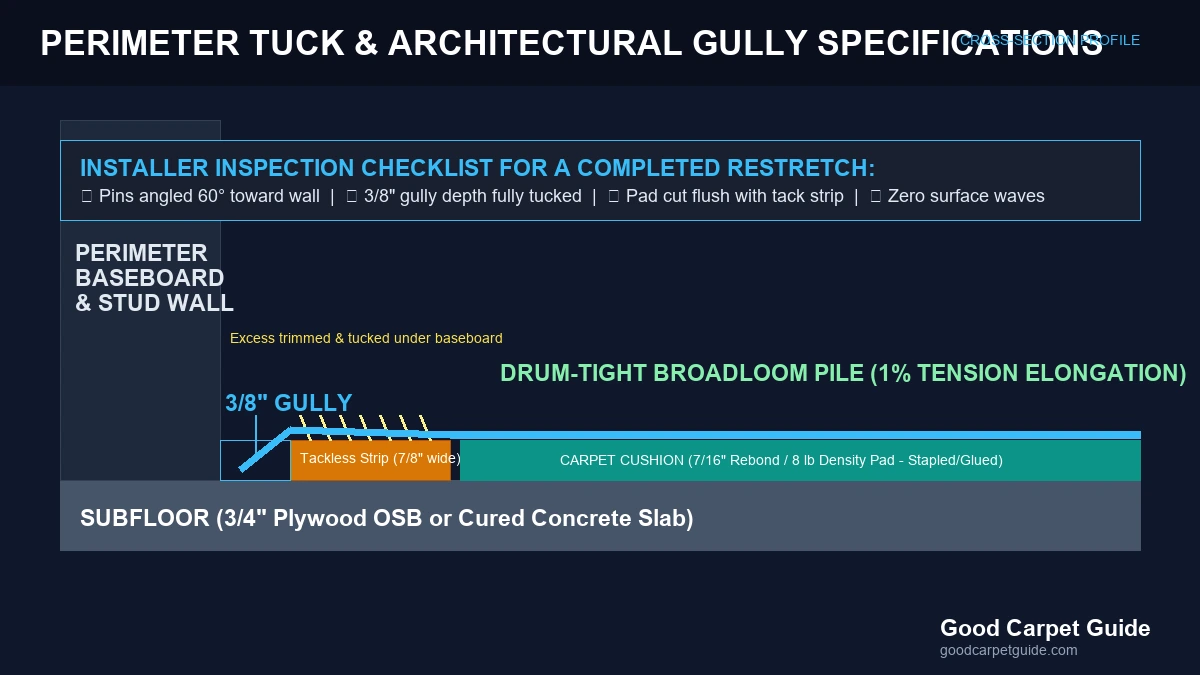
A loose carpet often appears to be a manufacturing or material defect when the true root cause was insufficient installation tension. A broadloom floor that looks smooth on installation day can develop deep ripples following seasonal humidity shifts, heavy furniture movement, or hot-water extraction because tension slack remained in the primary backing. The Carpet and Rug Institute residential installation standard specifies a minimum 1% drum-tight stretch in both length and width for tufted carpet with synthetic secondary backing when the manufacturer does not specify an alternative rate. ( Carpet and Rug Institute )
The economic decision rests on the structural condition of the carpet beneath the ripples. An intact 6-year-old nylon carpet with localized looseness is an outstanding restretching candidate. Conversely, a 12-year-old carpet with crumbling latex, severe traffic matting, or delamination requires complete replacement, even if a technician can temporarily pull it taut over a carpet tack strip .
what does carpet stretching cost by room, size, and repair type?
Carpet stretching cost varies by total square footage and service layout, with a one-room trip minimum commonly controlling the bottom-line invoice for small jobs. Data from trade reports places professional stretching at 100–300 per room (0.50–1.50 per square foot), while multi-room projects typically bill at 50–75 for each additional room after the primary setup charge. ( HomeGuide )
| Service Scope | Typical Cost Range | Cost Determinant |
|---|---|---|
| First / Single Room | 100–300 | Mobilization, tool setup, minimum labor charge |
| Additional Room | 40–80 | Incremental labor while tools are on-site |
| Hallway | 50–120 | Linear power-stretcher setup along traffic spine |
| Stairs (Full Flight) | 60–150 (7–25/step) | Individual riser and tread tensioning |
| Berber / Loop Upcharge | +20% to +25% | Extra row-running care to prevent fiber pull |
| Heavy Furniture Handling | 25–75 per room | Clearing stretch paths for stretcher tubes |
| Bonded Carpet Insert (Patch) | 95–225 | Donor carpet excision and precision seam welding |
| Seam Separation Repair | 100–250 | Hot-melt tape activation and latex seam sealing |
Contractors quote single rooms at a flat rate rather than pure square footage because the initial charge absorbs travel, equipment mobilization, power-stretcher assembly, and baseboard protection. A 120-square-foot bedroom carries a higher effective rate per square foot (1.25–2.00) than an open 800-square-foot basement (0.60–0.90).
[!IMPORTANT]
Quote Check: Always verify that the quote includes unhooking carpet from tack strips, full power stretching with extension tubes, trimming perimeter excess, re-tucking into the architectural gully, and resetting furniture. A low-cost 100 estimate that excludes trimming and re-tucking frequently balloons into a250 invoice on the day of work. For comprehensive repair planning, review our carpet repair master guide .
what does carpet restretching cost for Berber, stairs, and complicated layouts?
Berber and looped carpet styles incur a 20% to 25% pricing surcharge because continuous filament loops require specialized row-running techniques to prevent catastrophic zippering under tension. HomeGuide notes that looped carpets demand slower, directional stretching to protect the primary backing from tearing across tuft rows. ( HomeGuide )
| Architectural Layout | Cost Impact | Mechanical Reason |
|---|---|---|
| Open Rectangular Room | Baseline (100–200) | Long, unobstructed opposing walls allow single-axis stretcher bracing |
| Multi-Corner / L-Shaped | Moderate (+15% to +30%) | Tension angles must be redistributed across multiple wall vectors |
| Hallways | Fixed (50–120) | Confined geometry requires specialized tail-block wall anchoring |
| Stairs & Landings | High (7–25 / step) | Each bullnose and tread requires independent kicker and stair-tool tucking |
| Berber / Level Loop | Surcharge (+20% to +25%) | Stretcher teeth must engage backing without snagging surface loops |
| Patterned Carpet | Surcharge (+25% to +35%) | Stretch must be square to maintain geometric pattern alignment |
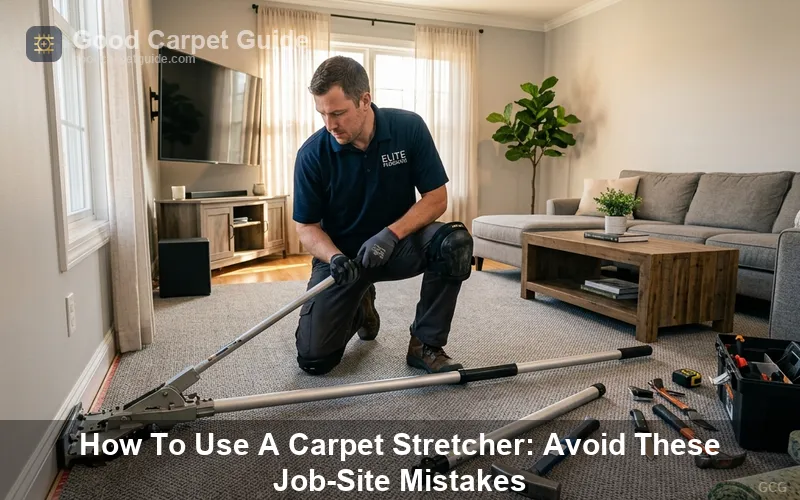
CRI 105 explicitly distinguishes power stretching from manual knee-kicking, requiring a mechanical power stretcher with steel extension tubes for all main spans. Knee kickers are strictly classified as positioning tools for stair treads, closets, and perimeter pin engagement. ( Carpet and Rug Institute )
Staircases require an entirely distinct labor profile. An installer must reset tension across each individual step, tucking under the stair nosing with an awl and stair chisel while securing the backing onto dedicated architectural tack strips. For stair installations and repairs, learn more about how to use a carpet stretcher .
how does professional carpet restretching work?
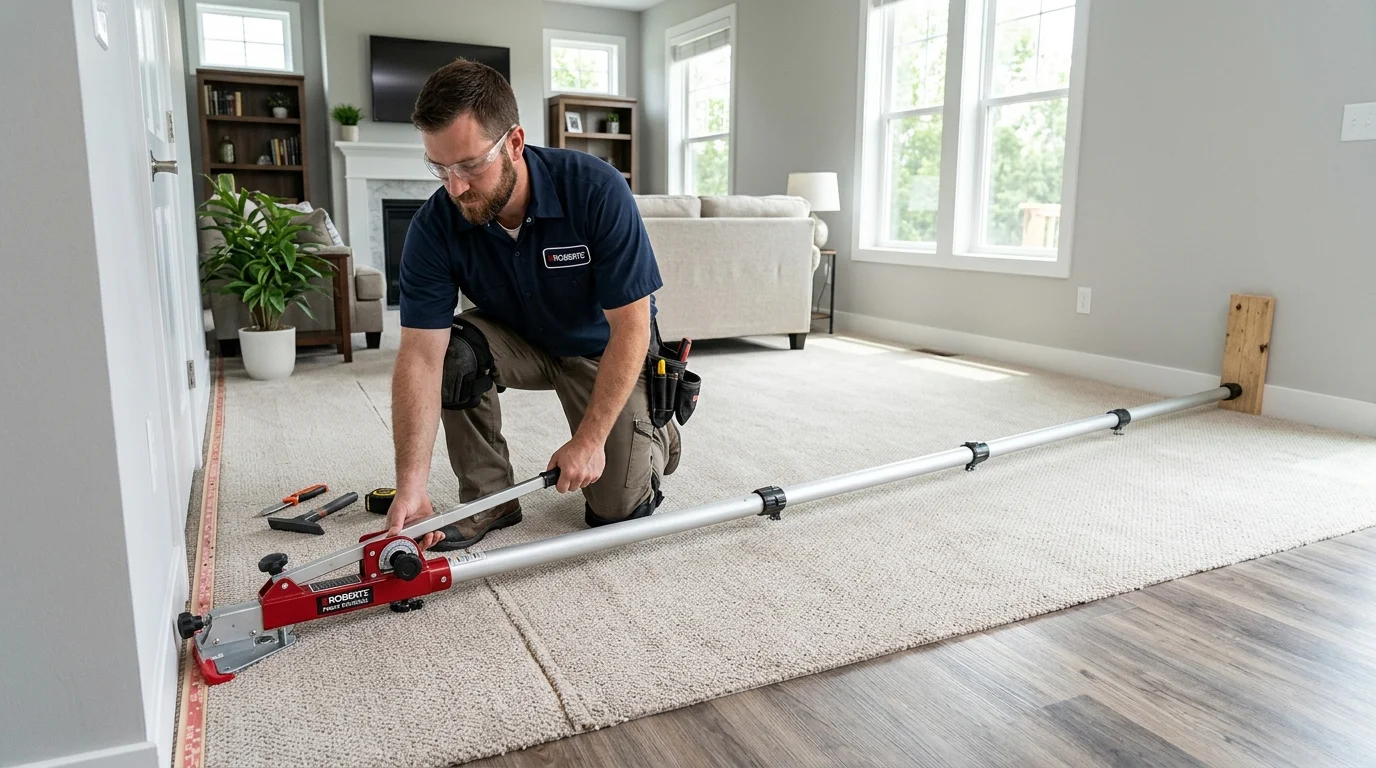
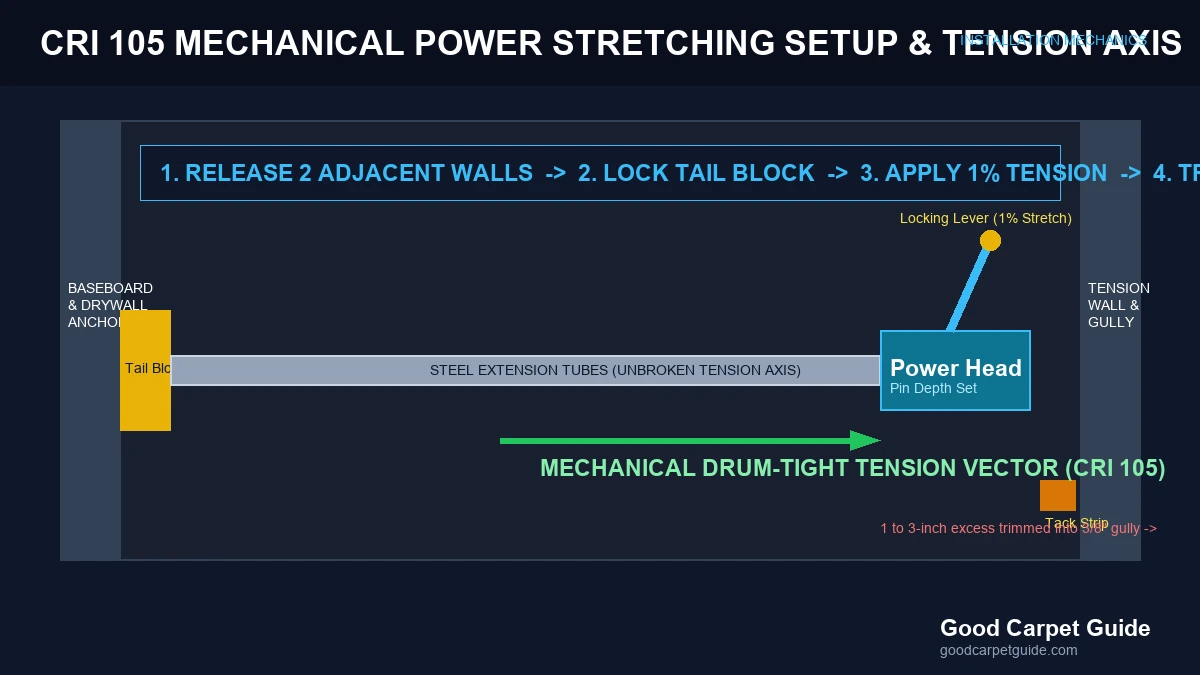
Professional carpet restretching follows a precise sequence of perimeter release, mechanical power tensioning, edge trimming, and tack-strip reattachment rather than simply kicking wrinkles toward the baseboard. CRI 105 mandates a power stretcher equipped with an adjustable head, locking lever mechanism, steel extension tubes, and a padded tail block to prevent drywall damage. ( Carpet and Rug Institute )
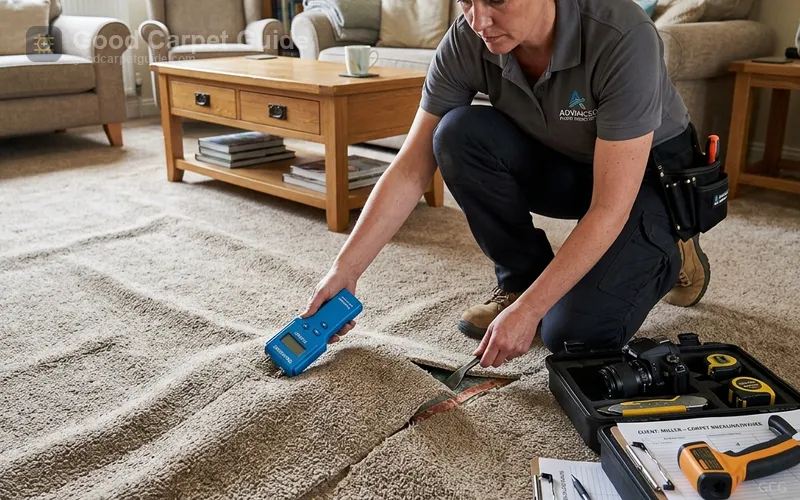
- Backing Diagnostic: The technician inspects traffic lanes, seams, baseboards, and secondary backing integrity.
- Room Clearance: Furniture is shifted away from the tension axis to allow unbroken stretcher tube extension.
- Perimeter Edge Release: The installer gently disengages the carpet from tack strips along two adjacent walls using a carpet awl.
- Mechanical Power Tensioning: The power stretcher is locked against the far wall tail block, applying 1% tension across the length and width axes.
- Perimeter Trimming: Excess broadloom is trimmed using a dedicated wall trimmer or carpet knife, then tucked firmly into the 3/8-inch gully.
- Seam Welding: Doorway seams and metal transitions are inspected and re-bonded with hot-melt seaming tape where required.
can you restretch carpet yourself to save on cost?
DIY carpet restretching costs between 50 and250 for tool rentals and materials, but the apparent financial savings vanish immediately if incorrect tension rips the secondary backing or damages perimeter drywall. Tool rental for a power stretcher and knee kicker averages 40 to70 per day, plus blade and adhesive expenses. ( Angi )
A proper job requires specialized installation equipment:
- Heavy-duty mechanical power stretcher with locking head and extension pipes
- Adjustable knee kicker for positioning and corner tucking
- Precision carpet knife or wall trimmer
- Carpet awl and stair chisel for gully tucking
- Hot-melt seaming iron, thermoplastic seaming tape, and solvent-free latex seam sealer
The primary risk in DIY stretching is mechanical failure. Applying tension with only a knee kicker cannot generate the 1% elongation required by CRI 105, leaving the carpet prone to re-wrinkling within 6 months. Furthermore, excessive or uneven use against interior drywall without an anchor board can puncture baseboards and framing.
DIY is viable only for small closets or single doorway adjustments where the backing is pliable and the span is under 6 feet. Full living rooms, basements, hallways, and stairs should be handled by a certified installer.
how long does carpet restretching last?
A professional mechanical restretch lasts 5 to 10 years when the secondary backing latex is intact and the carpet cushion maintains an 8 lb/cu ft density rating. Industry longevity data indicates that proper 1% power stretching permanently removes original installation slack, allowing the carpet to remain flat for the remainder of its wear cycle. ( Angi )
Longevity depends on three structural variables:
- Cushion Density & Thickness: A soft, low-density cushion (under 6 lbs or over 7/16-inch thick) allows excessive vertical flex under foot traffic, pulling the carpet off perimeter tack strips over time.
- Indoor Relative Humidity: Broadloom backing expands in high humidity and contracts in dry conditions. Maintaining indoor humidity between 30% and 50% stabilizes dimensional elasticity.
- Secondary Backing Latex Integrity: If the synthetic rubber latex compound has degraded into powdery dust, the carpet cannot retain mechanical tension and will loosen after heavy vacuuming.
Repeated restretching of the same room more than twice indicates either subfloor tack-strip failure or structural cushion collapse rather than standard carpet relaxation.
is restretching cost worth it compared with carpet replacement?
Restretching is financially advantageous whenever total repair costs remain below 40% to 50% of the replacement estimate and the carpet fibers retain adequate pile density. Comparing a 150–250 single-room restretch against a 1,200–2,400 replacement represents an immediate 80% to 90% capital savings.
| Floor Condition | Recommended Strategy | Financial & Practical Justification |
|---|---|---|
| Wrinkles only; intact pile & backing | Restretch (100–250) | Restores original tension and eliminates trip hazards at minimal cost |
| Wrinkles + moderate traffic lane matting | Restretch + Deep Hot-Water Extraction | Restores surface flatness; hot-water extraction lifts resilient nylon pile |
| Dry, crumbling latex or delaminated backing | Replace (3–6 / sq ft) | Backing cannot grip tack strips; restretching will rip primary tufts |
| Severe pet urine saturation through pad | Replace Pad & Carpet | Uric acid crystals destroy latex bonding and subfloor wood |
| Localized burn or stain with spare remnant | Bonded Insert (Patch) (95–225) | Restores floor appearance without replacing undamaged room areas |
| Carpet age > 15 years with worn pile | Full Replacement | Restretching cannot restore lost fiber density or worn carpet cushion |
Current market data places basic-to-midrange carpet replacement between 3.00 and6.00 per square foot installed, with complete tear-out, padding, and labor. ( Angi ) For a detailed square-footage cost model, see our complete carpet cost guide .
what restretching cost do professionals recommend for older carpet?
Installers evaluate older carpet by inspecting backing pliability and tuft bind strength rather than chronological age alone. While carpets older than 10 to 12 years often exhibit reduced flexibility, a well-maintained nylon broadloom with solid latex can be restretched successfully.
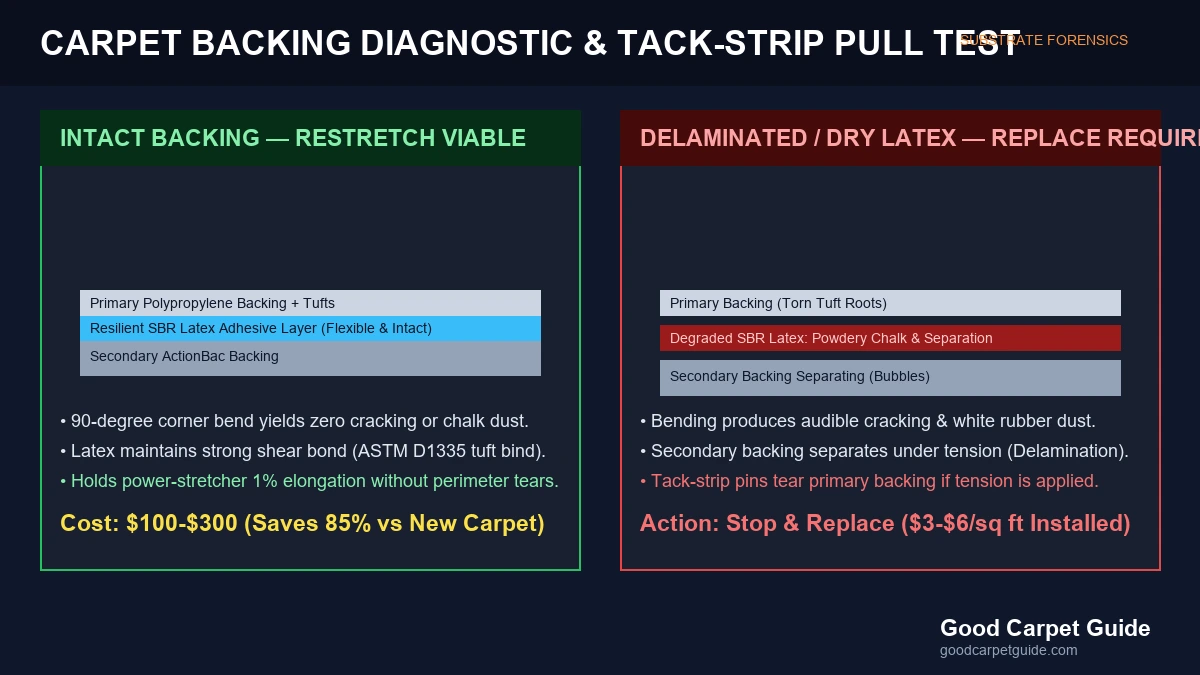
Before approving a restretch on carpet over 8 years old, conduct the Tack-Strip Pull Test:
- Lift a corner edge with an awl near a low-traffic baseboard.
- Bend the exposed backing backward at a 90-degree angle.
- Check for white latex dust, cracking sounds, or separation between primary and secondary backings.
If the backing flexes cleanly without shedding chalky residue, the carpet will hold power-stretcher tension. If the backing flakes or delaminates, stop the project and allocate funds toward new carpet and underlayment.
what is the difference between restretching cost types?
Carpet repair invoices separate into four distinct mechanical operations, each addressing a unique failure mode in the flooring system.
1. full-room power restretch (100–300)
Addresses broadloom ripples across open floor spans. The technician releases perimeter edges, anchors a power stretcher to the opposite baseboard, elongates the backing by 1%, trims excess fabric, and anchors into tack strips.
2. bonded insert / patch repair (95–225)
Replaces localized burn holes, pet tears, or permanent bleach spots. The technician excises the damaged square along tuft rows and welds a matching donor remnant using hot-melt seaming tape and latex edge sealer.
3. seam separation repair (100–250)
Repairs peaked, frayed, or opening doorway seams. The installer cleans old adhesive, aligns pile nap direction, inserts new thermoplastic seam tape, and activates the bond with a professional seaming iron under heavy weight blocks.
4. perimeter tack-strip replacement (20–50 per strip)
Replaces rotted, loose, or rusted tackless strips along concrete or wood subfloors. Concrete subfloors require masonry nails or heavy-duty construction adhesive before restretching can proceed.
how much do carpet cleaners cost before or after restretching?
Professional hot-water extraction carpet cleaning averages 120 to240 for a standard home (or 50 to150 per room), but cleaning and restretching must be scheduled in the correct chronological order. Cleaning removes soil and allergens; it cannot correct mechanical tension slack. ( Angi )
[!TIP]
Correct Service Sequence:
1. Perform Restretching First: Restretch the carpet while dry. Applying hot-water extraction to a loose carpet injects moisture into slack backing, worsening ripples and risking temporary delamination.
2. Deep Clean 48–72 Hours Later: Once the carpet is drum-tight on its tack strips, professional steam cleaning lifts matted pile fibers and removes embedded soil without shifting the backing.
what is carpet installation cost compared with restretching?
New wall-to-wall carpet installation costs 3.00 to6.00 per square foot for basic-to-midrange materials and 7.00 to12.00+ for premium wool or patterned nylon broadloom. In contrast, mechanical restretching costs only 0.50 to1.50 per square foot.
| Project Scope (500 sq ft Area) | Professional Restretch | Full Carpet Replacement |
|---|---|---|
| Material Cost | 0 (existing carpet) | 1,000–$2,500 |
| Cushion / Underlayment | 0 (existing intact pad) | 350–$650 |
| Labor & Installation | 250–500 | 500–1,000 |
| Old Carpet Tear-out & Disposal | 0 | 150–$300 |
| Total Estimated Project Cost | 250–500 | 2,000–4,450 |
When the subfloor beneath the carpet is damaged, replacement costs rise further with subfloor plywood patching (1.00–3.00/sq ft) or self-leveling concrete underlayment (2.00–5.00/sq ft).
which carpet restretching option fits each room?
Each living space presents unique traffic loads, subfloor types, and architectural obstacles that influence the restretching method.
bedrooms
Bedrooms represent the most cost-effective restretch scenario because low foot traffic preserves backing integrity. If bedroom carpet shows extensive fiber wear, soft and durable high-twist nylon options provide strong replacement value.
living rooms and family rooms
Living rooms require furniture-moving considerations. Entertainment centers and sectional sofas must be raised or shifted to maintain an uninterrupted power-stretcher line of sight.
hallways and stairs
Hallways experience concentrated linear foot traffic that stretches carpet along the center path. Staircases require individual tread re-tensioning.
basements and concrete subfloors
Basements require moisture testing prior to restretching. High moisture vapor emission rates (MVER) from concrete can corrode tack-strip pins and weaken secondary backing latex.
real homeowner and installer experiences
Homeowner reports and installer forums highlight two recurring issues: premature rippling after 12 to 18 months, and audible crackling sounds from moisture-barrier cushion pads.
"Our carpet developed massive ripples after our first professional steam cleaning. The cleaner thought it was defective carpet, but a certified installer diagnosed that the original builder crew only used knee kickers and skipped power stretching entirely."
— Homeowner field report, Flooring Professionals Forum
This scenario is common: a knee-kicked installation appears acceptable until humidity or hot-water extraction releases the temporary friction hold, causing the carpet to buckle. A mechanical power stretcher corrects the issue permanently.
A second frequent report involves loud "crinkling plastic" noises beneath stretched carpets. This occurs when film-faced moisture-barrier padding delaminates from the foam cushion beneath heavy foot traffic. Ensuring the carpet is stretched drum-tight minimizes friction between the backing and the cushion membrane.
what should you ask a carpet restretching contractor?
Before signing an estimate, require the contractor to provide an itemized scope of work that conforms to CRI 105 residential standards:
- Equipment: Will you use a mechanical power stretcher with extension tubes for the main room spans? (If they only use a knee kicker, decline the bid.)
- Perimeter Work: Does the estimate include releasing edges, trimming excess carpet, and re-tucking into the wall gully?
- Hardware Inspection: Are replacement tack strips included if existing strips are cracked, loose, or rusted?
- Backing Diagnosis: Will you inspect the latex backing for delamination before applying full tension?
- Seam Treatment: If doorway seams separate under tension, is seam welding included or billed as an add-on?
- Furniture Handling: Are heavy furniture items included in the mobilization cost?
- Warranty: Do you provide a minimum 1-year written warranty against wrinkling and seam failure?
what carpet restretching cost is the best option for your situation?
Select a professional single-room restretch (100–300) when broadloom carpet has sound backing, healthy cushion, and wrinkles as the sole defect. This approach maximizes return on investment, eliminates trip hazards, and adds 5 to 10 years of service life without broadloom replacement.
Opt for multi-room bundled stretching (150–450 for 2 to 3 rooms) to capture contractor volume discounts. Reserve bonded insert patches (95–225) for localized stains or burns where matching donor broadloom is stored.
Finally, transition to full replacement (3.00–6.00+ per square foot) when latex backing sheds powdery dust, primary tufts separate from secondary backing, or extensive pet urine contamination penetrates subfloor plywood. Following CRI 105 power-stretching standards guarantees a safe, durable floor at a fraction of replacement cost.