Installer's safety alert box
Concrete slab moisture testing is skipped on a large share of budget repair jobs, and a seam re-glued over a damp subfloor fails again within months. Hot-melt seam irons run above the tape manufacturer's rated temperature scorch the pile and can release fumes in poorly ventilated rooms. Homeowners attempting a DIY seam repair over a live tack strip run a real risk of puncture injury if strips are not covered with a scrap board while the old seam is pulled. Never plug in a seam iron near standing water or a recently shampooed carpet.
Carpet seam repair cost runs from $75 to $250 per seam for a localized fix, according to national contractor rate surveys, while a full room re-stretch to correct buckling around a repaired seam adds $100 to $300. Carpet seam repair cost is driven less by the material itself and more by labor, access, and the underlying cause of the split. This guide breaks the cost down by repair type, compares professional seam tape brands installers actually load into their irons, and explains when a $200 seam fix is a smart move versus when it is a down payment on a bigger failure.
how much carpet repair cost
Carpet repair cost ranges from $75 for a single localized seam patch to $500 or more when a job combines seam repair with re-stretching across multiple rooms. A basic patch, sometimes called a carpet plug, runs $100 to $250 when the homeowner already owns a matching remnant, and professional patching is commonly billed at roughly $25 per square foot for the cut-and-set labor. Independent repair technicians add a minimum dispatch fee of $100 to $300 to cover drive time, tool setup, and administrative overhead, regardless of how small the actual repair turns out to be.
Room re-stretching, which is frequently bundled with seam repair when a carpet has pulled loose from the tack strip, costs $100 to $300 per room. Carpet repair cost climbs fast once a technician has to relocate furniture, cut back baseboard trim, or address a subfloor issue discovered mid-job. A repair quote that lands near or above 50% of the cost of a full new carpet installation in that room is generally treated by flooring restoration professionals as the signal to replace rather than repair.
| repair type | typical cost | primary cost driver |
|---|---|---|
| single seam re-glue | $75 – $250 | seam length, tape material, access |
| carpet patch (plug) | $100 – $250 | remnant availability, pattern match |
| room re-stretch | $100 – $300 | square footage, furniture removal |
| minimum service call | $100 – $300 | flat regardless of job size |
| DIY tape + iron kit | ~$100+ | tools only, excludes labor |
The table above separates carpet repair cost by the specific service performed rather than a single blended average, because a homeowner asking for "seam repair" pricing is often quoted a number that silently includes a re-stretch or a patch. Confirming which line items are included in a written quote prevents the most common source of billing disputes on repair jobs.
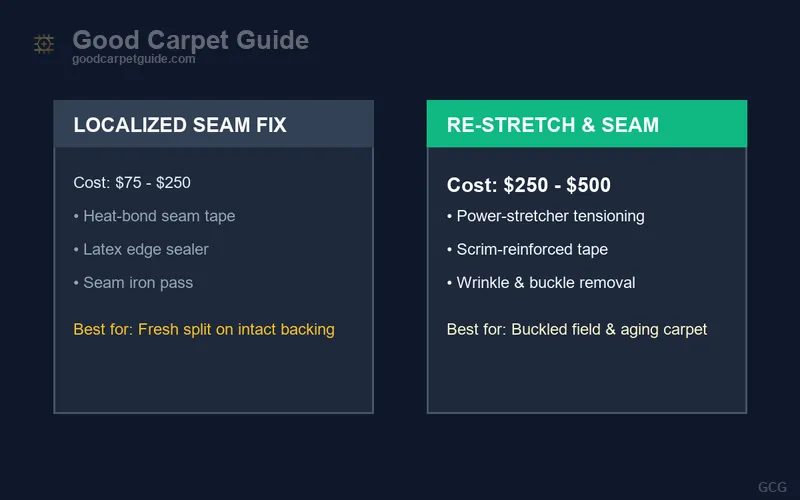
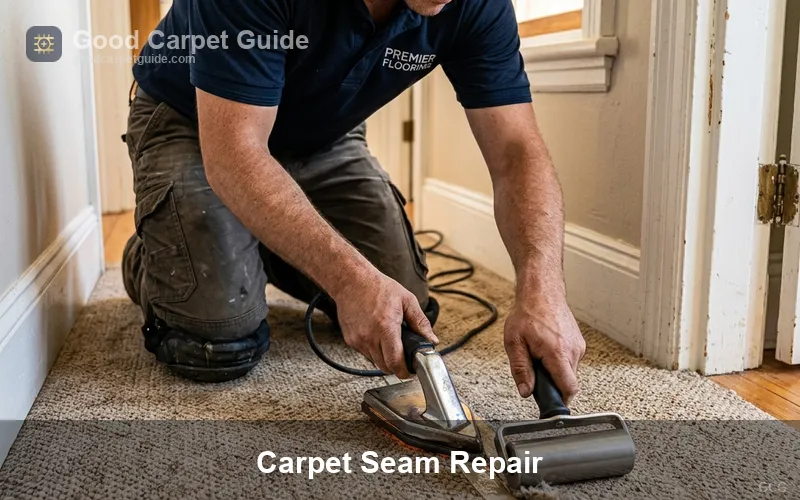
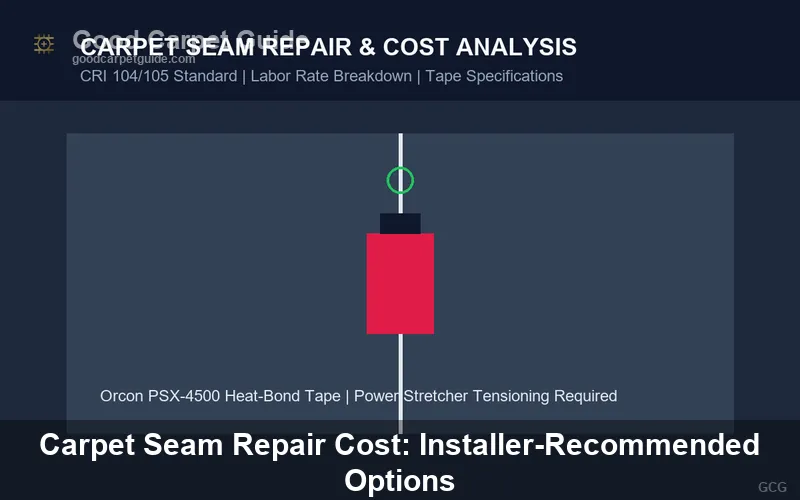
A seam iron melts thermoplastic adhesive along fiberglass-reinforced seam tape, the core labor step that makes up most of the carpet seam repair cost on a localized job.
which brand makes the best repair cost
Orcon PSX-4500 is the seam tape most frequently specified by veteran installers for professional seam repair, based on its fiberglass-reinforced scrim and low-smoke hot-melt adhesive formulation. Orcon PSX-4500 carries a higher per-roll cost than generic tape, though the price difference is small relative to total carpet seam repair cost once labor is factored in, since tape typically represents under $10 of a $150 seam job. Roberts Power-Loc and Roberts Heat-Loc are thermoplastic seaming tapes stocked at major retail chains including Home Depot, and both are rated for aggressive initial grab on synthetic backings.
Tape selection affects long-term outcome more than it affects the upfront invoice. A seam sealed with a fiberglass-reinforced tape resists the shearing forces from a power stretcher better than a plain paper-scrim tape, which matters directly for how long a carpet repair cost investment holds up under foot traffic. Field reports document that seams re-taped with a scrim-reinforced product after a prior failure rarely reopen at the same location, provided the underlying subfloor issue that caused the first failure has also been corrected.
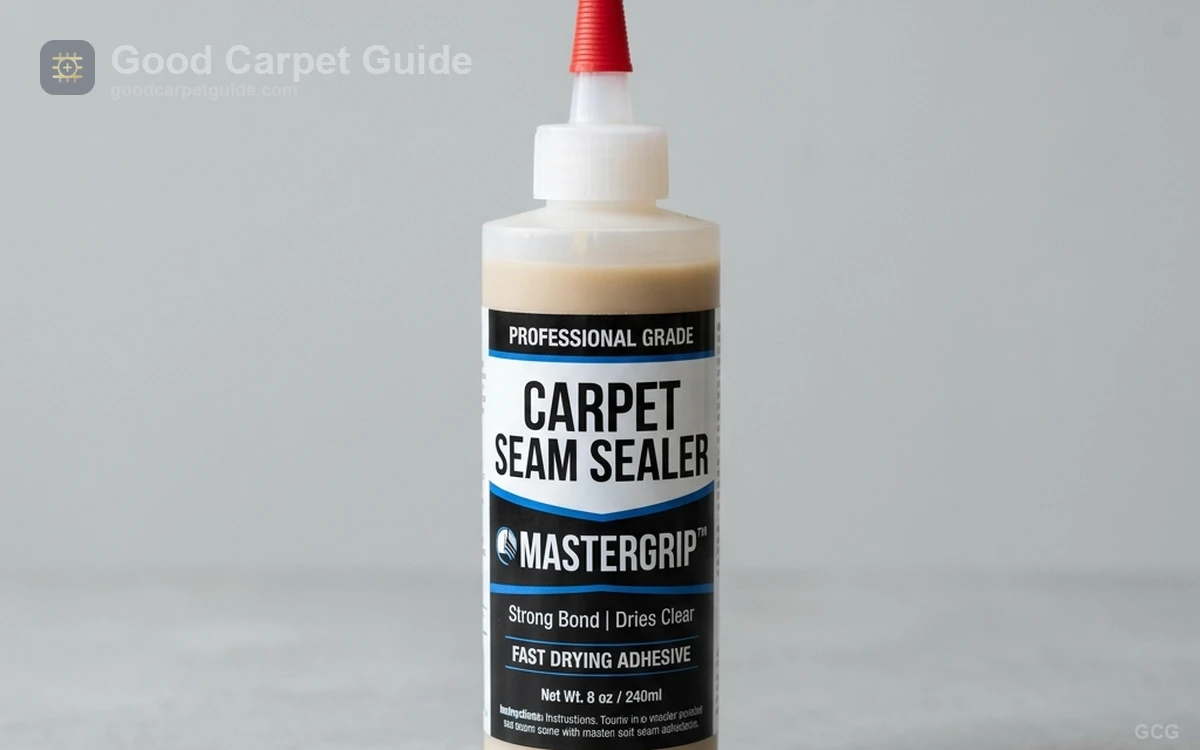
Roberts 8015 Universal Carpet Seam Sealer
Latex seam sealer applied to raw carpet edges before taping, preventing the backing yarns from fraying loose at a repaired seam.
Check Price on Amazonhow long does repair cost last
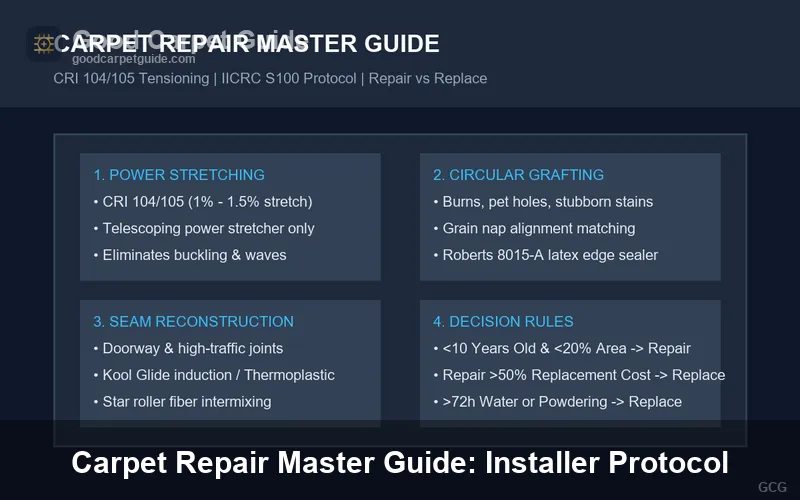
A properly executed seam repair, performed with fiberglass-reinforced tape and a power stretcher rather than a knee kicker alone, lasts for the remaining service life of the surrounding carpet under standard residential foot traffic. Repair cost longevity is tied directly to installation method: the Carpet and Rug Institute's CRI 104/105 installation standards specify power-stretcher use as the baseline for warrantied seam performance, and a seam installed without one is significantly more prone to re-opening within 6 to 18 months.
Cushion thickness also governs how long a seam repair holds. A carpet cushion exceeding roughly 1/2 inch, or one built with low-density foam, allows excessive vertical flex under foot traffic. That flex bends and shears the heat-bond adhesive under the seam tape over repeated loading cycles. Padding selection at the time of repair is not a cosmetic choice; it is a structural variable in how long the repaired seam survives.
Diagnostic checklist for repair longevity risk:
- Confirms whether the original installation used a power stretcher or knee-kicker-only method.
- Measures existing cushion thickness against the 1/2-inch CRI guideline for standard residential traffic.
- Checks the seam location relative to entry doors and window light, since raking light exposes texture mismatch regardless of adhesive quality.
- Tests subfloor moisture at the repair site before re-taping, particularly on ground-level concrete slabs.
- Inspects carpet backing at the seam edge for latex delamination from prior pet urine exposure.
Skipping these checks does not always cause immediate failure, but it removes the diagnostic basis for predicting how long the repair will last. A seam re-taped over a damp slab or thick memory-foam cushion can look sound on delivery day and still fail well inside the typical 7-to-10-year service window of mid-grade carpet.
do carpet manufacturers and installers agree on lifespan
Carpet manufacturers and on-site installers frequently disagree on what causes seam failure, and that disagreement shapes both repair cost and warranty outcomes. Manufacturers publish CRI 104/105 installation requirements calling for power-stretcher use on every job, yet installer trade reports describe knee-kicker-only installation as common on budget subcontracted work, largely because a power stretcher adds labor time that flat-rate promotional pricing does not account for.
Installers are also blunt about a claim manufacturers rarely state outright: seams that are fully invisible under all lighting conditions are not a realistic guarantee. A seam constructed to CRI tolerances can still read as a visible line when placed parallel to a window or directly inside a main entry, because raking light exaggerates pile-direction differences regardless of tape quality. Manufacturer marketing that promises smooth results without qualifying it against sightline and light source sets homeowner expectations that installers then have to manage on-site.
Warranty conflict warning
A seam that splits on carpet installed without a power stretcher is commonly treated by manufacturers as an installation-standard violation, which voids the seam and stretch-related warranty coverage outright. Homeowners paying out of pocket for what should have been a covered repair is one of the more common disputes documented in flooring warranty claim records.
Padding density is a second point of friction. Consumers frequently associate a thicker, softer cushion with a premium purchase, while installers and manufacturer technical sheets both flag over-thick or low-density cushion as a mechanical risk to seam integrity. Padding thickness and density selection plays a larger role in seam durability than most retail sales conversations acknowledge, particularly in rooms where the carpet sits over a below-grade concrete subfloor.
warranty fine print analysis
Standard carpet manufacturer warranties require documented proof of professional cleaning, typically every 18 to 24 months, performed by an IICRC-certified technician using hot water extraction rather than a rented steam unit. Warranty fine print rarely gets read at time of purchase, and homeowners commonly discover the cleaning-proof requirement only after a claim is denied for lack of receipts.
Cleaning method matters as much as cleaning frequency. Hot water extraction, the method referenced in IICRC S100 cleaning standards, is distinct from the shallow surface agitation produced by a grocery-store rental steam cleaner. DIY cleaning with oxygen-bleach or bleach-based spot removers breaks down the factory-applied stain-resist coating on carpet fibers, and that coating breakdown is grounds for a manufacturer to deny a stain warranty claim even when the visible stain itself is unrelated to the cleaning product used.
Common warranty voiding triggers documented in claim disputes:
- Missing professional cleaning receipts for the 18-to-24-month required interval.
- Use of non-IICRC-certified cleaning services, even when hot water extraction equipment was used.
- Application of bleach-based or oxygen-bleach DIY spot cleaners on stain-warrantied fiber.
- Installation performed without a power stretcher, voiding seam and stretch coverage under CRI 104/105 noncompliance.
- Pet-related biological damage misattributed by an inspector to a cleaning product rather than urine salt exposure.
That last point reflects a documented pattern: pet-friendly carpet warranty claims are sometimes denied when an independent inspector attributes discoloration to "optical brighteners" in a cleaning product, even where the product's own ingredient list does not contain them. Homeowners who escalate past the retail point of sale to a manufacturer's corporate contact have, in documented cases, obtained a reversal of an initial denial. This pattern illustrates why keeping both cleaning receipts and product ingredient documentation matters more than most buyers assume at purchase time.
should i see seams in my new carpet
Yes, a technically correct carpet seam is visible under some lighting conditions, and installers describe this as an expected outcome rather than a defect. Seam visibility depends on the angle and intensity of light hitting the pile, not solely on installation quality. A seam positioned perpendicular to a window wall catches raking light directly and reads as a line even when the tape bond and pile match are both within CRI tolerance.
Seam placement strategy reduces visibility more reliably than tape choice alone. Installers who discuss seam location with the homeowner before the job, specifically avoiding placement directly inside a main entry or parallel to the dominant light source in a room, produce a result that reads as satisfying even though the seam is not literally invisible. That upfront placement conversation is one of the clearest satisfaction drivers identified in homeowner feedback on vetted local dealer installations, as distinct from low-bid subcontracted crews who place seams wherever the roll happens to run out.
can a bad carpet seam be fixed
A split, peaked, or zippered carpet seam can be fixed in most cases, provided the surrounding backing has not deteriorated from age or moisture damage. Fixing a bad seam involves cutting back the damaged tape section, re-gluing with fresh seam tape, and re-stretching the surrounding carpet with a power stretcher to remove tension that contributed to the original failure.
Seam repair becomes impractical, rather than impossible, once the carpet backing itself has broken down. Latex backing that has delaminated from pet urine exposure, or that has passed the 10-year mark referenced by flooring restoration professionals as the standard mid-grade carpet lifespan, no longer provides a stable bonding surface. New adhesive applied over degraded latex backing does not hold regardless of tape quality, which is why a repair estimate on carpet this age is worth comparing directly against replacement cost before committing.
how to fix a ripped carpet seam
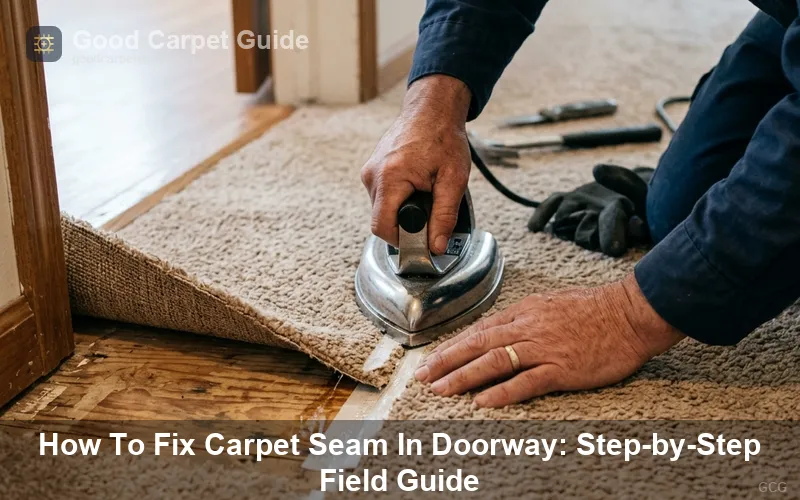
Fixing a ripped carpet seam follows a defined sequence that matches how installers approach the repair on-site, using a specific tool and material set.
Tools and materials required:
- Seam iron (thermoplastic hot-melt activator)
- Carpet trimmer or utility knife
- Row runner (straightedge for cutting a clean seam line)
- Power stretcher
- Fiberglass-reinforced seam tape (e.g., Orcon PSX-4500)
- Latex seam sealer
- Knee kicker (for final edge tucking only)
Step-by-step repair workflow:
- Pull back the carpet on both sides of the ripped seam to expose the old tape and backing edge.
- Trim any frayed or torn backing fiber squarely using a carpet trimmer guided by a row runner.
- Apply latex seam sealer to both raw edges to lock the backing yarns in place before taping.
- Position fresh seam tape centered beneath the seam line, adhesive side facing up.
- Run the seam iron slowly along the tape to melt the hot-melt adhesive without scorching the pile.
- Press the two carpet edges into the melted adhesive and hold pressure with a seam roller until the bond sets.
- Power-stretch the surrounding carpet outward from the seam to remove slack that could re-open the repair.
- Tuck the perimeter edge with a knee kicker and re-set any base trim removed for access.
Skipping the power-stretch step is the single most common shortcut on budget seam repairs, and it is also the step most directly linked to repeat failure at the same seam location within a year.
is repair cost worth it
Repair cost is worth the investment when the total quote stays meaningfully under 50% of a full replacement price for that room and the carpet has not yet passed its expected service life. Mid-grade carpet has a useful life of roughly 7 to 10 years under standard residential traffic, while premium wool or high-end nylon can extend to 15 to 25 years, so a five-year-old carpet with a single split seam is a far stronger repair candidate than a twelve-year-old carpet showing the same symptom.
Repair cost stops being worth it once the underlying backing is compromised, since a new seam bonded to deteriorating latex will not hold regardless of tape or labor quality. A homeowner facing a $400 repair quote on carpet already past the 10-year mark is, in most documented cost comparisons, closer to the price of replacing that single room than the number initially suggests once padding and installation labor are added to a repair-only quote.
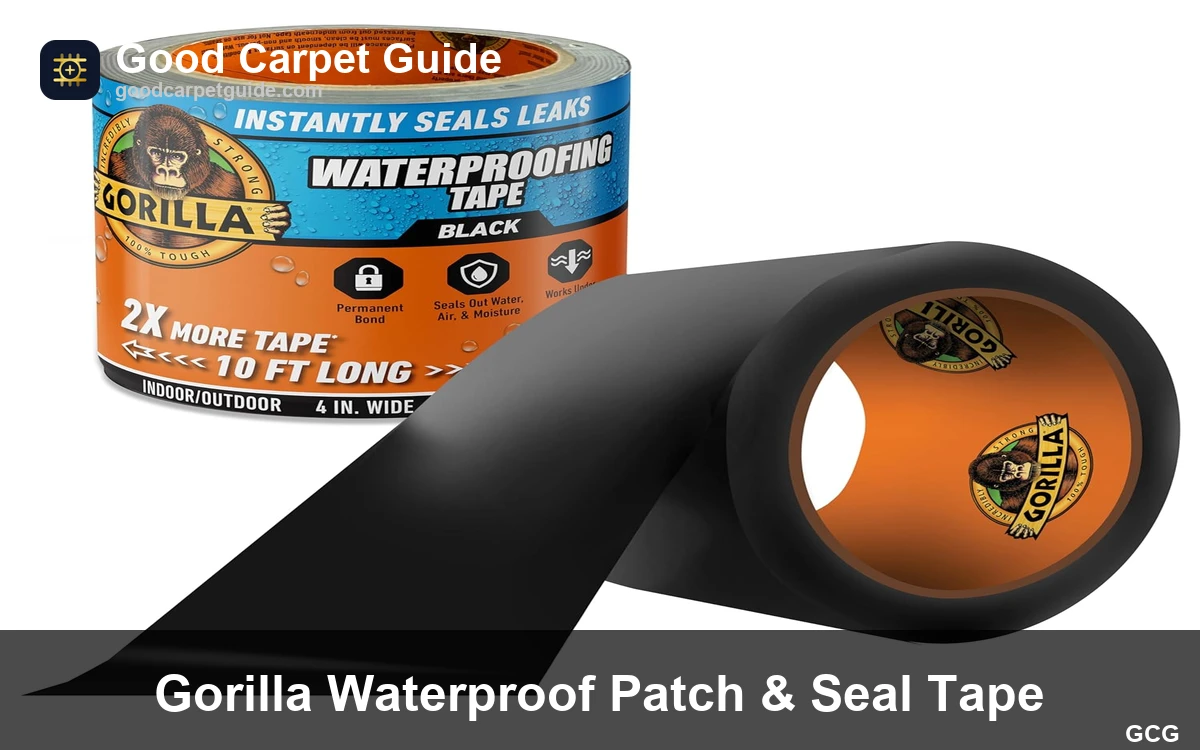
Gorilla Double Sided Carpet Tape
Suited to securing rugs and small remnant patches over hard flooring, useful as a temporary hold while a permanent seam repair is scheduled.
Check Price on Amazonwhen should you replace repair cost
Replacement becomes the recommended path once a seam or re-stretch quote approaches or exceeds 50% of full new-carpet installation cost for that room, a threshold used consistently by flooring restoration professionals as a financial cutoff. Carpet age compounds this math: once a standard carpet passes the 10-year mark, backing degradation makes repeated seam splitting more likely even after a competent repair, turning a repair line item into a recurring cost rather than a one-time fix.
Biological damage changes the calculation independently of age. Pet urine chemically breaks down latex backing through repeated moisture exposure, since urine salts act as a desiccant that keeps the backing persistently damp. A seam that has opened due to urine-related delamination is a symptom of backing failure across a wider area than the visible split, not an isolated seam defect, and re-taping that single spot without addressing the surrounding backing typically buys only a short delay before a new failure appears nearby.
what is the best repair cost
The most cost-effective repair path pairs a fiberglass-reinforced seam tape, such as Orcon PSX-4500, with full power-stretcher re-tensioning rather than spot-gluing a seam without stretching the surrounding field. This combination costs more upfront than a bare tape-and-iron patch, generally landing in the $150 to $300 range once labor is included, but it directly addresses the CRI 104/105 installation gap that causes most repeat seam failures.
Homeowners comparing quotes benefit from asking whether a bid includes power stretching as a line item, since a lower bid that omits it is not a genuinely cheaper repair; it is a repair likely to require a second paid visit. Carpet delamination issues frequently masquerade as a simple seam split on initial inspection, so a repair quote should specify whether the technician checked backing condition beyond the visible tear before pricing the fix.
how much does it cost to patch carpet
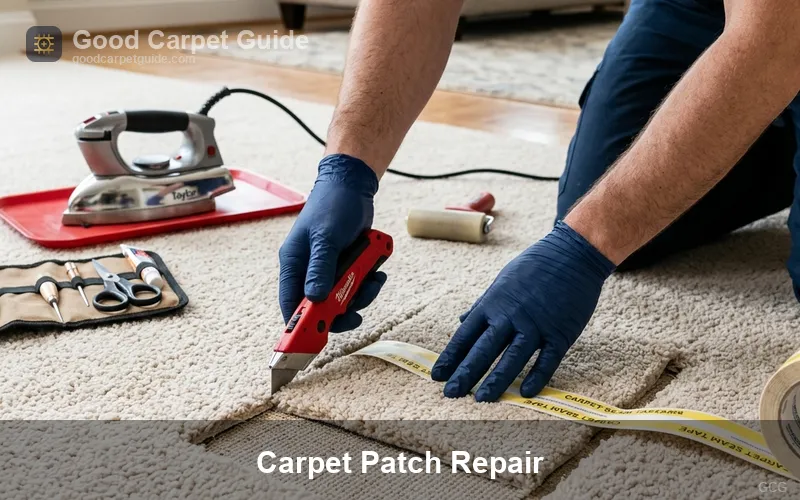
Patching a damaged section of carpet, distinct from a linear seam repair, costs $100 to $250 when a homeowner already has a matching remnant available, or roughly $25 per square foot on a unit basis for professional cut-and-set labor. A patch job requires the technician to cut a "donor" piece that matches pile direction, color, and texture, then seam it into place on all sides using the same tape and iron process as a standard seam repair.
Patch cost rises when no matching remnant exists, since the technician then has to source carpet from a low-visibility area of the home, such as a closet floor, to use as the donor piece. Field reports document a specific long-term failure mode tied to this practice: a donor patch cut from an unused closet still carries its original factory soil-protection coating, and within roughly two years that pristine patch resists dirt noticeably better than the surrounding worn carpet, producing a visible "clean block" contrast that a color-matched patch alone does not solve. Carpet hole repair guide covers how installers select and blend donor material to reduce this specific mismatch.
can you install repair cost yourself
DIY seam repair is possible for a homeowner willing to purchase a seam iron, tape, and sealer, which runs slightly over $100 in materials alone. DIY repair carries a real cost risk beyond the materials themselves: a poorly executed seam, particularly one run with an iron set too hot or one skipped on power stretching, commonly requires a professional to undo and redo the work, which then adds the original DIY material cost on top of the eventual professional labor bill.
Scorched carpet pile from an overheated seam iron is one of the more visible DIY and low-bid-crew mistakes, leaving a permanent 4-to-6-inch discolored band directly above the seam line that no amount of cleaning removes. A homeowner attempting a first DIY seam repair benefits from practicing the iron pass on a scrap remnant before working on the visible seam itself, since heat control is the variable most responsible for a failed attempt.
Cost & budget considerations
Carpet seam repair cost sits inside a broader labor-pricing structure that differs sharply between big-box retailers and independent local showrooms. Big-box installation promotions, such as a flat $199 whole-house installation fee, embed the true labor cost of $3.00 to $5.00 per yard directly into marked-up material and padding prices rather than itemizing it, which makes an apples-to-apples repair quote comparison difficult for homeowners shopping multiple bids.
Independent local dealers typically quote itemized labor separately, in the range of $1.25 to $1.50 per square foot or roughly $4.50 per yard, resulting in a total that can run 10% to 20% higher than a big-box promotional number on paper. That higher itemized quote commonly reflects certified in-house installers using power stretchers as standard practice rather than an optional upsell, along with more direct advocacy on warranty disputes when a repair issue traces back to original installation quality.
| cost factor | big-box retail model | independent local showroom |
|---|---|---|
| labor pricing | bundled into material markup | itemized, $1.25–$1.50 per sq ft |
| padding markup | ~$0.55 per sq ft | $1.75–$2.25 per sq yd (supply cost) |
| power stretcher use | inconsistent on subcontracted jobs | standard practice |
| warranty advocacy | limited, routed through store | direct dealer involvement |
| upfront payment | 90%–100% required | often 50% deposit / 50% on delivery |
Homeowners weighing carpet seam repair cost against a full replacement quote should request the labor line item separately from both types of provider, since a repair estimate that folds labor into a flat number is the same pricing structure that makes original installation defects harder to spot before they cause a seam failure.
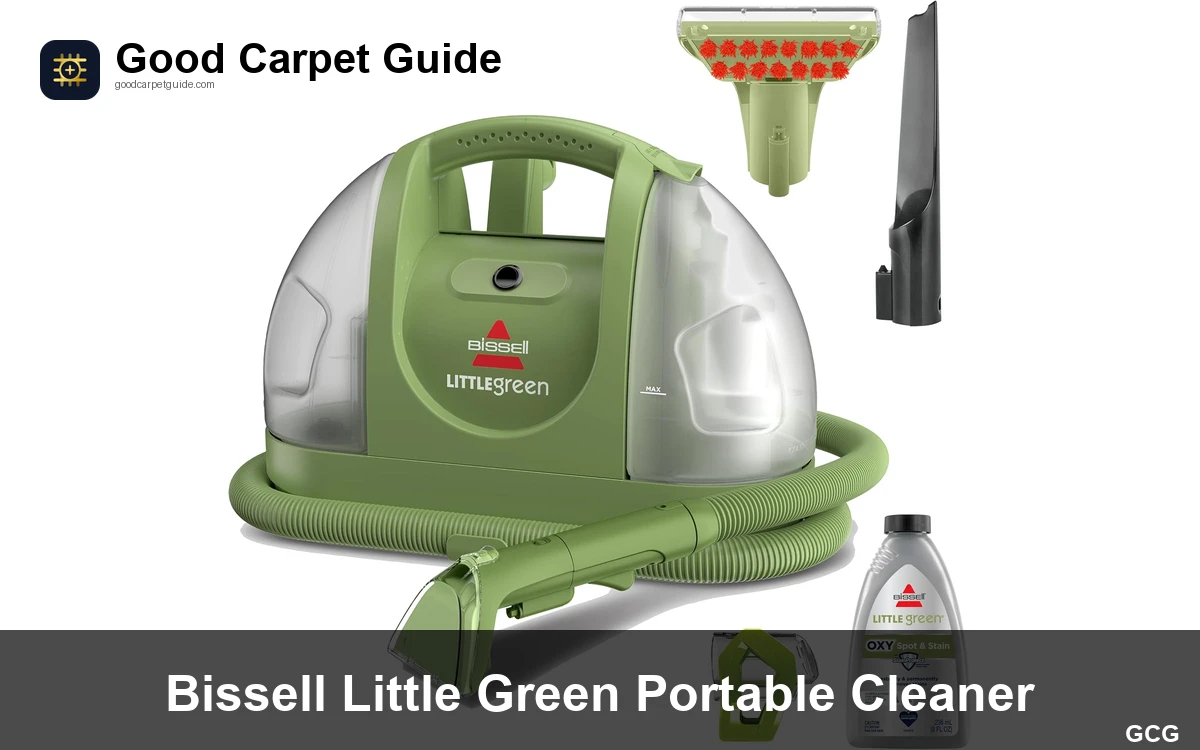
Bissell Little Green Portable Carpet Cleaner
A compact extraction unit for maintaining a freshly repaired seam area between the professional hot water extraction cleanings that most manufacturer stain warranties require.
Check Price on Amazonfrequently asked questions
What is the difference between repair cost types?
Seam repair cost covers re-gluing a split or peaked seam line, patch cost covers replacing a damaged section with donor carpet, and re-stretch cost covers removing buckling across an entire room. Each is priced separately, and a quote combining more than one service should itemize them individually.
What repair cost do professionals recommend?
Installers most commonly recommend combining fiberglass-reinforced seam tape with full power-stretcher re-tensioning, since this addresses the CRI 104/105 installation gap linked to repeat seam failure, rather than a bare tape-only patch.
Should I get multiple repair quotes before choosing a contractor?
Comparing at least two itemized quotes helps a homeowner confirm whether power stretching, dispatch fees, and material costs are broken out separately, since a bundled flat-rate quote can obscure which specific service is driving the total repair cost.
To get started, homeowners comparing local rates commonly enter your zip code into a contractor-matching tool to get started with itemized quotes from technicians who service that specific region, since regional labor rates for carpet repair pros vary based on local material supply costs and service call density.
Long-term data on how newer Triexta-based carpet backing performs under repeated seam repair cycles beyond the 10-year mark remains limited, since the fiber itself is a comparatively recent addition to the residential market relative to nylon and polyester.