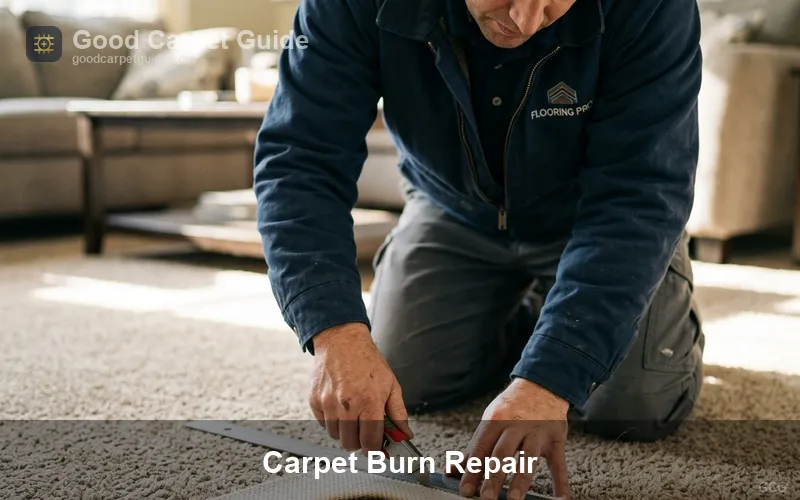
A tipped steam iron left unattended on a bedroom carpet for roughly ninety seconds produces a hard, glazed circle where synthetic pile once stood. Field reports from flooring inspection crews describe this exact scenario repeatedly: a distracted homeowner sets an iron on its heel, the appliance tips, and the plastic soleplate contacts nylon or polyester fibers heated to between 350°F and 400°F. Iron burn carpet repair addresses this specific damage pattern, and iron burn carpet repair remains one of the most commonly misdiagnosed jobs in residential flooring because homeowners assume the entire room requires replacement when the damage is confined to a six-inch circle. This guide walks through the diagnostic thresholds installers use, the excision-and-patch workflow that meets Carpet and Rug Institute (CRI) 105 standards, regional cost and humidity variables, and the decision framework separating a $325 patch from a full room tear-out.
can you repair an iron burn on a carpet
Iron burn damage on carpet is repairable in most cases when the melted or scorched zone stays under roughly 10% of the room's total carpet area and matching donor material exists. Synthetic fibers — nylon, polyester, and olefin — are thermoplastic polymers, meaning they melt and fuse into a hardened, discolored mass rather than burning cleanly. Wool carpet reacts differently under the same heat exposure; wool carbonizes into a dry, brittle char that can sometimes be selectively trimmed without full excision. The repair method depends directly on which fiber type absorbed the heat, and installers confirm fiber type with a burn test or manufacturer sample before selecting a technique.
Damage confined to a single tuft cluster, roughly the footprint of a clothes iron soleplate, typically falls well inside repairable range. Systemic thermal damage spanning multiple traffic lanes, or scorching that reaches the secondary backing and causes delamination, pushes the job toward the replacement side of the threshold discussed later in this guide.
can you fix iron burn on carpet
Iron burn on carpet is fixed through excision and patching, not through surface abrasion or fiber shaving, according to standard flooring trade practice. Installers cut out the damaged tuft zone using a carpet trimmer or utility knife guided by a template, then insert a donor patch harvested from the same dye lot. Homeowners attempting DIY repair frequently reach for wire wool, scouring pads, or fabric shavers instead, and these tools create secondary damage that complicates the eventual professional fix.
Excision and patching works because it replaces the melted fibers entirely rather than trying to salvage them. Abrasive removal, by contrast, physically pulls at the pile structure surrounding the burn.
- Abrasive scrubbing catches and breaks intact loop fibers on Berber or loop-pile carpet, unraveling adjacent rows and converting a coin-sized burn into a visible run.
- Fiber shaving with clippers or scissors trims the melted tips level but leaves a shallow divot that functions as a dirt trap, becoming visibly darker within roughly six months.
- Retail adhesive patch kits ship with generic donor material that rarely matches the field carpet's pile height, twist level, or dye lot, and the peel-and-stick backing frequently lifts within a year, creating a trip hazard.
Each of these DIY approaches trades a small, containable burn for a larger, harder-to-hide repair zone. Professional excision avoids that trade-off by controlling the cut geometry from the start.
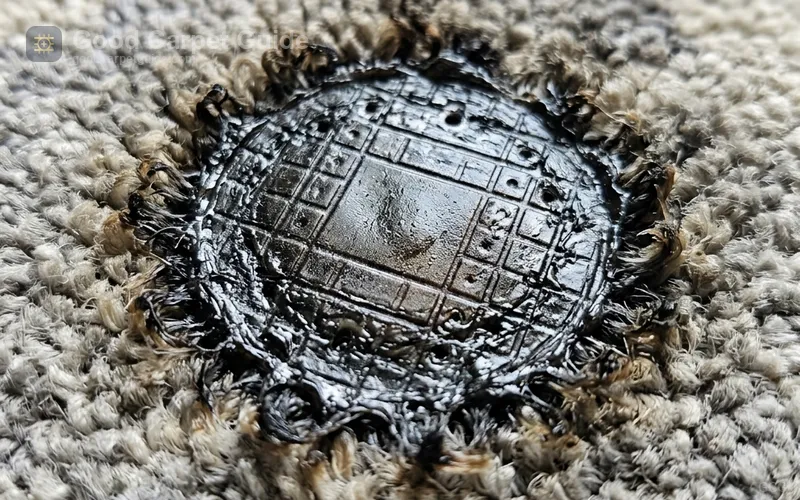
A fused, glazed iron burn zone on nylon pile carpet, the exact damage pattern that excision-and-patch repair is designed to correct.
how to fix iron burn on carpet
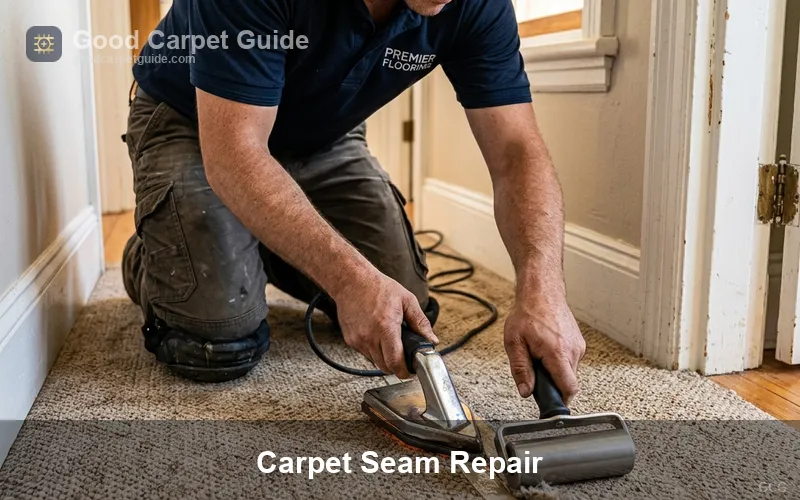
Fixing an iron burn on carpet follows a sequential workflow: diagnose the fiber type, source a matching donor patch, excise the damaged tufts, and seam-seal the insert using a power-stretched or template-fit installation. Installers document each step with named tools because skipping any single stage — particularly seam sealing — produces a patch that fails within one to two years of foot traffic.
- Identify the fiber type. Touch a burned tuft with a heated pin; synthetic fibers melt into a bead, wool chars into ash.
- Source the donor patch. Pull matching material from a hidden, same-dye-lot zone — behind a closet corner, under a fixed radiator, or beneath a permanent furniture footprint — rather than a garage remnant that has faded differently under UV light.
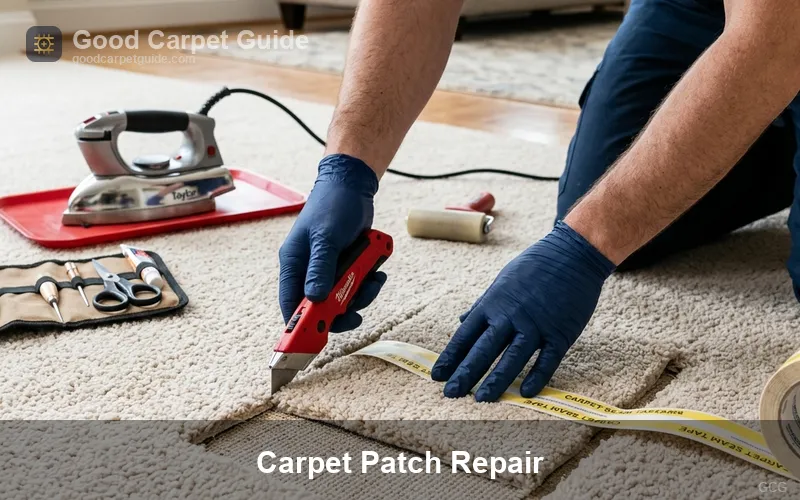
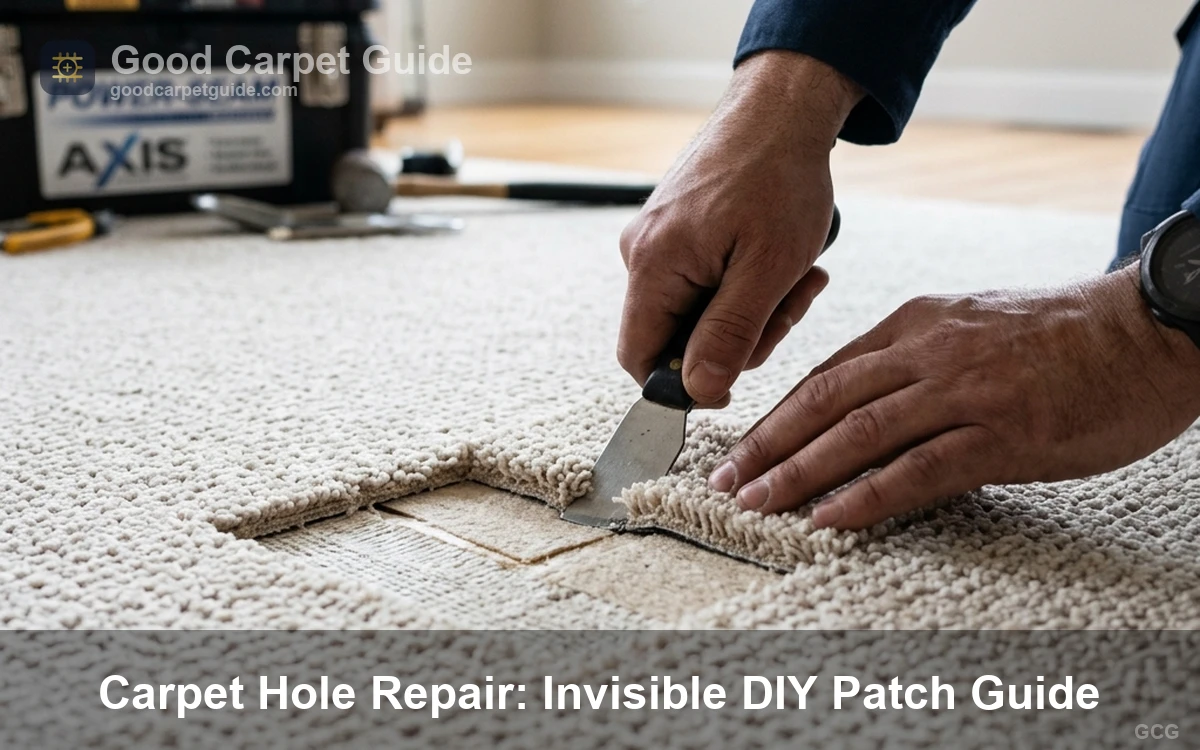
- Cut the excision template. Use a carpet trimmer to remove the damaged tufts in a clean geometric shape, cutting through pile and backing together.
- Apply hot-melt seam tape. Activate the tape at approximately 250°F with a seaming iron, positioning it beneath the cut line to bond the donor patch to the surrounding field.
- Seal the cut edges. Apply a latex edge sealer such as Roberts 8015-A Universal Seam Sealer or Capitol AC17 to every cut fiber edge before final seaming, preventing the tuft unraveling known in the trade as "zippering."
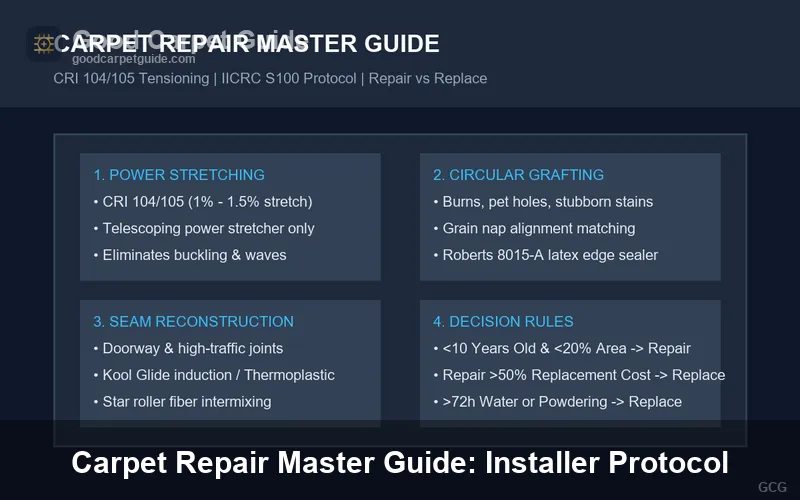
- Power-stretch the surrounding field. CRI 105 specifies power stretchers for wall-to-wall re-stretching operations; knee-kickers position carpet but do not deliver stretch tension, and a patch installed without power stretching tends to peak or bubble in high-traffic zones within roughly two years.
Skipping the edge-sealing step is the single most common cause of patch failure documented in installer trade reports. A carpet patch that looks flawless on installation day can begin zippering along its cut edge within months if the latex sealer was omitted or applied too thin.
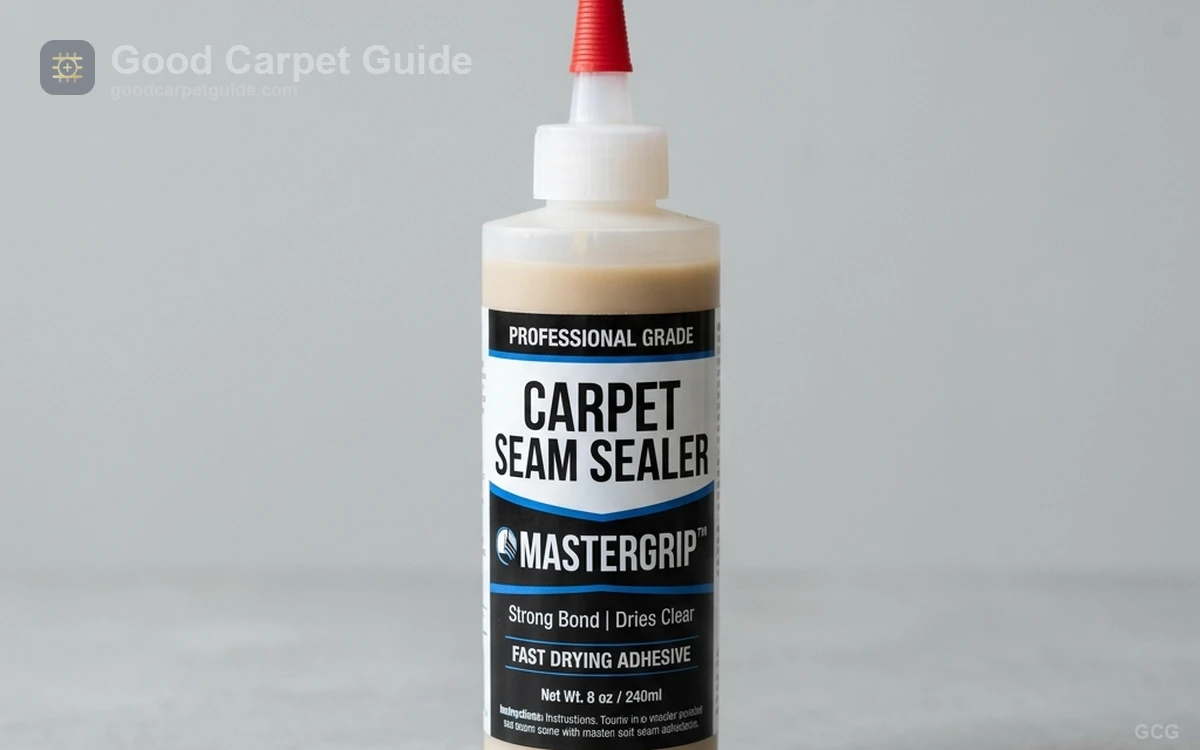
Roberts 8015 Universal Carpet Seam Sealer
Applied to every cut edge before seaming, this latex sealer is the step most DIY iron burn repairs skip, and its absence is the leading cause of patches unraveling within a year.
Check Price on AmazonMany renters confuse seam tape with consumer-grade double-sided carpet tape or household duct tape, and this substitution accounts for a meaningful share of failed DIY patches. Hot-melt seam tape bonds through heat activation and pressure across the entire seam width, while adhesive-backed carpet tape relies on surface tack alone and lifts under normal foot traffic within a matter of weeks. Trapped moisture beneath an improperly sealed patch can also trigger hydrolysis, a chemical process in which water molecules break down the backing adhesives of synthetic carpet, causing localized delamination separate from the original burn damage.
Internal links: this workflow overlaps closely with carpet burn repair techniques used for cigarette and ember damage, and shares tooling with general carpet patch repair jobs where the donor-sourcing protocol stays identical regardless of the damage cause.
regional performance differences
Carpet repair outcomes vary by region primarily because of humidity, subfloor construction type, and seasonal HVAC cycling, not because of differences in repair technique. Coastal and Gulf Coast humidity zones expose seam adhesives to sustained moisture loads that inland, low-humidity regions rarely produce. Slab-on-grade construction, common across the Sun Belt, introduces alkaline moisture emission from concrete that can weaken adhesive bonds at the patch perimeter over time.
| Region | Primary Environmental Factor | Typical Impact on Patch Longevity |
|---|---|---|
| Gulf Coast / Southeast | High ambient humidity, concrete slab moisture | Seam sealer and hot-melt tape bonds face accelerated hydrolysis risk without a moisture-tested subfloor |
| Southwest / Arid Interior | Low humidity, high UV exposure through windows | Donor patches fade slower, but field carpet fades faster, increasing visible mismatch over 12–24 months |
| Upper Midwest / Northeast | Seasonal heating cycles, dry winter air | Static buildup and fiber brittleness increase during winter months, raising the risk of tuft breakage at cut edges |
| Pacific Northwest | Sustained moisture, basement installations | Basement-level carpet repairs carry elevated mold risk if hot-melt seams trap moisture underneath |
Installers working in high-humidity regions routinely specify moisture-resistant adhesives — HENRY 650 R Releasable Bond, for example, is rated for use up to 99% relative humidity — specifically because standard adhesive formulations underperform in those conditions. Arid-region repairs, by contrast, hinge less on adhesive chemistry and more on matching UV-faded field carpet to a donor patch that has not experienced the same sun exposure.
big box store vs local dealer comparison
Big box retailers and local flooring dealers differ most significantly in installation accountability, not in the underlying carpet products, since many private-label big box lines are manufactured in the same mills as dealer-exclusive lines. Home Depot's LifeProof and Lowe's SmartCore programs, for instance, often originate from the same production facilities as premium dealer brands, but the private-label runs typically use lower-density backing.
| Factor | Big Box Store | Local Specialty Dealer |
|---|---|---|
| Installation crew | Subcontracted, high turnover, managed through third-party firms | Direct employees, consistent crew familiarity with local subfloor conditions |
| Post-installation claims | Routed through regional call centers | Handled directly by the original selling dealer |
| Warranty structure | Standard manufacturer terms | Frequently includes dealer-added lifetime labor warranties |
| Product matching for repairs | Custom SKU runs, difficult to source matching donor material later | Dye lot records retained, easier donor patch sourcing years later |
| Padding upsell guidance | Generic, price-tier driven | Density-matched to warranty pile-height limits |
Homeowners who need an iron burn repaired two or three years after original installation report the sharpest divide here. Local dealers that retained dye lot and product records can source matching donor material efficiently, while big box custom-run SKUs frequently rotate out of production within a year or two, leaving no matching stock for a future carpet patch repair. This single factor drives many flooring inspectors to recommend local dealer installation specifically for buyers who anticipate needing spot repairs later.
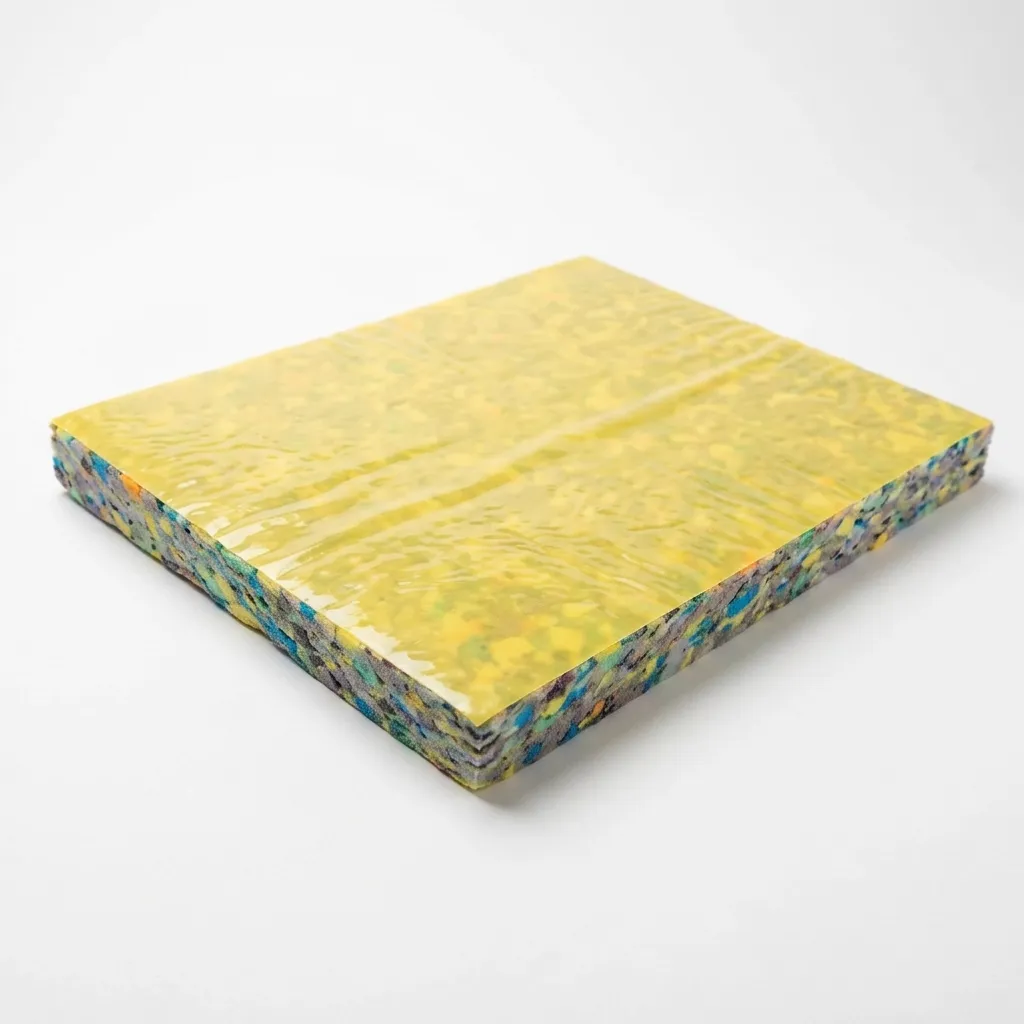
Mohawk SmartCushion Premium Carpet Padding
Density-rated padding that stays within CRI-referenced thickness limits, reducing the excess flexing that accelerates backing wear around repair zones.
Check Price on Amazonhow long does carpet repair last and when should you replace instead
A properly executed iron burn patch, sealed and power-stretched to CRI 105 standards, holds for the remaining service life of the surrounding carpet field in most residential settings. Patch failure before that point typically traces back to a skipped seam-sealing step, an unmatched donor pile height, or UV-driven color drift between the patch and the surrounding fibers. Replacement, rather than repair, becomes the better economic choice once specific structural or financial thresholds are crossed.
Two conditions signal replacement over repair. Carpet older than 10 years has typically reached a stage of systemic backing deterioration that undermines any new seam, regardless of patch quality. A repair quote exceeding 50% of the cost of a full new room installation also tips the calculation toward replacement, since the remaining carpet life rarely justifies the labor cost at that ratio.
- Replace when total damage exceeds roughly 25% of the room's carpet area or spans multiple primary traffic lanes.
- Repair when damage stays under roughly 10% of the total area and matching donor material is available from a hidden zone.
- Evaluate case-by-case when damage falls between 10% and 25%, weighing donor availability, carpet age, and remaining warranty coverage.
Rental units add a separate financial layer to this decision. Under IRS depreciation guidelines, carpet follows a 5-year depreciation schedule, meaning carpet older than 5 years has typically depreciated to a $0.00 book value, and tenants cannot legally be billed full replacement cost for a single burn spot at that carpet age. Several state landlord-tenant frameworks separately recognize a 5-to-7-year useful life standard for rental carpet, with some jurisdictions extending that figure to 10 years.
which brand makes the best carpet repair material
Brand selection for repair material depends on matching the donor patch to the field carpet's existing fiber, backing, and pile construction rather than selecting a brand in isolation. Shaw Floors carries strong reputation among specialty dealers, particularly its Anso Nylon line paired with LifeGuard backing, and Shaw Courage padding extends manufacturer carpet warranties by an additional 10 years when installed together as a system. Mohawk's SmartStrand Forever Clean triexta carpet line and Karastan's Delicate Dimension in the Cloudmist colorway, a 100% triexta construction at 41 oz. face weight, represent premium tiers where donor matching requires exact dye lot records.
Dreamweaver, manufactured by Engineered Floors, appears frequently in entry-level installations such as the Trendsetter 1 line, but specialty dealers have documented recurring secondary-backing separation issues on this product line, and several showrooms report discontinuing Dreamweaver sales as a result. This matters directly for repair work: a donor patch pulled from carpet with loose secondary backing will not seam reliably regardless of installer skill.
Adhesive and sealant brand choice matters as much as carpet brand for repair durability. HENRY (Ardex) products, including HENRY 650 R Releasable Bond rated to 99% relative humidity and HENRY 263 WeatherPro rated waterproof after a two-hour cure, dominate professional adhesive selection, alongside ROBERTS Universal Seam Sealer for edge treatment on cut synthetic fibers.
cost & budget considerations
Iron burn carpet repair costs scale primarily with material type, patch size, and whether the job requires a standalone service call or bundles into a larger flooring visit. National pricing data places a standard iron burn patch, including excision and donor insertion, between $150 and $550, with $325 representing the typical midpoint for a single-fiber-type residential repair.
| Cost Item | Typical Rate | Scope |
|---|---|---|
| National average carpet repair | $209 ($134–$285) | General localized repair or stretching visit |
| Standard iron burn patch | $325 ($150–$550) | Excision plus donor insertion for one damage zone |
| Labor billing rate | $60–$80 / hour | Standard professional mechanic hourly rate |
| Minimum call-out fee | $100–$300 | Flat dispatch charge covering travel and first-hour labor |
| Polyester repair material | $1.00–$1.25 / sq. ft. | Raw donor fabric cost |
| Nylon repair material | $1.25–$2.00 / sq. ft. | Raw donor fabric cost |
| Triexta and wool material | $2.00–$3.00 / sq. ft. | Premium fiber donor cost |
| Carpet stretching | $100–$300 / room | Power-stretcher re-securing of loose field carpet |
| Padding replacement | $0.75–$3.75 / sq. ft. | Standard residential foam padding, labor and material |
The gap between the $209 general repair average and the $325 iron burn midpoint reflects the added labor of donor sourcing and precision excision that thermal damage requires compared to a simple re-stretch. Homeowners comparing quotes should confirm whether the quoted figure includes the minimum call-out fee separately or bundles it into the total, since a $150 low-end iron burn quote sometimes excludes the $100–$300 dispatch charge and creates an unexpected total on the invoice.
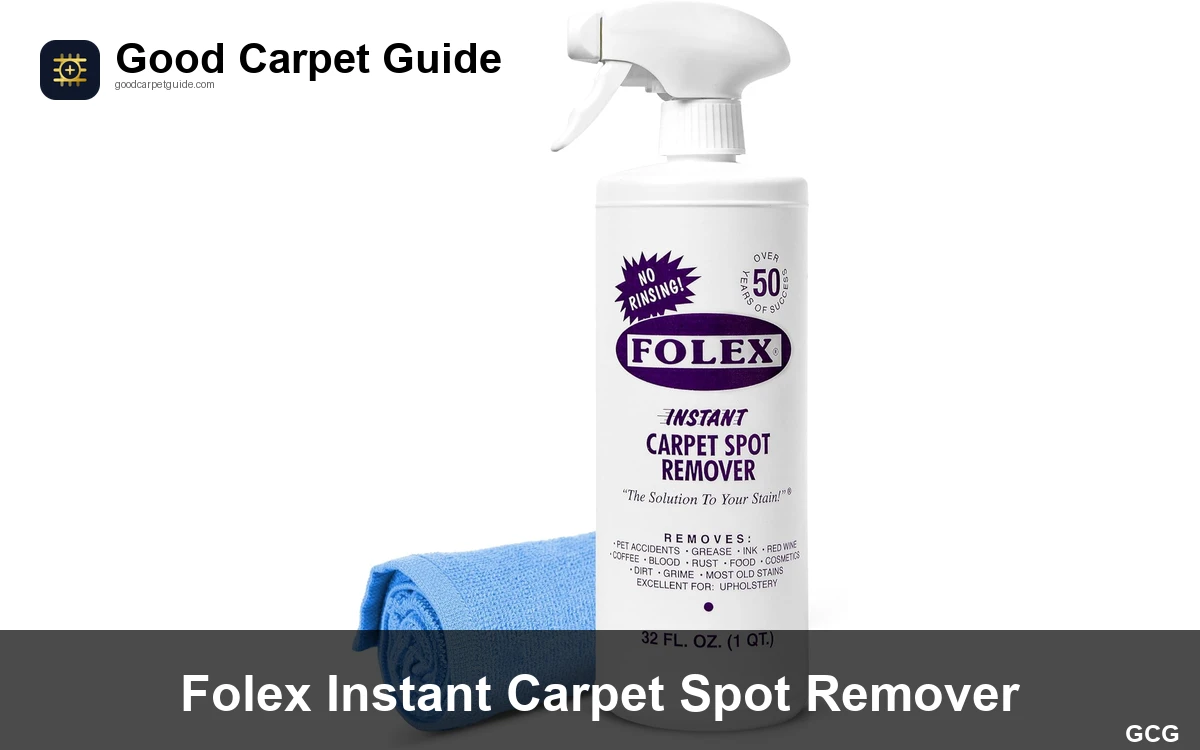
Folex Instant Carpet Spot Remover
Recommended for treating soil buildup around a completed patch seam, since dirt accumulation at a repair edge is what makes a well-matched patch become visible over time.
Check Price on Amazonfrequently asked questions
Can you install a carpet repair patch yourself?
Homeowners can install a basic patch on loop-free cut pile carpet with retail patch kits, though the excision precision and seam sealing that professional installers apply typically produce longer-lasting results. DIY patches most commonly fail at the cut edge, where an unsealed tuft line unravels under vacuum suction or foot traffic within roughly six to twelve months.
What is the difference between carpet repair types?
Carpet repair splits into three primary categories: spot patching for isolated thermal or physical damage, re-stretching for loose or rippled field carpet unrelated to a specific damage zone, and seam repair for separating or zippering seams along an original installation line. Each category uses distinct tools — a carpet trimmer and donor patch for spot repair, a power stretcher for re-stretching, and hot-melt seam tape with a seaming iron for seam repair.
How do you choose the right carpet repair approach?
Choosing the correct repair approach starts with measuring the damaged area against the room's total carpet footprint, then confirming donor material availability from a hidden, same-dye-lot zone. Damage under roughly 10% of the room area with available matching donor material points toward spot patching, while damage spanning multiple traffic lanes or exceeding 25% of the room typically points toward full replacement.
Is carpet repair worth it compared to replacement?
Carpet repair is generally worth the cost when the repair quote stays under roughly 50% of a full room replacement price and the surrounding carpet has more than a few years of remaining service life. A $325 iron burn patch on carpet installed three years ago, for example, represents clear savings against a multi-thousand-dollar room replacement, while the same patch on carpet already past its 10-year mark offers diminishing value.
Does carpet for stairs and runners need a different repair approach?
Carpet installed on stairs and runners experiences concentrated point-load traffic on each tread nose, which accelerates wear differently than flat-field carpet and often requires re-stretching alongside any spot patch. Installers frequently recommend addressing stair carpet repairs promptly, since a loose or damaged stair tread carpet presents a slip hazard beyond the cosmetic concern that a similar patch would represent on a bedroom floor.
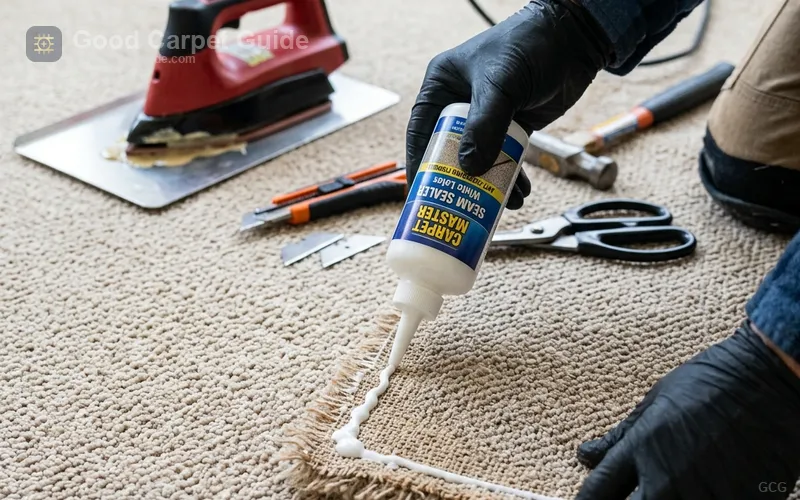
Latex edge sealer applied to a cut carpet patch boundary, the step that prevents zippering and determines whether a repair holds for years or fails within months.
Iron burn carpet repair remains a contained, budget-predictable job when the damage stays localized and a qualified installer follows the full excision, donor-matching, and seam-sealing sequence. Homeowners facing a fresh iron burn should measure the damage against the 10% localization threshold, check whether their carpet has crossed the 10-year or 50%-of-replacement-cost marks, and select an installer who commits to power stretching and latex edge sealing rather than a faster, unsealed shortcut. Renters facing a landlord bill for full replacement over a single burn spot should separately confirm the carpet's age against the 5-year IRS depreciation schedule before agreeing to any charge.