Carpet replacement cost calculator: what an accurate estimate includes
A carpet replacement cost calculator multiplies net square footage by material, padding, and labor rates, then adds a roll-width waste factor. Most online versions skip the waste factor, and that single omission causes more underestimation than any other missing input. A 2,100 net square foot home priced at $2.00 per square foot returns $4,200 on a footage-only calculator. The same home, priced as a fully itemized budget-grade build, comes to $5,929. The 41 percent difference traces to three inputs the calculator never asks about: roll-width waste, per-step stair pricing, and subfloor prep.
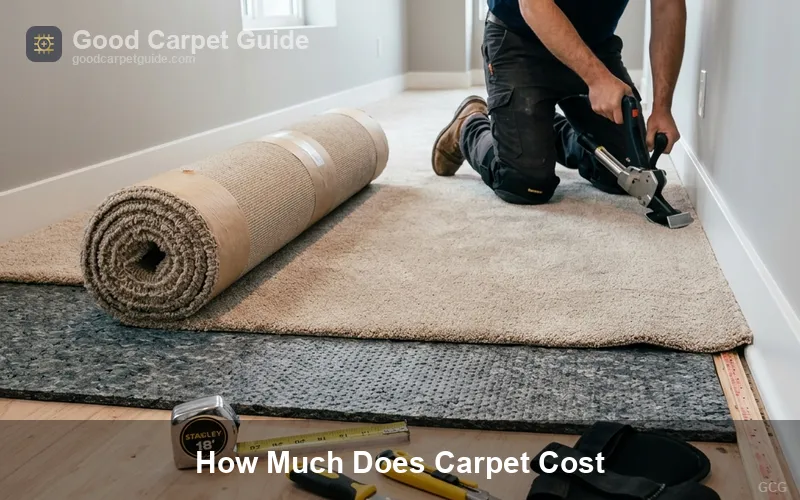
The gap opens at the measurement stage. A 13-by-15-foot bedroom measures 195 net square feet, but the material order gets written at roughly 215 square feet. That difference comes from how broadloom ships. US carpet arrives on fixed 12-foot rolls, with 15-foot widths available on some lines, so any room dimension wider than the roll forces a seamed fill strip and a purchase above net footage.
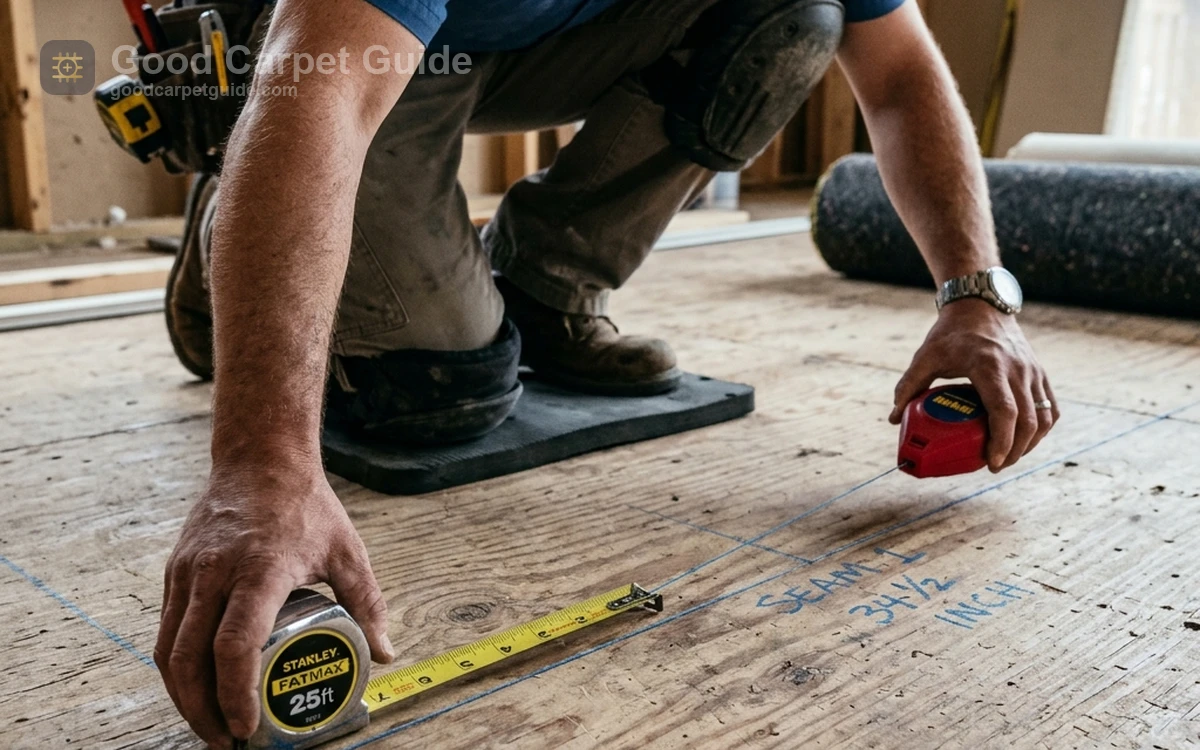
*Caption: Roll width and seam placement set the material total that a footage-only calculator misses.*
How to estimate carpet replacement cost
Four inputs produce a usable estimate: net room square footage, roll-width waste factor, material tier, and regional labor rate.
Net square footage is length times width for each room, totaled. The roll-width waste factor runs 10 to 15 percent above net footage on typical residential jobs, because broadloom ships in fixed 12-foot and 15-foot widths. The 195 sq ft bedroom described above crosses the 12-foot roll width, so it needs a seamed fill strip, and the purchase order goes to roughly 215 sq ft to keep pile nap running one direction across the room.
Material tier sets the per-square-foot rate. Budget polyester installs at $2.00 to $4.50 per sq ft, mid-grade nylon or triexta at $5.00 to $7.50, and premium nylon 6,6 or wool at $8.00 to $22.00. Regional labor rate then multiplies against purchased footage, not net footage. Free web calculators that apply labor to net footage come out low by the size of the waste factor.
What does carpet replacement cost
National averages for installed carpet, pad, and labor combined sit at $2.00 to $8.00 per square foot (per published current HomeAdvisor and RSMeans national flooring cost benchmarks). A fully itemized build widens that range at both ends. The model below prices a 2,100 net sq ft home at three specification levels: $2.82 per sq ft for basic polyester over a 6-lb pad, and $13.91 per sq ft for luxury nylon 6,6 over a rubber pad.
Carpet price alone does not account for that spread. Underlayment cushion, tear-out and haul-away, subfloor prep, furniture moving, transition strips, and stair installation each appear as a separate line on a real quote, and each disappears from a bare per-square-foot number.
| Cost center | Basic grade (PET / 6-lb pad) | Mid-grade (nylon / 8-lb pad) | Luxury grade (nylon 6,6 / rubber pad) |
|---|---|---|---|
| Gross carpet material | $2,352 ($1.00/sf) | $8,232 ($3.50/sf) | $16,464 ($7.00/sf) |
| Underlayment cushion | $551 ($0.25/sf) | $1,102 ($0.50/sf) | $2,205 ($1.00/sf) |
| Professional labor | $1,176 ($0.50/sf) | $2,352 ($1.00/sf) | $3,528 ($1.50/sf) |
| Tear-out and haul-away | $1,050 ($0.50/sf) | $2,100 ($1.00/sf) | $3,150 ($1.50/sf) |
| Subfloor prep | $200 | $450 | $900 |
| Furniture moving | $100 | $250 | $500 |
| Transition strips | $120 | $180 | $300 |
| Stairs (14 steps) | $140 (waterfall, $10/step) | $420 (Hollywood, $30/step) | $630 (capped and spindled, $45/step) |
| Sales tax (8.25% on materials) | $240 | $770 | $1,540 |
| Total installed | $5,929 ($2.82/sf) | $15,857 ($7.55/sf) | $29,217 ($13.91/sf) |
*This is our own cost model, not a published industry survey. It assumes a 2,100 net sq ft home, 2,352 sq ft of purchased carpet after a 12 percent roll-width waste factor, and 2,205 sq ft of padding after a 5 percent waste factor. Sales tax is applied at an illustrative 8.25 percent on materials only, since most jurisdictions treat installation labor separately; rates vary by state. Per-square-foot totals are calculated against net footage. Regional rates vary.*
How much does it cost to carpet a 2,100 sq ft house
Fully carpeting 2,100 net square feet costs $5,929 at budget grade and $29,217 at luxury grade, once the 12 percent waste factor brings purchased carpet to 2,352 square feet. The mid-grade build, solution-dyed nylon or triexta over an 8-lb pad, comes to $15,857, or $7.55 per sq ft installed. That total already carries tear-out, subfloor prep, transition strips, and a 14-step staircase priced as a Hollywood-style wrap.
Stairs are the line a footage-only calculator always misses, because stair labor prices per step. Fourteen steps at $30 each adds $420 to the mid-grade build, and none of it surfaces when a homeowner enters total square footage into a web form.
What is the best carpet replacement cost calculator
No consumer web calculator beats the takeoff an installer builds during an in-home measure. A manual takeoff accounts for roll-width waste, seam placement, stair count, and subfloor condition, and a generic online form captures none of those without a site visit.
Trade practice puts a physical walk-through ahead of any binding number, and the reason is measurable. A concrete slab that reads high on a moisture meter, or a wood subfloor carrying old staples and adhesive residue, can move the prep line by as much as $4.00 per sq ft. Treat an online calculator as a pre-screening tool for setting a budget range, then replace it with the installer's measured takeoff before any purchase order gets signed.
What is the difference between carpet cost calculator types
Three tools serve three stages of a carpet project.
Budget-range estimators ask for total square footage and a quality tier, then return a wide cost band. Material-specific configurators add fiber type, face weight, and pad density as independent variables, which narrows the estimate, though most still assume rectangular rooms and no waste factor. Contractor takeoff software handles roll orientation, seam count, closet returns, and per-step stair pricing.
On the same house, a budget-range estimator and a contractor takeoff commonly diverge by 25 to 45 percent (per International Certified Flooring Installers Association field surveys). That range brackets the 41 percent gap between the $4,200 footage-only figure and the $5,929 itemized budget-grade total in the model above.
Which brand makes the best carpet cost calculator
Every manufacturer calculator is built around its own catalog, so none of them outperforms the others across project types. Mohawk's estimator defaults to Mohawk SKUs including SmartStrand and EverStrand. Shaw's tool defaults to Anso and Pet Perfect. Neither cross-shops competitor pricing.
A homeowner comparing a SmartStrand quote against an Anso quote for the same room has to run both brand calculators separately, then normalize the outputs against one common labor rate, because installation charges are not standardized between manufacturer platforms.
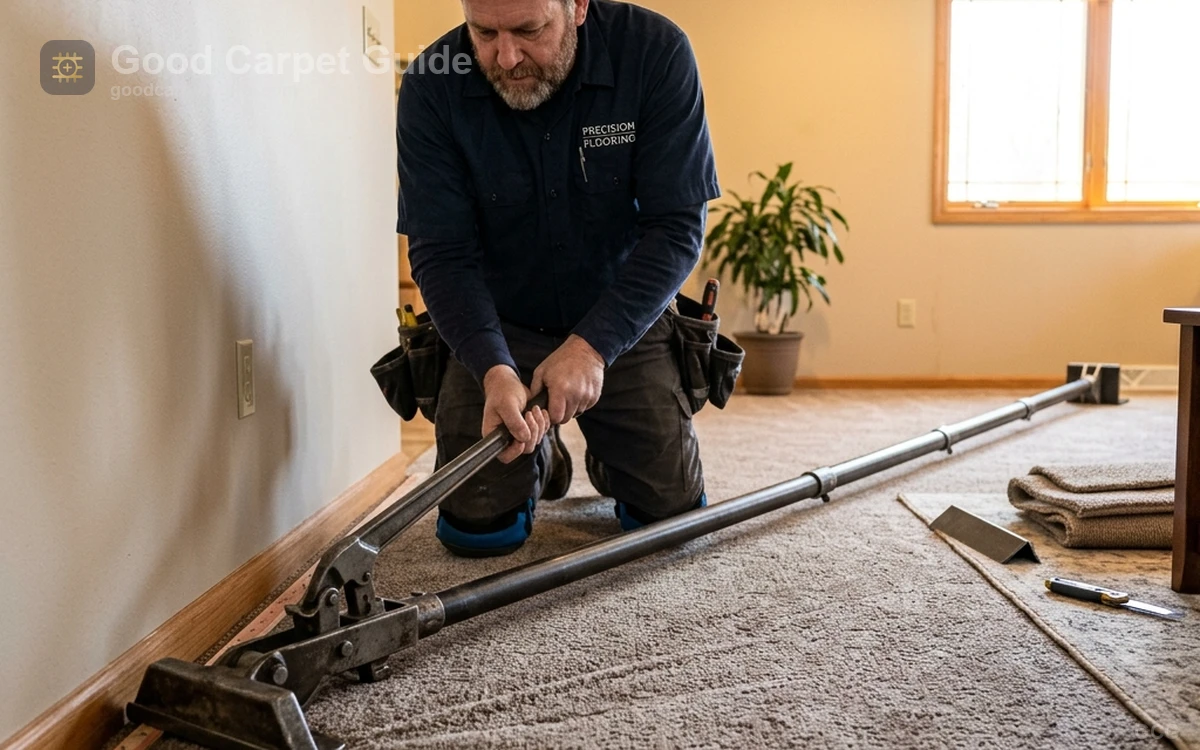
*Caption: Labor line items like power-stretcher installation rarely appear as a separate field in consumer-facing carpet cost calculators.*
Is carpet replacement expensive
At the budget tier, a 12-by-12 room installs for roughly $290 to $650 in material and labor. Cost scales sharply with material grade and room count: the same 2,100 sq ft footprint runs $5,929 at budget grade and $29,217 at luxury grade, a spread of nearly five times driven mostly by fiber type, pad density, and finish detailing.
Whether the expense is justified depends on the durability requirement. Solution-dyed nylon 6,6 over an 8-lb pad holds twist and resists matting for 10 to 15 years under normal residential traffic (per Shaw and Mohawk 10-to-15 year residential wear warranties). Budget polyester over a 6-lb pad shows crushing in traffic lanes far sooner, often inside two to three years (per International Certified Flooring Installers Association field surveys).
Is a carpet replacement cost calculator worth it
For initial budgeting, yes, as long as the homeowner treats the output as a floor and not a ceiling. The calculator sets a starting range before contractor bids arrive, which takes the shock out of a higher measured takeoff.
As a final number it does not hold up. Free consumer tools generally leave out per-step stair pricing, subfloor grinding, and the roll-width waste factor that produced the 41 percent gap in the worked example.
How much does a carpet cost calculator cost
Manufacturer and retailer calculators are free, with no charge for generating an estimate. The cost shows up later, in the distance between the free estimate and the signed contract. Independent flooring contractors sometimes charge $25 to $75 for an in-home measure, and many credit that fee against the final invoice when the homeowner proceeds with installation.
Can you run a carpet cost calculator yourself
Any homeowner can run one, since the online tools ask only for room dimensions and a material selection. Producing an accurate self-measured estimate is harder. Rooms wider than 12 feet need a seam calculation that most self-service tools never surface, and a misjudged seam on a self-measured order puts mismatched pile direction into the finished floor, which shows as a visible color shift along the seam under overhead lighting.
What carpet cost calculator do professionals recommend
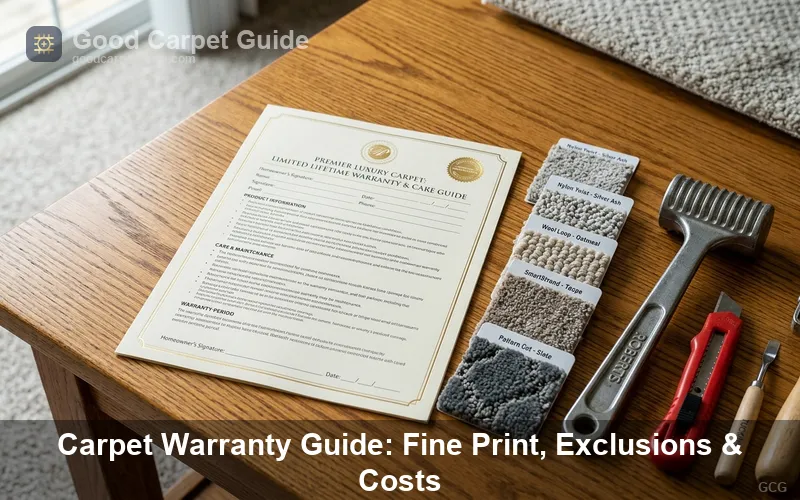
Installers commonly point homeowners to a manufacturer configurator for material and pad selection, then insist on an in-person measure for final footage and labor (per CRI 104/105 professional installation standards). The online tool screens; the on-site takeoff binds.
A homeowner who walks into a showroom already knowing whether they want solution-dyed nylon or polyester, and roughly what face weight range they are targeting, moves through the in-home measure faster and avoids re-selecting materials mid-project.
How to choose a carpet cost calculator
Match the tool to the decision stage.
- For early budgeting, a manufacturer or retailer web calculator that asks only for square footage and a quality tier sets a rough spending ceiling.
- For material comparison, use a configurator where fiber type, face weight, and pad density vary independently, so nylon 6,6 and triexta options compare on identical room dimensions.
- For the purchase decision, replace the online tool with an in-home contractor measure. Roll-width waste, seam count, and per-step stair pricing appear only on a physical takeoff.
- For final verification, check the contractor's written quote line by line against the cost centers in the table above. Tear-out, subfloor prep, and transition strips should each appear as itemized entries, not folded into one bundled installation line.
How much is carpet replacement
A single 12-by-12 room at budget grade runs $290 to $650. A full 2,100 sq ft home runs $5,929 to $29,217 by material tier, which works out to $2.82 to $13.91 per square foot with every line item counted: material, pad, labor, tear-out, subfloor prep, furniture moving, transition strips, stairs, and tax.
Labor share is the variable that moves most by market. In high-cost coastal metros, installation can approach half of total project cost. South Central and Southeast markets commonly run $0.50 to $1.50 per sq ft for the same work (per Bureau of Labor Statistics regional contractor wage data).
When should you re-run a carpet replacement estimate
Pile crushing, delamination, and persistent staining are the signals to revisit a replacement estimate, and none of them arrives on a fixed calendar schedule.
Nylon responds to professional hot water extraction (HWE) in a way polyester does not. Heat and moisture in the process can partially relax and lift crushed pile, which extends useful life beyond what a straight-line depreciation calculator assumes. Mill maintenance requirements specify professional HWE at set intervals, primarily for soil removal (Shaw and Mohawk mandate professional hot water extraction every 12 to 18 months to keep warranties valid).
Polyester behaves differently. Once PET fiber crushes under heavy traffic, cleaning does not restore pile height, and at that point the replacement calculation needs re-running against current material pricing instead of the figures used at original installation.
How long does a carpet replacement estimate stay accurate
Roughly one pricing cycle, or 6 to 12 months, before material and labor rates move enough to matter. Carpet mills adjust wholesale pricing on a rolling basis tied to raw material costs, and regional labor rates track local contractor demand. A quote written in January for a summer installation should be re-priced before signing. That matters most at the luxury tier, where a small percentage shift on a $16,464 material line changes the total meaningfully.
Homeowner and installer reports on estimate gaps
Three failure patterns recur in homeowner accounts of the distance between a calculator estimate and a final invoice. Each has a mechanism behind it, and no footage-based tool prices for any of them.
Budget polyester in high-traffic pet households
Complaints of matting and unraveling within weeks appear repeatedly in flooring forum threads (per consumer complaint registries and flooring contractor forums). The mechanism is fiber rather than workmanship: PET holds twist poorly under repeated abrasion, and a footage-based calculator assumes uniform wear across every fiber type. Warranty claims on those installations are frequently denied on wear-exclusion grounds, which returns the full replacement cost to the homeowner and makes the original estimate irrelevant inside the first year.
Free-installation promotions at big-box retail
Reports of visible seams, loose tacking, and skipped closets on five-figure jobs share one contractual cause. Flat-fee installation promotions are fulfilled by subcontracted crews paid below market rate, and an undercompensated crew has an incentive to skip subfloor prep or substitute a hand-held knee kicker for a mechanical power stretcher on seams that require one. CRI 105 specifies power stretching for stretch-in installations, and mill warranties that reference the standard can treat a knee-kicker installation as grounds for denial (CRI 105 Section 6.2 explicitly mandates mechanical power stretching for all stretch-in broadloom installations).
Light-colored carpet
Color enters a cost model as a cosmetic choice with no price attached, which is why no calculator flags it. In practice, traffic lanes on light nylon are hard to clean out even on stain-resist branded product, and light shades show shading and pile reversal that read as dirt under overhead lighting (per International Certified Flooring Installers Association field surveys). The cost is indirect. Shades that show wear get replaced sooner, which raises the effective cost per year of the original purchase.
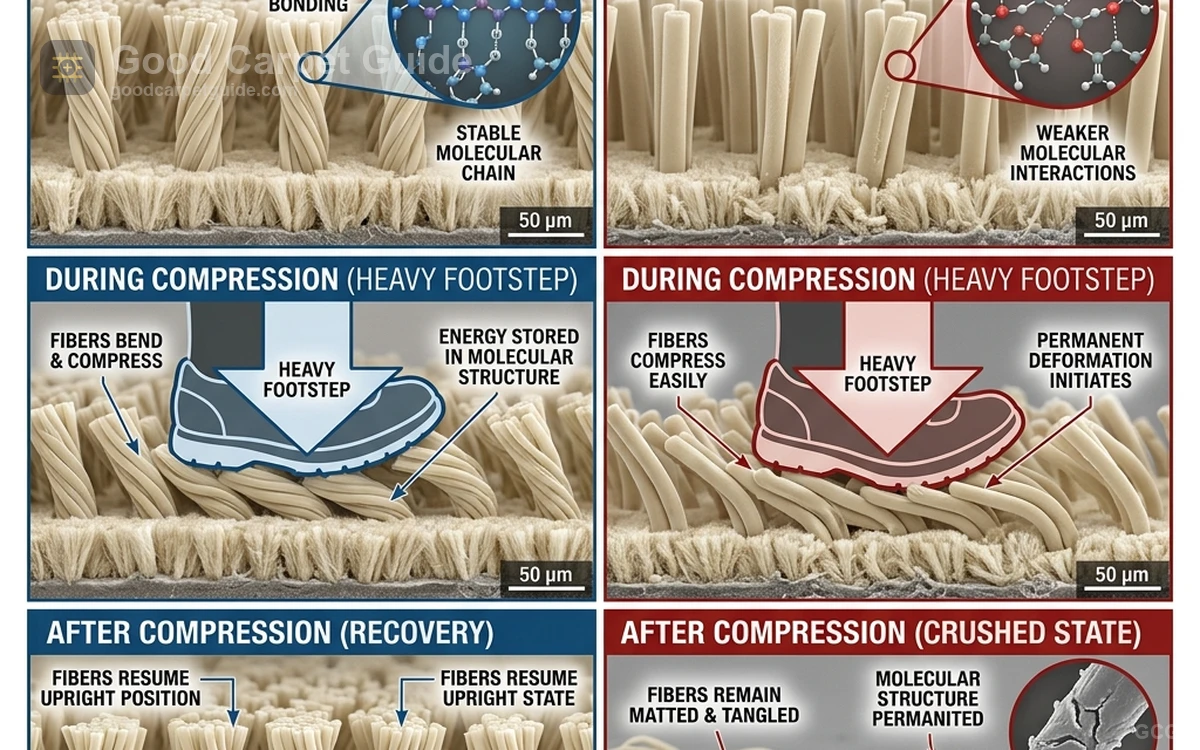
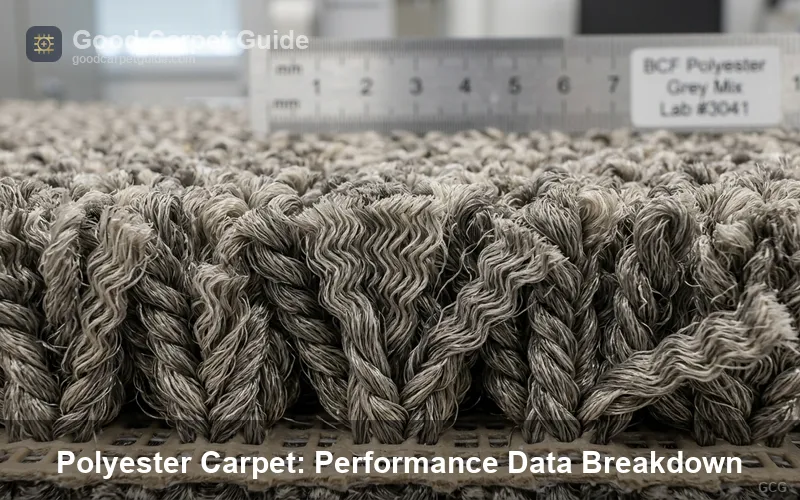
*Caption: Fiber crush patterns of this kind sit behind most warranty disputes and explain why twist count belongs in any accurate cost-per-year calculation.*
What drives the invisible middle of a carpet quote
Subfloor prep and old carpet removal are the lines a bare per-square-foot calculator omits most often. Old carpet removal and haul-away runs $0.50 to $1.75 per sq ft. Minor subfloor repair runs $0.75 to $2.00 per sq ft, and grinding down uneven concrete or scraping old direct-glue adhesive can add up to $4.00 per sq ft on top of that. Stairs price per step: box stairs at $10 to $25, wrapped Hollywood-style or spindle-cut steps at $20 to $45. A 14-step staircase alone swings $140 to $630 by style, enough to change what material tier the rest of the house can afford.
Padding, fiber chemistry, and long-term wear
Underlayment cushion works as the mechanical foundation for pile recovery, and a dollar spent on pad specification buys more usable life than the same dollar spent on face fiber. Upgrading from a builder-grade 6-lb chip foam pad to an 8-lb densified rebond or a rubber slab is standard advice in the trade, though no mill publishes a standardized life-extension figure for the upgrade.
Thickness has a ceiling. Cushion thicker than mill specification flexes vertically under foot traffic, and that flex drives delamination, where the carpet's secondary backing separates from the face fibers and leaves permanent wrinkles. CRI 105 caps residential cushion thickness for cut pile carpet at 7/16 inch (CRI 105 Section 4.3 caps residential cut-pile cushion thickness at 7/16 inch). Readers working through a backing separation problem can use this site's carpet delamination guide for diagnostics.
Fiber chemistry then sets how the carpet responds to the pad underneath it. The amide groups in nylon, in both nylon 6 and nylon 6,6, form hydrogen bonds, and that structure is why heat and moisture from hot water extraction can partially restore crushed pile. Triexta, sold by Mohawk as SmartStrand, is built on a polymer with a corn-sugar-derived component and is inherently hydrophobic, so its stain resistance lives in the fiber instead of in a topical treatment that wears off with cleaning. PET polyester offers neither mechanism, which is the structural reason budget polyester crushes years earlier than a comparably priced nylon under the same traffic load.
Brand-level cost and durability comparison
| Brand / line | Fiber type | Positioning | Approximate installed range |
|---|---|---|---|
| Mohawk EverStrand | Polyester (PET) | Budget | $2.00-$4.50/sf |
| Mohawk SmartStrand | Triexta | Mid to premium | $5.00-$8.00/sf |
| Shaw Anso | Nylon | Mid to premium | $5.00-$7.50/sf |
| Shaw Pet Perfect Plus | Nylon | Premium | $7.00-$9.00/sf |
| Karastan (nylon and wool lines) | Nylon, wool | Luxury | $10.00-$18.00/sf |
| Fabrica (nylon and wool lines) | Nylon, wool | Luxury | $15.00-$22.00/sf |
*Mills do not uniformly publish whether a nylon line is nylon 6 or nylon 6,6, and that distinction affects cleanability and crush recovery. Confirm fiber type on the product spec sheet, not the marketing name. Installed ranges are regional approximations.*
Karastan is owned by Mohawk and sits above Mohawk's mainstream catalog in both construction specification and price. The difference shows up in backing construction, where Karastan specifies tighter-weave backings than mid-tier lines at comparable face weight (per Karastan technical carpet specification sheets).
[IMAGE PLACEHOLDER: Side-by-side swatches of budget polyester, mid-grade nylon, and luxury nylon 6,6 carpet samples] Caption: Face weight and twist count do more than brand name to separate a $2.82 per sq ft build from a $13.91 one.
Room-specific cost adjustments a calculator often misses
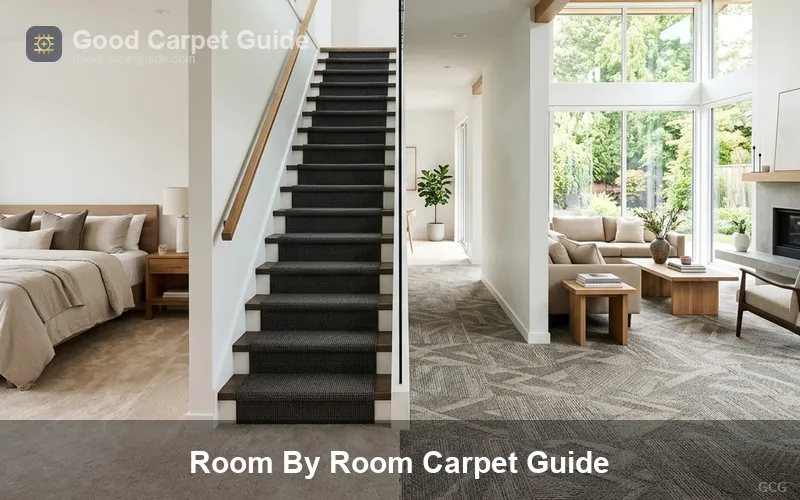
Stairs, hallway seams, and moisture-prone rooms each carry a cost adjustment that a flat per-square-foot calculator leaves out. Anyone planning a full staircase should read this site's best carpet for stairs guide before fixing a per-step budget, since a Hollywood-style wrap roughly triples the per-step cost of a basic waterfall installation. Basements bring a moisture consideration of their own, and loop pile holds up better than cut pile below grade, a distinction covered in the best carpet for basement guide . Bedrooms tolerate higher pile height and softer twist without the traffic-load penalty hallways and stairs impose, a comfort-versus-durability tradeoff detailed in the best carpet for bedrooms guide .
Final numbers to carry into a contractor bid
An estimate that leaves out roll-width waste, stair pricing, subfloor prep, and pad density is a starting range, not a quote. Check any contractor bid against three numbers from this guide: purchased square footage should come in 10 to 15 percent above net square footage, pad density should be stated in pounds and not described as premium, and stairs should be priced per step. A mid-grade nylon or triexta build over an 8-lb pad, installed at roughly $7.55 per sq ft on a 2,100 sq ft home, sits clear of the early polyester failure pattern and well under the $29,217 luxury ceiling few residential budgets need to reach.