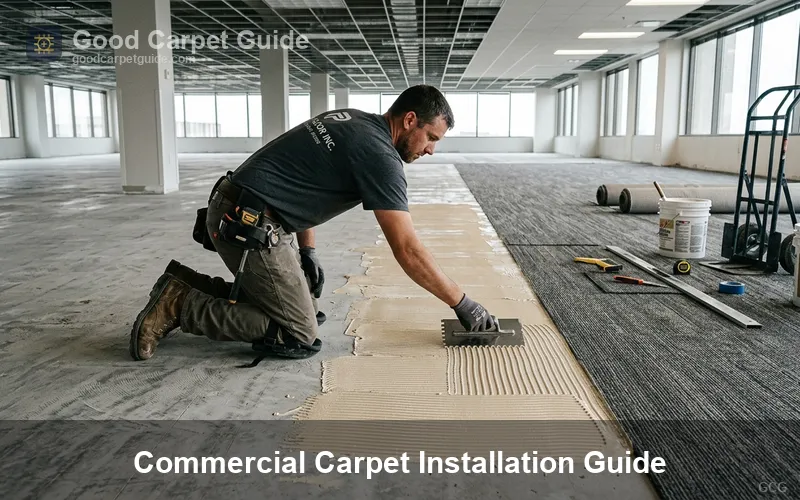
Commercial carpet installation is a mechanical bonding process. The assembly connects three separate systems: the concrete slab, the adhesive or attachment method, and the carpet backing. Each system carries its own tolerance, and a failure in any one of them produces a specific, diagnosable defect.
direct glue-down vs double glue-down vs carpet tile vs stretch-in
Method selection is a load calculation driven by traffic type, rolling loads, and acoustic requirements. The table below sets out the four commercial attachment methods and their governing specifications per CRI 104 standards.
| Method | Best Application | Subfloor Requirement | Adhesive / Trowel | Roller | Rolling Load Resistance | IIC (Impact Isolation) | Installed Cost |
|---|---|---|---|---|---|---|---|
| Direct glue-down (DGD) | Heavy wheeled traffic, ramps, high lateral shear zones | Smooth, flat concrete, free of wax or sealers | High-solids SBR latex or synthetic polymer, permanent bond. 1/8" x 1/8" x 1/8" U-notch for rough-back carpet, 1/8" x 1/8" x 1/16" V-notch for ActionBac | 75-100 lb sectional roller | Excellent | Low to moderate | $2.50-$5.00/sq ft |
| Double glue-down (dual bond) | Executive suites, ballrooms, luxury commercial | Smooth, flat concrete | Floor-to-pad: 1/16" square-notch. Carpet-to-pad: 1/8" x 1/16" x 1/8" U-notch | 35-50 lb roller | Good | Very high | $3.50-$18.00/sq ft |
| Carpet tile (PSA releasable) | Corridors, modular offices, tenant spaces | Flat, porous or sealed concrete | Acrylic copolymer pressure-sensitive adhesive, 3/8" nap roller application, 30-minute releasable flash | 3/8" nap paint roller for application | Excellent | Moderate to high, depends on tile backing | $3.50-$7.50/sq ft |
| Stretch-in (commercial tack strip) | Boardrooms, low-traffic suites | Any stable perimeter substrate | 3-row pin architectural tack strip, 1-1/4" wide. Power stretching is mandatory | Double-head mechanical power stretcher | Poor. Avoid under caster chairs | High | $3.00-$10.00+/sq ft |
Direct glue-down carries the highest lateral shear resistance of the four methods because the carpet backing bonds directly to the slab with no intermediate cushion layer to shear under wheeled loads. Double glue-down trades some of that shear resistance for acoustic performance. The intermediate pad layer raises IIC ratings by a measurable margin. This is why the dual-bond method dominates in ballroom and hospitality specifications despite the higher installed cost.
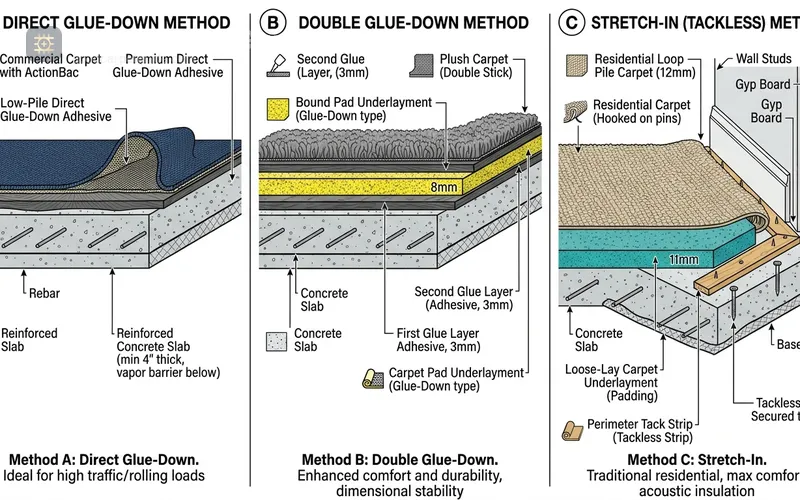
Technical cross-section comparing direct glue-down, double glue-down, and stretch-in assemblies over commercial concrete substrates.
Stretch-in installation is excluded from rolling-load environments for a mechanical reason. The tack strip anchors only the perimeter, so repeated caster wheel pressure works the backing loose from the pins over time. Knee kickers are prohibited as the primary stretching tool on commercial jobs. A power stretcher is required to reach the 1.0% width and 1.5% length tension specification a knee kicker cannot consistently deliver across a room-width span.
A 75-100 lb sectional roller seats the backing into wet adhesive immediately after trowel application, before initial tack sets.
subfloor moisture testing per ASTM F2170 and ASTM F1869
Adhesive failure on commercial slabs traces back to moisture more often than any other cause. Two ASTM protocols govern pre-installation testing, and they measure different physical values.
ASTM F2170 (in-situ relative humidity) drills a probe into the slab to a depth of 40% of slab thickness for slab-on-grade construction, where drying occurs from one side only. For elevated pan decks with two-side drying, probe depth drops to 20% of slab thickness. Each probe requires a 72-hour equilibration period before an accurate reading is possible. Standard SBR latex adhesives typically tolerate RH readings up to 75%-85%, whereas high-solids polymer adhesives extend into the 90%-99% RH range.
ASTM F1869 (calcium chloride, or MVER) measures moisture vapor emission from only the top 1/2" to 3/4" of the slab, in units of lbs/1000 sq ft/24 hr. Standard adhesives generally require an MVER reading at or below 3.0 lbs. Specialty polymer adhesives extend that ceiling into the 8-10 lb range. The calcium chloride test is disallowed on lightweight concrete because the aggregate skews vapor readings.
Because F1869 samples only the top fraction of the slab, it can miss moisture reserves deeper in the concrete that F2170's full-depth probe will catch. A slab can pass an MVER test and still fail an RH test. Per CRI 104, both protocols should be run on any commercial slab where prior water exposure, missing vapor barrier documentation, or a below-grade pour is suspected.
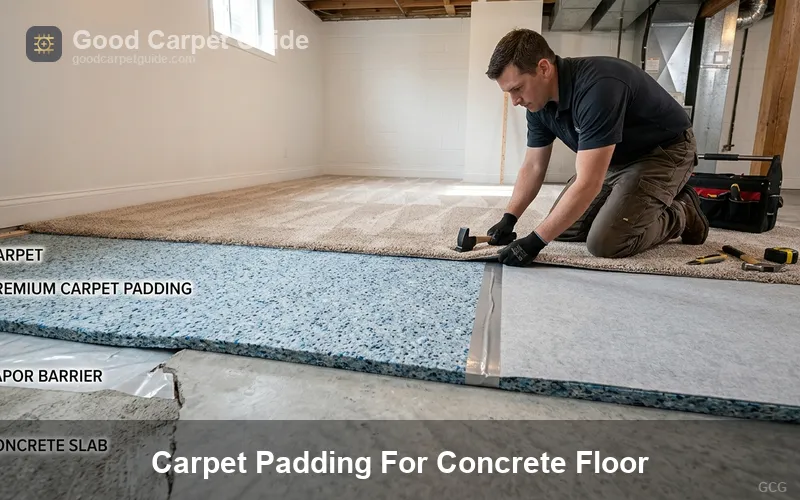
For projects requiring an intermediate cushion layer over a slab with borderline moisture readings, see carpet padding for concrete floor for barrier-rated pad selection.
concrete alkalinity, saponification, and slab pH thresholds
Standard concrete cures at a pH between 7.0 and 9.0. A reading at or above pH 10.0 is a critical failure trigger for standard adhesive chemistry, and mitigation is advised once a slab tests above pH 9.0.
The failure mechanism is ester hydrolysis. Moisture trapped in or migrating through the slab dissolves calcium hydroxide, Ca(OH)2, a byproduct of the concrete curing reaction. That alkaline moisture reaches the adhesive layer and attacks the ester bonds in SBR latex or acrylic adhesives:
R-COOR′ + OH⁻ → R-COO⁻ + R′OH
The reaction converts a cured, solid adhesive film into a soft soap gel or a dry, powdery residue with no bond strength. This is saponification, and once it starts, the adhesive layer has lost its cohesion permanently. No amount of additional rolling or drying will restore the bond.
Mitigation requires one of three interventions before adhesive application: a polymer-modified pH neutralizer, an alkali-resistant primer, or a full epoxy moisture mitigation system conforming to ASTM F710. Skipping this step on a slab that tests above pH 9.0, even if RH and MVER numbers pass, sets up a delayed failure that can surface months after installation once moisture migration resumes seasonally.
subfloor flatness, porosity, and asbestos cutback protocols
ASTM F710 sets the flatness tolerance for a slab receiving commercial carpet at ±3/16 inch over 10 lineal feet, the FF32 standard. A slab outside that tolerance needs a self-leveling underlayment pour before any adhesive method proceeds. Trowel notch depth cannot compensate for a low spot without starving adjacent high spots of adhesive.
Porosity determines primer and adhesive selection. The ASTM F3191 field test places a 0.05 mL water drop on the slab. If the drop is not absorbed within one minute, the slab is non-porous and requires mechanical abrasion to a CSP 1-3 surface profile (per the ICRI concrete surface profile chip scale) before adhesive will bond reliably.
Pre-1986 commercial slabs frequently carry black asphaltic cutback adhesive from a prior resilient floor installation. Per RFCI guidelines, this material must be presumed asbestos-containing regardless of visible condition. Dry sanding, grinding, beadblasting, shotblasting, or dry sweeping the material is strictly forbidden, since these methods aerosolize asbestos fibers. The approved method is RFCI wet scraping: one ounce of surfactant detergent per gallon of water, applied and worked with a stiff floor blade, followed by HEPA vacuum collection and disposal in rated bags.
Where full removal is impractical, encapsulation with a polymer-modified cementitious underlayment seals the cutback in place. Vinyl-backed carpet must never be laid directly on exposed cutback residue. Plasticizers in the vinyl backing migrate into the old asphaltic adhesive and liquefy it, creating a soft, shifting bond layer under the new carpet.
adhesive selection, notch sizing, and coverage rates
Adhesive chemistry, tolerance range, and coverage rate vary enough between products that a spec mismatch is one of the most common causes of early bond failure on commercial jobs. Verify all published tolerances below against the current manufacturer data sheet before specifying.
| Product | Chemistry | Max RH Tolerance | Max MVER | Max pH | Coverage Rate |
|---|---|---|---|---|---|
| Roberts 3095 | High-solids SBR latex | 90% | 10 lbs | 10 | 65-75 sq ft/gal, 1/8" U-notch. Not approved for solid vinyl or PVC-backed carpet |
| Henry 430 | Clear acrylic latex | 95% | 5 lbs | 12 | 300-350 sq ft/gal. Dries clear |
| MAPEI Ultrabond ECO 185 | Synthetic polymer | 90% | 8 lbs | 9.5 | 90-110 sq ft/gal. Fast-track ready |
| MAPEI Ultrabond ECO 810/811 | PSA acrylic copolymer | 99% (ECO 810) | 10 lbs | 11 | 270-400 sq ft/gal. Wet application bonds permanent; dry-tacky application is releasable |
Trowel notch wear is a specific and underreported failure cause. A worn trowel blade lays a shallower ridge than its rated notch depth. This thins the adhesive transfer rate and spreads coverage past the manufacturer's rated area for a full-contact bond. Worn or damaged trowels rank among the leading contributors to commercial bond failures, alongside moisture and pH issues per CRI technical bulletins. Trowels should be checked against a notch gauge before each pour.
Flash time and open time both shift with ambient conditions. Normal working conditions sit at 65-85°F and 40-60% relative humidity. Cold job sites extend open time and slow initial tack, which risks adhesive skinning over before the carpet is laid into it. Hot, dry conditions or a non-porous slab shorten open time and can force a dry-lay bond with no wet transfer at all. Roller weight also shifts by method: 75-100 lb rollers for direct glue-down broadloom, 35-50 lb rollers for double glue-down, and a maximum of 35 lb for flat-weave construction carpet, where heavier rolling forces adhesive bleed-through to the face fiber.
commercial tool fleet and precision cutting
Eight tools form the core commercial installation kit: the Crain 366 or Roberts 10-517 row finder, the Roberts 10-152-3 or Crain 303 loop cutter, the Crain 302 cushion-back cutter, the Crain 290 seam cutter plus, the double-head mechanical power stretcher (knee kickers are prohibited as the primary stretching tool), a commercial seaming iron set to 250°F, the Roberts 10-122 or 10-124 seam roller, and the 75-100 lb sectional roller.
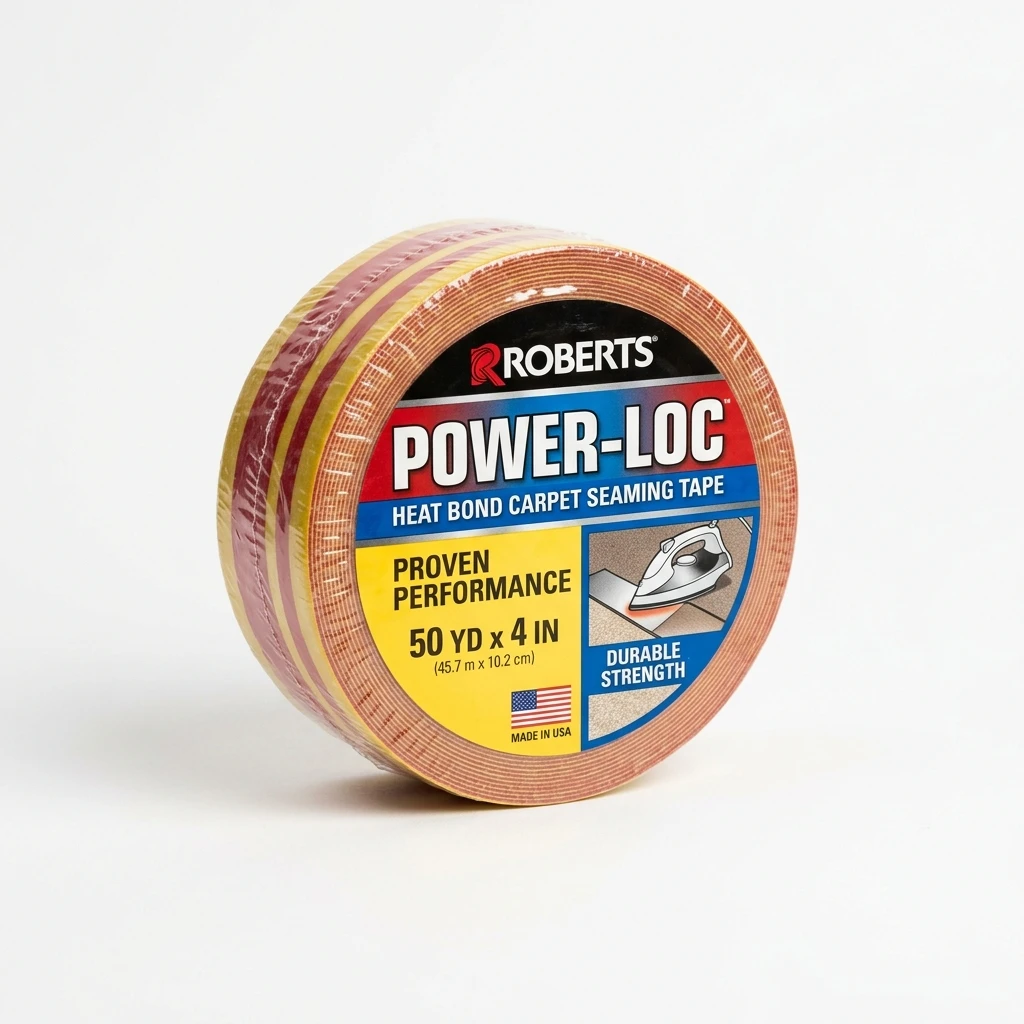
Roberts Power-Loc Premium Carpet Seaming Tape
Commercial-grade thermoplastic hot-melt seaming tape designed for high-tensile seaming and power-stretched broadloom installations.
Check Price on Amazon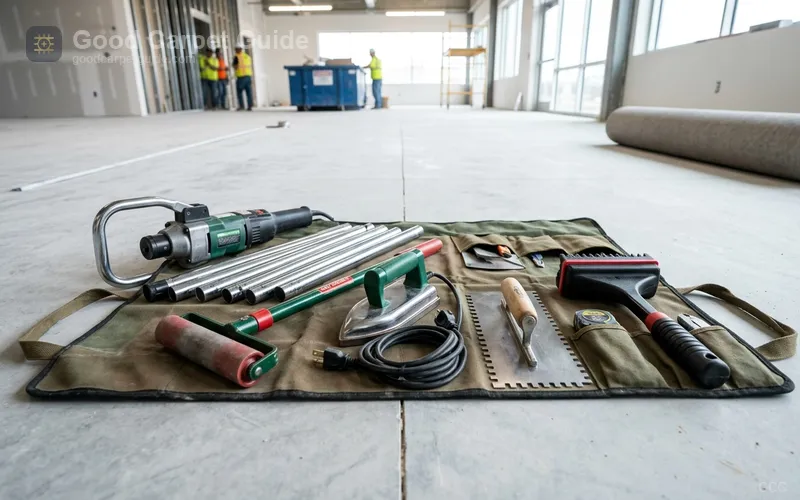
Core commercial flooring installer tool kit required for precision seam cutting, power tensioning, and roller embedding.
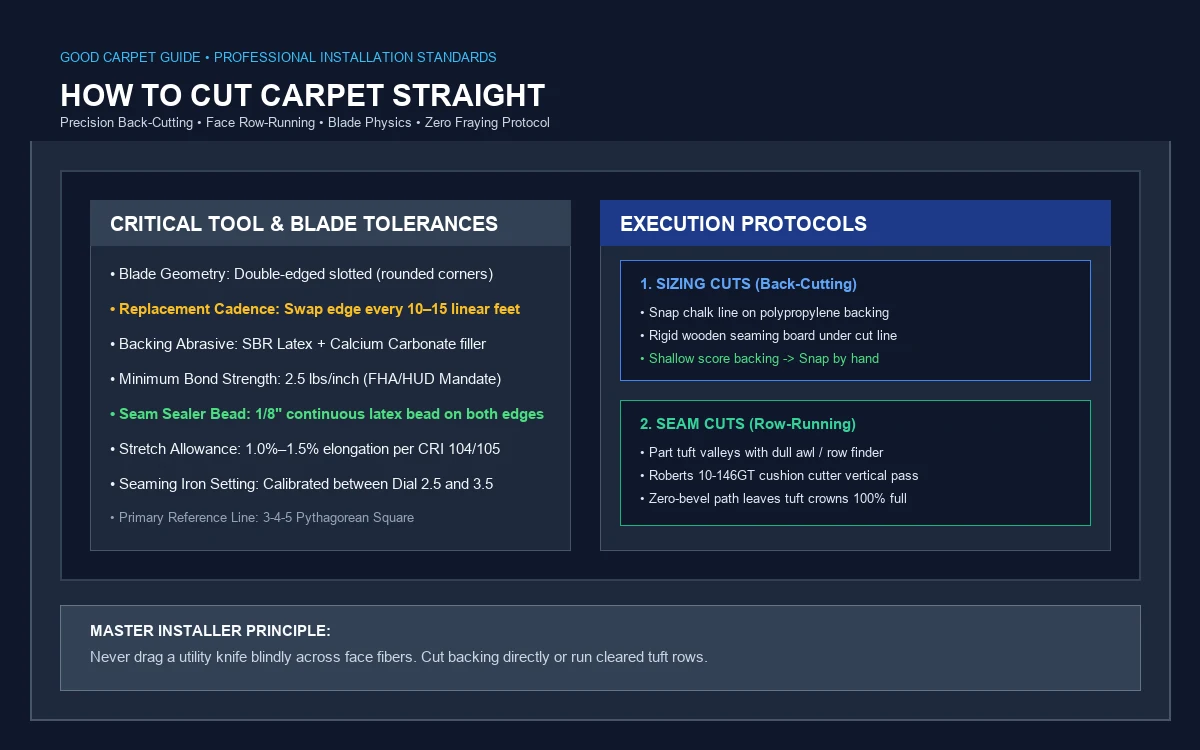
Row finding and cutting technique depends on pile construction. Dense loop pile is cut using the Crain 366's sawing action with a back-cut at a 30-degree angle. Dense cut pile is cut with a Crain 361 or 365 separator and a matching back-cut. Cutting against the wrong angle for the pile type produces a visible seam gap once the carpet relaxes.
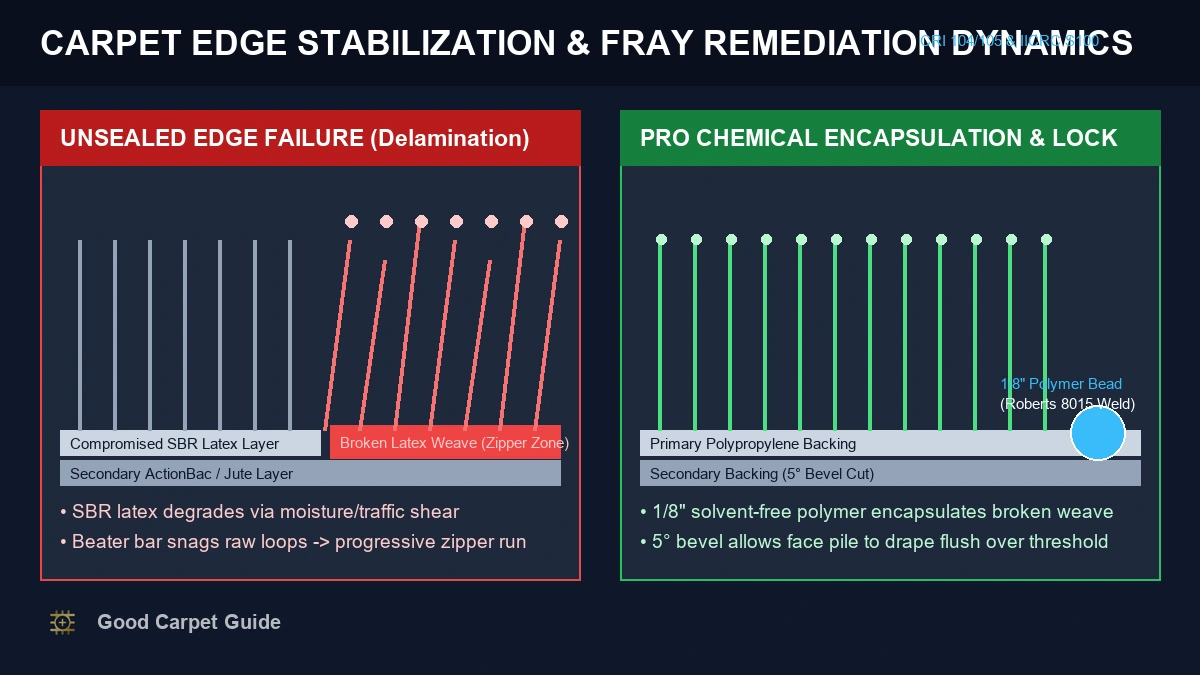
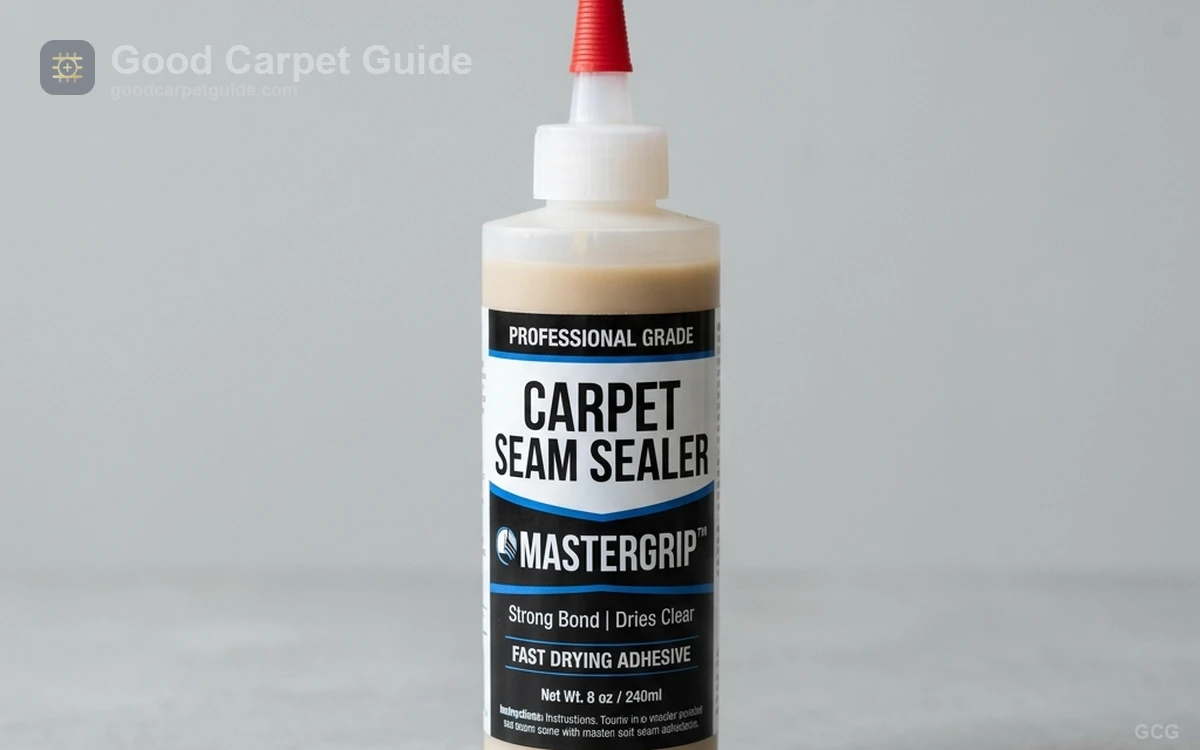
Per CRI 104, every cut edge on a commercial installation requires seam sealing: a continuous 1/8" bead of high-solids latex seam sealer or thermoplastic seam tape, applied before the two edges are joined. Seam quality on completed jobs is verified with a UV tracer chemical built into many commercial sealers, inspected under blacklight during final walkthrough. An unsealed or under-sealed edge is the single most common origin point for the fraying and peaking pattern covered below.
Roberts 8015 Universal Carpet Seam Sealer
High-solids edge sealer applied along cut broadloom edges per CRI 104 to prevent yarn raveling, seam peaking, and edge delamination.
Check Price on Amazonpower stretching, tensioning, and bow/skew prevention
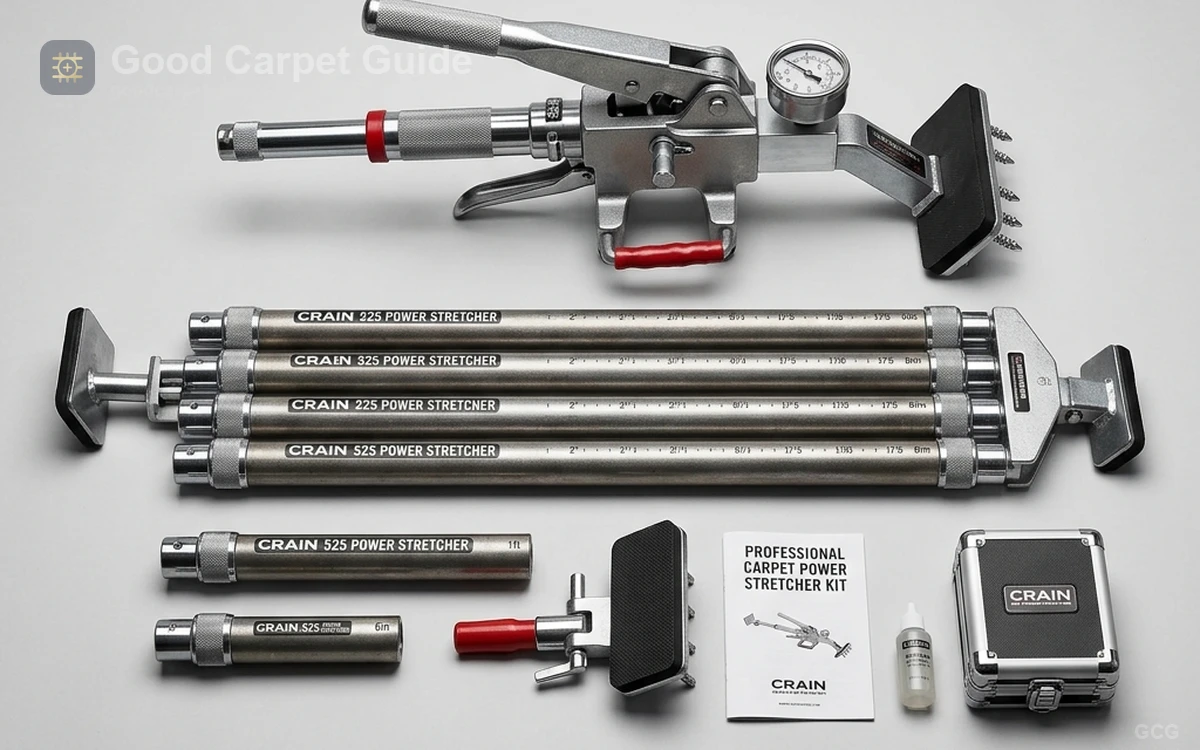
Synthetic carpet backing needs to reach a specific tension target before it is anchored. The commercial specification is 1.0% tension in the width direction and 1.5% in the length direction. Reaching that target consistently across a room-width span requires a double-head mechanical power stretcher working off deadman boards.
Roberts 10-254 Professional Power Stretcher Kit
Essential commercial tensioning tool required to establish 1.0% width and 1.5% length tension specifications and prevent carpet bubbling and bow/skew distortion.
Check Price on AmazonBow and skew distortion, where the pile lines curve or drift out of square with the room, traces directly back to inconsistent tensioning. Skipping deadman boards or under-tensioning one section relative to another leaves residual stress in the backing that continues to move for weeks after installation. The residual stress distorts seams that were straight and tight on install day. For the correct stretcher sequencing and deadman board placement, see how to use a carpet stretcher .
ADA Section 303 transitions, thresholds, and z-bar profiles
ADA Section 303 sets three tiers for vertical height changes at carpet-to-hard-surface transitions:
- A vertical rise of 1/4" (6.4 mm) or less is permitted as a plain vertical edge with no bevel required.
- A rise between 1/4" and 1/2" (6.4 to 12.7 mm) must be beveled at a maximum 1:2 slope, which means a 1/2" rise requires at least 1.0" of horizontal bevel run.
- Any rise greater than 1/2" must be treated as a ramp, with a maximum slope of 1:12.
Per CRI 104, transition moldings must cover the carpet edge to prevent fraying at the cut line, and the adjoining hard surface should sit slightly higher than the carpet edge beneath the molding. Commercial-grade transition profiles include slim reducer and aluminum z-bar options trimmed to width with a Crain 290 cutter. Specify a profile rated to ASTM E648 Class I for critical radiant flux and ASTM E662 for smoke density.
A transition strip that has worked loose, cracked, or lifted at the seam is both an ADA compliance failure and a trip hazard on a commercial property. For repair procedure on an existing transition, see how to repair a carpet transition strip .
commercial failure forensics: five patterns and their root cause
An inspector diagnosing a failed commercial carpet installation is working backward from a visible symptom to a specific mechanical or chemical cause. Five patterns account for most commercial claims:
- Adhesive saponification: Soft, soapy, or powdery adhesive residue under a delaminated section. Root cause: alkaline moisture at pH 10.0 or above that triggers ester hydrolysis in the adhesive's Ca(OH)2-exposed layer.
- Seam fraying and peaking: Visible gap or raised ridge along a seam line. Root cause: missing or inadequate edge sealing per CRI 104, or premature power stretching applied before hot-melt seam tape has fully cooled and set.
- Delamination under rolling casters: Backing separating from the primary or secondary layer in high-wheel-traffic zones. Root cause: backing cohesion strength below the FHA standard (minimum 2.5 lbs per inch of width), often from marble dust filler overloading in the backing compound, compounded by wet extraction cleaning that further degrades a marginal bond. Full diagnostic detail is covered in carpet delamination .
- Carpet bubbling and buckling: Visible waves or loose pockets across a glued-down field. Root cause: carpet installed without the mandatory 48-hour HVAC acclimation window at 65-95°F, or adhesive applied with a worn trowel that left an inconsistent, thin transfer layer.
- Bow and skew distortion: Pile lines drifting out of square, seams pulling apart under load. Root cause: failure to tension synthetic backing to the 1.0% width / 1.5% length specification, typically from omitting deadman boards or substituting a knee kicker for a power stretcher on the primary stretch.
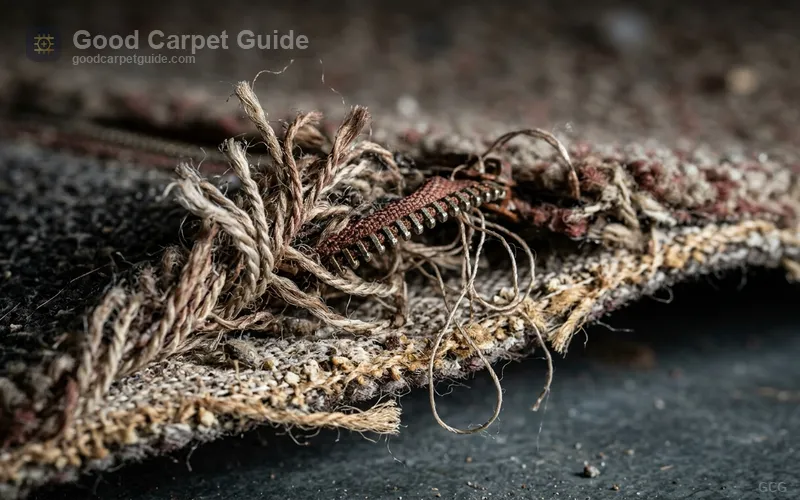
Forensic cross-section illustrating adhesive bond breakdown, zippering, and secondary backing delamination under rolling loads.
commercial pricing and labor breakdown
Commercial carpet cost varies by material class, installation method, and the site condition work required before the carpet goes down.
| Line Item | Cost Range (per sq ft) | Primary Cost Drivers |
|---|---|---|
| Olefin broadloom | $1.00-$2.50 | Entry-level commercial spaces, low pile density |
| Nylon broadloom | $3.00-$5.00 | Solution-dyed commercial fiber, high durability |
| Carpet tile | $3.50-$7.50 | Modular replacement convenience, hardback vs cushion |
| Woven wool | $5.00-$15.00 | Natural luxury fiber, hospitality ballrooms |
| Standard labor | $0.50-$2.00 | Open commercial floor plates, straight corridors |
| Stair installation | $3.50-$12.00 | Custom cap trimming, spindle detailing |
| Patching | $0.25-$1.00 | Localized feather finish, crack repairs |
| Self-leveling | $1.75-$4.70 | Subfloor leveling, mechanical scarification |
| Moisture barrier | $1.00-$3.00 | Two-part epoxy moisture mitigation primers |
| Demolition & disposal | $0.50-$1.60 | Adhesive scraping, tack strip pull-out |
Three representative commercial bids illustrate how these line items combine in practice:
- Scenario A, 10,000 sq ft office: Nylon carpet tile at $6.00/sq ft installed, totaling $60,000.
- Scenario B, 5,000 sq ft healthcare facility: Nylon broadloom with an epoxy moisture barrier at $7.75/sq ft installed, totaling $38,750. The epoxy barrier line item reflects a slab that failed initial moisture testing and required ASTM F710 mitigation before adhesive work could proceed.
- Scenario C, 15,000 sq ft ballroom: Woven wool on a double glue-down assembly at $16.00/sq ft installed, totaling $240,000. The cost reflects the acoustic and appearance-retention requirements typical of luxury hospitality specifications.