Safety notes before you buy
• Thick, high-pile carpet on a stair nose reduces footing stability. The rounded pile edge gives way under the ball of the foot on descent.
• Low-density foam pad shifts under lateral foot pressure. Manufacturer specifications restrict stair coverage once pad density drops below its stated minimum.
• Wear warranties cover documented abrasive fiber loss above a set threshold. Matting, crushing, and flattening fall outside that definition, and some lines exclude stairs from coverage altogether.
• Visible staples along the stair nose mean the installer skipped the stair-tool finishing pass. Ask to see this step done before signing off on the job.
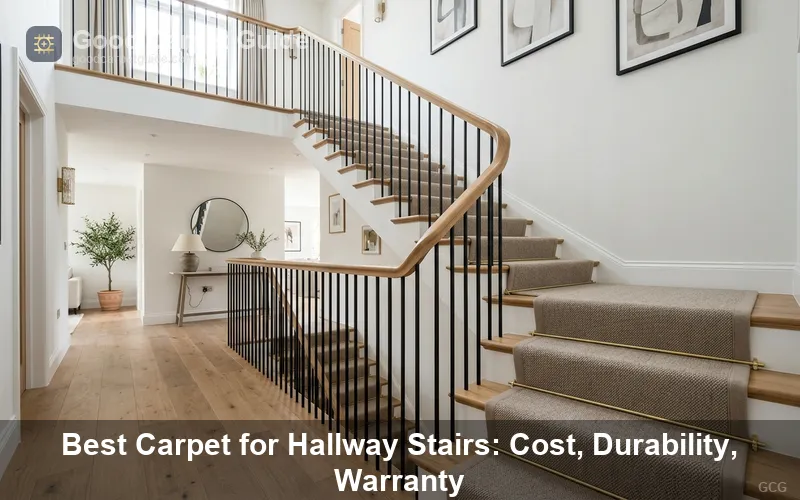
The best carpet for hallway stairs is a dense, low-pile, high-twist nylon 6,6 over a thin, firm 8-lb to 10-lb pad. Stairs destroy carpet on a different mechanism than open floors do. The same few inches of tread and nose absorb concentrated, pivoting foot pressure thousands of times a week, and that pressure permanently flattens weak fiber long before abrasion ever wears it through.
Which carpet is best for hallway stairs
Nylon 6,6 has the highest elastic recovery of the common synthetic fibers. Compressed pile springs back toward its original height between traffic cycles, which is the property that keeps a stair nose looking intact after a year of shoe traffic.
Solution dyeing is a separate attribute and is often confused with durability. Locking pigment into the fiber before extrusion protects color against bleach and UV fading. Texture retention comes from twist level and heat setting, so a solution-dyed fiber with low twist still flattens on a stair nose.
Triexta (sold as Mohawk SmartStrand) and polyester resist staining better because both fibers lack the open dye sites that bind acid-based food and drink stains. Under the lateral, twisting load of a foot descending a stair nose, neither fiber matches nylon's structural memory. Industry reports document how quickly Triexta and polyester stair installations lose pile height under moderate daily traffic.
Nylon 6,6 suits households with heavy shoe traffic and no major pet-stain risk. Where stain resistance from pets or small children outweighs long-term texture retention, Triexta or a solution-dyed polyester becomes the reasonable trade.
How the common stair fibers compare
Fiber type sets the ceiling on how long stair carpet holds its pile height. The six fibers that dominate residential stair work land in very different places on that measure.
| Fiber | Primary strength | Primary weakness on stairs | Installed cost per sq ft (Current Rates) |
|---|---|---|---|
| Nylon 6,6 (mid-grade) | High elastic recovery, resists matting | Higher upfront cost | $4.00 – $8.50 |
| Nylon 6,6 (premium) | Best texture retention under heavy traffic | Most expensive synthetic | $6.00 – $12.00 |
| Triexta (SmartStrand) | Stain release without added treatment | Loses stair-nose texture faster than nylon 6,6 | $3.50 – $8.00 |
| Polyester (PET) | Low cost, easy cleaning | Crushes fastest under concentrated stair traffic | $2.50 – $6.50 |
| Olefin / polypropylene | Lowest cost, moisture resistant | Loses pile height permanently once crushed | $2.00 – $5.50 |
| Wool (premium natural) | Natural resilience, high face weight options | Highest cost; some wool lines exclude stairs from warranty | $9.00 – $22.00 |
Face weight (oz/sq yd) and twist count (turns per inch) sit alongside fiber type as independent specifications. In the same price tier, a high-twist mid-face-weight nylon outlasts a low-twist high-face-weight polyester on a stair nose, because twist count governs how well the yarn resists untwisting when a foot lands and pivots.
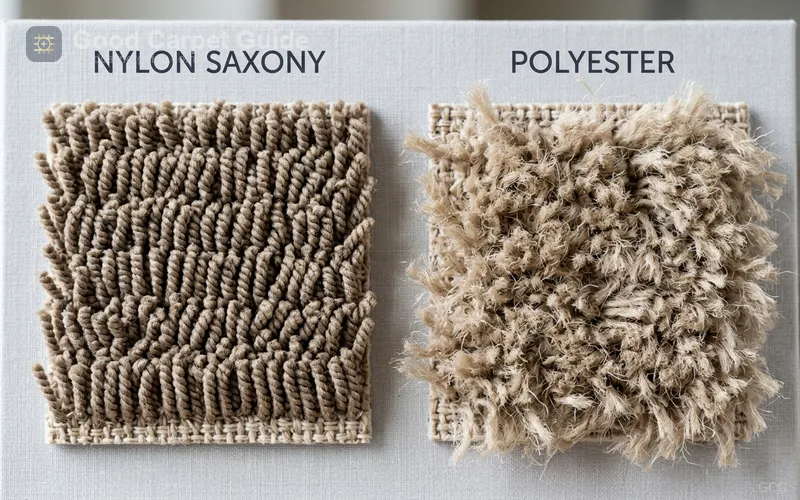
*Twist count carries more weight than face weight alone when carpet has to survive the pivoting foot pressure described in the fiber comparison above.*
What owners and installers report
Mid-to-high pile carpet on stairs flattens within about two years under normal household traffic, and the traffic path down the center of each tread shows well before that point according to flooring inspector reports. After two to four years the pile can pack down far enough that vacuum brushes stop making contact with the flattened area, at which point professional cleaning no longer restores pile height.
Manufacturing defects sit outside fiber quality entirely. Fiber pulling and loose strands turn up as complaints across premium lines, including Triexta constructions.
Pet owners face a failure mode of their own. Cats taking a staircase at speed hook claws into loop-pile construction and pull a loop, and the yarn then runs in a continuous line down the step. Loop pile is a poor fit for stairs in households with cats, whatever the fiber.
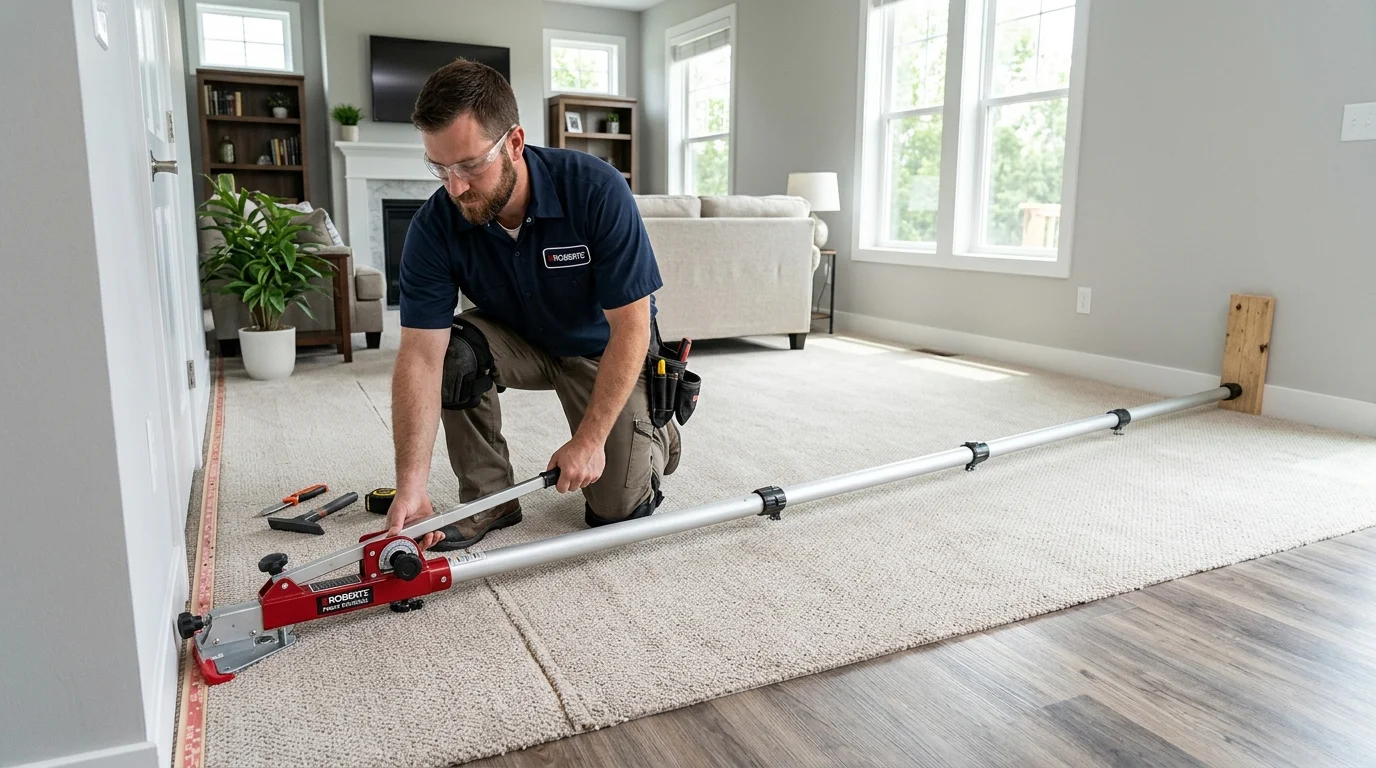
Across owner and trade accounts, pile construction and fiber choice predict stair failure more reliably than the price paid does. Installation quality carries similar weight: carpet set with a power stretcher holds tension, while knee-kicked carpet develops wrinkles and seam separation within months.
Carpet padding for hallway stairs
Pad density does more to set the service life of hallway stair carpet than the carpet price does, because the pad absorbs foot impact before it reaches the carpet backing. A mid-priced carpet over a dense 8-lb to 10-lb pad routinely outlasts an expensive carpet laid over a thin, low-density pad.
For stairs, Carpet and Rug Institute (CRI) 105 trade standards cap pad thickness at 3/8 inch and keep the pad firm.
Padding gets specified by density, expressed as a pound rating, and softness underfoot is a poor proxy for it. A quality 8-lb to 10-lb pad feels firm by design: its job is to resist compression and hold the carpet under tension. A softer, lower-density pad on a stair nose creates a shifting surface that reduces traction, and it can void the manufacturer's stair-specific warranty conditions. Full padding specifications and pound-rating comparisons are covered in this best carpet padding for stairs guide .
Installation cost by method: waterfall vs. Hollywood wrap
Two methods dominate hallway stair carpeting, and the choice moves both material use and labor cost per step.
The waterfall method drapes carpet straight down each riser over the nose with no tuck underneath. Hollywood wrap hand-contours the carpet tightly under the nose and riser, which produces a defined edge on every step.
That extra contouring consumes roughly 10% to 20% more carpet material across a full flight. Labor separates the two methods further. Waterfall installation runs $25 to $45 per step nationally; Hollywood wrap runs $40 to $75 or more, since the hand work takes roughly twice the time.
On a straight 14-step flight, waterfall lands at $650 to $1,250 all-in for carpet, pad, and labor. The same flight in Hollywood wrap runs roughly $900 to $1,750.
Two site conditions push either figure higher. Carpet routed around vertical stair spindles adds $10 to $20 per step. A flat landing adds a flat $50 to $100 fee on top of the per-step total.
Full cost breakdown for hallway and stair carpet
Stair carpet gets priced by the step, because shaping and securing carpet around a nose takes manual labor that a flat-floor installation never requires.
| Cost item | Range (US national) |
|---|---|
| Waterfall install labor, straight 12-16 step run | $300 – $720 total ($25 – $45 per step) |
| Hollywood wrap install labor, same run | $480 – $1,200 total ($40 – $75 per step) |
| Full replacement per step including tear-out and disposal | $25 – $80+ per step, method-dependent |
| Installer trip minimum (small stair-only jobs) | $150 – $300 |
| Bundled full-service "all-in" retail rate | $10 – $14 per sq ft, stairs often excluded |
Big-box retailers advertise free installation tied to a minimum material purchase. The labor cost still gets paid, folded into a higher per-yard material price, and the retailer then bills tack strips, subfloor prep, transition strips, and stair-specific labor as separate lines. Local flooring specialty dealers tend to itemize those same charges up front, and many fold basic subfloor prep and squeak repair (screwing down a warped subfloor sheet) into a power-stretch installation.

8 lb Density Stair Carpet Pad Roll
Firm, low-thickness underlayment sized for stair-nose installation rather than open-floor rooms.
Check Price on AmazonThe wear warranty trap
Wear warranties cover one thing: documented loss of physical fiber weight through abrasion, with the qualifying threshold commonly set around 10% measured loss per Carpet and Rug Institute standards. Matting, crushing, and flattening on hallway stairs sit outside that definition, which makes them the most common source of denied claims. A permanently packed-down traffic path gets classified as normal wear and tear.
Some lines go further and exclude stairs from wear and stain coverage entirely. Stair exclusions appear in synthetic and premium wool warranty documents alike. Before buying on the strength of a warranty length quoted in a showroom, read the written warranty for that specific style and confirm that stair application is covered.
Which brands hold up on hallway stairs
Brand reputation is a weak predictor of stair performance. Construction and fiber grade within a specific product line decide it, so compare line-level specifications when shortlisting.
- Shaw Anso lines are 100% Nylon 6 constructions positioned for heavy-traffic residential use, including stairs.
- Mohawk SmartStrand and SmartStrand Silk use Triexta fiber with strong stain release and a softer hand-feel. On long-term stair-nose texture retention, Triexta trails nylon 6,6.
- Mohawk EverStrand is a budget polyester made from recycled PET, better suited to low-traffic hallways than to stair noses.
- Stainmaster PetProtect uses Nylon 6,6 construction with an easy-release fiber treatment aimed at shedding-pet households. Confirm stair-specific warranty language before purchase.
- Anderson Tuftex offers heavy solution-dyed nylon constructions in premium face weights, which suits heavy-traffic stair runs.
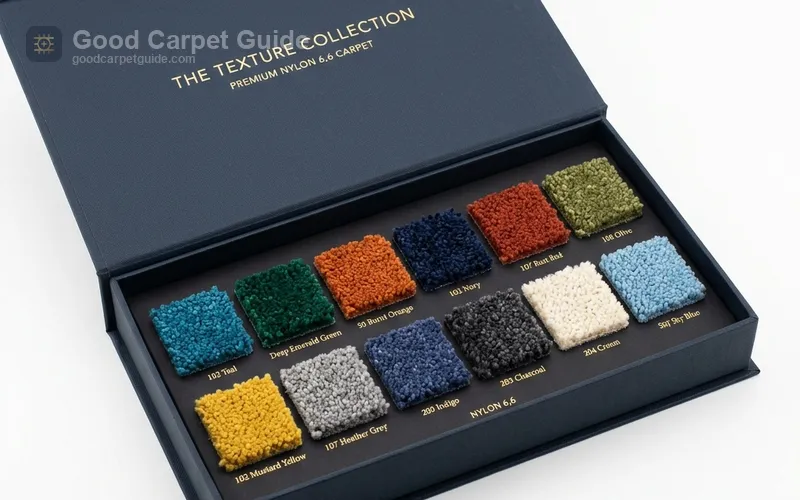
Stainmaster PetProtect Carpet Sample Kit
Physical fiber samples for comparing nylon 6,6 twist and hand-feel before ordering a full stair run.
Check Price on AmazonBest color and pattern for hall stairs and landing
Mid-tone patterned carpet holds up visually on hallway stairs better than solid light or solid dark carpet, because the pattern disguises the visual signature of traffic wear. Herringbone and tone-on-tone stripe runners pull the eye away from scuffing and flattened traffic paths on the tread nose.
Solid light carpet on stairs reveals soiling and installation staples along the nose more readily than a patterned or mid-tone surface. Solid dark carpet hides staining well and then broadcasts crushed pile and traffic sheen, which is the flattening itself made visible.
Color and pattern change none of the underlying fiber durability covered above. A patterned Triexta carpet flattens on the same timeline as a solid Triexta carpet under identical traffic.
Big box stores vs local flooring dealers
The installation crew is what separates the two channels. Local flooring specialty dealers keep in-house installers who power-stretch the carpet; big-box retailers such as Home Depot and Lowe's advertise low base material rates and free-install promotions, then subcontract the work out.
Charges for carpet removal, subfloor prep, tack strips, and transition moldings get billed on top of the advertised promotional price. Local dealers stocking higher-density padding and wool product lines will quote a higher material cost, though their estimates typically break out line items on an apples-to-apples basis. Their crews are also more likely to reach for a power stretcher, which is the installation-quality factor most closely linked to wrinkling and seam separation in the first months after installation.
Is carpet worth it on hallway stairs at all
Carpet earns its place on hallway stairs where traction and sound absorption outweigh long-term visual perfection. Low maintenance is not among its strengths.
Hard flooring such as vinyl plank eliminates matting completely, which is why owners hit with early stair matting sometimes replace carpet with plank on the second go-round. What carpet offers in exchange is footing traction on a pitched surface and sound dampening between floors, and hard flooring matches neither. Carpet also traps dust and dander until the next vacuum pass, where hard flooring lets it circulate.
Vacuum choice affects the trade. Heavy upright vacuums with aggressive rotating brush bars fray and fuzz stair carpet fiber over time, cutting into the service life the fiber was engineered for.
For comparison against flat hallway or bedroom applications, see this best carpet for stairs guide . For basement-specific fiber and moisture considerations, see this best carpet for basement guide . Owners evaluating whether existing carpet backing has already failed structurally, beyond the visible pile, should review this carpet delamination guide before deciding between replacement and repair.
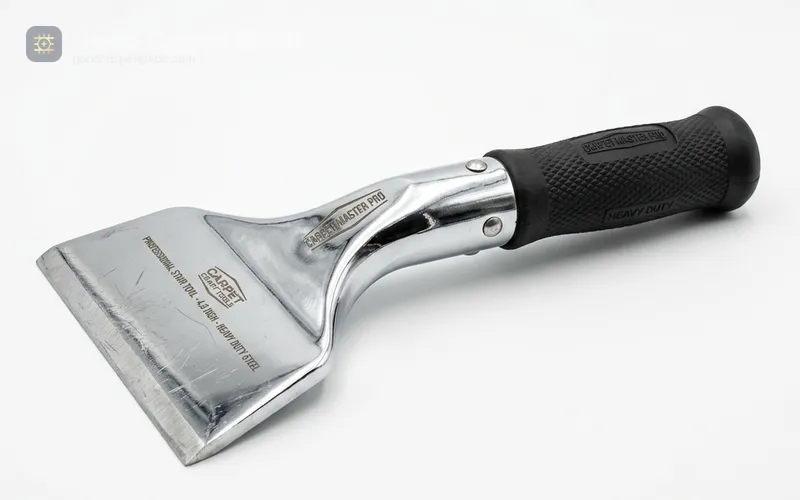
Stair Tool for Carpet Installation
The hand tool installers use to blend staples into the stair nose and finish the tuck along waterfall or Hollywood wrap installations.
Check Price on AmazonChoosing by household type
A hallway with moderate shoe traffic and no significant pet-stain risk is well served by mid-grade nylon 6,6 at $4.00 to $8.50 per sq ft installed, laid over an 8-lb to 10-lb firm pad. That combination buys the longest texture retention for the money.
Households with pets or frequent spills should look at nylon 6,6 with a stain-release treatment or a solution-dyed polyester line, accepting some loss of long-term texture retention in exchange for stain performance. Either choice needs written stair-rated warranty confirmation before the contract gets signed.
Waterfall installation is the cost-rational default for most straight staircases. Hollywood wrap justifies its extra $250 to $500 per flight only where the stair nose sits in a sightline the household sees every day.