tl;dr recommendation matrix
| Cleaning situation | Recommended method | Main mechanical reason | Expected drying time | Primary structural risk |
|---|---|---|---|---|
| Small fresh spill | Hand spot cleaning with microfiber | Limits moisture volume to localized spill boundary | Several hours | Overworking the pile |
| Pet accident | Spot cleaner with controlled extraction | Removes liquid and organic contamination from backing/pad | 12–24 hours | Incomplete rinsing leaving detergent residue |
| 12–16 dirty stairs | Rental or professional extractor | Higher extraction capacity across full flight | 12–24 hours DIY; 2–6 hours Pro | Over-wetting backing and pooling in tread crease |
| Heavily matted traffic lanes | Certified professional cleaning | Higher suction lift (CFM) and controlled 150 PSI pressure | 2–6 hours | Permanent pile distortion if unaddressed |
| Wool or delicate loop pile | Professional assessment / suction-only tool | Reduces snagging and prevents fiber distortion | Depends on system | Bullnose loop zippering and cellulosic browning |
| Repeatedly wet stairs | Stop wet cleaning; inspect subfloor | Moisture may have reached backing, tack strips, or wood | Depends on damage | Delamination, carbon-steel rust, subfloor rot |
Drying ranges vary by cleaning method and equipment. Exact conditions depend on ventilation, humidity, carpet construction, backing, and moisture load.
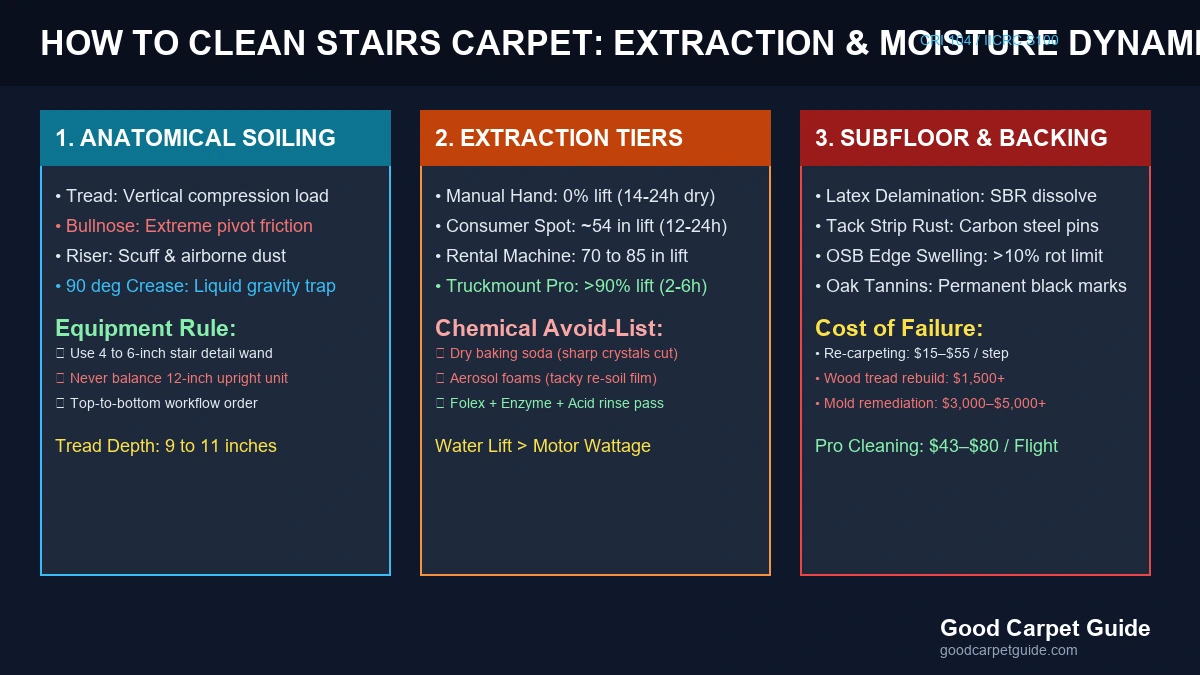
The safest protocol for how to clean stairs carpet is to vacuum dry particulates first, spot-test the cleaning chemistry, apply limited solution volume to one step at a time, agitate strictly according to pile construction, and extract moisture aggressively. The physical geometry of residential staircases dictates this rigorous workflow: standard US building codes specify tread depths between 9 and 11 inches, making standard 10-to-12-inch upright carpet extractors mechanically unstable and dangerous on steps.
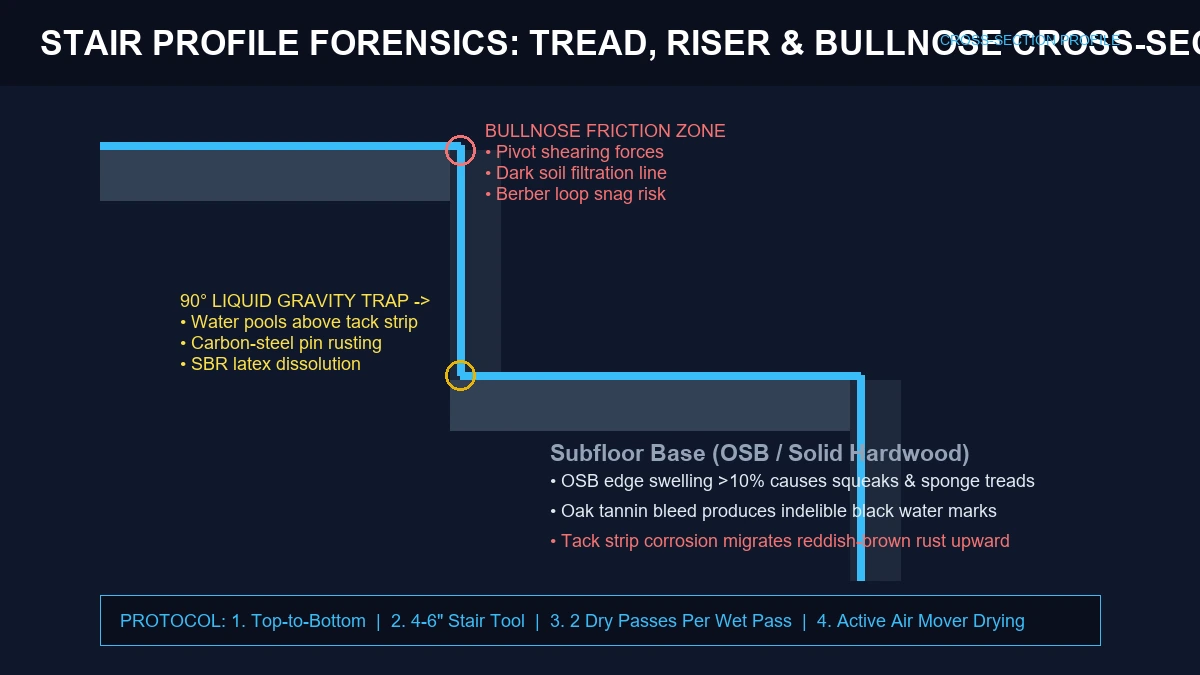
Deep cleaning stairs requires separate engineering protocols for the horizontal tread, vertical riser, and curved bullnose. While the tread absorbs vertical compression footfalls, the bullnose absorbs severe pivoting friction that distorts fiber pile and embeds soils deep into the backing. Furthermore, gravity relentlessly pulls excess liquid down into the 90-degree tread-riser junction and wall edges. Uncontrolled liquid pooling dissolves latex adhesive binders, corrodes carbon-steel tack strip pins, and triggers irreversible subfloor swelling.
how to deep clean stairs carpet
To deep clean stairs carpet, vacuum loose soil, treat localized stains, clean one stair at a time, and extract moisture before moving downward. A narrow stair tool is preferable because standard upright cleaning heads commonly measure about 10–12 inches while residential stair treads are commonly about 9–11 inches deep.
The cleaning sequence matters because dry soil becomes embedded through repeated foot traffic. The horizontal tread receives vertical compression, while the bullnose receives additional friction as people pivot their feet. A wide brush head cannot properly follow the bullnose curve.
Start at the highest stair and work downward. Keep the cleaning solution volume low enough that liquid does not collect in the tread-riser crease. Gravity moves excess solution toward lower portions of the staircase, so a wet upper stair can create problems on the steps below.
step 1: execute thorough dry pre-vacuuming
Use a crevice tool or narrow attachment around the stair edges and tread-riser junction. Vacuum each tread, riser, and bullnose separately.
The bullnose deserves particular attention because ordinary vacuum heads may leave soil concentrated along the curved edge. Repeated foot pressure pushes dry particles deeper into the pile.
Do not skip vacuuming before wet cleaning. Loose grit mixed with water forms a soil suspension that can spread across the carpet instead of leaving the carpet through extraction.
step 2: inspect carpet construction and fiber type
Identify whether the staircase uses cut-pile nylon, polyester, loop pile, Berber, wool, or another construction before selecting an agitation method.
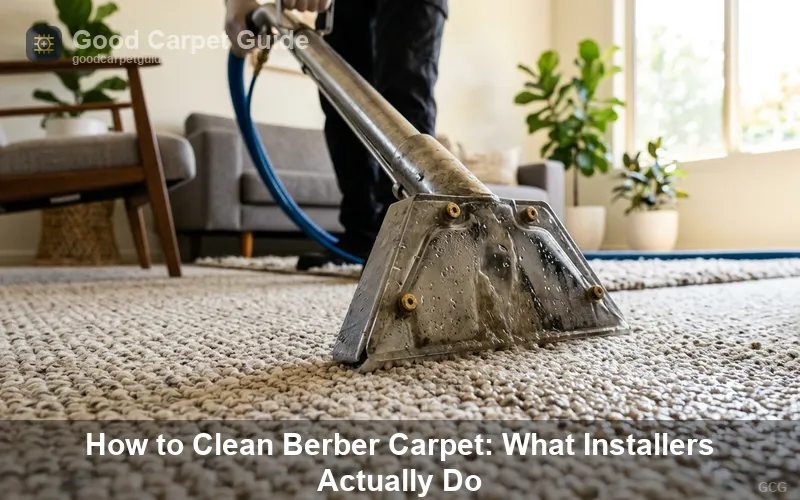
Looped Berber requires particular care. A rotating brush or stiff scrub brush can catch individual loops and produce fraying or yarn distortion, especially around the bullnose where mechanical wear is already high.
For looped Berber, use a soft-bristled brush or suction-only upholstery-style tool where appropriate.
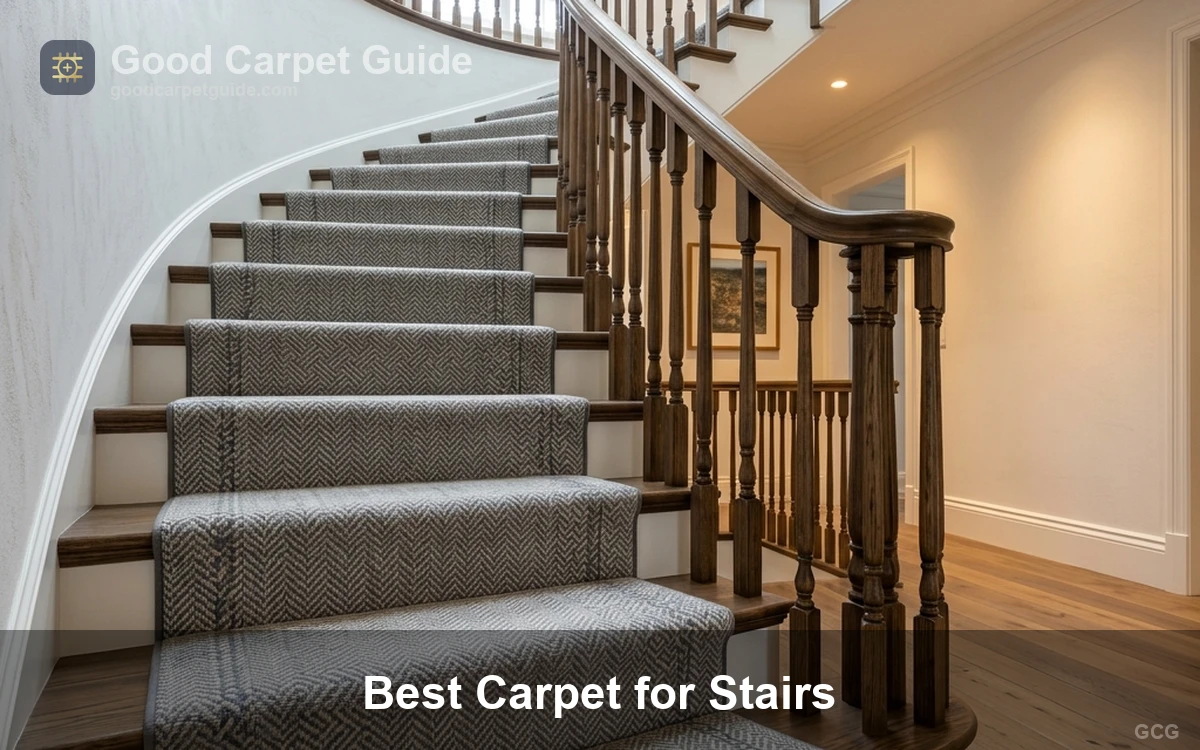
If the staircase is part of a larger carpet installation, construction and traffic requirements should also be considered before repeated wet cleaning. The best carpet for stairs guide provides the relevant relationship between carpet construction, stair traffic, and wear.
step 3: spot-test cleaning chemistry
Apply the selected solution to an inconspicuous section and check for color change, texture change, or bleeding before treating the visible area.
Avoid mixing several chemicals simply because a stain remains visible. Different carpet fibers, dyes, backings, and previous treatments can respond differently to cleaning chemistry.
Vinegar and acidic mixtures are a concern for latex-backed carpet. Repeated exposure to acidic solutions or excessive water can contribute to backing failure under susceptible conditions.
step 4: apply controlled pre-treatment
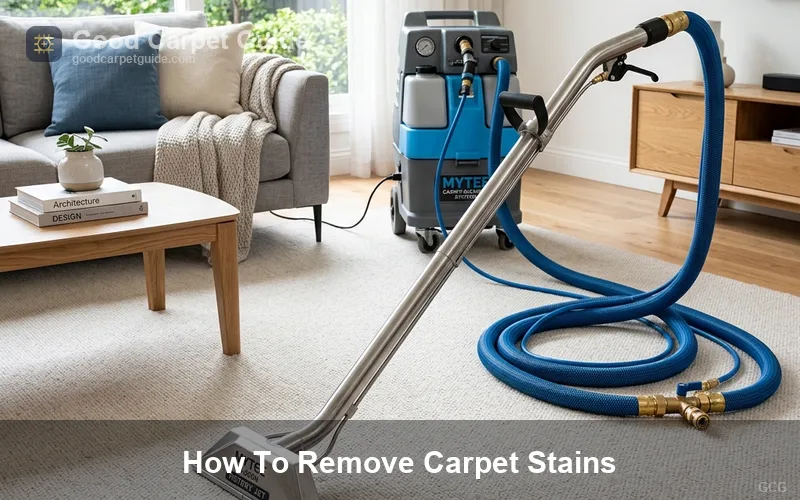
Apply enough solution to suspend soil without saturating the carpet backing. Work across the tread and then address the riser. For targeted stain protocols, reference our guide on how to remove carpet stains .
Use a narrow stair tool rather than trying to balance a full-size upright machine on the step. A heavy machine can slide or tumble because of vibration, limited tread depth, and restricted hose movement.
For a staircase with 16 steps, the logistics can become significant. Consumer spot cleaners with small tanks may require repeated trips to a sink, which increases labor and makes consistent cleaning more difficult.
step 5: perform overlapping extraction passes
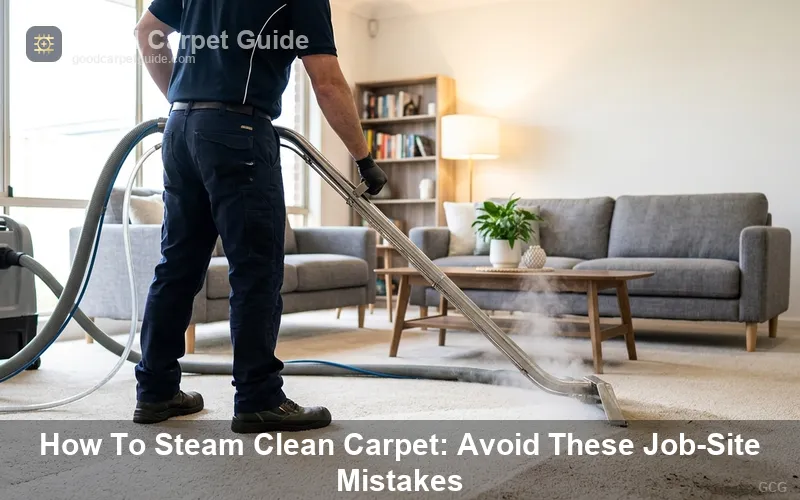
Make additional extraction passes after the cleaning pass. The objective is to remove suspended soil and cleaning solution rather than leaving detergent in the pile. Follow the extraction principles outlined in how to steam clean carpet .
Consumer spot cleaners have substantially less extraction capacity than professional systems. Average consumer spot cleaners provide approximately 54 inches of water lift, while professional truckmount extractors remove more than 90% of moisture under appropriate operating conditions.
Drying time is directly affected by residual moisture. A professionally extracted staircase may dry within roughly 2–6 hours under suitable conditions, while DIY wet-cleaning methods can require approximately 12–24 hours or longer.
step 6: establish active drying airflow
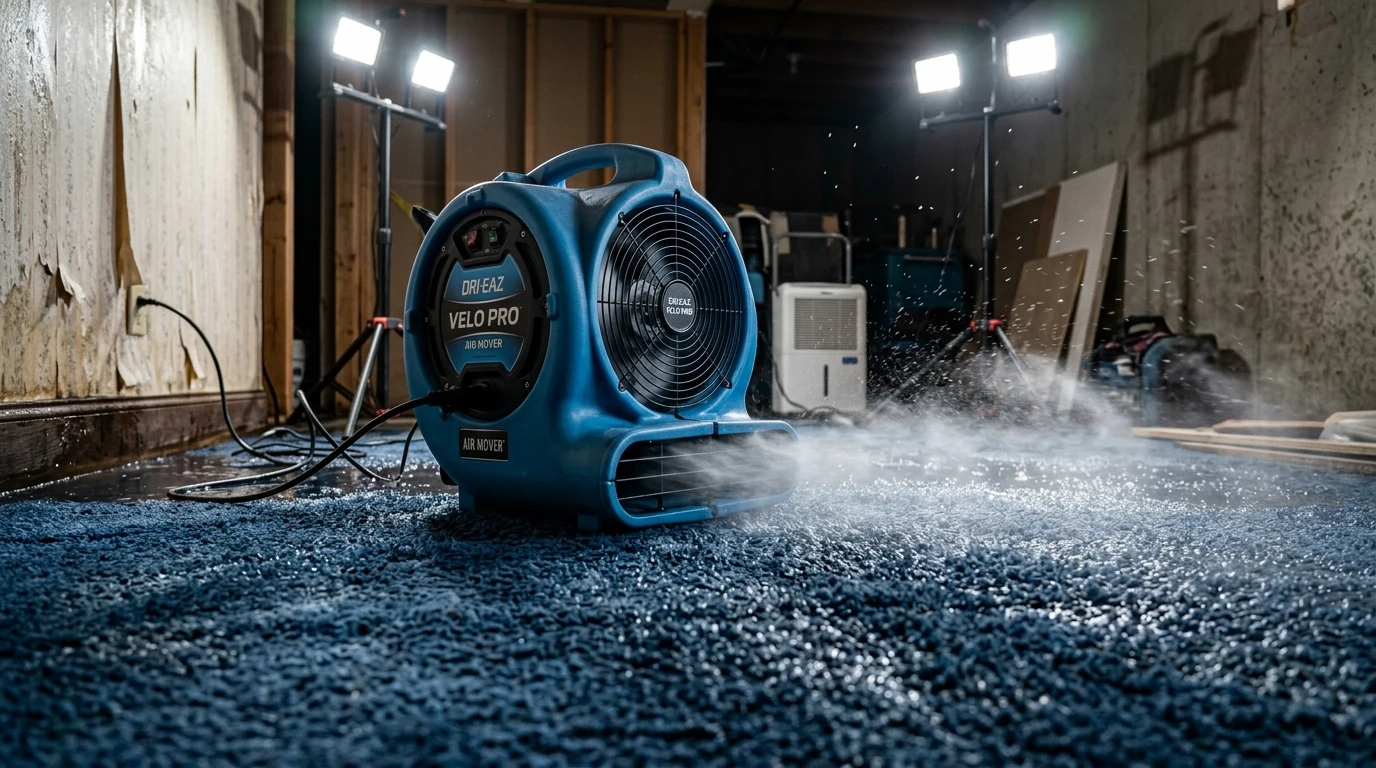
Increase air movement and ventilation after cleaning. Keep foot traffic off the wet carpet until the pile is adequately dry.
Pay particular attention to the edges near the wall and the tread-riser crease. These areas can retain water after the visible surface appears relatively dry.
A staircase that remains damp for an extended period requires inspection rather than repeated chemical treatment. Moisture can reach the carpet padding, backing, tack strips, and subfloor.
how to deep clean carpet on stairs without a machine
To deep clean carpet on stairs without a machine, vacuum thoroughly, use a small amount of compatible cleaning solution, agitate gently with a suitable brush, and remove moisture with absorbent towels or a suitable extraction attachment. This method is labor-intensive and provides less extraction than a dedicated carpet extractor.
Manual cleaning works best for localized soil rather than an entire heavily soiled staircase. Manual cleaning typically requires approximately 14–24 hours of drying time, with relatively low extraction capacity.
A manual process requires strict control. Vacuum every tread, riser, and bullnose before treating individual spots. Apply minimal solution, agitate gently according to pile construction, blot moisture immediately with dry microfiber towels, and maintain active airflow.
Do not compensate for weak extraction by adding more cleaning solution. Detergent left in carpet fibers can produce a sticky or tacky feel after drying. Residual surfactants can attract additional soil and cause traffic lanes to become dirty again quickly.
Baking soda is also a poor choice for routine carpet cleaning. Small sodium bicarbonate crystals can remain inside dense carpet pile after household vacuuming. Foot traffic can move the particles against fiber surfaces, while fine powder can also enter vacuum components.
how to clean dirty stairs carpet without machine
To clean dirty stairs carpet without a machine, concentrate manual cleaning on soil hotspots rather than soaking every stair. The highest-priority areas are the tread center, front walking edge, bullnose, and tread-riser junction.
Dark lines along the stair edge require diagnosis before aggressive scrubbing. A darkened line can represent ordinary traffic soil, but older installations can also develop discoloration associated with tack-strip rust, degraded adhesive, or wood resins.
Repeated wet cleaning can mobilize these compounds. Carbon-steel tack-strip pins can develop reddish-orange rust staining, while degraded adhesives may produce darker brown or black discoloration. Wood resins can create yellowish-brown staining.
If a dark edge remains after reasonable soil removal, more scrubbing is not necessarily the correct next step. Chemical identification should precede additional treatment.
how to clean carpet stairs with baking soda
You should not use dry baking soda as the primary cleaning method for carpet stairs. Household vacuums may leave fine sodium bicarbonate particles inside dense pile, where foot traffic can increase mechanical abrasion.
The safer approach is to remove dry soil with a vacuum and use a carpet-compatible liquid spot treatment for localized stains. Dry baking soda remains a strict avoid item for routine stair carpet maintenance.
Baking soda combined with vinegar also creates an ineffective compromise for deep carpet cleaning. The reaction produces visible bubbling, but the resulting mixture does not provide the extraction capability required to remove suspended soil from the carpet backing and pile.
Acidic vinegar mixtures also introduce a separate backing concern. Susceptible latex-backed carpets can experience adhesive deterioration when exposed to acidic solutions or excessive water.
how to clean stairs with a vax carpet cleaner
A Vax carpet cleaner can be used on stairs only when the model provides an appropriate hose and stair attachment and the machine can remain stable during operation. The machine should never be balanced precariously on a narrow tread.
Before using a Vax system, verify the manufacturer instructions, hose reach, attachment size, solution requirements, and recovery capacity.
Use the same operational principle as other extractors: low solution volume, controlled agitation, immediate extraction, and active drying.
The staircase geometry remains the limiting factor. A machine designed for floor cleaning may perform well on a broad room surface while becoming awkward on a 9–11 inch stair tread.
how to clean stairs carpet with bissell
A Bissell spot cleaner is suitable for localized stair cleaning because its compact form and stair-oriented attachments can fit areas that an upright carpet cleaner cannot. The compact form reduces physical instability on narrow treads.
The Bissell SpotClean Pro (model 3624/3624A) features a 96 oz clean-water tank, 5 ft hose, 22 ft cord, 13.2 lb weight, a 6-inch stair tool, and generates approximately 15,000 Pa of suction lift.
The machine compact form reduces the physical problem created by narrow stair treads, but the operator still needs to place the main unit on a stable surface. Do not position a heavy machine where vibration can make it slide toward the stair edge.
The dirty-water tank and hose should be cleaned after use. The dirty-tank baffles can trap residue and contribute to musty odors if cleaning is incomplete.
Caption: A compact extraction machine with a narrow stair tool allows the tread, riser, and bullnose to be treated separately, which reduces the equipment and moisture problems created by standard upright cleaners.
how to clean stairs with a carpet cleaner
To clean stairs with a carpet cleaner, use a machine that can safely reach the stair surface with a narrow attachment while keeping the main unit stable. Extraction capacity matters more than motor wattage alone.
Water lift is the relevant extraction measurement. A consumer spot cleaner may provide approximately 54 inches of water lift, while professional truckmounted systems can exceed 90% moisture extraction under suitable operating conditions.
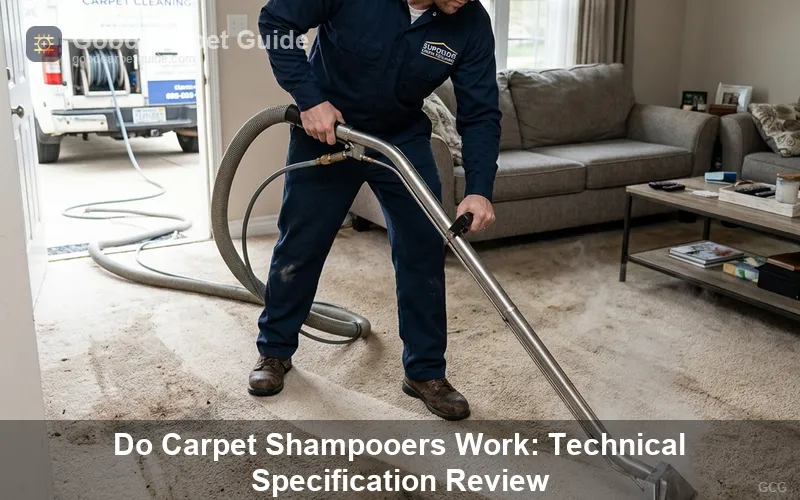
A machine with a higher wattage rating does not automatically provide better stair cleaning. Vacuum design, airflow, water lift, recovery system, attachment geometry, and operator technique all influence how much moisture remains in the carpet. Compare system mechanics in our guide on carpet cleaning methods compared .
practical machine-cleaning sequence
- Vacuum the staircase thoroughly.
- Pre-treat localized stains.
- Allow the treatment to dwell according to instructions (5–8 minutes).
- Apply limited cleaning solution.
- Agitate gently according to carpet construction.
- Make slow extraction passes.
- Make additional dry passes where moisture remains.
- Check the tread-riser crease and wall edges.
- Ventilate the staircase actively with air movers.
- Keep traffic off the carpet during drying.
The same sequence applies whether the machine is a Bissell, Hoover, Rug Doctor, Vax, or another compatible extractor. Model-specific instructions override generic procedures.
professional staircase cleaning cost breakdown: per-step pricing and regional rates
The cost to clean carpet on stairs depends on the contractor per-step rate, minimum service charge, staircase size, and location.
Across the United States, professional stair cleaning rates average .00 to .00 per step in standard markets, and .00 to .00 per step in higher-cost metropolitan areas. A standard flight of 12 to 16 stairs is often bundled as a flat package ranging from .00 to .00, while intermediate landings are billed at .00 to .00 each.
Contractors enforce minimum visit fees ranging from .00 to .00 (.00 in major metros). If a homeowner books cleaning exclusively for a single flight of stairs, the minimum service fee applies, bringing the effective cost to roughly .00 to .00 per step.
regional staircase cleaning price benchmarks
| Metropolitan Region / State | Average Per-Step Rate | Flat Flight Package (12–16 Steps) | Typical Minimum Visit Fee | Primary Local Environmental Driver |
|---|---|---|---|---|
| Dallas-Fort Worth (DFW), TX | .00 – .00 | .00 – .00 | .00 – .00 | Highly competitive metro market; multi-room bundle discounts common |
| State of Tennessee | .00 – .00 | .00 – .00 | .00 – .00 | Standard suburban market; low regional overhead |
| Orlando, FL | .00 – .00 | .00 – .00 | .00 – .00 | High coastal humidity requires professional air movers to prevent mold |
| Charlotte, NC | .00 | .00 | .00 | Heavy red-clay tracking requires high-pressure industrial pre-treatment |
| Denver, CO | .00 | .00+ | .00 – .00 | Low-moisture extraction protocols adapted for high-altitude drying |
how much does it cost to clean stairs carpet: diy vs replacement roi
The cost of professional stair carpet cleaning should be evaluated against the substantial cost of replacing carpet, padding, tack strips, or damaged subfloor wood.
- DIY Equipment Cost: Purchasing a quality portable spot cleaner (–) plus specialized pre-treatments (–) requires roughly – upfront.
- Cost of Over-Wetting Failure:
- Re-carpeting a 14-step staircase: .00 to .00 per step ( to total material and labor).
- Full replacement including new padding and rusted tack strips: .00 to .00 per step ( to total).
- Structural subfloor repairs (warped hardwood treads or swollen OSB): ,500.00+.
- Mold remediation for a water-damaged staircase: ,000.00 to ,000.00+.
The decision is therefore economic as much as technical. A homeowner can spend less on a DIY machine and still lose money if repeated wet cleaning damages the backing, tack strips, padding, or subfloor.
structural risks of overwetting: latex delamination, tack strip rust, and subfloor swelling
Overwetting stair carpet can move water into the backing, pad, tack strips, and subfloor. Gravity makes stairs more sensitive to this problem because water travels toward lower surfaces and collects in corners.
Latex-backed carpet can develop delamination when the bonding system deteriorates. Delamination separates primary and secondary backing layers and produces permanent bubbling or rippling.
Tack strips create another moisture-sensitive area. The strips contain carbon-steel pins, and water exposure promotes rust. Rust migrates into carpet fibers and produces reddish-orange or brown discoloration.
Wood substrates also respond badly to excessive water. OSB edges swell by over 10% after moisture exposure, while oak treads can warp or cup. Oak tannins produce dark, indelible black staining after water exposure under susceptible conditions.
These failure modes explain why a visibly dirty staircase should not automatically receive more water and more detergent.
when a professional stair carpet cleaning service makes more sense
Professional cleaning makes more economic sense when the staircase has heavy matting, persistent pet contamination, delicate wool or Berber construction, or a history of moisture problems.
Professional systems provide higher extraction capacity and use narrow stair tools designed for controlled application and recovery. Certified IICRC technicians utilize extractors operating at approximately 150 PSI and commercial truckmounts delivering 220°F+ water under appropriate conditions.
Professional extraction also reduces drying time. A professionally extracted staircase typically dries in 2 to 6 hours compared with 12 to 24 hours for DIY methods.
The value of professional cleaning rises when the cost of a failed DIY cleaning approaches the cost of replacing carpet or repairing the substrate.
how to clean carpeted stairs without damaging the bullnose
Clean the bullnose with controlled agitation and a tool that follows the curve. The bullnose experiences concentrated friction because feet pivot across the front edge of the tread.
Loop pile requires the greatest caution. A rotating brush can catch loops and pull or distort yarn. A soft brush or suction-only attachment is more appropriate for susceptible looped constructions. Aggressive agitation can cause permanent runs.
Cut pile provides more flexibility for agitation, but aggressive scrubbing can still distort the pile crimp and accelerate visible traffic wear.
The correct method therefore depends on both the soil condition and the carpet construction. A traffic-darkened bullnose should receive targeted pre-treatment and light manual agitation rather than repeated high-force machine brushing.
hand-cleaning methods vs portable spot extractors: equipment comparison
The best equipment depends on the amount of soil, staircase size, carpet construction, and expected cleaning frequency.
| Method | Labor | Extraction | Typical drying range | Best use |
|---|---|---|---|---|
| Manual cleaning | Very high | Low | 14–24 hours | Small areas and localized stains |
| Consumer spot cleaner | High | Moderate (~54 in water lift) | 12–24 hours | Spills, pet accidents, occasional cleaning |
| Rental extractor | High | Moderate to high | 12–24 hours | Larger DIY cleaning projects |
| Certified professional | Low homeowner labor | High (>90% extraction) | 2–6 hours | Heavy soil, delicate carpet, difficult stairs |
A consumer spot cleaner becomes easier to justify when spills and pet accidents occur regularly:
- Bissell SpotClean Pro (3624/3624A): 96 oz clean tank, 5 ft hose, 22 ft cord, 13.2 lb weight, 6-inch stair tool.
- Hoover CleanSlate Pro (FH14020V): 40 oz clean tank, 4.5 ft hose, 18 ft cord, 9 lb weight.
- Rug Doctor Pet Portable (93390/93306): 64 oz tanks, 5.5 ft hose, 15 ft cord, 16.5 lb weight, approximately 88 inches of water lift.
- Shark StainStriker HairPro (PX251): 24.3 oz tank, 4.5 ft hose, 12 ft cord, 8.5 lb weight.
Tank size directly impacts stair-cleaning labor. A smaller tank requires more refilling and emptying, which becomes significant over 12–16 stairs.
chemical safety and the avoid-list: why baking soda and unrinsed foams ruin stairs
Avoid dry baking soda, aerosol foams, and unrinsed shampoos for routine stair carpet cleaning.
Dry baking soda remains trapped in dense pile, where crystalline particles act like sandpaper under footfalls. Aerosol foams and concentrated shampoos leave sticky surfactant residues that accelerate traffic-lane graying.
- Folex Instant Carpet Spot Remover: Preferred pre-treatment for water-soluble organic stains.
- Enzymatic Cleaners (Nature's Miracle / Bissell Pet Oxy): Digestion chemistry for bio-protein and urine contamination.
- Color-Safe Oxidizers: Tested for fiber safety on synthetic traffic paths.
- Mild Acid Rinse: 1/4 cup white vinegar per gallon of clean water to neutralize alkalinity and eliminate surfactant stickiness.
how to tell whether the dark line is soil or damage: tack strip bleed diagnosis
A dark line that remains after reasonable cleaning may indicate a material problem rather than removable soil.
| Appearance | Potential source | Mechanism |
|---|---|---|
| Reddish-orange | Carbon-steel tack-strip rust | Moisture oxidizes steel pins and carries iron compounds upward into fibers |
| Dark brown or black | Degraded adhesive | Moisture mobilizes degraded SBR latex backing or adhesive compounds |
| Yellowish-brown | Wood resin | Moisture mobilizes resins from susceptible Douglas fir or pine wood strips |
Aggressive scrubbing should stop when the discoloration behaves differently from ordinary surface soil. Specialized rust treatments may be required for iron-oxide staining, but the correct chemistry should be selected after diagnosing the stain source.
when stair carpet should be replaced instead of repeatedly cleaned
Replacement becomes more rational when the pile has permanent traffic-lane matting, the backing has delaminated, tack strips have deteriorated, or the substrate has sustained water damage.
Repeated cleaning cannot restore permanently crushed fiber geometry. A carpet with severe bullnose distortion will remain visibly worn even after successful soil extraction.
The economics also change when padding and tack strips require replacement. Replacing carpet without correcting damaged underlying components leaves the installation unstable.
the practical cleaning rule for most homeowners
For routine stair maintenance, vacuum frequently, spot-clean spills promptly, and reserve full wet extraction for periods when the staircase can remain unused while drying.
A compact spot cleaner is reasonable for localized spills because the operator can control the treated area. Full DIY extraction becomes less attractive as staircase size, soil load, and carpet sensitivity increase.
A professional cleaner provides the better value when high extraction capacity, short drying time, or specialized treatment is required for wool, Berber, heavily matted traffic lanes, or pet urine contamination.
The core rule is simple: remove dry soil first, add the minimum effective amount of cleaning solution, extract aggressively without flooding the staircase, and stop when discoloration indicates a backing, tack-strip, or substrate problem rather than surface dirt.