Carpet underlayment alternatives decide whether new flooring survives five years or fifteen. A homeowner comparing carpet for basement rooms, bedrooms, or stairs runs into the same wall of options every time: rebonded foam, prime foam, memory foam, frothed foam, flat rubber. Density rating and moisture barrier type matter more than brand name in nearly every failure case documented below.
TL;DR Recommendation Matrix
| Homeowner Scenario | Best Underlayment Alternative | Why It Fits |
|---|---|---|
| Bedroom, allergy or asthma history | Healthier Choice HC Green 7/16" 10-lb memory foam | Greenguard Gold and CRI Green Label Plus certified, eliminates VOC off-gassing |
| Concrete slab with unknown moisture history | Frothed foam with dual moisture barrier (Shaw Courage) after slab testing | Resists vapor drive without sealing untested moisture underneath |
| Berber or low-profile loop carpet | Carpenter Serenity 8-lb Rebond, 3/8" max | Prevents loop stretch and backing separation |
| High-traffic living room | 8-10 lb density rebond or ComfortTouch foam | Resists matting and crushing, supports proper power stretching |
| Stairs | Leggett & Platt Elite DuraPlush with StairGuard | Built for nosing wear and repeated flex |
| Flooded or water-damaged room | Full pad replacement, never reused | Wet pad traps mold permanently regardless of drying effort |
| Vinyl or laminate over concrete | MP Global QuietBoard or DMX 1-Step 2.0 | Subfloor moisture management designed for hard flooring, not carpet cushion |
what are the main carpet underlayment alternatives
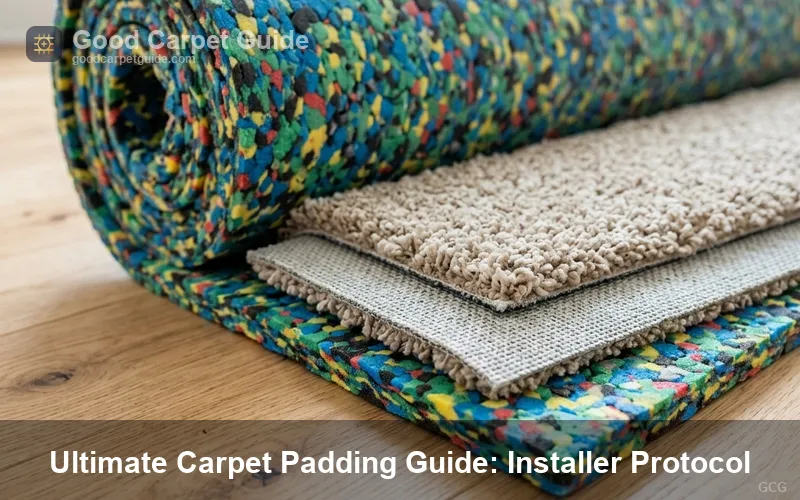
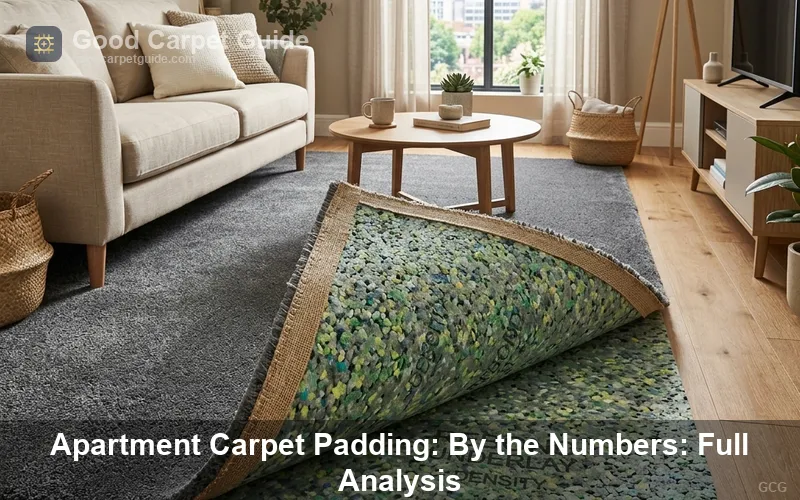
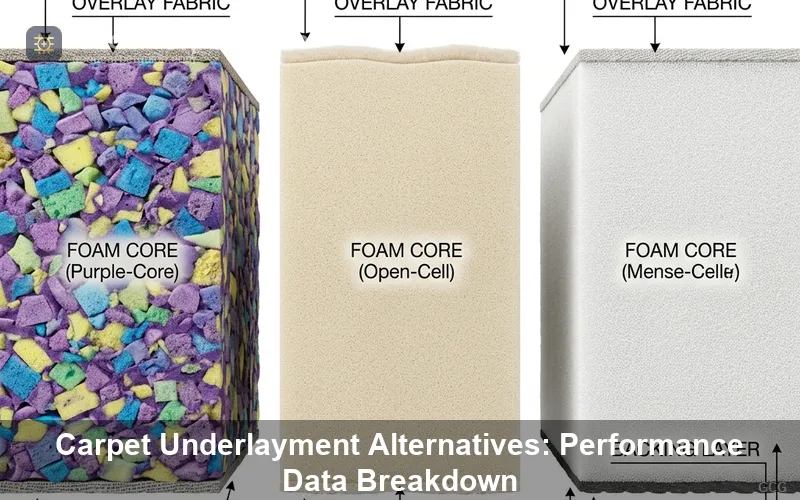
Six material categories cover nearly every carpet underlayment alternative sold in the US market. Rebonded foam uses recycled foam scraps compressed into a dense sheet and costs $0.25 to $0.80 per square foot. Prime foam is virgin polyurethane foam poured in sheets, priced between $0.25 and $1.50 per square foot depending on density.
Memory foam padding, priced $0.50 to $1.00 per square foot, distributes body weight and reduces pile crush in furniture zones. Synthetic fiber, jute, and felt padding run $0.35 to $1.25 per square foot and suit installations where chemical sensitivity rules out foam products entirely. Frothed foam, a higher-end urethane poured directly during manufacturing, costs $0.50 to $2.00 per square foot and delivers the densest, most stable core on this list.
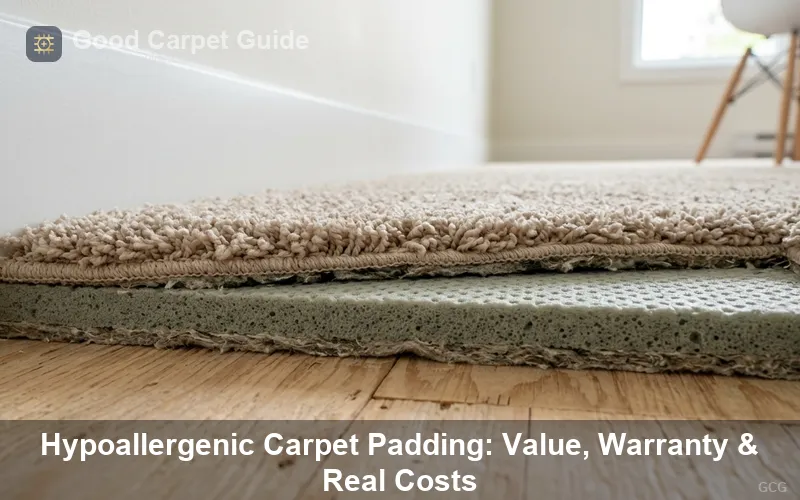
Flat rubber padding sits at the top of the price range, $0.75 to $3.00 per square foot, and performs best under commercial-grade carpet or in rooms needing maximum sound dampening. Leggett & Platt dominates the mid-to-premium tier with the Napa line (DuraPlush foam, Triple Protection barrier system, $0.85-$1.15 per square foot) and the entry-level Coronado prime urethane foam ($0.45-$0.65 per square foot). Healthier Choice occupies the allergy-focused segment with HC Green, a 100% high-density memory foam pad carrying Greenguard Gold and CRI Green Label Plus certification.
Carpenter Co. supplies local specialty dealers with Serenity 8-lb rebond and Viscobond Spillguard, which adds a surface-level moisture barrier that keeps spills from soaking into the pad core. High-tech alternatives outside the traditional foam category include Palziv HQ Living, a closed-cell polyethylene foam rated 100% waterproof with a 93 IIC sound rating, and DMX 1-Step 2.0, a dimple-textured foam built for vapor and thermal barrier duty under vinyl or laminate. Choosing among these options starts with matching density and moisture-barrier type to the subfloor, not with picking a brand first — a full carpet padding selection guide breaks each carpet cushion option category down by room type.

Density and core material decide long-term performance more than surface texture does — the next section maps each subfloor condition to its matching pad type.
how to choose carpet underlayment alternatives by subfloor type
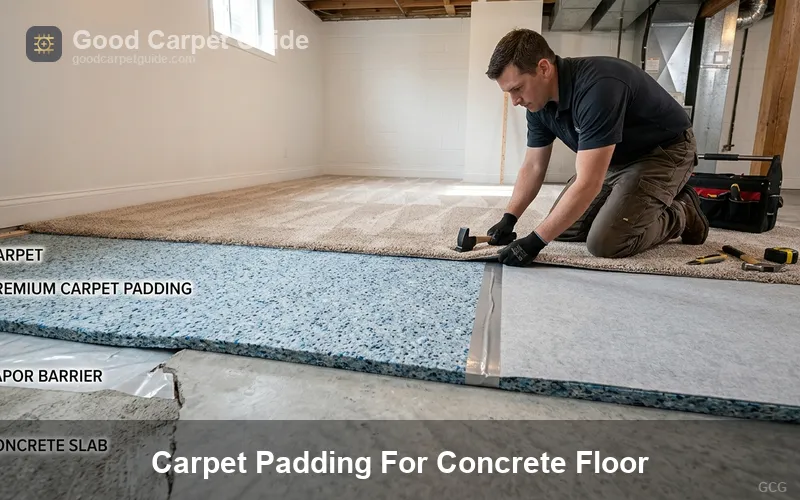
Concrete subfloor moisture drives more carpet underlayment alternative failures than any other single factor. A simple test isolates the problem before any pad gets installed: tape a 12-inch by 12-inch square of clear polyethylene sheet flat to the bare concrete, sealing all four edges with duct tape, and check it after 24 hours. Condensation forming underneath the plastic indicates vapor drive rising through the slab itself; condensation forming on top of the plastic points to ambient room humidity instead.
This test costs nothing and requires no tools beyond plastic sheeting and tape, yet it rarely appears in retail buying guides. Skipping it has consequences documented directly by renters and DIYers. One Florida tenant on a slab-on-grade unit described a carpet that stayed "damp for so long" the backing stained and the pad developed a sand-like residue, alongside diagnosed mold allergy symptoms that included recurring headaches and asthma flare-ups.
A separate Florida DIYer laying laminate over concrete with a standard 6-mil vapor barrier found moisture droplets on the underside of the barrier after installation, confirming active vapor drive the barrier alone did not stop. Concrete subfloor moisture testing has to happen before any moisture-barrier pad goes down, not after symptoms appear. Wood subfloors carry far lower moisture risk and accept standard rebonded or prime foam without additional vapor testing in the large majority of cases.
Basement installations sit in a middle category: below-grade concrete, frequently adjacent to grade-level soil moisture, warrants the same plastic-sheet test plus a hygrometer reading before any carpet or pad purchase. Stairs need a different selection logic entirely, prioritizing structured foam with reinforced nosing support like Leggett & Platt's StairGuard line over standard flat padding. Matching pad category to subfloor type, not to showroom feel alone, is the single highest-leverage decision in the entire underlayment alternatives category.
do carpet manufacturers and installers agree on pad thickness limits
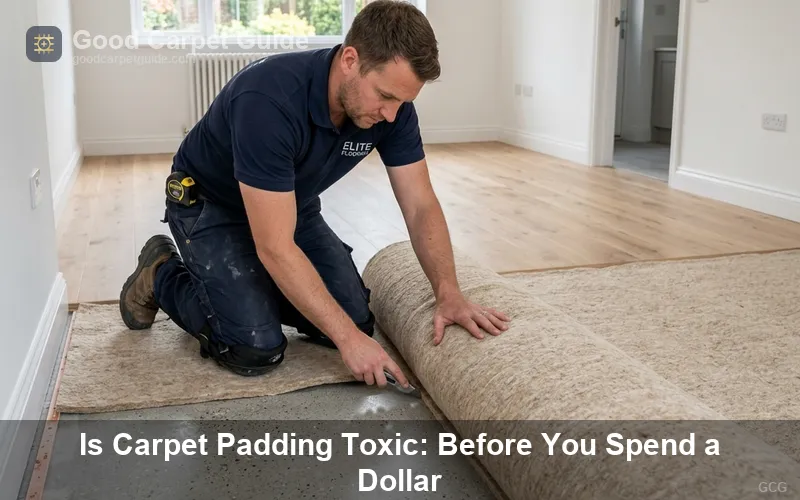
Manufacturer warranty language and field installation practice conflict on two specific points: stretching method and pad thickness. Phenix Flooring's warranty states plainly that installations must be stretched in over padding using a power stretcher, and that a "Stinger" knee-kicker-style tool used in place of a power stretcher voids the warranty outright because it permanently damages the carpet backing. High-volume installers, particularly subcontractor crews paid by the room rather than by the hour, frequently bypass the power stretcher anyway.
Consequences of skipped power-stretching rarely show up on install day. Bubbling and wrinkling typically surface twelve to eighteen months later, once foot traffic and temperature cycling work the slack out of an improperly tensioned carpet. Firmer pads — 8-lb rebond or frothed foam — resist what installers call the "Kleenex effect," where thin, cheap padding tears and balls up under stretcher tension instead of holding its shape.
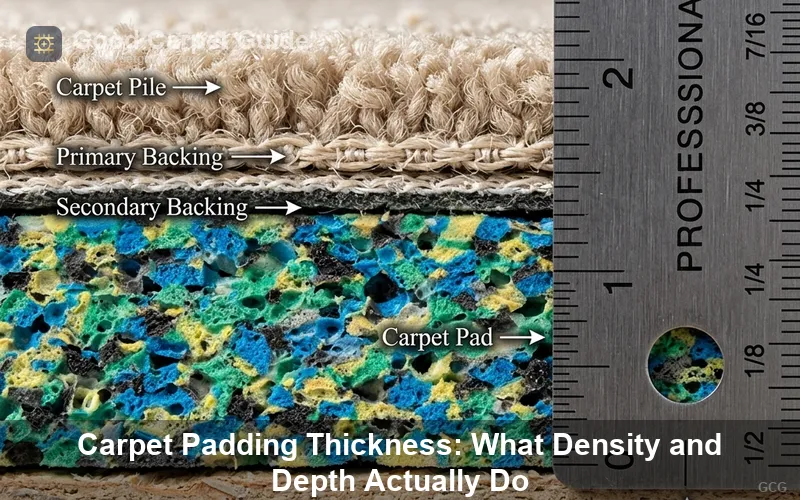
Thickness limits create the second manufacturer-installer conflict. Retail marketing frequently promotes half-inch open-cell padding as a luxury upgrade, but excessive thickness under a fully adhered or stretched carpet flexes the backing beyond its design tolerance. That flex separates the primary backing from the secondary backing over time, a failure mode with no field repair. Berber and other low-profile loop carpets carry the tightest restriction in the entire category: a maximum 3/8-inch pad thickness paired with a minimum 8-lb density, per manufacturer specification.
Thick, soft padding under looped carpet stretches individual loops until they pull free from the backing, tearing the backing adhesive apart from underneath. A claims inspector finding a half-inch pad under a Berber installation treats it as an automatic warranty denial, no further inspection required. Density rating and warranty compliance move together on every spec sheet in this category — the 8lb vs 10lb density comparison page details exact thresholds by carpet construction type.
what the warranty fine print hides about reusing old underlayment
Extended warranty language is a sales tool first and a performance guarantee second. Shaw extends its carpet warranty from the standard term out to ten years when the carpet is installed over Shaw's own Courage pad line, a pairing requirement buried in warranty fine print rather than stated on the price tag. One installer summarized the practical value bluntly: the extended coverage doesn't change the physical outcome much, but it closes the sale.
Manufacturer warranties, extended or standard, exclude matting, crushing, wrinkling, vacuum cleaner damage, pet damage, and any moisture-related failure regardless of pad quality. A second warranty trap concerns reusing padding across two separate carpet installations. Premium pad lines carrying a "Life-of-the-Home" warranty describe the life of the original carpet installed over that pad, not the life of the physical building.
Stretching a second, newer carpet over that same existing pad voids the underlayment warranty immediately, a condition retail buying guides almost never disclose. Backing adhesive breakdown compounds this risk on older installations: wet adhesive degrades over time into a brown, gritty, sand-like dust that releases a musty odor and can trigger asthma symptoms even after the original moisture source is gone. A full breakdown of this failure mode, including how to identify it before it spreads, is covered in the carpet delamination and backing adhesive breakdown section of this guide.
Cleaning method interacts with warranty terms too. Most manufacturers require hot water extraction performed by an IICRC-certified technician and explicitly exclude home steam mop use from approved maintenance. DIY steam cleaners run hot enough to strip factory-applied stain-resistant coatings off synthetic fibers, and manufacturers run fiber-heat tests specifically to catch this during warranty disputes. A memory foam vs rebond padding comparison is useful context here too, since pad choice and cleaning method both factor into how claims adjusters evaluate a failed installation.
Folex Instant Carpet Spot Remover
Manufacturer-approved spot treatment that avoids the heat damage steam cleaners cause to stain-resistant coatings
Check Price on Amazonhow much do carpet underlayment alternatives cost in the us
Total project cost for carpet underlayment alternatives ranges from $170 to $850, with most homeowners spending close to $510 based on current market pricing. Material cost varies significantly by category: rebonded foam runs $0.25 to $0.80 per square foot, prime foam $0.25 to $1.50, memory foam $0.50 to $1.00, synthetic fiber or jute or felt $0.35 to $1.25, frothed foam $0.50 to $2.00, and flat rubber $0.75 to $3.00 per square foot.
Labor cost depends on scope. A padding-only installation, where existing carpet is lifted and reinstalled over new pad, costs $0.50 to $1.00 per square foot in labor. A full carpet-and-pad replacement runs $3.00 to $11.00 per square foot including materials and labor combined. Old carpet and pad removal plus disposal adds $0.50 to $5.00 per square foot on top of either scenario, depending on local disposal fees and square footage.
| Cost Factor | Range |
|---|---|
| Total average project | $170-$850 (typical: ~$510) |
| Rebonded foam material | $0.25-$0.80/sq ft |
| Frothed foam material | $0.50-$2.00/sq ft |
| Flat rubber material | $0.75-$3.00/sq ft |
| Padding-only labor | $0.50-$1.00/sq ft |
| Full replacement labor + material | $3.00-$11.00/sq ft |
| Removal and disposal | $0.50-$5.00/sq ft |
Density and moisture-barrier features push material cost toward the top of each range. Shaw's Courage 9-lb ComfortTouch pad with a dual moisture barrier costs $1.86 to $2.10 per square foot, well above standard rebonded foam, but the added density and barrier layer directly address the two most common failure modes covered in this guide. Buyers assembling a full room quote should price pad and carpet separately before accepting a bundled big-box estimate, since bundled pricing frequently obscures which pad tier is actually included.

Material cost alone does not predict installation quality — the next section breaks down how big-box and local dealer labor practices diverge on the same pad.
Mohawk SmartCushion Premium Carpet Padding
Mid-tier density option for homeowners pricing a padding-only upgrade separate from full carpet replacement
Check Price on Amazonbig box store vs local dealer: which delivers better carpet pad installation
Material selection and labor practice diverge sharply between big-box retailers and local specialty dealers. Big-box stores stock a narrower product range, typically limited to standard rebonded and prime foam priced $0.25 to $1.09 per square foot, while local dealers carry the full range up to $2.10 per square foot including frothed foam and moisture-barrier products. Installation crews differ just as much: big-box jobs commonly go to subcontractors paid piece-rate per room, creating direct financial pressure to skip power-stretching and finish faster.
Local specialty dealers more often employ master installers with 30 to 40 years of experience who use a power stretcher on every job as standard practice, not as an upsell. One documented case illustrates the gap directly: a homeowner who purchased carpet through a big-box "whole house installed" promotional package found the center seam buckling and tearing within five years, in a single-occupant home with no unusual traffic. Pricing structure compounds the installation-quality gap.
Big-box promotional pricing frequently excludes furniture moving, stair installation, and old-material cleanup as separate line-item fees added after the initial quote. A second, less visible big-box practice involves measurement itself: some estimators lay out carpet in a deliberately inefficient pattern that maximizes material sold, in some documented cases quoting close to double the room's actual square footage, with unnecessary seams placed directly through the middle of open living spaces. Local dealers offering all-inclusive flat bids remove most of this pricing ambiguity upfront.
| Metric | Big-Box Retailer | Local Specialty Dealer |
|---|---|---|
| Material range | $0.25-$1.09/sq ft, standard products only | $0.39-$2.10/sq ft, full product range |
| Installation crew | Subcontractors, piece-rate, power stretcher often skipped | Master installers, power stretcher standard |
| Pricing structure | Promo price plus added fees | All-inclusive flat bid |
| Typical carpet lifespan | Wrinkling or seam failure common in 1-2 years | Up to 40% longer with proper subfloor prep |
The lifespan differential between the two channels traces directly back to subfloor preparation and pad-density pairing, not to carpet fiber quality alone. A dense pad installed without power-stretching still wrinkles within two years; a lighter pad installed with proper technique over a well-prepped subfloor can outperform expectations. Labor practice, not material spec sheet alone, decides most of the outcome documented across these cases.
when should you replace carpet underlayment
Water exposure is the single clearest trigger for full pad replacement, no exceptions. Professional flood remediation crews describe wet padding acting like a sponge: pulling all wet pad out immediately is standard protocol, since the carpet itself can sometimes be salvaged but the pad underneath cannot be dried back to usable condition. Mold growth begins in saturated pad and migrates upward into the carpet backing regardless of how thoroughly the surface is dried afterward.
Backing adhesive breakdown is a second, slower-developing replacement trigger. Adhesive exposed to sustained moisture — even moisture that has since evaporated — degrades into the brown, sand-like dust described earlier in this guide, releasing musty odors that persist independent of any visible dampness. A homeowner noticing gritty residue under lifted carpet edges, paired with a lingering musty smell, is looking at adhesive breakdown rather than a simple dirt buildup.
Off-gassing symptoms mark a third replacement scenario tied directly to pad chemistry rather than moisture. One documented case involved six months of sleep disruption traced to VOC off-gassing from a budget foam pad, resolved only after replacement with a certified low-VOC product like Healthier Choice's HC Green line. Persistent chemical odor, headaches concentrated in a single room, or symptoms that improve when away from home all point toward pad off-gassing as a root cause worth testing before assuming it is the carpet fiber itself.
Visible bubbling or wrinkling eighteen months to two years after installation, discussed earlier in the power-stretcher conflict section, signals pad and stretching failure together rather than pad failure alone. Replacing pad without correcting the stretching method during reinstallation reproduces the same failure on the same timeline. Homeowners weighing a full pad swap should treat any of these four triggers — flood exposure, adhesive breakdown, off-gassing symptoms, or early wrinkling — as sufficient justification on its own, without waiting for multiple symptoms to compound.
Bissell Little Green Portable Carpet Cleaner
Spot extraction tool for isolated spills, useful for containing moisture before it reaches the pad layer
Check Price on Amazonfrequently asked questions about carpet underlayment alternatives
What is the best carpet underlayment alternative for someone with allergies or asthma?
Healthier Choice HC Green 7/16" 10-lb memory foam carries Greenguard Gold and CRI Green Label Plus certification, both of which specifically test for low chemical emissions. Standard budget foam pads lack this certification and are the more common source of off-gassing complaints documented in this guide.
Carpet vs hardwood for a room with known moisture problems — does pad choice matter?
Pad choice matters less than moisture testing in this scenario. A moisture-barrier pad installed over an untested concrete slab can trap vapor drive underneath it, creating conditions worse than standard carpet without any barrier at all, so the plastic-sheet slab test should happen before choosing between flooring types.
What pad specification does carpet for basement installations require?
Basement slabs need the same plastic-sheet moisture test recommended for any concrete subfloor, plus a hygrometer reading, before selecting a pad. Closed-cell or frothed foam with a genuine dual moisture barrier performs best in basements that test dry, while basements testing damp need moisture remediation addressed before any carpet installation proceeds.
How thick should padding be under Berber or loop-style carpet?
Manufacturer specifications cap Berber and other low-profile loop carpet at 3/8-inch pad thickness with a minimum 8-lb density. Thicker, softer padding stretches individual carpet loops until they separate from the backing.
Does thicker padding always improve comfort and performance?
No. Padding beyond manufacturer thickness limits flexes the carpet backing past its design tolerance, which can separate primary and secondary backing layers permanently. Density rating, not thickness alone, correlates with warranty compliance and longevity across the product categories covered here.
Can old carpet underlayment be reused under a new carpet?
Reusing existing padding under a newly installed carpet voids most manufacturer underlayment warranties, since "Life-of-the-Home" coverage applies to the original carpet the pad was installed under. New carpet installations should pair with new padding to preserve warranty coverage on both products.