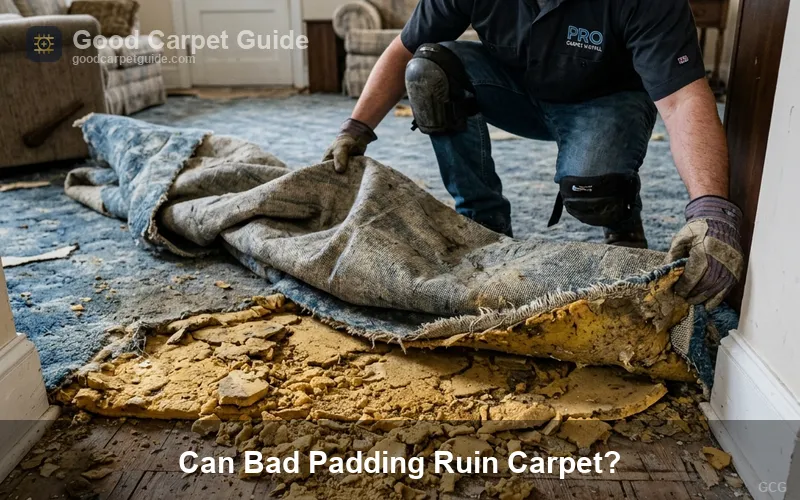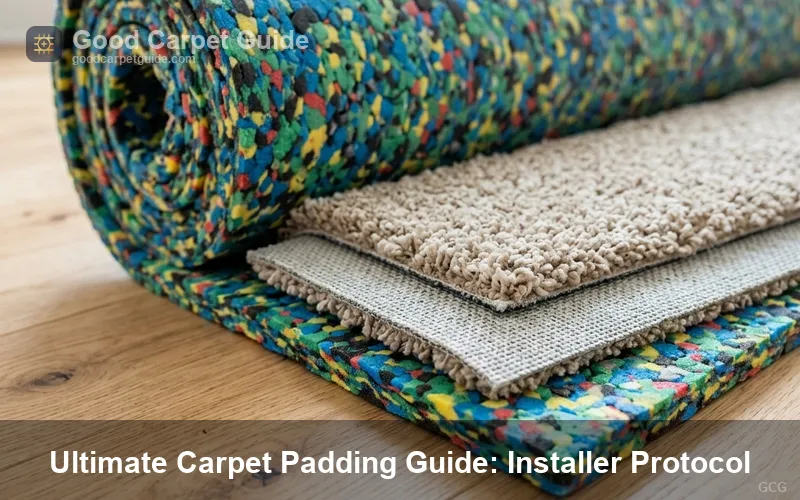
I pulled into a job in a two-year-old subdivision on a Tuesday morning expecting a routine re-stretch. The hallway carpet had rippled into a wave pattern that ran the full thirty-foot run, and the homeowner assumed the carpet itself was defective. It was not the carpet. Underneath, the original installer had dropped in a half-inch-thick, low-density prime foam pad rated under 4 lb per cubic foot, and eighteen months of foot traffic had crushed it flat in the traffic lanes while the edges stayed full. This ultimate carpet padding guide exists because that failure pattern repeats in roughly one out of every four inspections I run, and the carpet padding underneath almost always gets blamed on the wrong material.
This ultimate carpet padding guide breaks down padding selection by density and thickness standards, cost per square foot across material tiers, replacement timing tied to visible wear signs, brand-specific warranty mechanics, and the installation realities that separate a pad that lasts twelve years from one that fails in three. The sections below move in order from material science through cost data, professional brand recommendations, DIY installation steps, room-specific applications, and real field reports pulled from installer forums and homeowner complaints.
what is the best carpet padding for most residential rooms
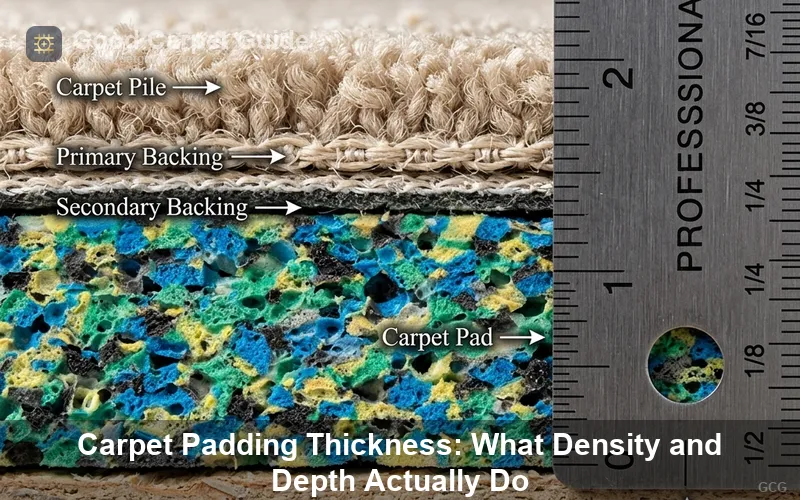
Density determines carpet padding performance more than thickness in the overwhelming majority of residential installations. A 7/16-inch pad rated at 8 lb per cubic foot outperforms a 1/2-inch pad rated at 4 lb per cubic foot under standard foot traffic, because the denser foam resists compression rather than simply cushioning impact. The Carpet and Rug Institute's CRI 104 installation standard for commercial settings and CRI 105 standard for residential settings both tie padding specification to traffic level rather than to thickness alone.
| Padding Type | Typical Density | Typical Thickness | Best Fit | Approx. Cost/Sq Ft (Material Only) |
|---|---|---|---|---|
| Prime foam (unbonded) | 1.5-2.7 lb | 3/8"-1/2" | Low-budget rentals only | $0.15-$0.30 |
| Rebond foam (standard) | 5-6 lb | 7/16"-1/2" | General living areas | $0.25-$0.50 |
| Rebond foam (premium) | 8-10 lb | 3/8"-7/16" | High-traffic hallways, stairs | $0.50-$0.80 |
| Flat rubber | 10-12 lb | 1/8"-3/16" | Berber, commercial-grade carpet | $0.75-$3.00 |
| Memory foam / fiber hybrid | 8 lb equiv. | 7/16" | Bedrooms, premium comfort | $0.60-$1.20 |
Premium 8 lb rebond with an integrated moisture barrier runs close to $3.00 per square foot once installed, according to field pricing gathered across multiple regional installer surveys. The table above shows a clear inverse relationship between thickness and appropriate use case: thicker padding suits lower-traffic, softer-feel applications, while thinner and denser padding suits areas that take repeated compression. For a room-by-room density breakdown, the carpet padding buying guide covers CRI-recommended density minimums by carpet fiber type.
what is the difference between carpet padding types
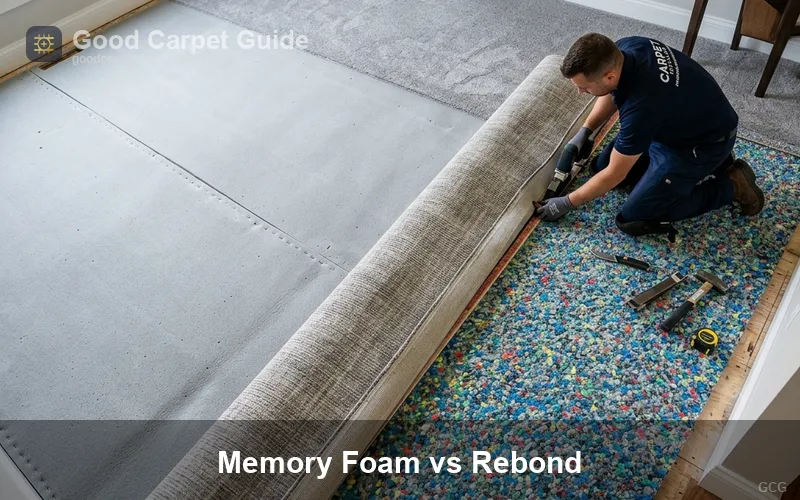
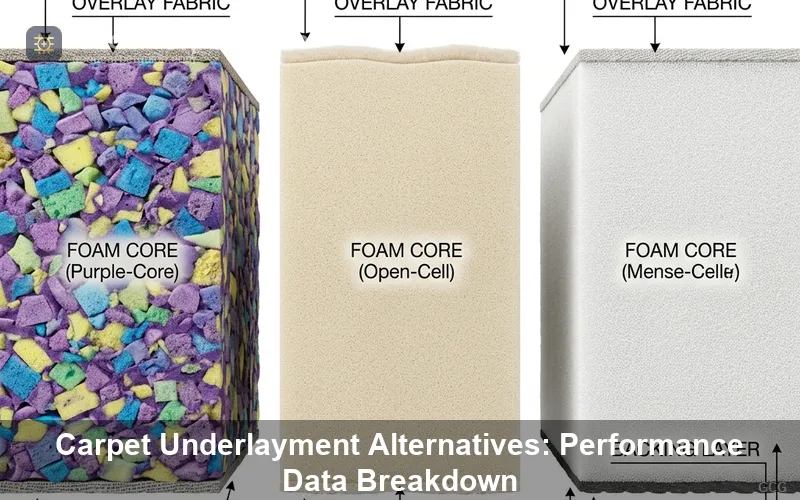
Rebond foam: A padding material manufactured by compressing recycled foam scraps of varying colors into a dense, bonded slab. Rebond foam accounts for the majority of residential installations because its density-to-cost ratio outperforms virgin foam alternatives under CRI 105 traffic classifications.
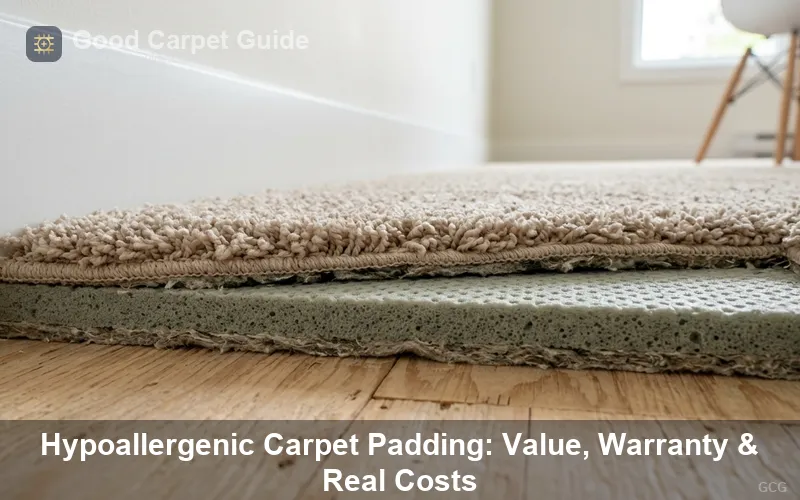
Prime foam: A single-color, unbonded polyurethane foam manufactured directly from virgin materials without the compression bonding process used in rebond. Prime foam's cellular structure collapses within three to four years of standard residential foot traffic because the material lacks the reinforced cell walls that bonding creates, leaving the carpet backing unsupported.
Flat rubber: A dense, non-foam padding material formed from natural or synthetic rubber compounds without air cells. Flat rubber padding resists compression more effectively than foam-based products and is specified frequently under Berber and loop-pile carpet, since low-profile padding prevents the loop structure from delaminating under lateral shifting.
Fiber cushion: A padding material constructed from bonded synthetic or natural fibers rather than foam or rubber. Fiber cushion padding is specified in commercial applications and select residential installs where fire-rating requirements exceed standard foam ratings.
Choose rebond foam for general living spaces and bedrooms. Choose flat rubber under Berber, loop, or commercial-grade carpet installations. Choose fiber cushion when local fire code or building specification requires it. Choose memory foam hybrids for bedrooms where underfoot comfort outweighs maximum durability.
how to choose carpet padding for a specific room
Match carpet padding density to the traffic level of the room before matching it to comfort preference. A pad selected purely on softness underfoot compresses faster in high-traffic zones regardless of brand.
- Identifies traffic level first: hallways, stairs, and entryways require 8-10 lb density minimum.
- Checks manufacturer warranty language: many carpet warranties become void if the installed pad falls below the manufacturer's specified density.
- Accounts for subfloor moisture: basements and slab-on-grade rooms require a moisture-barrier-rated pad regardless of density preference.
- Confirms thickness limits: padding exceeding 1/2 inch under standard tufted carpet voids most manufacturer warranties due to backing strain.
- Matches pad type to pile construction: loop and Berber carpets require flat rubber or low-profile rebond to prevent loop delamination.
This list functions as a pre-purchase checklist rather than a ranked order, since a room frequently triggers two or three of these variables simultaneously. A basement hallway, for example, requires both moisture-barrier rated padding and 8-10 lb density, which narrows product selection considerably before cost even enters the decision.
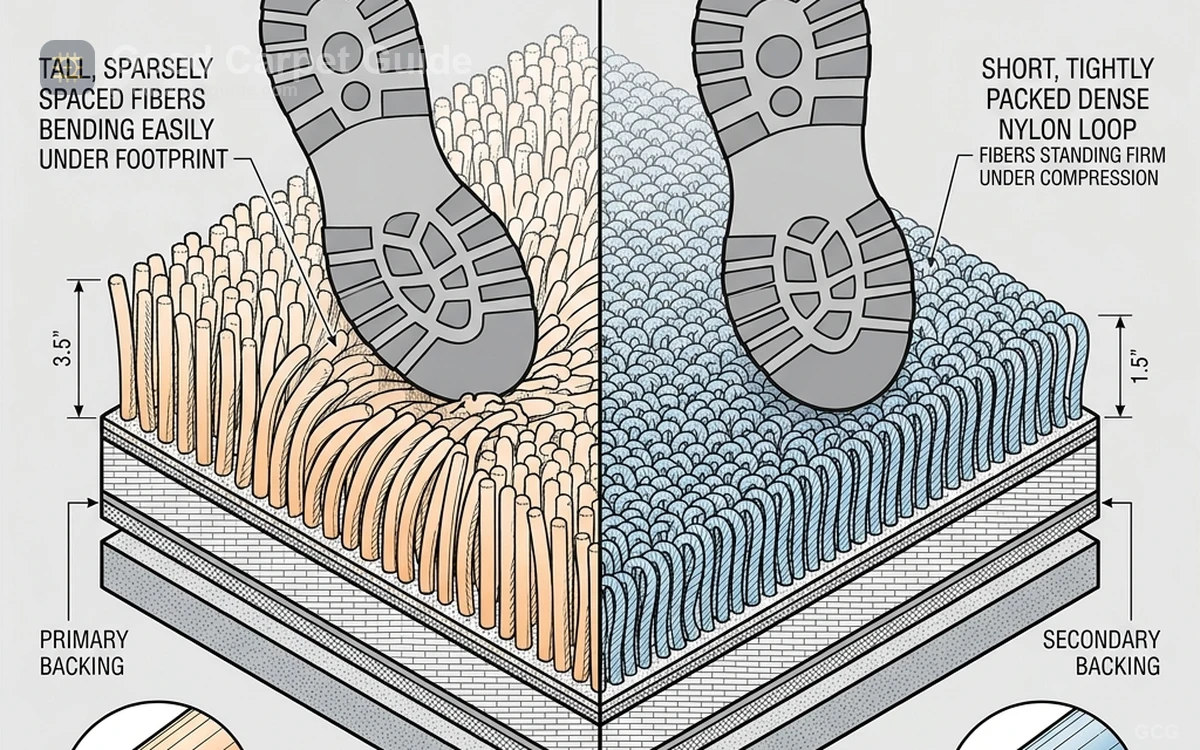
A compression gauge test on rebond foam padding confirms the density rating before installation begins, the same verification step that determines whether the finished carpet resists wrinkling under foot traffic.
how much does carpet padding cost per square foot
Carpet padding material costs range from $0.15 to $3.00 per square foot depending on density tier and moisture-barrier features, based on aggregated contractor pricing data. Installation labor for padding runs $0.50 to $1.50 per square foot under standard residential conditions, and complex layouts or stair applications push labor to $0.50-$2.00 per square foot.
| Cost Component | Low End | High End |
|---|---|---|
| Prime foam material | $0.15/sq ft | $0.30/sq ft |
| Premium rebond w/ moisture barrier (installed) | — | $3.00/sq ft |
| Standard labor (flat areas) | $0.50/sq ft | $1.50/sq ft |
| Stair or complex-layout labor | $0.50/sq ft | $2.00/sq ft |
| Old carpet/pad removal & disposal | $0.50/sq ft | $1.60/sq ft |
| Furniture moving | $25/room | $75/room |
| Stair surcharge (total job) | $150 | $600 |
Total installed cost for carpet plus padding plus labor ranges from $2.50 to $18.00 per square foot across the full spectrum of material grades. Removal and disposal fees frequently surprise homeowners who priced only the new material, since a full room tear-out at $0.50-$1.60 per square foot adds several hundred dollars to a mid-size project before the new pad ever gets unrolled. Stair installations carry the widest cost swing because of the labor-intensive nature of wrapping padding around each nose and riser; the best carpet padding for stairs guide breaks down the nose-wrap technique that drives that surcharge.
big box store pricing versus local dealer pricing
Direct Answer: Local flooring dealers quote carpet and padding at $2.50-$3.00 per square foot every day without promotional markdowns, while big-box retailers advertise steep percentage discounts off inflated list prices that land at a similar final number.
Q: Does "free installation" from a big-box store actually mean free?
A: No. Big-box retailers commonly require a minimum order value, often $699 or higher, and recover installation cost through inflated per-square-foot material pricing rather than absorbing it as a true discount.
Q: Why do professional installers avoid working for big-box subcontracting programs?
A: Big-box retailers pay subcontracted installers a lower per-yard rate than local dealers pay their in-house crews, and installers working thin margins have less incentive to slow down for precise seam placement or padding density verification.
Q: Are hidden fees more common at big-box retailers?
A: Yes, in field experience. Old carpet and pad removal, furniture moving, and stair surcharges appear as line-item add-ons at checkout rather than being disclosed in the advertised per-square-foot price.
Installer Warning: A big-box quote that looks 45% cheaper than a local dealer's everyday price is not proof of savings. Compare the final installed price per square foot, including removal, padding upgrade, and stair surcharges, before signing either contract.
when should you replace carpet padding
Replace carpet padding whenever new carpet is installed, regardless of the existing pad's apparent condition, because reused padding rarely retains its original density rating after supporting a prior carpet's foot traffic. Replace carpet padding immediately, independent of a full carpet replacement, if any of the following conditions appear during inspection.
- Locates hard spots by pressing a palm flat against the carpet in traffic lanes; a spot with noticeably less give than the surrounding area signals collapsed foam cells underneath.
- Checks for visible rippling running perpendicular to a hallway's traffic path, which indicates the pad has compressed unevenly and the carpet backing has lost its stretch tension.
- Smells for mildew near baseboards in basements or slab-on-grade rooms, since a moisture-compromised pad traps humidity against the carpet backing.
- Feels for tack strip pins pushing through low-pile carpet near stairs and doorways, which happens when a thin or degraded pad no longer buffers the carpet from the tackless strip beneath it.
A pad showing any two of these four signs has typically exceeded its functional service life even if the carpet fibers on top still look presentable.
how long does carpet padding last
Standard 5-6 lb rebond foam padding lasts 8-10 years under moderate residential foot traffic before density loss becomes noticeable underfoot. Premium 8-10 lb rebond and flat rubber padding extends that service window to 12-15 years under the same traffic conditions, provided the subfloor stays dry and cleaning frequency follows IICRC S100 guidelines. Prime foam padding, by contrast, degrades within 3-4 years regardless of traffic level because its unbonded cell structure lacks the reinforcement that rebonding provides.
Lifespan figures shift downward in high-humidity regions and homes with pets, since repeated moisture exposure and localized soil accumulation accelerate foam breakdown independent of the density rating printed on the product label. A dense pad in a coastal, high-humidity climate does not automatically match the 12-15 year window observed in drier inland regions.
is carpet padding worth the extra cost
Upgrading carpet padding delivers a higher return on comfort and carpet longevity than upgrading the carpet face weight alone, according to consistent field observation across residential inspections. A mid-grade carpet installed over premium 8 lb padding frequently outperforms a premium carpet installed over budget prime foam, because the padding absorbs the majority of compressive foot-traffic stress before it reaches the carpet backing.
Padding upgrades typically add $0.25-$0.50 per square foot to a project, a modest increase relative to the $2.50-$18.00 total installed cost range. That incremental cost buys measurably longer service life and reduces the likelihood of premature wrinkling, seam splitting, or the kind of localized carpet delamination issues that show up when backing separates from face fiber under repeated compression stress.
which carpet padding brands do professional installers recommend
Installers cite a consistent short list of manufacturers across multiple regions, grounded in low failure rates during post-installation inspections rather than marketing claims.
- Leggett & Platt: Widely trusted rebond and flat rubber padding lines with a long field track record among commercial installers moving high container volumes.
- Shaw Courage: A solid-foam upgrade pad with an integrated moisture barrier, frequently selected in blind barefoot comparison tests conducted by flooring dealers.
- Mohawk SmartCushion: A premium memory-foam padding line with a built-in moisture barrier that extends Mohawk's abrasive wear warranty by up to 20 years and, uniquely among major brands, expands warranty coverage to stair installations.
- Healthier Choice: A high-density memory foam pad manufactured with built-in antimicrobial treatment, specified frequently in households managing allergy or air-quality concerns.
- KaraStep Reserve: A premium memory-foam line noted for producing a distinctly plush underfoot sensation in side-by-side dealer comparisons, positioned above KaraStep's standard 8 lb Relax rebond line.
Manufacturer-matched padding functions as a warranty multiplier in several of these product lines. Pairing Mohawk carpet with Mohawk SmartCushion, for example, extends coverage terms beyond what either product carries independently, which changes the long-term cost calculation even when the upfront padding price sits above a generic rebond alternative.
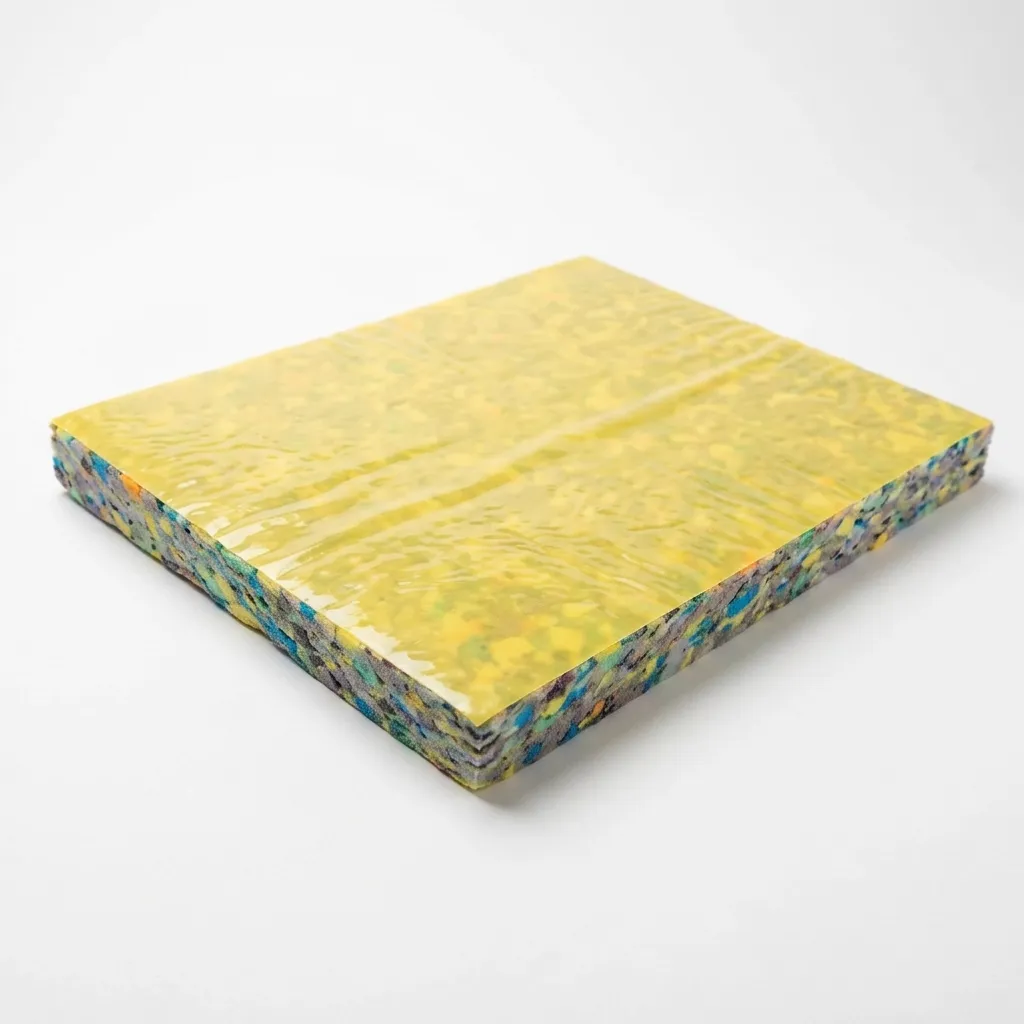
Mohawk SmartCushion Premium Carpet Padding
Recommended when installing manufacturer-matched carpet to activate extended abrasive-wear warranty coverage, including the stair coverage most competing pads exclude.
Check Price on Amazoncan you install carpet padding yourself
Homeowners with basic tool access can install carpet padding in a single room, though seam sealing and stretch tensioning present the highest failure risk for first-time installers. Follow this sequence for a standard room installation.
- Remove the old carpet and staples completely, using a flat pry bar and pliers to clear the subfloor of every staple before laying new material.
- Inspect the subfloor for leveling issues, since padding installed over an uneven subfloor telegraphs every dip and high spot through the finished carpet within months.
- Install tackless strips around the room perimeter with a 3/8-inch gap from the wall, using pins sized to the subfloor material and avoiding skip-bent pins that fail to grip.
- Roll out padding perpendicular to the planned carpet seams, stapling every 6 inches along the edges on wood subfloors or using padding tape on concrete.
- Seam the padding sections using seam tape or duct tape rather than staples if the pad carries a moisture barrier, since staple holes compromise the barrier's function.
- Trim padding flush to the inside edge of the tackless strip using a carpet trimmer, leaving no overlap onto the strip itself.
Installer Warning: Never staple a spillguard or moisture-barrier padding directly to a wood subfloor at the seams. Staples puncture the barrier film and create the exact leak path the product is designed to prevent, and the resulting seam has also been reported to cause an audible squeak underfoot when combined with taped joints.
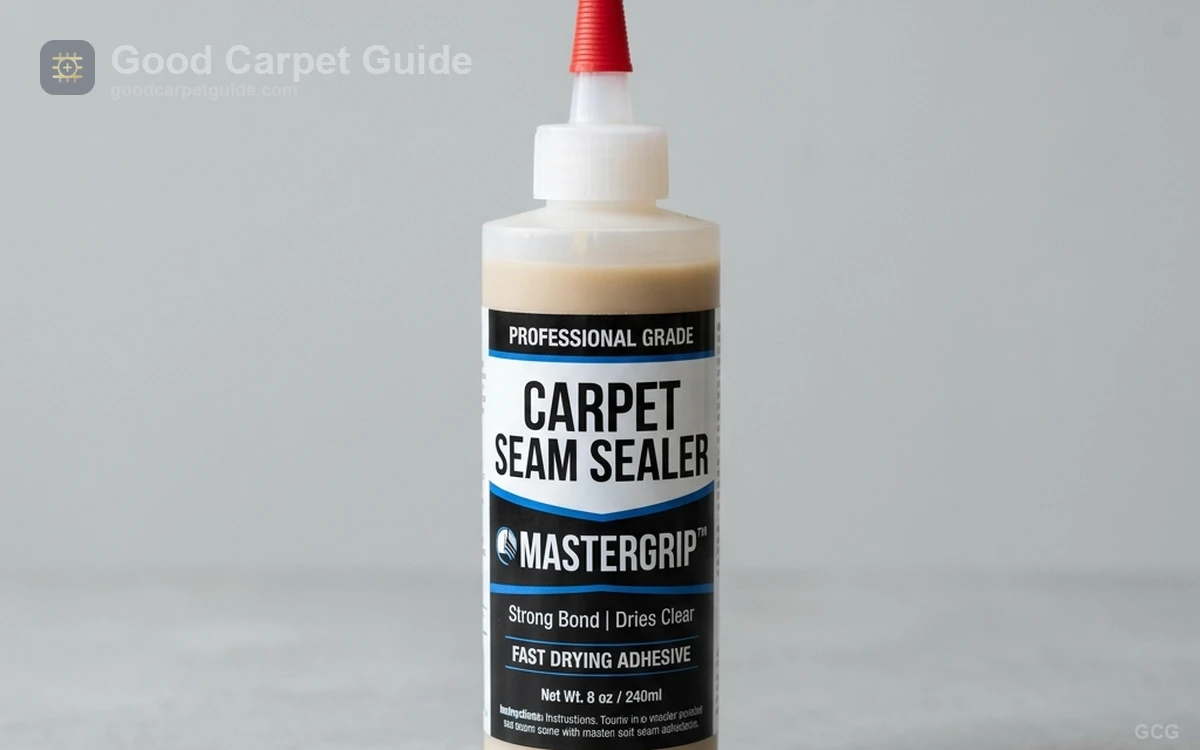
Roberts 8015 Universal Carpet Seam Sealer
Applied to padding and carpet seam joints during DIY installation to prevent the seam separation that leads to visible peaking within the first year.
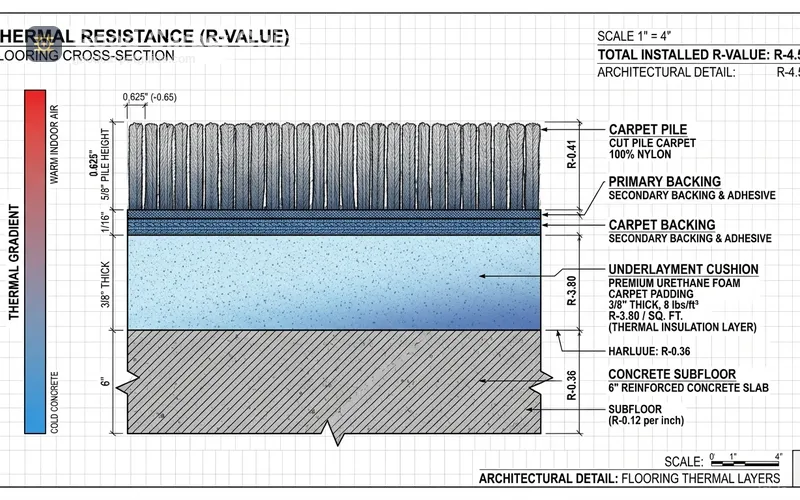
Check Price on AmazonRadiant floor heating changes this workflow substantially. Padding installed over radiant heat requires a thin, dense, flat rubber cushion rated between 0.31 and 0.48 R-value, the opposite of the higher-insulation padding typically recommended for comfort, since excess insulation traps heat beneath the floor rather than allowing it to transfer upward into the room.
what to put under carpet in a basement
Basements require a padding product with an integrated moisture barrier rated to resist vapor transmission from concrete slab alkaline moisture emissions, independent of density or comfort preference. Flat rubber padding or 8-10 lb rebond with a laminated moisture-barrier film both meet this requirement, while standard prime foam and unprotected rebond do not.
Concrete slabs release moisture vapor continuously regardless of visible dampness, and a pad without a barrier absorbs that moisture over time, creating conditions for mildew growth against the carpet backing. Confirm the moisture barrier is continuous across all seams using tape rather than staples, since staple punctures reopen the same vapor path the barrier is meant to block.
is carpet good for a basement floor
Carpet performs adequately in a basement provided the space has documented, consistent dryness and a moisture-barrier-rated pad is installed beneath it; carpet does not perform well in basements with active water intrusion history or unresolved grading issues outside the foundation. A basement with a sump pump, proper exterior drainage, and no history of flooding presents materially lower risk than a below-grade room without those mitigations.
Carpet in a marginal basement, even over quality padding, remains vulnerable to a single flooding event in a way that resilient flooring is not. A basement with any recent water intrusion history warrants a moisture assessment before carpet installation proceeds, regardless of the padding grade selected.
best carpet padding options for bedrooms
Bedrooms carry lower foot traffic than hallways and living rooms, which allows padding selection to prioritize comfort alongside durability rather than pure compression resistance. Memory foam and fiber hybrid pads rated near 8 lb density deliver a plush underfoot feel while still meeting most manufacturer warranty minimums for residential bedroom applications, which is essential to protect even the most durable carpet fiber recommendations from premature backing fatigue.
Modern bedroom carpet trends favor slightly thicker cut-pile carpet paired with an 8 lb memory-foam hybrid pad, a combination that consistently wins blind barefoot comparison tests conducted by flooring dealers. This pairing suits primary bedrooms and guest rooms with light daily traffic; a child's bedroom with higher activity levels benefits more from a standard 6-8 lb rebond pad that resists compression from frequent play-related impact.
cheap carpet padding for rental properties
Rental property owners face a different cost equation than homeowners, since turnover frequency often outweighs long-term padding durability in the return-on-investment calculation. Standard 5-6 lb rebond foam padding, priced between $0.25 and $0.50 per square foot in material cost, balances acceptable underfoot feel against a budget that must be replaced between tenants regardless of remaining service life.
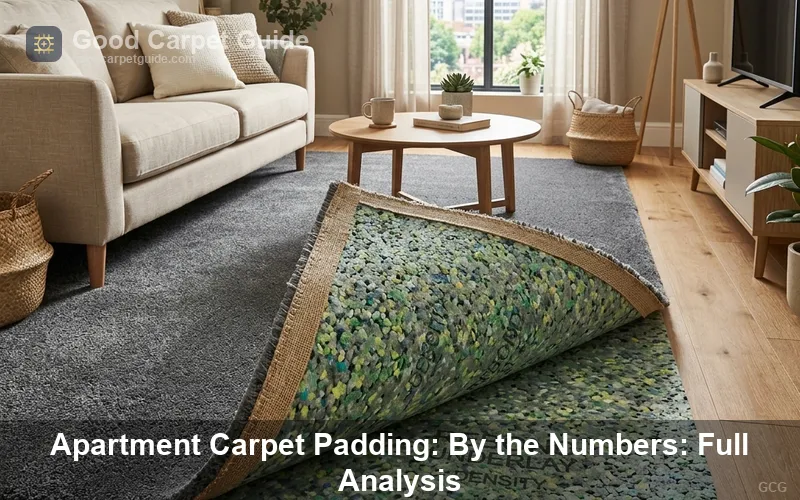
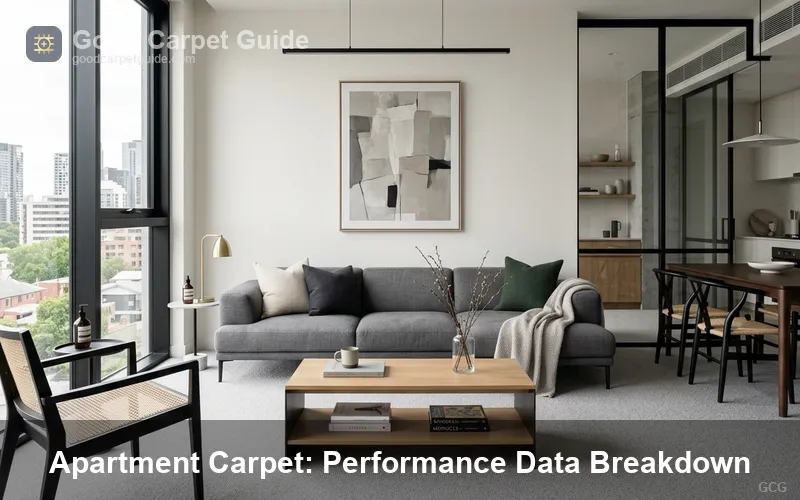
For a detailed breakdown of rental-specific cushioning metrics and IIC sound compliance ratings, see our guide on apartment carpet padding .
Avoid prime foam entirely in rental applications despite its lower upfront cost, since its 3-4 year collapse window frequently falls within a single tenancy period and creates mid-lease wrinkling complaints. A standard rebond pad costs marginally more upfront but avoids the mid-cycle failure that generates maintenance calls and tenant disputes.
what do real homeowners say about carpet padding on forums
Homeowner forum threads reveal recurring padding complaints that rarely surface in manufacturer marketing material. One recurring thread involves tack strip pins poking through low-pile carpet on stairs, which a homeowner described feeling directly underfoot after a fresh installation; the underlying cause is typically an undersized pad thickness relative to the carpet's pile height rather than a defective carpet.
Another common thread involves verifying whether an installer actually used the upgraded padding a homeowner paid for. Homeowners report the finished floor "not feeling like an upgrade" despite an itemized invoice listing premium pad, a discrepancy that a post-installation density gauge check resolves definitively. A third recurring complaint involves waterproof padding installed with quarter-inch gaps between seam sections, which homeowners correctly identify as defeating the product's core moisture-barrier function.
Installers describe similarly consistent frustrations from the professional side. Cheap, low-density padding is frequently described as tearing and balling up during cutting, comparable to working with tissue paper rather than a structural material, which slows installation and increases the chance of an uneven seam.
warranty fine print: what carpet padding warranties actually cover
Extended padding warranties frequently function as a sales incentive more than a meaningful consumer protection, according to field-level installer sentiment gathered across multiple contractor discussions. A warranty extension helps close a sale but rarely gets invoked in practice, since most warranty claims require documentation of professional installation, verified density specification, and moisture conditions that many homeowners never retain.
Manufacturer-matched warranty multipliers, such as Mohawk's pairing of SmartCushion with Mohawk carpet lines, represent the more substantive warranty benefit because the extension applies automatically at the point of matched purchase rather than requiring a separate claims process. Review the specific density and installation documentation requirements printed in a warranty's fine print before treating an "extended warranty" label as a meaningful purchase factor on its own.
regional performance differences in carpet padding
Padding lifespan and moisture-barrier necessity shift meaningfully by region due to humidity, subfloor construction norms, and climate-driven soil accumulation patterns. High-humidity coastal regions of the US see accelerated foam breakdown and mildew risk even in padding rated for 12-15 year service life inland, which shortens the practical replacement window in those markets.
Regions with predominantly slab-on-grade construction, common across much of the southern United States, encounter concrete slab moisture emission as a routine condition rather than an edge case, making moisture-barrier padding closer to a default requirement than an optional upgrade. Northern regions with basement construction and radiant floor heating installations face the opposite consideration, prioritizing low R-value flat rubber padding to avoid trapping heat rather than maximizing insulation.
frequently asked questions about carpet padding
Does thicker carpet padding always feel better underfoot?
Not consistently. A thick, low-density pad compresses quickly under foot traffic and creates a "trampoline effect" that strains carpet backing at seams, while a properly dense 7/16-inch pad maintains support longer under the same conditions.
Can carpet padding be reused under new carpet?
Reusing existing padding is not recommended under standard conditions, since a pad that has already absorbed one carpet's traffic load has typically lost measurable density before the new carpet is ever installed.
Does carpet padding affect indoor air quality?
Padding with antimicrobial treatment, such as Healthier Choice, addresses a specific air-quality concern tied to moisture and allergen accumulation within the pad's foam structure, connecting carpet padding selection to broader indoor air quality considerations beyond comfort alone.
Is 8 lb or 10 lb padding better for stairs?
Density requirements for stairs typically favor the higher end of the density range due to concentrated point-load traffic on stair noses; the 8lb vs 10lb carpet padding guide breaks down that comparison against specific stair-nose wear patterns.
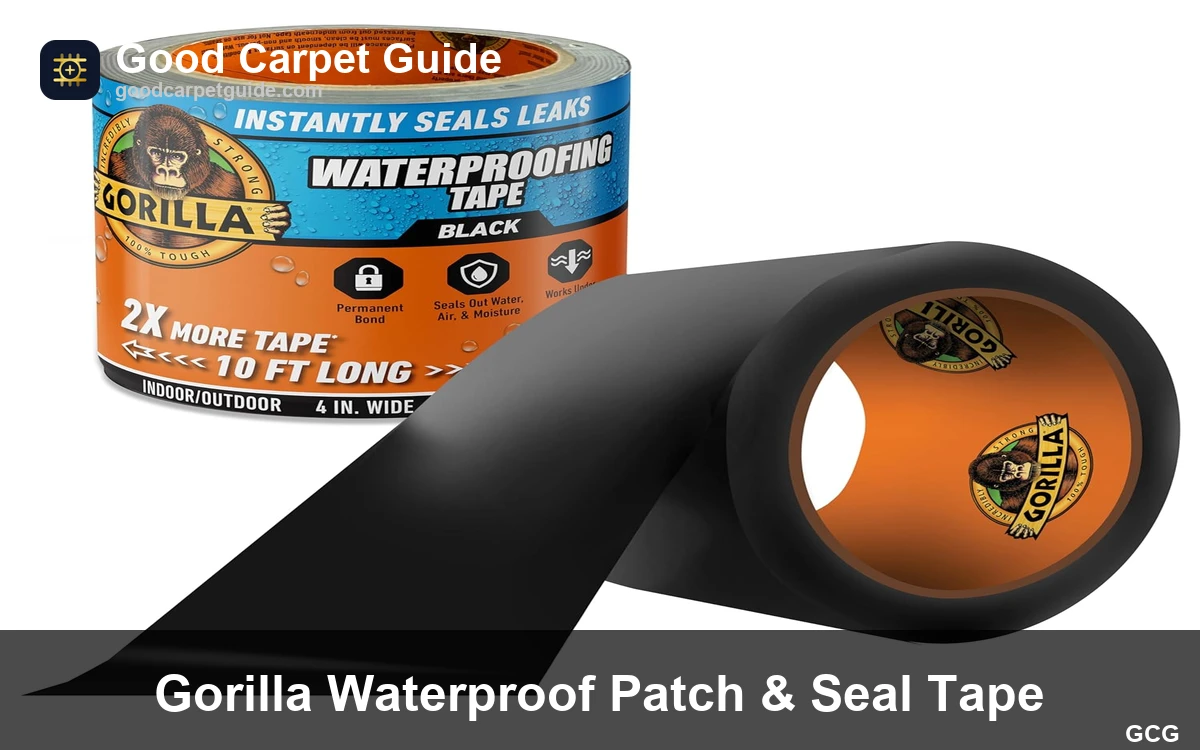
Gorilla Double Sided Carpet Tape
Used to seam moisture-barrier padding sections without puncturing the barrier film, avoiding the staple-related leak paths and squeaking reported by homeowners.
Check Price on Amazonfinal recommendations from the inspection van
Match carpet padding density to room traffic level before matching it to comfort preference, since a plush pad that compresses within two years creates more homeowner frustration than a slightly firmer pad that holds its shape for a decade. Specify 8-10 lb rebond or flat rubber for hallways, stairs, and living rooms, and reserve memory-foam hybrids for bedrooms carrying lighter daily traffic.
Verify moisture-barrier padding in basements and slab-on-grade rooms regardless of density preference, and seam those barrier products with tape rather than staples to preserve the barrier's function. Budget for both padding upgrade cost and full removal-and-disposal fees when comparing big-box and local dealer quotes, since the advertised per-square-foot price rarely reflects the total installed cost. According to the Good Carpet Guide team's field experience, a mid-grade carpet over premium padding consistently outperforms a premium carpet over budget padding across every inspection category that matters to long-term homeowner satisfaction.