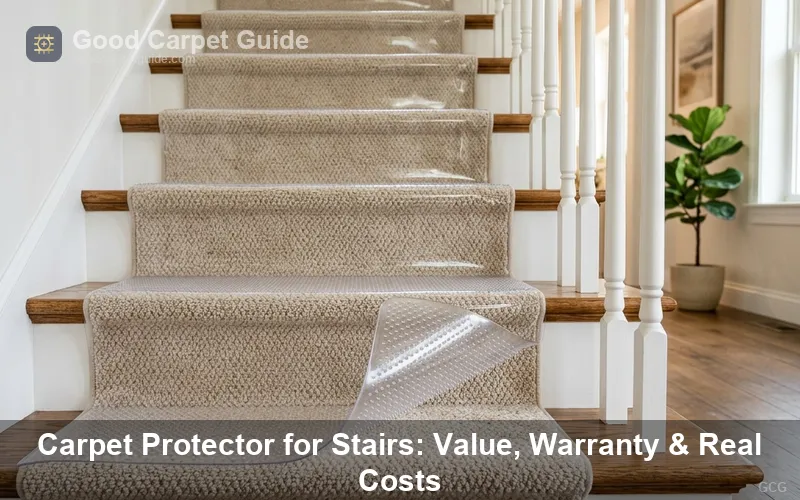
A flooring installer named Jboberek learned the true cost of a carpet protector for stairs the hard way. Jboberek applied a standard pressure-sensitive adhesive film to protect a first-floor staircase during a renovation. A few weeks later, the film tore the carpet fibers clean off the backing during removal — a failure that required replacing the entire first-floor carpet run at a cost far exceeding the price of the film. The core failure mechanism was straightforward: the acrylic adhesive chemically bonded to the synthetic fibers under heat, making the film impossible to peel without destroying the pile. A carpet protector for stairs prevents damage from foot traffic, construction debris, pet claws, and moisture, but the wrong carpet protector for stairs causes more destruction than the hazards it guards against. This guide covers the four primary protector categories — adhesive films, rigid vinyl runners, fabric runners, and mechanical barriers — alongside real installer experiences, warranty fine print that retailers omit, and per-square-foot cost data for the U.S. market. Decision factors include adhesive chemistry, pile-depth compatibility, breathability ratings, anchoring method, and maximum safe duration of deployment.
how to cover carpet stairs for painting
Cover carpet stairs for painting by installing folded cardboard mechanical barriers rather than adhesive plastic film, because painting environments expose protectors to elevated temperatures that accelerate adhesive cross-linking. Field reports from flooring professionals confirm the cardboard method as standard practice: cut a roll of cardboard floor covering into tread-sized sections, fold each section into a 90-degree angle to cover both the tread (horizontal surface) and the riser (vertical face), then staple each piece to the step using 1/2-inch staples through the cardboard and into the wood substrate beneath the carpet. The staples penetrate the carpet pile without damaging the fiber structure because the staple passes through the cardboard first, distributing the load. Quarter-inch plywood or luan sheeting cut to tread dimensions and secured with screws through the riser face is a higher-durability alternative for paint projects lasting more than two weeks.
Adhesive plastic films rated for construction use — including Surface Shields Carpet Shield and TapeManBlue — carry explicit 30- and 45-day maximum deployment windows, respectively. Painting schedules that exceed these windows, or that involve solvent-based primers and direct sunlight exposure on south-facing stair runs, create conditions where the pressure-sensitive acrylic adhesive migrates into the carpet fiber and fuses permanently. One composite field report from renovation contractors describes carpet darkening along the film footprint even after steam cleaning, because the residual adhesive acts as a soil magnet at the fiber level. The cardboard mechanical barrier eliminates adhesive contact entirely.
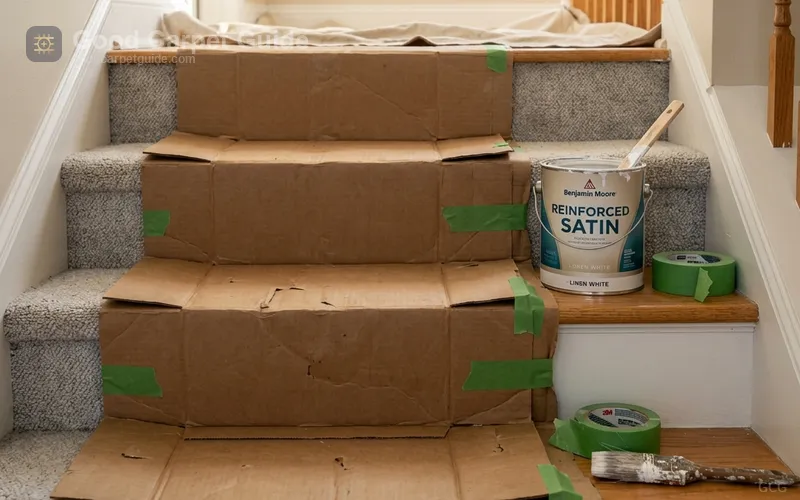
A folded cardboard mechanical barrier covers both the tread surface and riser face of a carpeted stair, the two zones where paint drips and boot traffic cause the most fiber abrasion during interior repaints — the same dual-coverage geometry that rigid vinyl stair runners and Ram Board Stair Armor replicate in non-renovation settings.
how to install carpet protector on stairs
Install a carpet protector on stairs by matching the anchoring method to the protector type, because each of the four carpet protector categories uses a mechanically distinct attachment system. The four installation methods are:
- Adhesive film installation: Clean the carpet surface with a dry cloth to remove all loose particles. Unroll the film from the bottom stair tread upward in a single continuous length without overlapping seams at the nose (bullnose) of each step. Press the film flat with a hand roller, working from the center of the tread outward to eliminate air pockets that trap moisture. Remove the film within the manufacturer's stated window — 30 days for Surface Shields, 45 days for TapeManBlue — before acrylic adhesive cross-links with synthetic fiber.
- Rigid vinyl runner installation: Unroll the vinyl runner from the top step downward. Press the gripper teeth — rigid polyvinyl chloride (PVC) spikes ranging from 0.100 to 0.150 inches in length — downward into the carpet pile at a 45-degree angle, using hand pressure to seat the teeth below the pile surface. The teeth prevent horizontal displacement under foot traffic. Resilia's clear vinyl runner for deep-pile carpet uses a crosshatch backing pattern that increases the tooth-to-fiber contact area by approximately 30% compared to flat-tooth designs.
- Fabric runner installation: Place the fabric runner at the top riser and unroll downward, allowing the foam backing to contact the carpet surface under gravity. Foam-backed runners such as CarpetSaver do not require mechanical fasteners on low-traffic stairs, because the foam backing develops sufficient friction against the pile. On high-traffic stairs or stairs with a slope exceeding 35 degrees, add double-sided carpet tape at the top and bottom tread to prevent creeping.
- Mechanical barrier installation: Measure each tread width and depth individually, because stair dimensions vary by as much as 1/2 inch across a single flight. Cut cardboard or plywood sections to match each tread. Fold cardboard at 90 degrees to cover the riser. Secure each piece with 1/2-inch staples or screws through the riser face, not through the tread surface, to avoid compressing the carpet pile permanently.
Verify anchoring security after installation by applying 15 lbs of downward pressure at the front edge (bullnose nose) of each step and confirming zero forward movement. Slip hazards on stairs account for a disproportionate share of home injury claims, making anchoring verification a mandatory step rather than an optional check.
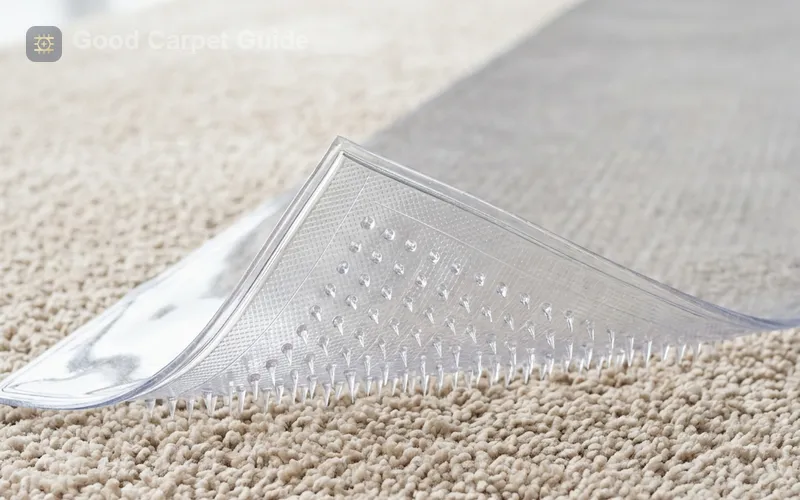
Resilia Clear Vinyl Carpet Protector Runner
Resilia clear vinyl runners feature heavy-duty 0.150-inch gripper teeth that anchor firmly into deep-pile carpets. Made of phthalate-free PVC in the USA, they provide high traction and prevent shifting without damaging fibers.
Check Price on Amazonstair protector for carpet stairs: which type matches your use case
A stair protector for carpet stairs functions through one of two mechanisms: adhesive bond (temporary films) or mechanical grip (vinyl teeth, foam friction, or fasteners). The mechanism determines the maximum safe deployment duration, the surface types the protector suits, and the failure mode when the protector is misapplied. The table below maps each protector type to its primary specifications:
The following table defines the four stair protector categories by deployment window, anchoring mechanism, cost per square foot in USD, and primary failure risk. The data is drawn from manufacturer specification sheets and installer field reports in the U.S. residential market.
| Protector Type | Max Deployment | Anchoring | Cost/sq ft (USD) | Primary Failure Risk |
|---|---|---|---|---|
| Adhesive plastic film | 30–45 days | Pressure-sensitive acrylic | $0.11–$0.26 | Adhesive cross-linking into fiber |
| Rigid vinyl runner | Indefinite | PVC gripper teeth (0.100–0.150 in) | $0.96–$1.08 | Tooth compression of deep pile over time |
| Fabric/foam runner | 12–24 months (washable) | Foam friction + optional tape | $0.40–$0.75 | Creep migration on high-angle stairs |
| Mechanical barrier (cardboard/plywood) | Per project | Staples or screws through riser | $0.05–$0.15 | Void if staples miss wood substrate |
Rigid vinyl runners from Resilia (48 in × 12 ft, $124.99) and ES Robbins (36 in × 20 ft, $116.58) dominate the heavy-duty residential segment because the PVC gripper teeth maintain grip on deep-pile carpets where foam-backed runners slide. Fabric runners such as CarpetSaver and Laminet target homeowners seeking a machine-washable protector for pet-soiled stairs, because both products tolerate standard washing machine cycles at temperatures up to 104°F without deforming the foam backing. Adhesive films (TapeManBlue, Surface Shields, Dura-Gold, Kenley) remain appropriate exclusively for construction and renovation periods under 45 days on synthetic fiber carpets only — manufacturer documentation explicitly excludes wool, oriental rugs, and natural fiber carpets from all adhesive film use.
See the best carpet for stairs guide for fiber and pile specifications that affect protector compatibility across different staircase configurations.
how do homeowners and installers actually experience carpet protector failures
Real homeowner and installer reports document three recurring failure patterns for carpet protectors on stairs, each with a distinct technical cause. The reports below represent composite field insights drawn from residential flooring forums and installer communities in the U.S.
Adhesive residue darkening: One homeowner applied an adhesive film to a carpeted stair run for approximately two months. After removal, the carpet in the film footprint appeared permanently darker than the surrounding pile. Steam cleaning failed to restore the original color. The technical cause is acrylic adhesive cross-linking: at deployment durations beyond 45 days, the pressure-sensitive acrylic adhesive migrates from the film backing into the synthetic carpet fiber structure. The residue is hydrophobic, repelling water from steam cleaning while attracting dry soil particles.
Slip and horizontal migration on stairs: Flat plastic covers without gripper teeth migrated down staircases under foot traffic in multiple field reports, creating a visual and physical slip hazard. The technical cause is insufficient pile penetration: flat-bottom films cannot develop friction against carpet pile deeper than 3/8 inch, because the pile fibers deflect laterally rather than resisting horizontal shear forces. Rigid vinyl runners with 0.150-inch gripper teeth solve this failure by anchoring below the pile surface.
Moisture trapping and mold formation: Homeowners in high-humidity regions who used non-breathable plastic protectors during winter months reported mold development beneath the film within 6 to 8 weeks. The technical cause is vapor impermeability: non-breathable plastics trap condensation from tracked-in slush and mud, maintaining the moisture content of the carpet backing above the 18% threshold at which mold colonies establish.
Film application to freshly cleaned or newly installed carpet: Applying adhesive film within 24 hours of steam cleaning, or within 72 hours of new carpet installation, dissolves the pressure-sensitive adhesive into the carpet fiber. The technical cause is solvent incompatibility: residual moisture from steam cleaning and off-gassing solvents from installation adhesives react with the acrylic film backing, liquefying the adhesive layer before it cures properly.
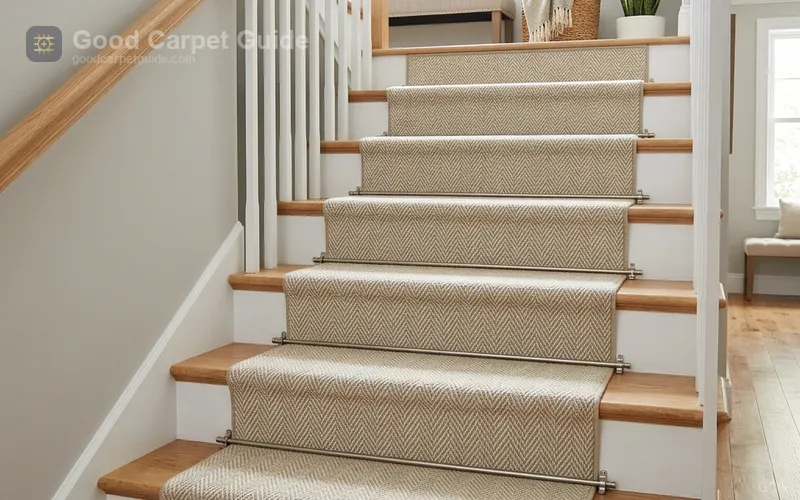
CarpetSaver Non-Slip Carpet Protector Runner
CarpetSaver features a breathable, machine-washable cotton-polyester fabric face bonded to a non-slip foam backing. Ideal for high-soil seasons, pet traffic, and active stairs where moisture evaporation is critical.
Check Price on Amazoncarpet protector for stairs from cats: the bullnose and riser problem
Carpet protector for stairs from cats addresses a specific geometric problem: domestic cats target the bullnose (the rounded front edge of the stair tread) and the riser (the vertical face between treads) as scratching surfaces, not the flat tread surface that standard runner protectors cover. Standard vinyl tread mats and fabric runners cover only the horizontal tread surface, leaving the bullnose and riser fully exposed. Field reports from cat owners confirm that conventional tread-only protectors provide zero scratch protection for the two surfaces cats actually use.
The Ram Board Stair Armor system addresses this geometry directly. Each Stair Armor unit is a rigid corrugated fiberboard piece measuring 34 inches wide × 19 inches deep, with an adjustable fold that covers both the tread and the full bullnose nose. A 6-pack retails between $38.90 and $46.99, covering approximately 6 stair treads and risers. Ram Board Stair Armor includes Spill Guard Technology, a moisture-resistant coating on the fiberboard surface that prevents cat urine and vomit from wicking through to the carpet fiber below.
For cats pulling at carpet corners, adhesive films present a secondary hazard: when cats scratch adhesive-backed plastic film, the plastic fibers fragment into small filaments that cats ingest. Field reports from cat owners document cats chewing the loosened film edges and ingesting the plastic fibers, making adhesive films an active pet safety concern rather than merely a carpet protection failure.
Use nylon stair carpet if selecting new carpet for stairs with cats, because nylon resists scratching more effectively than polyester due to nylon's higher tensile strength. Pair nylon stair carpet with the best carpet padding for stairs guide to select an underlayment density that resists compression from repeated cat claw impact without voiding the carpet manufacturer's wear warranty.
how to protect carpet stairs from dirt: breathability and daily maintenance
Protect carpet stairs from dirt by selecting a breathable carpet protector — fabric runners with cotton-polyester blends and perforated vinyl sheets — over non-breathable plastic films, because breathable materials allow moisture vapor to escape the carpet backing rather than concentrating soils at the fiber surface. The breathability requirement intensifies in entry stair runs where tracked-in mud, winter slush, and salt deposits are daily inputs.
The soil-prevention hierarchy for stair carpet, ranked by long-term cost-effectiveness, operates as follows:
- Apply a fluorochemical spray treatment — Scotard or DuPont Teflon carpet protector — to the carpet fiber surface before installing any physical barrier. Fluorochemical treatments create an oil- and water-repellent barrier at the fiber level that prevents soil adhesion without affecting breathability or pile texture.
- Install a machine-washable fabric runner such as CarpetSaver over the treated carpet. The foam backing grips the pile, and the fabric face is laundered every 4 to 6 weeks during high-soil seasons.
- Enforce a no-shoe policy on carpeted stair runs. Professional flooring inspectors document that shoe traffic accounts for 80% of soil load on residential stair carpet, because the stair geometry concentrates foot strike force on a narrow tread band.
Fluorochemical treatments do not substitute for physical runner protection on high-traffic stairs, because fluorochemical coatings degrade under repeated abrasion from foot traffic. The fluorochemical treatment rate of carpet protector application reapplication is every 12 to 18 months under normal residential traffic conditions. Physical runners extend the fluorochemical service life by reducing direct abrasion against the treated fiber surface.reapplication is every 12 to 18 months under normal residential traffic conditions. Physical runners extend the fluorochemical service life by reducing direct abrasion against the treated fiber surface.
how to protect carpet stairs during construction
Protect carpet stairs during construction by applying mechanical barriers — cardboard floor covering or 1/4-inch plywood — rather than adhesive film, because construction timelines routinely exceed the 30-to-45-day adhesive film limit and construction environments expose protectors to temperature spikes, solvent vapors, and heavy tool traffic that adhesive films are not rated to withstand. Ram Board Stair Armor is the professional-grade construction protector rated for repeated heavy foot traffic and tool drops, with a reinforced bullnose guard that covers the most impact-vulnerable zone on each step.
Adhesive film brands rated for construction use — including Surface Shields Carpet Shield at $124.90 to $130.99 per 36 in × 500 ft roll — carry explicit deployment limits that contractors often exceed on projects with delayed completion. The cost of replacing stair carpet damaged by over-deployed adhesive film far exceeds the cost differential between adhesive film and mechanical barrier protection. One installer's documented case required replacing the full first-floor carpet run after a few weeks of adhesive film use, at a replacement cost orders of magnitude higher than the film's purchase price.
sticky carpet protector for stairs: when adhesive film is appropriate
Sticky carpet protector for stairs — pressure-sensitive adhesive film — is appropriate under four specific conditions: the carpet fiber is 100% synthetic (nylon, polyester, or polypropylene), the deployment window is under 30 days (Surface Shields, QuicPrep) or under 45 days (TapeManBlue, Kenley), the ambient temperature remains below 104°F throughout the deployment period, and the carpet was last steam cleaned more than 24 hours before film application. Outside these four conditions, adhesive film transitions from a protector to a source of irreversible carpet damage.
TapeManBlue at $44.90 per 24 in × 200 ft roll and Dura-Gold at $25.99 per 24 in × 50 ft roll represent the short-duration adhesive film segment. TapeManBlue's 45-day rating provides a meaningful advantage over 30-day competitors for renovation projects with standard completion timelines. Neither product is appropriate for wool carpet — manufacturer documentation for all major adhesive film brands explicitly excludes natural fiber carpets, including wool, sisal, and jute, from adhesive film use.
The "sticky carpet protector" category also intersects with the carpet delamination guide because improper adhesive film removal on cut-pile carpet can separate the primary backing from the secondary backing, a failure mode that is classified as delamination and is not covered by carpet manufacturer warranties.
do carpet installers and manufacturers agree on protector recommendations
Carpet installers and carpet manufacturers disagree on two specific protector-related topics: steam cleaning frequency and underlayment thickness thresholds. The conflicts between installer practice and manufacturer warranty terms create financial risk for homeowners who follow field advice without reading the warranty documentation.
Steam cleaning conflict: Field installers commonly recommend rented steam cleaners — including Rug Doctor units — for removing soil from stair carpet. Carpet manufacturer warranties, including those from major synthetic fiber producers, specify that steam cleaning with rented consumer equipment voids the stain-resistance warranty because consumer steam cleaners operate at temperatures that destroy the fluorochemical stain-resistant coating applied to the fiber surface during manufacturing. Manufacturer warranties require "hot water extraction" performed by a certified professional, a method that uses lower water temperatures than consumer steam cleaners despite the name similarity.
Underlayment thickness conflict: Installers sometimes recommend upgrading to thick, plush carpet padding — 10mm soft foam — to improve the feel and noise reduction of stair carpet. Carpet manufacturers require a minimum padding density (typically 6 lb or 8 lb per cubic foot) AND a maximum pad thickness, because underlays exceeding the manufacturer's thickness specification cause the carpet to stretch and the primary backing to separate from the secondary backing — a condition classified as delamination. Exceeding the maximum underlayment thickness voids the wear warranty regardless of carpet fiber quality.
The installer-versus-manufacturer conflict is most financially damaging on stair carpet because stair installation is labor-intensive, and warranty claims on stair carpet that has delaminated or lost stain resistance represent a complete loss of the carpet investment. Review the best carpet padding for stairs guide to confirm that the selected underlayment meets manufacturer density specifications before installation.
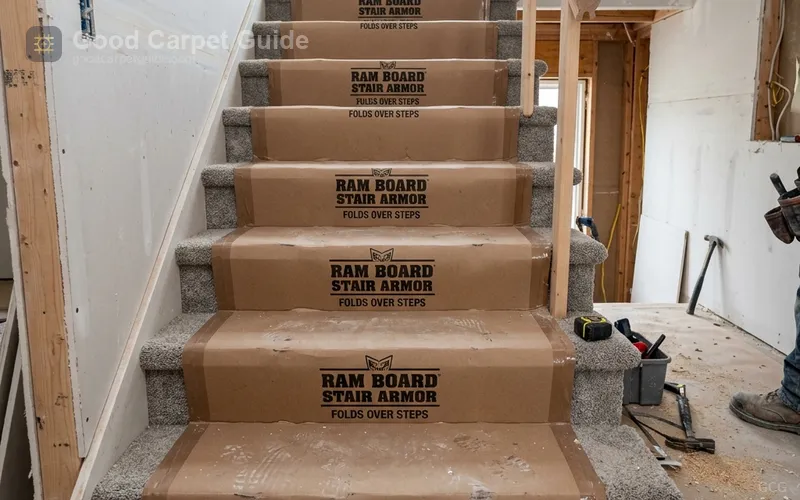
Ram Board Stair Armor (6-Pack)
Ram Board Stair Armor is a heavy-duty corrugated board protector designed for renovations and construction. Featuring Spill Guard technology and an adjustable fold to cover tread, riser, and bullnose.
Check Price on Amazoncarpet protector cost and budget: big box vs. local dealer
Carpet protector costs in the U.S. market range from $0.05 per square foot for cardboard mechanical barriers to $1.08 per square foot for premium rigid vinyl runners. The table below presents current retail pricing for the principal carpet protector for stairs products available in the U.S. residential market, organized by category and unit size.
The following table compares product pricing by protector category to support purchase decisions based on budget, deployment duration, and stair traffic volume. All prices are in USD at standard retail.
| Product | Size | USD Price | Cost/sq ft |
|---|---|---|---|
| TapeManBlue adhesive film | 24 in × 200 ft | $44.90 | $0.13 |
| Surface Shields Carpet Shield | 36 in × 500 ft | $124.90–$130.99 | $0.10–$0.11 |
| Dura-Gold adhesive film | 24 in × 50 ft | $25.99 | $0.26 |
| Ram Board Stair Armor (6-pack) | 34 in × 19 in per piece | $38.90–$46.99 | $0.18–$0.22 |
| Resilia vinyl runner (deep pile) | 48 in × 12 ft | $124.99 | $1.04 |
| ES Robbins ribbed vinyl runner | 36 in × 20 ft | $116.58 | $0.97 |
Big-box stores vs. local specialty dealers: Big-box retailers (Lowe's, Home Depot) display lower unit prices for carpet protector products but use outsourced, third-party subcontractors for installation, which produces inconsistent stair-run results and frequently supplies lower-quality product variants not available through specialty channels. Local specialty flooring dealers employ certified in-house installers and provide written specifications for underlayment density and pile compatibility, which is the documentation required to maintain manufacturer warranty coverage on stair carpet.
Purchase timing: Carpet protector pricing follows the same seasonal pattern as flooring materials. Purchasing between late December and February, or between mid-May and early June, captures discounts of 15% to 30% compared to peak-season pricing (August through November). Labor rate negotiation on stair installation is also more favorable in the off-peak windows.
For stair carpet replacement following protector failure, the best carpet for basement guide documents moisture-resistant fiber specifications that apply equally to below-grade stair runs where humidity management is a parallel concern.
frequently asked questions about carpet protectors for stairs
How long does adhesive carpet protector film last on stairs before causing damage?
Adhesive carpet protector film remains safe on synthetic stair carpet for a maximum of 30 days (Surface Shields, QuicPrep) or 45 days (TapeManBlue, Kenley). Deployment beyond these windows allows the pressure-sensitive acrylic adhesive to cross-link with synthetic carpet fibers, producing a permanent gummy residue that standard cleaning cannot remove. Deployment beyond 45 days in temperatures above 104°F or in direct sunlight accelerates cross-linking to a matter of days rather than weeks.
What is the best non-slip carpet protector for stairs?
The best non-slip carpet protector for stairs is a rigid vinyl runner with PVC gripper teeth measuring 0.100 to 0.150 inches in length, because the teeth anchor below the carpet pile surface and resist horizontal displacement under stair foot-strike forces. Resilia's deep-pile vinyl runner and ES Robbins' ribbed runner both meet this specification. Foam-backed fabric runners (CarpetSaver, Laminet) provide adequate slip resistance on low-to-moderate traffic stairs with pile depths under 1/2 inch but require double-sided tape on high-traffic or steep-angle stair runs.
Can carpet protector film be used on wool stairs?
Adhesive carpet protector film cannot be used on wool stair carpet. Manufacturer documentation for all major adhesive film brands — including Surface Shields, TapeManBlue, and Dura-Gold — explicitly restricts film use to synthetic fiber carpets (nylon, polyester, polypropylene). Wool, oriental rugs, sisal, and other natural fiber carpets are excluded because the adhesive chemistry damages natural fiber protein structures differently from synthetic polymer reactions, and because the removal process physically tears natural fiber constructions.
How do you protect carpet on stairs when moving furniture?
Protect carpet stairs when moving furniture by installing Ram Board Stair Armor or plywood tread covers before moving begins, because moving blankets and cardboard slip under furniture load. Ram Board Stair Armor's reinforced corrugated fiberboard withstands repeated impact from furniture corners and appliance feet without compressing the carpet pile. Plywood tread covers (1/4-inch luan) screwed through the riser face provide the highest impact resistance for heavy appliances. Remove all protectors and inspect the carpet backing for compression damage within 24 hours of the move.
What happens to carpet when a plastic film is left on for more than a year?
Plastic adhesive film left on synthetic stair carpet for longer than 45 days produces adhesive cross-linking that darkens the pile, attracts dry soil, and resists steam cleaning. Film left for 6 to 24 months produces fiber-level bonding that cannot be reversed without fiber replacement. Non-breathable plastic film left for extended durations also traps moisture vapor in the carpet backing, raising the moisture content above the mold colonization threshold and degrading the secondary backing adhesive. Rental property and apartment stair runs requiring 6-to-24-month protection use fabric runners or rigid vinyl runners, not adhesive films.
How should carpet be fitted on stairs for proper protector compatibility?
Carpet fitted on stairs using the waterfall method (draping straight over each bullnose without tucking) is compatible with all four protector types. Carpet fitted using the cap-and-band method (individually cut and tucked per tread and riser) requires protectors that match the tread dimensions precisely, because cap-and-band installation produces a seam at the bullnose that adhesive films can lift and fabric runners can snag. Consult the best carpet for stairs guide for installation method specifications that affect both protector selection and wear warranty compliance.
Stair carpet protection resolves into four distinct use cases, each requiring a different protector type. Construction and painting projects under 45 days on synthetic carpet use adhesive film (TapeManBlue at $44.90 per roll) or cardboard mechanical barriers for projects of any duration. Daily residential use with pets or heavy foot traffic uses rigid vinyl runners (Resilia at $124.99, ES Robbins at $116.58) with 0.150-inch gripper teeth, because no other category provides equivalent slip resistance on deep-pile stair carpet. Rental and apartment stairs requiring 6-to-24-month protection use machine-washable fabric runners (CarpetSaver, Laminet) combined with fluorochemical spray treatment. Construction projects requiring bullnose and riser coverage use Ram Board Stair Armor ($38.90–$46.99 per 6-pack). The warranty conflict between installer practice and manufacturer documentation makes two actions non-negotiable before any protector installation: confirm that the selected underlayment meets the carpet manufacturer's density specification, and confirm that the film or runner material is rated for the specific carpet fiber type installed on the staircase.