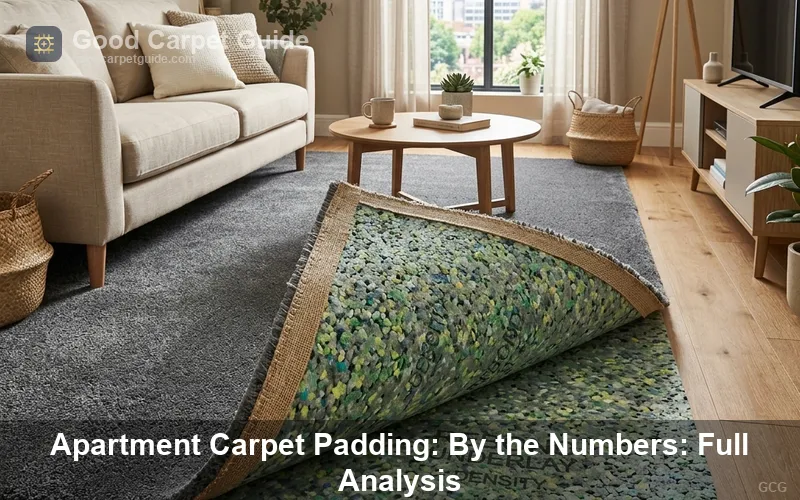
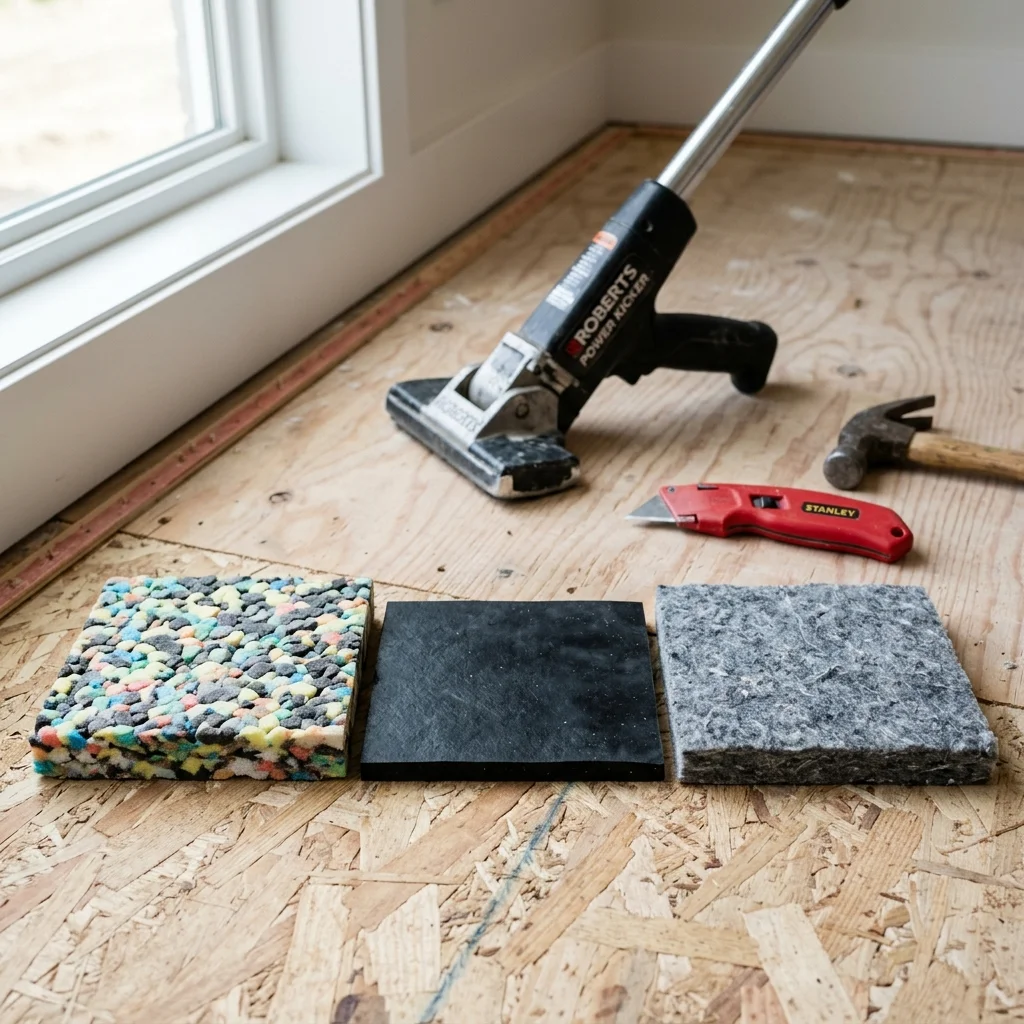
The best carpet padding for radiant heat is a dense, low-profile slab rubber or frothed polyurethane pad with an R-value under roughly 0.6. Thick memory foam, the category most retail floor associates push, traps heat in the subfloor. Padding over a heated floor has one job: move heat upward. That requirement rules out most of the cushion stocked at Home Depot and Lowe's.
Get the R-value wrong and the heating system runs roughly 40°F hotter to reach the same room temperature, which shortens the service life of the tubing or wiring underneath and the carpet backing above it.
Recommendation matrix
| Scenario | Recommended pad | Thickness | R-value | Why |
|---|---|---|---|---|
| Hydronic (water-based) slab or above-joist panel | Leggett & Platt Tred-Mor 2580 (SBR slab rubber) | 1/4 in | 0.31 | Dense and low-profile, so heat passes through |
| Electric foil/mat system | Healthier Choice OmniChoice frothed poly | 0.055 in | 0.08 | Minimal thickness, minimal thermal drag |
| Budget-conscious install | MP Global QuietWalk | 11 mm | 0.58 | Recycled synthetic fiber, no organic content to hold moisture |
| Staple-up PEX under plywood | Not recommended without above-joist panels | — | — | Uninsulated plywood plus carpet padding blocks too much heat |
| Never buy | Stainmaster Elite DuraPlush, Shaw Courage Pad, bonded/prime urethane | 1/2 in+ | 1.6–2.2 | Functions as a thermal blanket and forces the system to overheat |
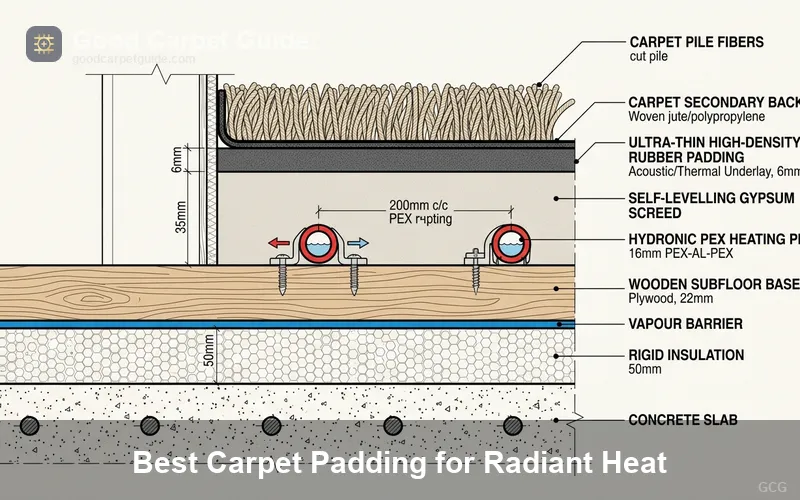
Best carpet pad for radiant floor heat
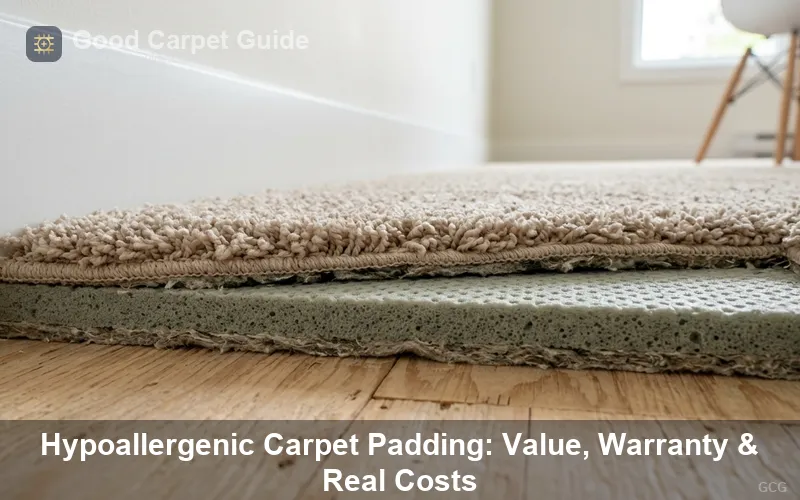
Synthetic styrene-butadiene rubber (SBR) slab foam is the strongest option in this category, and Leggett & Platt's Tred-Mor line is the most widely stocked example. The 1/4-inch Tred-Mor 2580 carries a listed density of 26.0 lbs/ft³ and an R-value of 0.31, near the bottom of the insulation scale for carpet cushion. R-value is the specification that decides this choice; loft and softness are secondary. The same tight cell structure that gives the pad its low R-value also resists crushing under rolling loads like furniture casters and kitchen carts.
Frothed polyurethane is the second acceptable category. Healthier Choice's OmniChoice pad measures 0.055 inches thick and is rated at an R-value of 0.08 with a 25.0 lbs/ft³ density. Thickness matters most on electric systems, where the heating element already adds a few millimeters to the stack-up and every layer competes for the same limited clearance under door thresholds.
Can you put radiant heat under carpet?
Yes. Carpet works over radiant heat when the padding is thin and dense.
Home-renovation forums often answer with a blanket no, on the reasoning that any padding insulates the floor and stops heat from reaching the room. That reasoning describes thick, high-R-value cushion such as 1/2-inch bonded urethane. It does not describe the SBR slab rubber and frothed poly pads that specialty dealers spec for heated floors, which sit at a fraction of the thickness and R-value. Thickness and density decide the outcome.
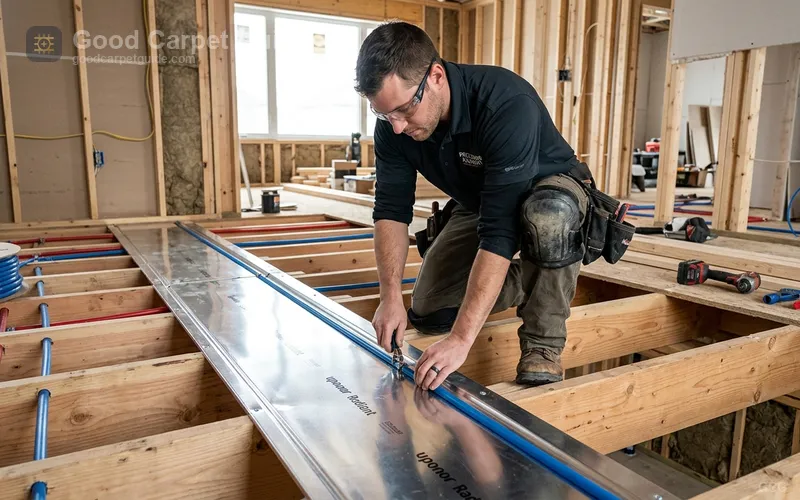
The exception is a staple-up hydronic system, where PEX tubing runs inside joist bays under an uninsulated plywood subfloor. Plywood is a poor thermal conductor on its own, and stacking carpet padding on top of it blocks the limited heat that does make it through. Above-joist aluminum heat-transfer panels such as Warmboard or Ecowarm RadiantBoard spread heat across the plywood before it reaches the carpet. Without one of those panels, a staple-up install and a carpeted floor are a poor match.
Why big-box padding fails on radiant floors
Thick, high-loft polyurethane memory foam sells well in showrooms because it feels luxurious underfoot. On a heated subfloor it fails. Stainmaster Elite DuraPlush and similar 1/2-inch or 13 mm foams carry listed R-values above 2.0, which becomes a liability the moment a radiant system sits underneath. Heat stalls in the assembly, and the system raises its water or wire temperature to compensate, often past the range it was designed for.
The split is straightforward: retail floors move 1/2-inch rebonded foam in the 5–6 lb/ft³ range on comfort marketing, while dealers who handle radiant work stock 1/4-inch to 3/8-inch dense slab rubber or frothed poly and treat 7/16 inch as a hard thickness ceiling.
Shaw's technical documentation for its Courage Pad line, a 1/2-inch ComfortTouch foam pad often recommended at retail for barefoot feel, states the pad is unsuitable for installation over radiant heating, and its listed R-value above 2.0 accounts for that.
R-value and system temperature
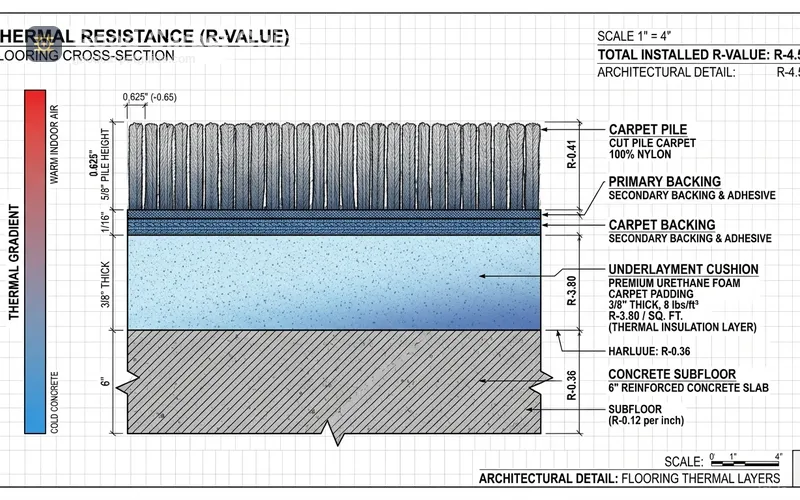
R-value determines how much water or wire temperature a radiant system needs to reach a given room temperature, and the gap between a good and a bad pad choice is roughly 40°F. A standard 10 mm (3/8-inch) prime urethane cushion is rated at an R-value of about 1.62. A 6 mm (1/4-inch) slab rubber foam pad is rated at 0.31, over five times lower. The higher-R pad forces the system to run about 40°F hotter for the same heat output.
That higher setpoint raises energy use, because the boiler or electric mat works harder to hold it. It also pushes subfloor materials and adhesives past the operating temperatures they were rated for, and it moves PEX tubing and electric mats closer to their manufacturer-specified maximum operating temperature more often, which shortens their working life.
Total assembly thickness dominates thermal resistance in a carpet installation; fiber type has a much smaller effect. A 1/2-inch bonded urethane pad alone is rated near an R-value of 2.1, roughly three times the 0.70 R-value of a standard 1/4-inch carpet.
How cheap padding fails under radiant heat
Continuous thermal cycling in the 70–85°F range that radiant systems produce degrades low-quality padding on three different timelines.
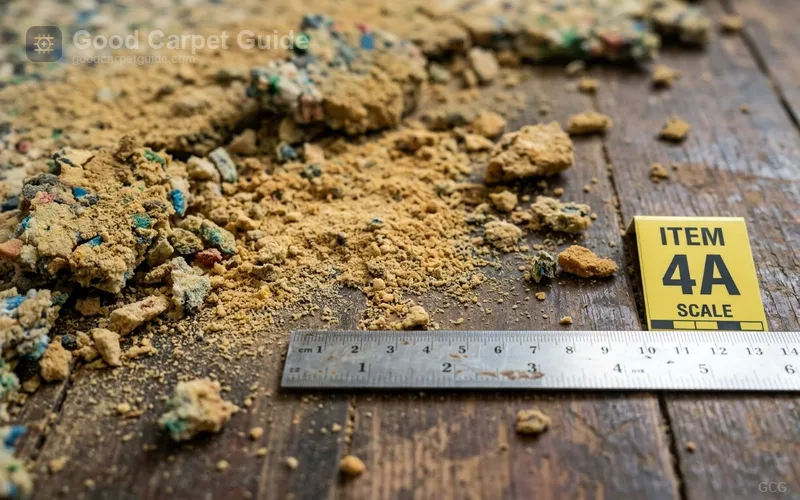
- Binder breakdown, two to three years. Low-grade waffle rubber and rebonded foam often use clay binders and petroleum-based fillers to add weight cheaply. Sustained heat drives those oily fillers to the surface, where they dry out. The pad loses its binding agent and crumbles into an abrasive, sandy powder that destroys cushioning and abrades the carpet backing above it.
- Premature flattening, 12 to 24 months. Standard rebonded polyurethane foam in the 5–6 lb/ft³ range cushions through microscopic trapped air pockets. Combined heat and foot traffic collapse the thin cell walls permanently. High-traffic zones like hallways flatten first, and once the pad loses elasticity, every footstep transfers directly to the carpet fibers, which shows up as matting and visible wear paths.
- Trapped moisture, immediate to two years. Wet-stretching, an installer shortcut that dampens the carpet backing to make it easier to stretch over tack strips, becomes a liability over an active radiant floor. Heat drives that moisture upward before it can evaporate. Backing adhesives soften, and the carpet wrinkles, buckles, or delaminates. Organic padding materials like jute lack synthetic antimicrobial treatment, so moisture held in those pads adds a mold and mildew risk to the structural damage.
Warranty fine print that voids radiant heat claims
Carpet and padding warranties commonly include radiant-specific conditions. Some manufacturers cap maximum floor surface temperature at 81–85°F (27–30°C), and some require physical documentation proving that cap was never exceeded.
| Warranty requirement | Detail | Consequence of skipping it |
|---|---|---|
| Concrete cure and thermal purge | 60–90 day cure, then system run at maximum for 14–21 days, then neutral 24–48 hrs before install | Claim voided without ASTM F1869 or F2170 moisture test documentation |
| Thermal sensor stickers | Some brands require crystal stickers over heating lines that blacken irreversibly above roughly 81°F | Missing or blackened sticker at inspection can auto-deny structural claims |
| Electric mat embedding | Heating wires must be fully embedded in cementitious self-leveling underlayment or thin-set mortar | Loose wires or non-approved mats under floating floors void the warranty |
| Labor cost coverage | Manufacturer liability limited to replacement material, F.O.B. plant | Tear-out and reinstall labor is rarely covered under a material defect claim |
An ASTM F1869 calcium chloride test measures moisture vapor emission, and allowable emission is typically capped around 3.0–5.0 lbs per 1,000 sq ft per 24 hours. An ASTM F2170 in-situ relative humidity test is typically capped at 75–85%. Both results need to be documented and kept on file, since inspectors request that paperwork routinely after a moisture-related failure. Confirm the exact thresholds in the warranty document for the specific carpet and pad being installed.
Brands and products: what to buy and what to avoid
Leggett & Platt Tred-Mor 2568 and 2580 lead the SBR slab rubber category. The 1/4-inch 2580 runs around $1.70 per sq ft (roughly $459 per 270 sq ft roll) and is rated at an R-value of 0.31 with 26.0 lbs/ft³ density. Healthier Choice Sound Solution and OmniChoice frothed polyurethane pads run about $1.15–$1.50 per sq ft and reach R-values as low as 0.08. MP Global QuietWalk, made from recycled synthetic fiber at 8.0 lbs/ft³ and 11 mm thickness, is rated at an R-value of 0.58 and sells for about $1.10–$1.35 per sq ft; MP Global markets it as producing no VOC off-gassing.
On the avoid list: the Shaw Courage Pad, which the manufacturer's own documentation flags as unsuitable for radiant heat; Stainmaster Elite DuraPlush and other high-loft memory foams above R-2.0; and prime or bonded urethane generally, which above-joist radiant panel manufacturers advise against for its combination of high R-value, low density, and heat degradation risk.
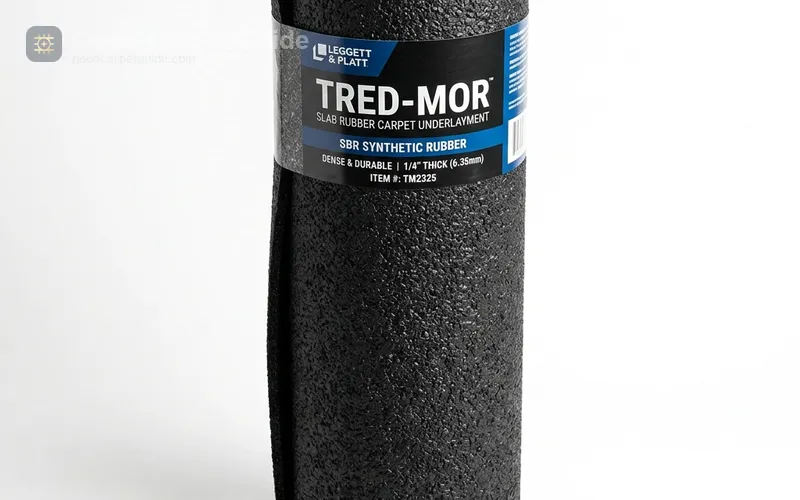
Leggett & Platt Tred-Mor SBR Slab Rubber Carpet Cushion
Dense, low-profile slab rubber padding built for radiant floor compatibility
Check Price on Amazon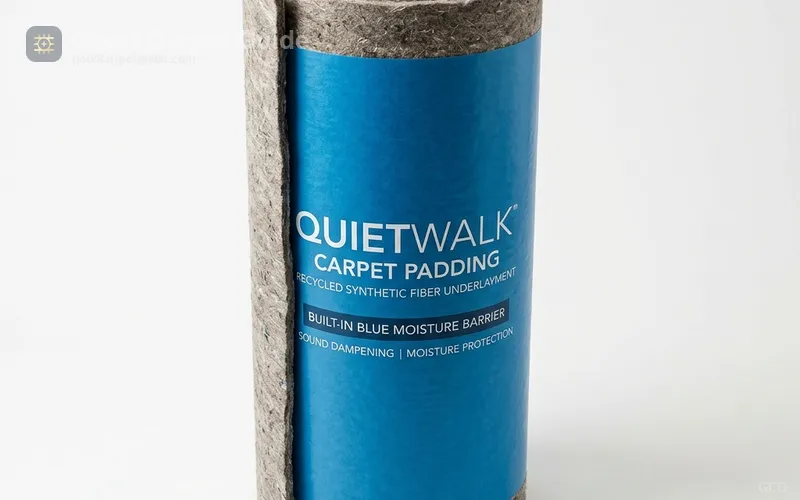
MP Global QuietWalk Recycled Fiber Carpet Pad
Recycled synthetic fiber pad with a moderate R-value and no VOC off-gassing
Check Price on Amazon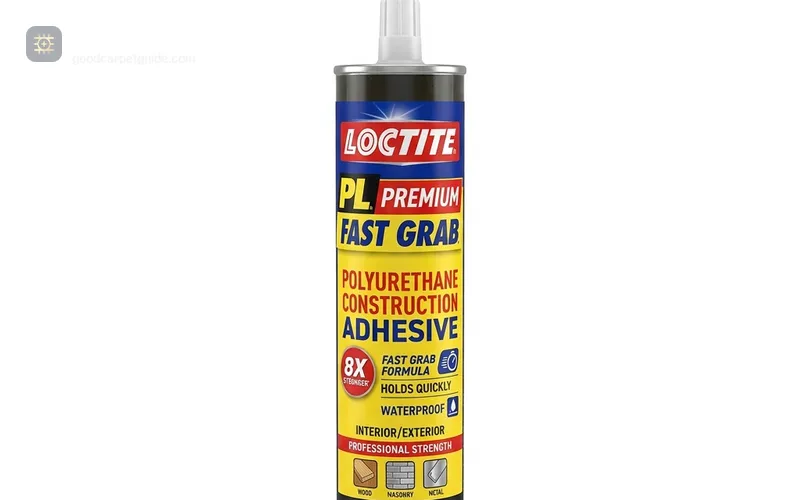
Loctite PL Premium Fast Grab Polyurethane Adhesive
Heat-resistant adhesive for gluing tackless strips over radiant subfloors instead of nailing
Check Price on AmazonHow to choose radiant heat carpet padding
The tradeoff is tactile comfort against thermal efficiency.
| Factor | Low-density rebond / thick memory foam | High-density SBR slab rubber / frothed poly |
|---|---|---|
| Tactile feel | Plush at first, flattens in high-traffic zones within 12–24 months | Dense, firm feel that holds loft far longer |
| Thermodynamic efficiency | R-value above 1.5–2.0 holds heat in the assembly and raises running costs | R-value 0.08–0.40 lets heat rise quickly, with reported energy savings of 25–30% |
| Long-term durability | Petroleum binders and clay fillers crumble into abrasive dust within 2–3 years of thermal cycling | Withstands continuous cycling and resists mold and pet-stain moisture |
Higher R-value pads increase thermal resistance across the assembly, so the system needs a higher water or wire temperature to hit the same room temperature. The trapped-air structure that cushions footsteps is the same structure that blocks heat transfer, which is why comfort and thermal performance pull against each other in this application.
Before ordering padding, check whether the current subfloor uses a staple-up PEX system or an above-joist panel, since the padding choice depends on which heat-transfer method sits underneath it. For cushion selection outside radiant applications, the carpet padding guide covers density and thickness standards for standard subfloors.
Installation realities on a radiant subfloor
Tackless-strip installation changes once PEX tubing or electric mats are buried in the subfloor, and skipping any of these three adjustments risks puncturing a line or failing under tension.
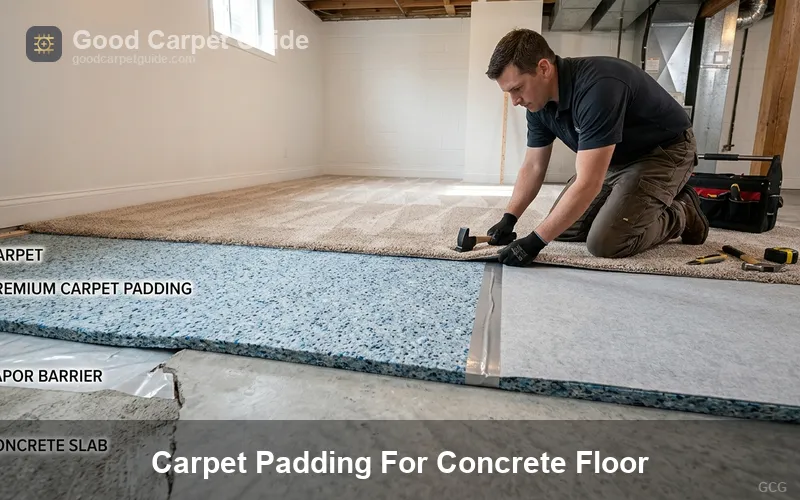
- Nails come out of the process. Steel nails or staples used to secure tackless strips to concrete risk puncturing buried PEX tubing or slicing electrical cables, so strips get glued instead.
- Only heat-resistant adhesive holds. Standard PVA wood glue and basic latex construction adhesive soften under continuous radiant heat. Power-stretching a carpet requires roughly 1.5–2% stretch tension, and softened glue pops loose under that load. Polyurethane adhesives rated for heat, such as Loctite PL Premium Fast Grab, hold where PVA fails.
- The install splits across two days. Specialized dealers glue tack strips on day one and let the polyurethane adhesive cure 24–48 hours before laying pad, heat mats, and stretching carpet on day two. Crews working to a same-day schedule often skip that cure window, and the adhesive then fails under stretch tension.
Tooling on this job matches any stretch-in carpet install: knee kickers, power stretchers, seam irons, row runners, latex seam sealer, and felt underlayment where a moisture barrier is called for. The tackless strip pin length and the adhesive choice are what change on a radiant floor.
How much does radiant heat carpet padding cost?
Radiant-compatible padding costs more than standard rebond, and the heating system itself is the larger line item in most budgets. Costs vary by region and dealer.
| Item | Approximate cost |
|---|---|
| Tred-Mor 2568 (1/4 in SBR) | $1.80/sq ft (about $486 per 270 sq ft roll) |
| Tred-Mor 2580 (1/4 in SBR) | $1.70/sq ft (about $459 per 270 sq ft roll) |
| Leggett & Platt Berber Supreme (premium SBR) | $2.20–$2.50/sq ft |
| Healthier Choice frothed poly | $1.15–$1.50/sq ft |
| MP Global QuietWalk | $1.10–$1.35/sq ft |
| Standard 6 lb rebond (not radiant-rated) | ~$0.33/sq ft |
| Hydronic system, retrofit | $10–$25/sq ft |
| Hydronic system, new build | $15–$35/sq ft |
| Electric radiant (materials + install) | $11–$22/sq ft |
A 100 sq ft electric under-carpet foil system for a bedroom runs about $1,000–$1,300 in materials, with operating costs of roughly $0.08–$0.20 per hour depending on room size. A whole-home hydronic retrofit for a 3,000 sq ft house typically lands between $30,000 and $75,000. Independent dealers that stock Tred-Mor or Sound Solution lines usually have more room to negotiate on padding and accessories than big-box stores, which compete mainly on headline padding price.
Pet households: padding and carpet choice
Antimicrobial-treated synthetic padding matters more in a pet household than fiber choice does, since an accident on an unprotected organic pad creates a mold risk that a heated subfloor accelerates. SBR slab rubber and frothed polyurethane pads are water-resistant and usually antimicrobial-treated, so they repel moisture that jute or other organic-backed padding would absorb and hold against a warm subfloor. Pair that padding with a stain-resistant nylon or triexta carpet for the easiest cleanup over radiant heat.
Service life and replacement timing
Matched padding and radiant systems run within their documented temperature caps last longer than mismatched ones, though exact service life depends on the system type and how consistently it stayed inside the 81–85°F ceiling most manufacturers set. Replacement comes sooner when a high-R pad forced the system to run hotter than intended, because that overheating wears tubing, wiring, and adhesives ahead of the padding's own crumbling or flattening timeline.
DIY installation and payback
Most homeowners hand the heating system itself to a licensed installer, particularly for hydronic systems where the thermal purge protocol and documented moisture testing directly affect warranty coverage. Whether radiant heat pays back depends on the padding and R-value decisions above: a correctly specified SBR or frothed poly pad delivers the 25–30% energy savings radiant systems are marketed on, while a mismatched high-R pad can erase those savings and shorten the system's working life at the same time.
What homeowners and installers report
Threads on Reddit's flooring and home improvement communities and on Houzz discussion boards show a consistent gap between blanket advice and field results. A recurring position in those threads is that carpet padding blocks radiant heat from reaching the room and should be avoided outright, which holds for the thick, high-R padding those commenters are picturing and not for the thin SBR or frothed poly cushions specialty dealers carry. Homeowners asking about staple-up PEX under plywood get similar mixed signals, and the most common warning from plumbers in those threads is that an uninsulated plywood subfloor plus any carpet padding blocks too much heat until an above-joist heat-transfer panel is added.
Recommended use cases
Choose the Tred-Mor 2580 for a hydronic slab or above-joist panel install; its 0.31 R-value and 26 lbs/ft³ density hold up to continuous thermal cycling without the crumbling failure mode common in cheaper rebond. Choose Healthier Choice OmniChoice for an electric foil or mat system where stack-up clearance under door thresholds is tight. Skip Stainmaster-style memory foam and the Shaw Courage Pad regardless of how the showroom sample feels underfoot, since both products' published R-values sit far above the 0.6 ceiling this application needs. For a staple-up PEX system with no above-joist transfer panel, add the panel before choosing a floor covering; no padding choice fixes that assembly.