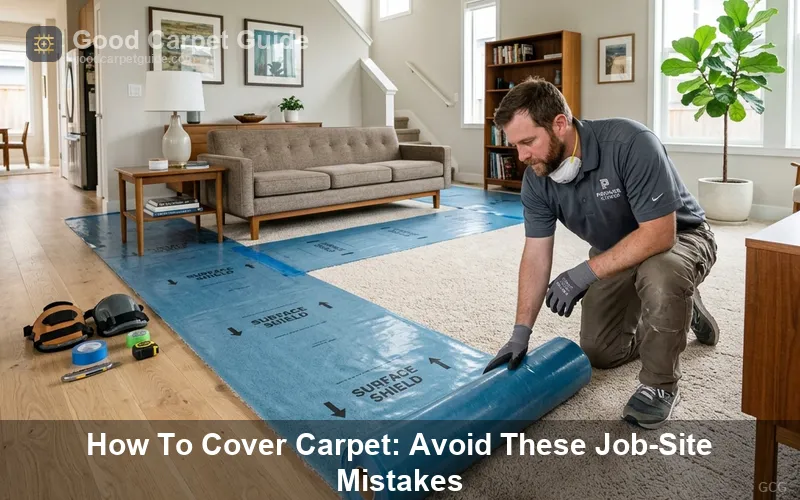
quick answer: how to cover carpet
Covering existing carpet involves choosing between temporary protection methods, semi-permanent floating floors, and full replacement, and each path depends on subfloor condition, moisture exposure, and how long the covering needs to last. Carpet covering fails most often when installers skip subfloor flattness checks or when homeowners choose a rigid click-lock product over a compressible pad. The table below sorts common covering scenarios by material, approximate cost, and durability under standard residential foot traffic.
| Scenario | Recommended covering | Cost per sq. ft. (installed) | Expected durability |
|---|---|---|---|
| Painting walls or trim | Self-stick plastic film + masking tape | $0.10–$0.30 | Single project use |
| Renting, no permanent changes allowed | Interlocking foam or rubber tiles | $1–$3 | 1–3 years |
| Construction or renovation traffic | Fiber-based surface board (Ram Board style) | $0.40–$0.90 | Single project use |
| Permanent hard-surface upgrade | Glue-down LVP over low-pile commercial carpet | $5–$12 | 10–20 years |
| Full replacement over worn carpet | New carpet and pad system | $3–$8 | 8–15 years |
Covering carpet successfully starts with matching the covering material to the subfloor's actual rigidity, not to the marketing claims printed on the box. The rest of this guide walks through each PAA scenario, documented installer conflicts, and the cost breakdowns that separate a durable covering job from a callback.
how to cover over carpet
Covering over carpet requires first confirming whether the existing carpet is low-pile, commercial-grade, and glued directly to the subfloor without padding. Padded residential carpet compresses under foot traffic, and that compression is the primary cause of failure when a rigid product sits on top of it. Field reports document that click-lock laminate and vinyl plank installed over cushioned carpet develop "vertical deflection," a flexing motion that stresses the locking tabs at each seam until they separate.
Only one carpet type tolerates a floating floor placed directly above it: dense, low-pile commercial carpet glued to a concrete or plywood subfloor with no separate cushion layer. Padded residential carpet, Berber weaves, and any carpet installed over foam cushion do not meet this threshold. Removing the padding and re-securing the carpet backing flat against the subfloor is the only reliable workaround, and even then, manufacturers of click-lock flooring generally exclude carpet substrates from their warranty coverage.
Subfloor rigidity test: Installers commonly press a bathroom scale against the carpet and note how much the needle moves under body weight; deflection beyond roughly 1/8 inch signals a cushion layer is still present underneath.
how to cover carpet when painting walls
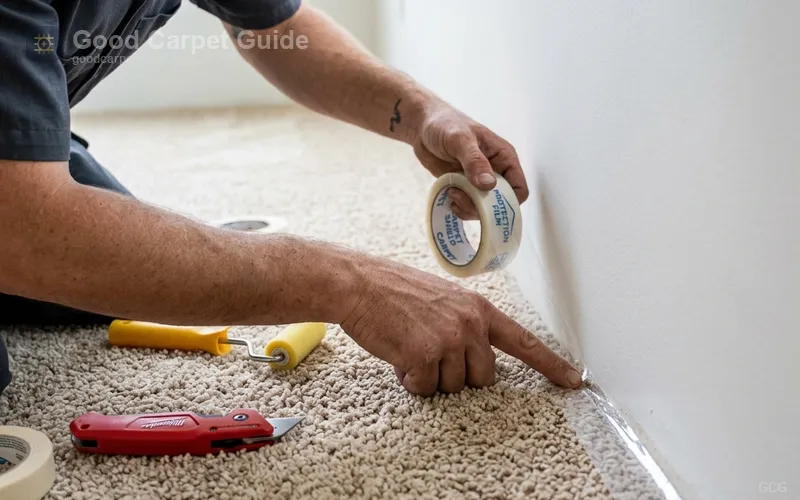
Painting walls above carpet requires laying down a physical barrier before opening a paint can, and painter's tape alone does not achieve a tight seal against carpet fiber. Standard blue or green painter's tape adheres poorly to the uneven, textured surface of carpet pile, which allows drips to travel underneath the tape edge and reach the fiber below. Self-stick carpet protection film, tucked tightly against the baseboard or wall edge and reinforced with high-stick masking tape, closes that gap in rooms that lack trim.
The following sequence reflects how flooring crews commonly prep a room before repainting walls or baseboards:
- Vacuum the perimeter along the wall line to remove loose debris that would trap paint drips against the fiber.
- Roll self-stick protection film along the wall edge, overlapping each strip by two inches to prevent gaps.
- Press masking tape over the film's outer edge where no baseboard exists, sealing it directly against the wall surface.
- Fold a second layer of film at inside corners, since a single flat sheet tends to lift at 90-degree turns.
- Remove the film within 24 hours of the final coat drying, since extended exposure to adhesive residue creates a dirt-attracting strip along the carpet edge.
Leaving plastic sheeting down for weeks rather than days causes a documented secondary problem: trapped moisture and adhesive residue combine with foot traffic to create a permanent dark line that resists standard vacuum extraction.
how to cover carpet for cats
Cat owners covering carpet to prevent scratching or urine damage generally choose between washable protective mats, sisal-topped runners, and enzymatic pre-treatment rather than a hard-surface swap. Cats target carpet edges and corners at a disproportionately high rate compared to open floor areas, so partial coverage of high-traffic scratching zones addresses the behavior without a full room replacement. Clear vinyl carpet runners, textured side down, discourage scratching in hallways while still allowing normal foot traffic across the covered path.
Urine exposure changes the covering calculus. Carpet padding absorbs liquid faster than the face fiber, and once urine reaches the padding layer, surface-level covering products do not stop the odor from resurfacing through seams. Documented cases show that pet owners who cover urine-affected carpet without first treating the subfloor and padding report recurring odor within weeks, since the ammonia compounds remain trapped beneath whatever new layer was installed.
| Cat-related carpet issue | Covering approach | Addresses root cause |
|---|---|---|
| Corner and edge scratching | Sisal-topped floor runner | Yes, redirects behavior |
| Fresh surface urine spots | Enzymatic cleaner + spot covering | Partial, treats surface only |
| Urine soaked into padding | Full pad and subfloor treatment before covering | Yes, if pad is replaced |
| General claw wear on pile | Low-pile berber remnant overlay | Yes, in the covered zone |
Covering alone rarely resolves a urine-saturated pad, and installers who receive complaints about recurring pet odor after a covering job commonly trace the source back to skipped padding replacement.
real reddit user experiences with carpet covering
Homeowner accounts on forums surface a pattern that manufacturer installation guides tend to skip: physical carpet covering attempts frequently fail from the adhesive layer up, not from the covering material itself. One contractor reported that plastic sheeting left down during a remodel tore the underlying carpet fiber on removal, an outcome expensive enough that the entire first-floor carpet needed replacement. That failure traces back to adhesive strength mismatched to fiber tensile strength, a detail glossed over on most product packaging.
A separate account described a landlord's attempt to freshen bedroom carpet through steam cleaning before re-covering it with a rental-friendly overlay. The steam cleaning process released compounds that had been bound into the carpet backing for years, producing an odor bad enough to force a full tear-out instead of a cover-up. Renters attempting a similar shortcut, laying click-vinyl planks directly over aging carpet to hide it during a lease term, report the flooring feels "spongy" underfoot and traps moisture against the carpet backing, conditions that favor mold growth in humid climates.
Field note: Long-term outcome data on click-vinyl-over-carpet installations beyond two years is limited, since most renters remove the covering before that mark or move out entirely.
do carpet manufacturers and installers agree on covering methods
Carpet manufacturers and independent installers diverge sharply on whether existing carpet can safely host a new floor covering, and the gap centers on how each group defines "over carpet" compatible flooring. DIY-marketed laminate and luxury vinyl plank (LVP) brands frequently list "installs over most surfaces" on packaging, language that homeowners commonly read as including carpet. Installers who service warranty claims report the opposite: "carpet, especially with padding underneath, would be way too soft of a surface to support laminate" in any configuration involving standard residential cushion.
The waterproofing claim follows a similar pattern. LVP marketing describes the product as fully waterproof, and the individual planks meet that standard under ASTM testing protocols specific to the plank material itself. The seams between planks remain the documented weak point; water sitting in a seam for an extended period seeps beneath the plank and reaches the subfloor, a risk that increases when planks are covering carpet fiber that retains moisture rather than a rigid, moisture-shedding subfloor.
- Manufacturer position: Click-lock systems are rated for "most subfloors" without excluding carpet by name on most retail packaging.
- Installer position: Compressible cushion beneath carpet causes locking tabs to flex and separate under normal foot traffic within months.
- Warranty outcome: Most manufacturer warranties exclude installations over carpet or cushioned substrates once a claim is filed, shifting the cost of failure back to the homeowner.
This conflict rarely appears in marketing copy, since brands sell to a general retail audience rather than a licensed installation crew, and the exclusion clause only surfaces once a warranty claim is denied.
how to cover exposed carpet tacks and nails
Exposed tack strip nails at doorway thresholds or carpet edges require immediate covering with a rigid transition strip or a folded fabric barrier, since bare tackless strip pins puncture skin on contact. Perimeter tack strips lift most often at high-traffic thresholds, where repeated foot pressure gradually pulls the strip's adhesive or nail bond loose from the subfloor. A parent reported a household injury from this exact condition, describing a cut deep enough to draw blood from kneeling near an exposed threshold with a crawling infant nearby.
Covering exposed tacks correctly follows a short diagnostic sequence rather than a single fix:
- Identify whether the strip is lifting or intact but exposed, since a lifting strip needs re-securing before any covering is added.
- Re-nail a lifting strip into solid subfloor material, avoiding any section of subfloor that shows rot or delamination.
- Install a metal or vinyl transition strip over an intact but exposed threshold, screwed directly into the subfloor rather than adhered with tape.
- Fold and tuck excess carpet fiber over any remaining exposed pin using a stair tool, then secure the fold with latex seam sealer.
Warning: Skip-bending tack strip pins, a manufacturing defect where the metal pins sit at an inconsistent angle, causes strips to lift unevenly even after correct nailing. Installers check for this defect by running a gloved hand along the strip length before final placement.
how to cover a carpet seam correctly
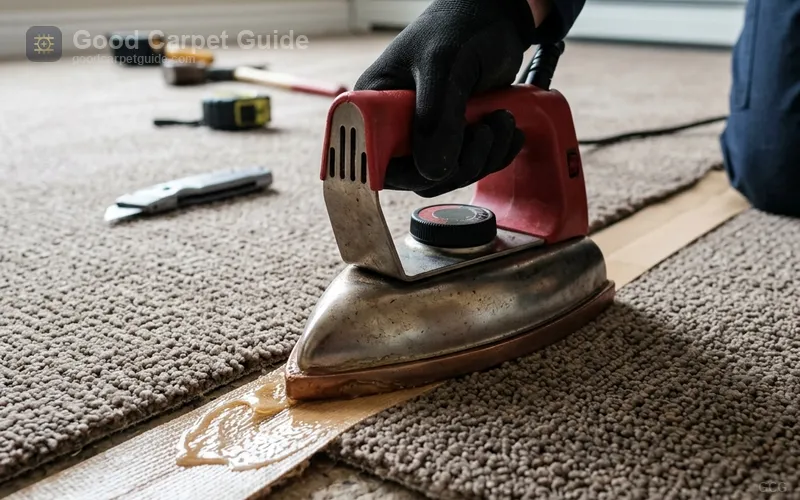
A carpet seam gets covered and sealed using a hot seam iron, latex-based seam tape, and even pressure applied while the adhesive is still warm, not through surface-level products applied after installation. Seam peaking, the visible ridge that develops along a seam line, results from the physical tension used to stretch carpet during installation rather than from a workmanship error. Installers who receive complaints about peaking generally decline to "fix" it after the fact, since no post-installation product reverses the tension-driven ridge once the backing has set.
Covering a fresh seam properly involves running a seam iron along the pre-applied hot-melt tape until the adhesive reaches a workable temperature, then pressing both carpet edges together while the seam is still pliable. Waiting until the adhesive cools before pressing the edges together produces a visible gap that no topical covering closes permanently. Wider seam tape, sometimes used by installers attempting to compensate for a poor initial seam, does not eliminate peaking in field-tested comparisons and can instead create a stiffer, more visible ridge line.
how to cover carpet with vinyl flooring
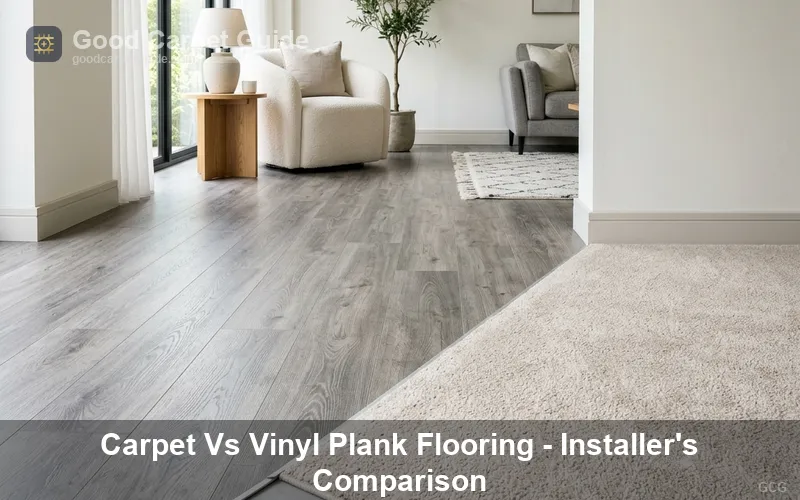
Covering carpet with vinyl flooring requires removing the carpet down to the subfloor in nearly every documented durable installation, rather than laying vinyl planks directly over the existing carpet layer. Vinyl plank flooring depends on a rigid, flat substrate to lock its tongue-and-groove edges together, and carpet cushion introduces the same flexing problem that undermines laminate installations. The single technical exception applies to thin, dense, glue-down commercial carpet with no separate pad, a substrate rarely found in residential homes built for comfort underfoot.
| Subfloor condition | Vinyl flooring compatibility | Reason |
|---|---|---|
| Padded residential carpet | Not compatible | Cushion causes seam flexing and tab failure |
| Glued commercial low-pile carpet | Conditionally compatible | Rigid, thin profile mimics a hard subfloor |
| Bare plywood subfloor | Compatible | Meets flatness tolerance for click-lock systems |
| Concrete slab | Compatible with moisture testing | Requires vapor barrier if alkaline moisture is present |
Subfloor flatness matters as much as rigidity once carpet is removed. A subfloor deviating more than 1/8 inch across a 10-foot span causes vinyl plank joints to bounce and eventually snap under repeated foot traffic, a tolerance drawn from standard flooring industry leveling practices rather than a single manufacturer's specification. Skipping this leveling step accounts for a documented share of early LVP failures traced back to installation rather than product defect.
how to cover carpet without removing it
Covering carpet without removing it limits the homeowner to non-structural, reversible options, since every rigid or adhered flooring product depends on a stable base that carpet cannot reliably provide. Interlocking foam tiles, rubber gym flooring, and area rugs represent the most common reversible coverings, chosen specifically because none of them require a fastened or glued connection to the subfloor beneath the carpet. These products distribute weight across a wider surface than a single foot placement, which reduces the compression stress that damages carpet pile over time.
Renters facing move-out restrictions gravitate toward this category, since a security deposit is commonly tied to the carpet's condition at lease end. Forum accounts describe interlocking floor tiles as a workable short-term fix, though several note the tiles trap moisture against carpet fiber in humid climates, creating conditions for mold growth if the tiles remain down for an extended period without periodic lifting and airing out.
- Interlocking foam or rubber tiles: Distribute weight evenly and lift without tools at move-out.
- Large area rugs with a non-slip pad: Cover worn or stained sections without any adhesive contact.
- Reversible carpet tile squares: Adhere with removable dots rather than permanent glue, preserving the original carpet underneath.
how to cover office carpet for a home gym or workspace
Office carpet under exercise equipment or rolling desk chairs requires a rigid protective layer, since concentrated point loads from dumbbells or chair casters compress carpet pile unevenly and cause permanent matting. Home gym setups commonly use interlocking rubber mats rated for impact absorption, a specification distinct from the foam tiles used in general living spaces. Rubber gym flooring rated for heavy equipment resists denting under weights, while lighter foam products compress permanently under the same load.
Rolling office chairs create a narrower but more concentrated wear pattern than gym equipment, since chair casters repeatedly travel the same short path between a desk and a filing cabinet. Polycarbonate chair mats designed for this purpose outlast lower-cost PVC mats, which tend to crack along the caster path within a season of daily use under standard office conditions.
cost and budget considerations for covering carpet
Carpet covering costs vary widely depending on whether the project is temporary protection, a reversible overlay, or a permanent replacement, and subfloor preparation is the line item most frequently missing from initial estimates. Temporary protection film runs $0.10 to $0.30 per square foot, while a full carpet-to-vinyl conversion, including material and installation, ranges from $5 to $12 per square foot. Subfloor leveling adds a separate cost layer: minor grinding and skim coating runs $0.25 to $0.50 per square foot, while extensive leveling with self-leveling compound or plywood replacement reaches $0.75 to $1.00 or more per square foot.
Big box retailers advertise flat-rate installation promotions, such as a $600 flat fee to carpet a standard bedroom, that undercut local dealer pricing on the surface. Property managers and installers who have worked both channels report that big box retailers take a significant cut of the labor fee before paying subcontractors, a structure that pushes toward rushed installations that skip subfloor prep. Local dealers charging $10 to $20 per square foot for materials commonly offset that premium through certified installation crews and remnant pricing, with small projects under 150 square feet sometimes available at up to 75% off standard remnant rates.
| Covering type | Material cost (per sq. ft.) | Labor cost (per sq. ft.) | Total installed range |
|---|---|---|---|
| Plastic protection film | $0.05–$0.15 | $0.05–$0.15 | $0.10–$0.30 |
| Interlocking foam/rubber tiles | $0.75–$2.00 | $0.25–$1.00 | $1–$3 |
| Fiber surface board | $0.30–$0.60 | $0.10–$0.30 | $0.40–$0.90 |
| Vinyl plank over stripped subfloor | $2.50–$6.00 | $2.00–$8.00 | $5–$12 |
| New carpet and pad | $3–$8 | $0.50–$2.00 | $3–$8 |
Subfloor prep gaps in the initial quote explain most of the cost overruns homeowners report on installation day, since a bid that omits leveling can undercut a thorough local dealer by a wide margin before the actual work begins.
frequently asked questions
How to cover up carpet burns?
Carpet burns from cigarettes or hot equipment get covered with a fiber patch cut from a matching remnant, adhered with carpet seam tape trimmed to the burn's exact shape. A patch smaller than roughly two inches across blends into surrounding pile more effectively than a larger repair, since smaller patches require less precise pile-direction matching.
How to cover carpet for construction work?
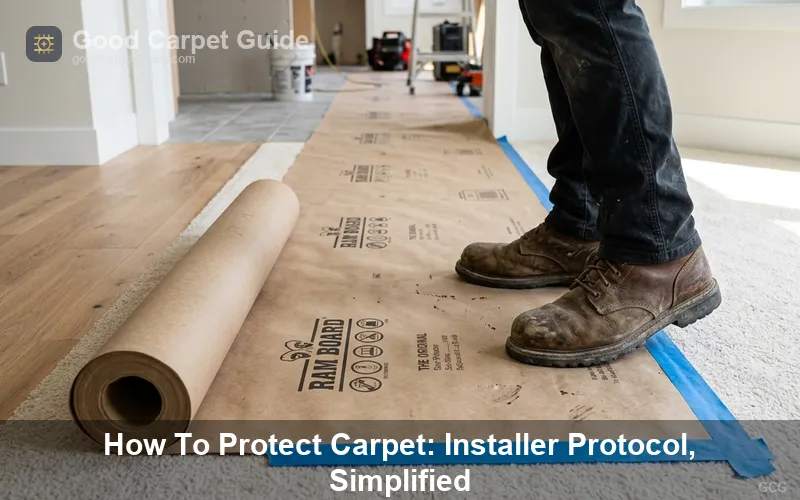
Construction-grade coverage uses a fiber-based surface board, commonly known by the Ram Board name in the trade, laid in overlapping sheets and taped at every seam. This material resists tearing under dropped tools and rolling equipment in a way that plastic sheeting alone does not.
How to cover carpet when painting skirting boards?
Painting skirting boards, known as baseboards in the US, requires the same protection film and masking tape sequence used for wall painting, applied directly beneath the board's lower edge. A putty knife pressed against the board while taping creates a tighter seal than tape applied freehand.
How to cover up carpet in an apartment rental?
Apartment renters generally rely on reversible coverings, interlocking tiles, or large area rugs, since lease agreements commonly restrict adhesives or fasteners applied to the existing carpet. Documentation of the carpet's pre-covering condition, through dated photographs, protects the security deposit if a dispute arises at move-out.
final recommendations
Match the covering method to how long it needs to last: plastic film and masking tape for a weekend paint job, fiber surface board for a construction project measured in weeks, and reversible tiles or rugs for a rental lease measured in years. Reserve vinyl plank or laminate installation for subfloors that have been stripped of carpet and leveled to standard flooring tolerances, since compressible padding underneath remains the most consistently documented cause of covering failures across installer reports. Treat any pet-related odor issue at the padding level before adding a new covering, since surface-level products do not resolve contamination trapped beneath the carpet face.