Walk into any flooring showroom and you’ll hear the same lazy sales pitch:
“This one feels softer underfoot. It’s like walking on a cloud.”
That statement alone has destroyed more carpets than bad vacuuming ever will.
Professional carpet systems are not designed around softness. They are engineered around load distribution, compression recovery, and how efficiently the underlayment absorbs kinetic energy before it destroys the carpet backing. The difference between an 8lb and 10lb carpet pad is not “a little firmer.” It is the difference between a stable flooring system and a slowly collapsing suspension bridge. A carpet only performs as well as the shock absorber underneath it. Once the pad collapses, the carpet starts dying from below—long before homeowners notice it on the surface.
In teardown inspections, failed 6lb or weak 8lb rebond usually turns brittle and powdery near door transitions first. Hallways become visibly darker because the carpet backing starts flexing independently from the subfloor support system. Most delamination claims I inspect start in hallways where the pad has physically degraded into dust.
Most homeowners obsess over carpet fiber while ignoring the structural layer underneath it. That is backwards. The carpet pad is the shock absorber of the entire assembly. Every footstep, rolling chair, furniture leg, pet impact, and vacuum beater bar transfers force through the face fiber into the secondary backing. The pad determines whether that energy is dissipated safely or reflected back upward into the carpet itself.
That is why low-density padding becomes catastrophic over time. A cheap 6lb or weak 8lb rebond behaves like a collapsing sponge. Initially, it feels plush because it contains excessive air volume relative to polymer mass. But once traffic begins compressing the foam cells, the structure rapidly loses resilience. The carpet starts flexing vertically. Seams begin separating. Latex adhesive fractures. Fibers crush in traffic lanes. Eventually the entire flooring system enters mechanical failure.
A properly engineered 10lb pad changes that physics entirely. Instead of collapsing under pressure, high-density rebond remains within its elastic recovery range. It absorbs impact energy while maintaining dimensional stability. The carpet stays taut. The backing remains supported. The fibers experience less shear stress and less molecular fatigue.
This is why experienced installers rarely argue about carpet brands first. They argue about padding density.
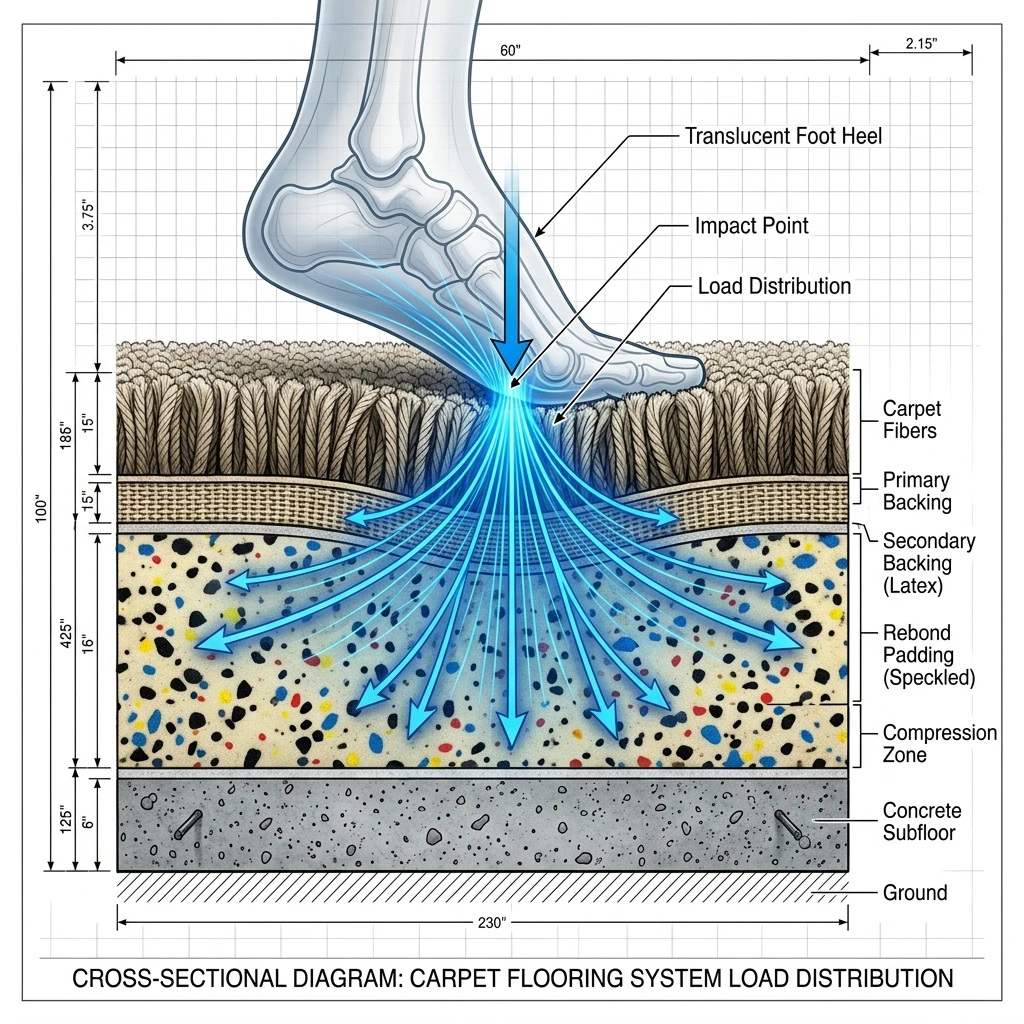
Technical forensic view: How padding density prevents independent movement between carpet layers.
The Density Myth: Why Thickness Is a False Metric
Retail flooring stores love selling thick padding because consumers equate thickness with luxury. That logic is technically wrong. Thickness only measures vertical height. Density measures how much actual material exists inside that volume. In foam engineering, density is what determines structural resistance, load-bearing capability, and long-term resilience.
Why Flooring Stores Push Thick Soft Padding:
Retailers rely on the '10-second comfort test.' Salespeople know that if they can make the floor feel mushy under your feet for 10 seconds in the showroom, you'll reach for your wallet. Thick, air-filled 6lb foam has higher margins for the store but zero mechanical utility for your home. It’s an upsell manipulation designed to exploit your emotional response to 'softness.'
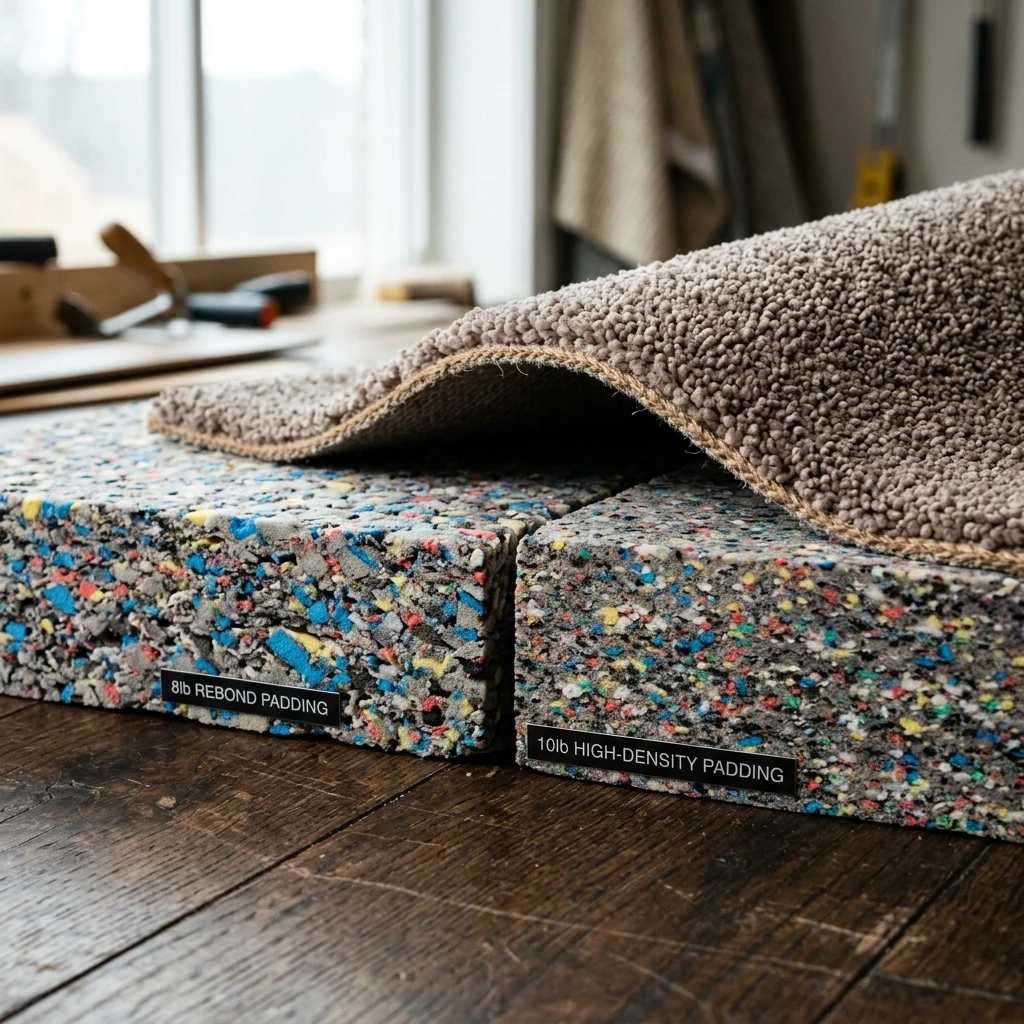
A thick low-density pad is basically an air mattress. A thinner high-density pad is an engineered shock absorber. Those are not the same thing. The flooring industry measures rebond density in pounds per cubic foot (pcf). An 8lb pad contains 8 pounds of polymer material per cubic foot. A 10lb pad contains 25% more material inside the exact same volume.
That extra polymer mass radically changes how the pad handles force. A 1/2-inch 6lb pad may feel luxurious in a showroom because your body only compresses it briefly. But inside a real home, under repeated dynamic loading, that oversized low-density foam starts collapsing almost immediately.
This is where installers use the phrase: “The pad bottoms out.” Bottoming out occurs when the foam reaches its densification point — the stage where cellular air pockets fully collapse and the material can no longer absorb energy progressively. At that point, impact force transfers almost directly into the subfloor.
That creates the infamous “hammer and anvil effect.” Your foot becomes the hammer. The subfloor becomes the anvil. The carpet fibers and backing get crushed in between.
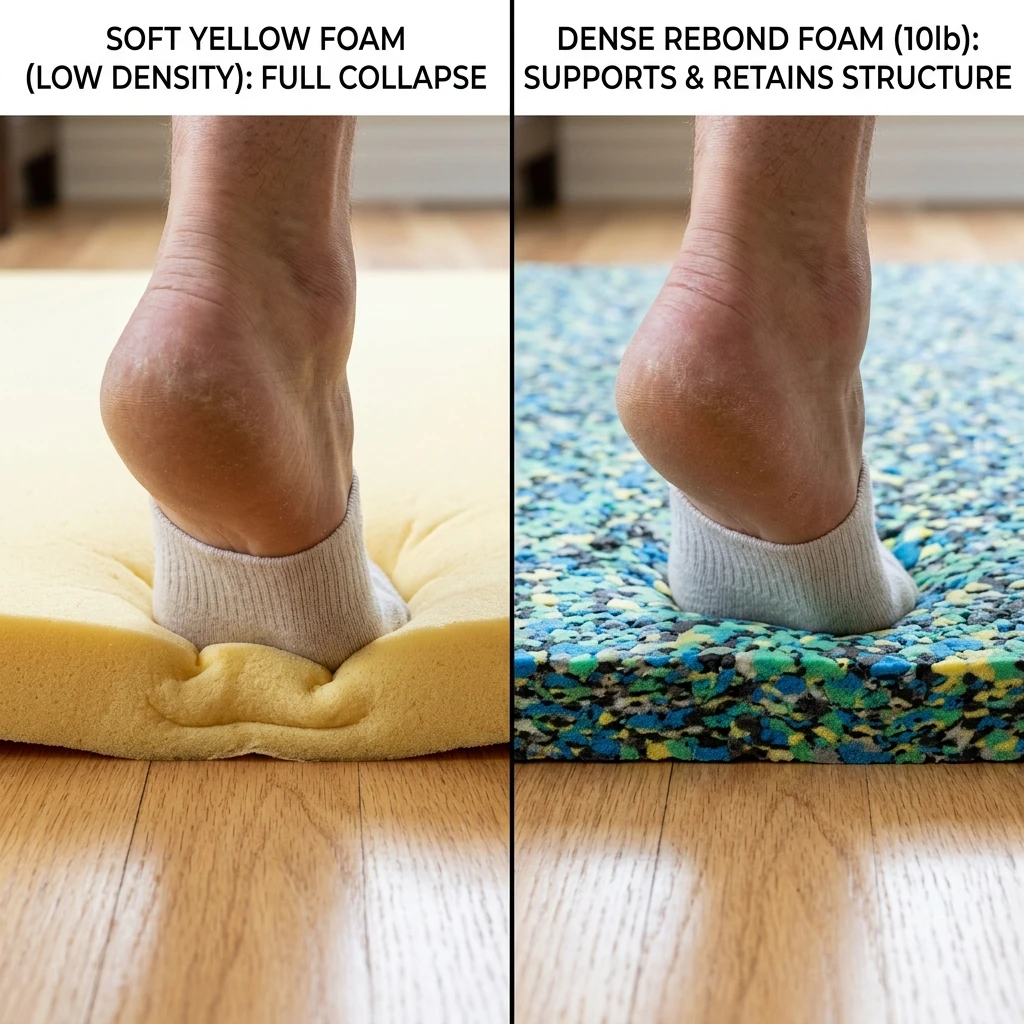
Left: Densification point reached in 6lb foam. Right: 10lb foam maintaining elastic support.
Technical Comparison: 8lb vs. 10lb Padding Performance
| Feature                     | 8lb Pad           | 10lb Pad              |
|-----------------------------|-------------------|-----------------------|
| IFD Range (Compression)     | 35–45 lbs         | 50–65 lbs             |
| Compression Set (Long-term) | Higher (10-15%)   | Lower (<8%)           |
| Traffic Resistance          | Moderate          | Excellent             |
| Stair Performance           | Acceptable        | Preferred / Mandatory |
| Delamination Risk           | Medium            | Low                   |
| Lifespan Expectancy         | 7–10 Years        | 15–25 Years           |
The tragedy is that consumers interpret early softness as quality. In reality, excessive softness is often evidence of structural weakness. Professional installers understand that carpet requires controlled support, not unrestricted flexion. Too much movement creates oscillation between the carpet backing and subfloor. That movement generates lateral shear stress, especially around seams, stairs, and high-traffic lanes.
The result: Premature texture loss, crushed pile, delamination, seam peaking, wrinkling, tack strip detachment, and traffic lane wear. A dense pad stabilizes the carpet system. A soft low-density pad destabilizes it. That is why serious installers often prefer a firmer 10lb 7/16-inch rebond over a mushy 1/2-inch 6lb product. One is structural engineering. The other is retail theater.
The Physics of Rebond: IFD, CFD, and Molecular Fatigue
Most homeowners never hear terms like IFD or CFD because flooring retailers rarely understand them themselves. But these metrics are the real science behind carpet pad performance.
What Is IFD?
IFD stands for Indentation Force Deflection. It measures how much force is required to compress foam by 25% of its thickness. Higher IFD means greater resistance to compression. An 8lb rebond pad typically delivers: IFD range 35–45 lbs. A 10lb rebond pad typically delivers: IFD range 50–65 lbs. That difference is enormous under repeated traffic loading.
A higher IFD means the pad resists collapse more effectively beneath concentrated pressure points like heels, furniture legs, stair noses, and rolling office chairs.
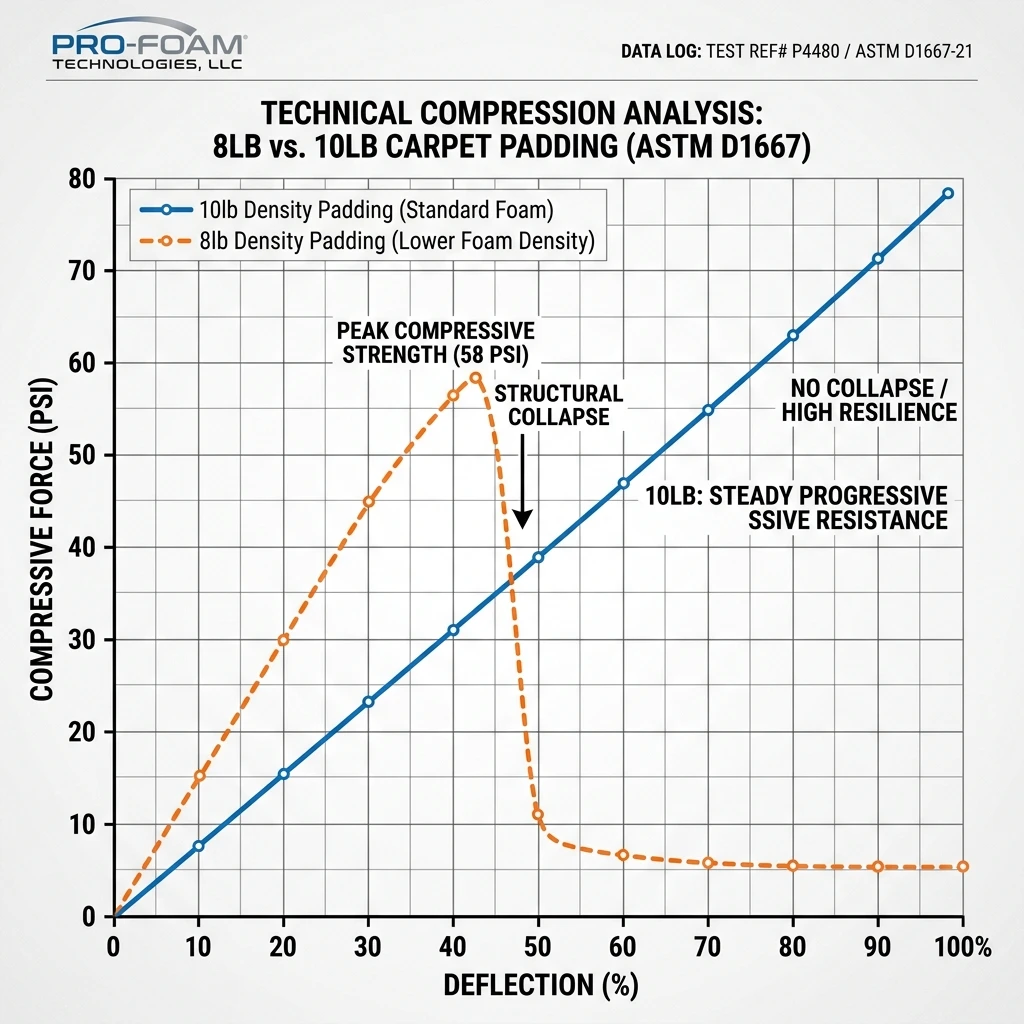
Molecular fatigue happens 30% faster in 8lb rebond compared to 10lb density under high-traffic classes.
CFD and Real-World Compression
CFD — Compression Force Deflection — measures deeper compression thresholds, often at 50% or 65% compression. This matters because carpet pads do not fail from one large impact. They fail from millions of micro-compressions. Every step slightly damages foam cell walls. Over time, weak foam structures experience molecular fatigue. The polymer bonds weaken. The cells stop rebounding fully. Permanent height loss begins.
This is called a compression set. Typical long-term compression set: 8lb rebond (10–15% loss) vs. 10lb rebond (under 8% loss). That difference determines whether your carpet still feels supportive after 10 years or turns into dead sponge material after 5.
The problem with weak foam is not just softness. It is energy management. Low-density pads cannot maintain elasticity under cyclic loading. Once the foam collapses, it stops absorbing force progressively. Instead, impact energy spikes directly into the carpet backing. That accelerates fiber fracture, latex deterioration, secondary backing separation, and traffic lane crushing.
The “Trampoline Effect”: How 6lb and Weak 8lb Pads Shatter Carpet Seams
Most carpet failures do not start on the surface. They start underneath. This is what homeowners miss entirely. When a carpet flexes excessively over soft padding, the backing experiences constant bending stress. Every footstep stretches and relaxes the carpet structure repeatedly.
That movement becomes catastrophic at seams. Installers call this the “trampoline effect.” A weak pad allows too much vertical travel. The carpet starts acting like a suspended membrane rather than a stabilized surface. Each step creates downward force, foam collapse, lateral carpet stretching, upward rebound, and adhesive fatigue.
Over time, latex adhesives inside the secondary backing begin cracking. Eventually: seams split, edges fray, delamination begins, and carpet loses dimensional stability. This is especially brutal on Berber carpets, loop pile systems, pattern carpets, and stair installations.
These constructions require a firm, stable substrate underneath them. A mushy low-density pad allows too much movement and creates destructive shear stress across the backing system. This is why experienced installers refuse to install Berber over cheap padding. Not because they are upselling. Because they know exactly how the failure happens.
Best Use Cases: Where 8lb works and 10lb is Mandatory
Best Situations for 8lb Padding:
- Guest Bedrooms: Low daily traffic means the pad isn't reaching its densification point often.
- Low-traffic formal spaces: Places where aesthetic matters more than structural absorption.
- Rental properties: A budget-conscious balance between cost and baseline utility.
Where 10lb is Mandatory:
- Stairs: Stair noses concentrate massive PSI into tiny areas; 8lb will bottom out and destroy the backing edge.
- Berber & Patterns: These systems lack the natural flexibility of plush carpet and shatter easily under flex.
- Heavy Furniture: Prevents permanent indentation from couch legs and pianos.
- Homes with Pets: Denser foam structure is less absorbent to liquid seepage compared to air-heavy 6lb/8lb.
The Staircase Disaster Zone
Stairs amplify every flooring defect. The stair nose concentrates massive PSI loads into a tiny surface area. Weak padding compresses aggressively at these points, causing the carpet to flex around the edge profile. That repeated bending destroys backing integrity. A 10lb rebond dramatically reduces this problem because the foam remains structurally stable under concentrated pressure.
Professional installers often specify 10lb high-density rebond, rubber waffle, flat rubber, or dense felt systems for stairs specifically because they minimize flexion and reduce backing fatigue. Cheap padding on stairs is not “budget friendly.” It is deferred failure.
Warranty Gatekeepers: FHA Standards vs. Luxury Manufacturer Mandates
Consumers think carpet warranties protect them. They usually do not. Most carpet warranties contain extremely strict underlayment requirements hidden in the fine print. Padding density is no longer considered optional by major manufacturers. It is treated as part of the engineered flooring system. Fail the padding requirements and your warranty claim can disappear instantly.
FHA Minimum Standards
Federal Housing Administration standards establish bare-minimum density thresholds. Typical FHA guidelines: Class 1 Residential (5.0–6.5 pcf density) and Class 2 Heavy Traffic (6.5–7.3 pcf density). These are minimum survival standards. Not performance standards. There is a huge difference.
Meeting FHA minimums simply means: “The carpet probably won’t fail immediately.” That is not the same as preserving appearance retention for 15 years.
Mohawk and Shaw Requirements
Major manufacturers increasingly demand higher-density support systems. For example: Many Mohawk loop and Berber products require minimum 8lb density padding. Some premium carpets recommend 10lb rebond for maximum warranty compliance. Thick soft pads may void texture retention coverage.
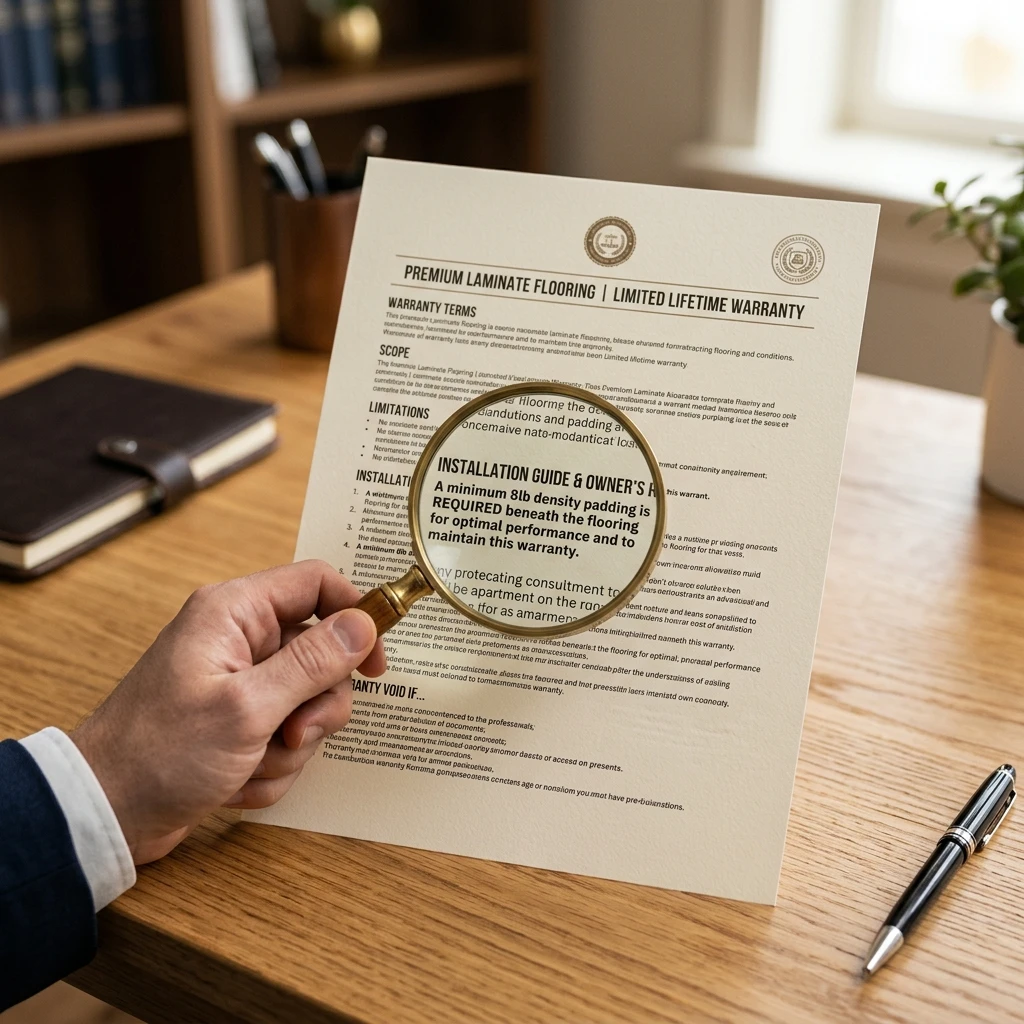
Denying claims: How manufacturers use padding density as a gatekeeper for texture retention payouts.
Acoustic Science: STC and IIC Ratings on Concrete vs. Wood
Padding density affects far more than comfort. It directly influences acoustic transmission. This becomes critical in apartments, condos, upstairs bedrooms, and home theaters. IIC (Impact Insulation Class) measures impact noise transfer (footsteps). STC (Sound Transmission Class) measures airborne noise transfer (voices).
Dense carpet padding improves both metrics because it absorbs vibration energy more efficiently. But here is the important nuance: Thickness alone does not create better acoustics. Mass matters. A dense 10lb pad often outperforms thicker low-density foam because the heavier cellular structure absorbs low-frequency vibration more effectively.
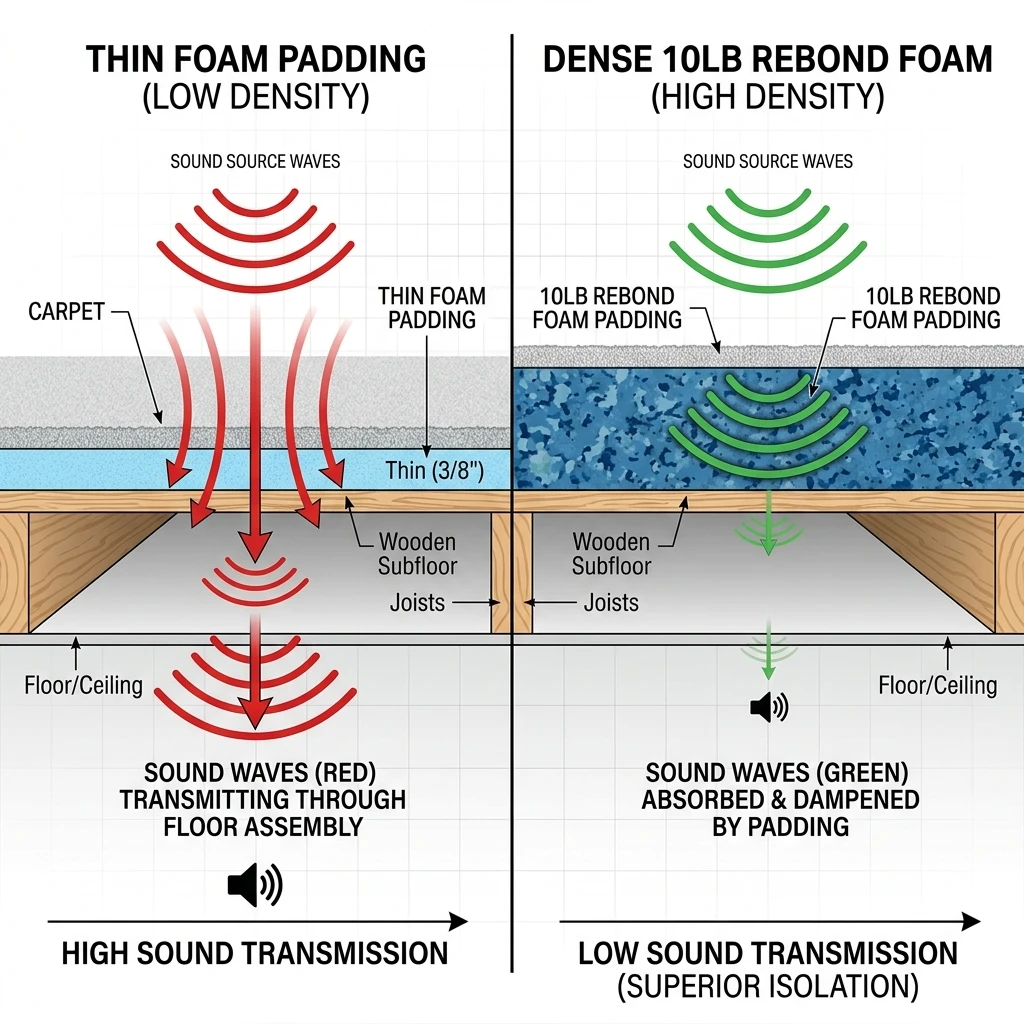
10lb density padding significantly reduces the 'hollow' acoustic feedback common on concrete slabs.
The Hammer and Anvil Effect: Why Low-Density Pads Destroy Carpet Fibers
Carpet wear is not primarily caused by dirt. It is caused by energy transfer. When padding collapses beneath impact, the carpet loses shock absorption. The force of each footstep travels through the backing into the subfloor and rebounds upward into the fiber structure. That creates microscopic fiber fractures. Over millions of cycles, those fractures become visible crushing.
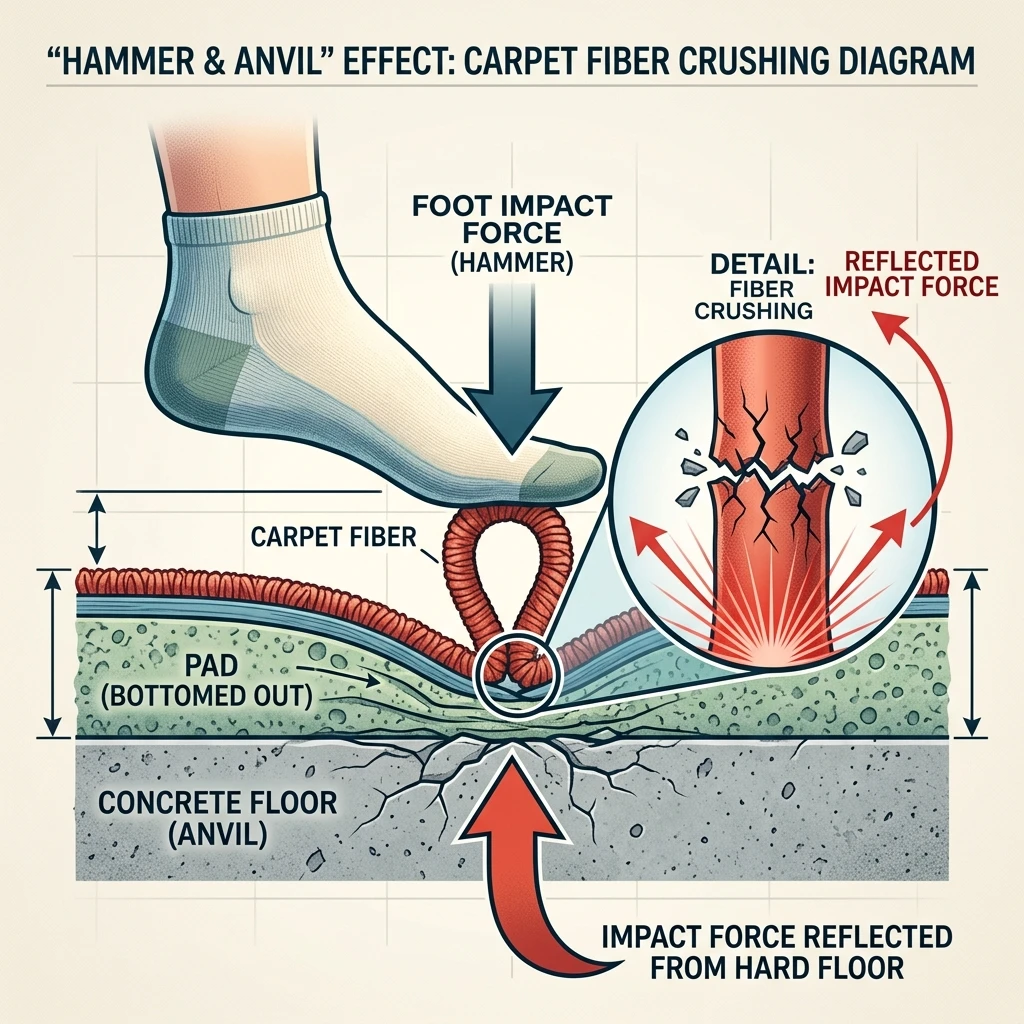
Mechanical trauma: When the pad bottoms out, the fiber tips are crushed against the subfloor anvil.
Best 10lb Carpet Padding for Heavy Traffic

Future Foam 10lb Rebond
**Best for**: Stairs, pets, and heavy family rooms. **Pros**: High CFD resistance, excellent seam stability. **Cons**: Firmer feel than showroom 'mushy' pads. Professional-grade durability.
Check Price on Amazon Mohawk SmartCushion Premium
**Best for**: Luxury nylon and Berber installations. **Pros**: Superior backing support, texture retention, includes moisture barrier. **Cons**: Higher upfront cost per yard.
Check Price on AmazonCheck out our other expert guides:
Take a look at our Ultimate Carpet Padding Guide , Understanding Carpet Delamination , and our Nylon vs Polyester Comparison for more expert flooring advice.
Final Verdict: Density is the Only Metric that Lasts
Here is the blunt installer truth: An 8lb pad is the minimum threshold for respectable residential performance. A 10lb pad is where true structural support begins. The industry spent decades convincing consumers that softness equals luxury. That marketing narrative ignored the actual mechanics of carpet longevity.
Carpet is not a mattress. It is a dynamic load-bearing system. The purpose of padding is not to feel mushy for 30 seconds in a showroom. Its purpose is to absorb impact energy for millions of compression cycles without destabilizing the carpet backing.
That requires density. Not fluff. A carpet starts dying from below long before homeowners notice it on the surface. Upgrade to 10lb density for any room you plan to live in for more than 5 years.